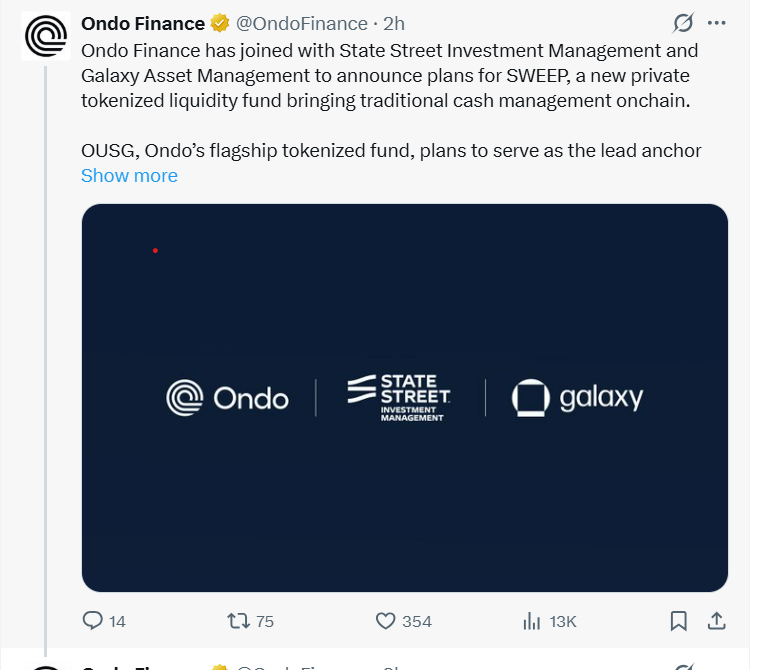
State Street Investment Management and Galaxy Asset Management are joining forces with Ondo Finance on a tokenized liquidity fund that pushes cash “sweep” balances directly onto public blockchains, opening up a source of potential 24/7 onchain liquidity.
The planned State Street Galaxy Onchain Liquidity Sweep Fund, or SWEEP, is designed to take in and pay out PayPal’s (PYUSD) stablecoin for accredited investors, the companies said Tuesday.
Ondo is expected to seed the fund with $200 million, tying a major tokenized real-world asset (RWA) issuer directly into State Street’s tokenization stack. The fund will be powered by Galaxy Digital infrastructure, and State Street Bank and Trust Company, an affiliate of State Street Investment Management, will act as custodian.
SWEEP is set to launch on Solana in early 2026, with rollouts on other networks, including Stellar and Ethereum, to follow, using Chainlink’s Cross-Chain Interoperability Protocol (CCIP).
Related: Solana and Coinbase’s Base connect together using Chainlink
Race to define onchain cash
The move drops another heavyweight into an increasingly crowded race to define what “onchain cash” looks like for institutions. BlackRock and Franklin Templeton already run tokenized cash‐management vehicles, including money‐market and other short‐term fixed‐income funds, on public blockchains. For its part, Ondo has built a business around wrapping Treasurys and other credit exposures into onchain vehicles that can plug into crypto markets.
“By partnering with Galaxy, we will push the envelope together and drive the evolution of the TradFi landscape onchain,” said Kim Hochfeld, global head of cash and digital assets for State Street Investment Management.
“Tokenization is rapidly becoming the connective tissue between traditional finance and the onchain economy,” said Ian De Bode, president of Ondo Finance. “Our planned investment would not only anchor this innovative fund – but also supports the continued growth of Ondo’s fund that offers institutional investors exposure to short-term US Treasuries with 24/7 instant mints and redemptions.”
Related: Blockchain trial on Canton Network tests collateral reuse with tokenized US Treasurys
Building an onchain capital markets stack
The launch comes as tokenized funds and tokenized equities are starting to resemble components of an emerging onchain capital markets stack more than isolated pilots.
Superstate opened up onchain capital raising for US Securities and Exchange Commission‐registered public companies via its Direct Issuance Programs on Ethereum and Solana Wednesday, targeting the equity side of that stack by letting issuers sell new stock directly for stablecoins and settle immediately to investor wallets.
State Street’s partnership with Galaxy and Ondo also highlights how the roles are shaping up as traditional finance and crypto firms share the same products. State Street brings Big Four regulatory cover and custody, Galaxy contributes digital‐asset infrastructure and tokenization expertise, and Ondo provides both capital and an existing RWA distribution network.
Related: Galaxy expands into UAE as part of Middle East push
Solana’s role in the tokenization race
Solana’s role as the initial venue highlights a second competitive race unfolding beneath the product arms race. The chain has become a favored home for tokenized assets and high‐throughput trading, from tokenized public shares to experiments in onchain liquidity funds, as issuers look for lower fees and fast settlement.
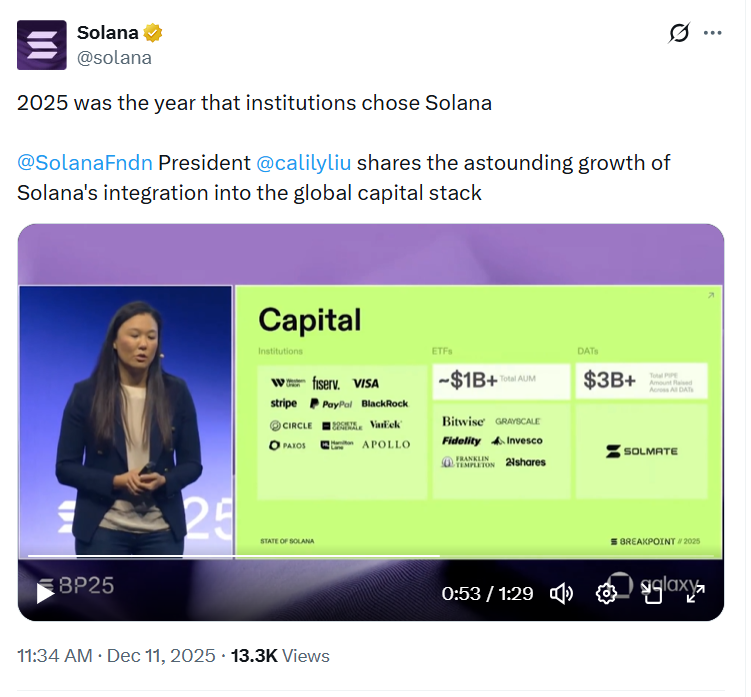
Some of the largest institutions in the world have chosen the Solana blockchain for their digital assets play, including Western Union, which processes over $100 billion in remittance volume every year, and Pfizer, which processes $2 trillion of merchant payment volume annually. Physical staked exchange-traded funds (ETFs) on Solana have also almost reached $1 billion in assets under management.
Launching on Solana first, with plans to expand to Stellar and Ethereum, allows SWEEP to tap into multiple ecosystems where stablecoins and RWA tokens are already part of the infrastructure.