Cyclical Stock or Growth Stock? Coinbase Q2 Earnings Report Reveals 'Valuation Divide'

marsbitPublished on 2026-07-31Last updated on 2026-07-31

Abstract

Coinbase's Q2 2026 results revealed a mixed picture, sparking debate over whether the company is a cyclical stock tied to crypto markets or a future growth stock. Total revenue of $1.22 billion missed expectations, declining 19% year-over-year. Retail trading revenue, still the largest income source, fell 30% to $452 million, reflecting a drop in spot crypto trading activity. While the company highlighted a record 10.3% overall crypto trading market share, this figure includes newer segments like derivatives and prediction markets. Net loss widened to $359 million, marking a third consecutive quarterly loss. However, the report showed diversification efforts. Subscription and service revenue reached $555 million, nearly matching transaction revenue. Stablecoin revenue, at $292 million, remained a strong second pillar. The company emphasized its future potential in stablecoins (notably USDC) and on-chain agent economies. Over 90% of agent stablecoin transactions occur on Base, its layer-2 network, positioning it as a leader in the emerging AI-agent finance (AIFi) sector. CEO Brian Armstrong expressed confidence in bitcoin's cyclical recovery but stressed the need for diversified revenue. The valuation divergence hinges on whether investors focus on current cyclical weakness or future growth from these new business lines.

Original |Odaily Planet Daily(@OdailyChina)

Author|Golem(@web3_golem)

On July 31, Coinbase released its Q2 2026 financial report. Coinbase CEO Brian Armstrong posted on platform X summarizing the quarter, "While market conditions were very challenging in Q2, Coinbase continued to make steady progress amidst various headwinds," highlighting achievements such as over 90% of agent stablecoin trading volume concentrated on Base; crypto trading market share reaching a new high of 10.3%; and predictive markets revenue doubling, up 106% quarter-over-quarter, among others.

Overall, the report accentuated the positive, which is Coinbase's consistent style, but the market won't play along. Coinbase's Q2 2026 revenue still fell short of expectations.

The financial report shows that for Q2 2026, Coinbase's total revenue was $1.22 billion, down 19% year-over-year and 14% quarter-over-quarter, missing market expectations ($1.29 billion); trading revenue was $599 million, also below the market expectation of $628 million; net loss reached $359 million, marking Coinbase's third consecutive quarter of net loss (Odaily Note: Net loss of $666.7 million in Q4 2025, $394.1 million in Q1 2026).

Affected by this, Coinbase (NASDAQ:COIN) shares fell over 5% in after-hours trading.

Market Share Hits New High, but Crypto Spot Trading Market Share Continues to Shrink

During the Q2 earnings call, Coinbase didn't even explain the reasons for the net loss this quarter, opting instead to gloss over it and focus on answering questions unrelated to its crypto brokerage business. In Q1 2026, Coinbase attributed the loss to weak crypto markets and impairment of crypto asset book value. However, Odaily Planet previously analyzed that the net loss was essentially caused by persistent user attrition and a sharp decline in crypto trading revenue.(Related reading:Q1 Net Loss of $394.1 Million, Coinbase Can Only Cling to Circle's Leg)

By Q2, the situation had not improved, with trading revenue continuing to decline. The financial report shows that Coinbase's Q2 total trading revenue reached $599 million, with the major contributor, retail trading revenue, at $452 million, down 30% year-over-year and 20% quarter-over-quarter, even falling back to 2023 levels. According to the report, retail crypto spot trading volume has already decreased by 24%.
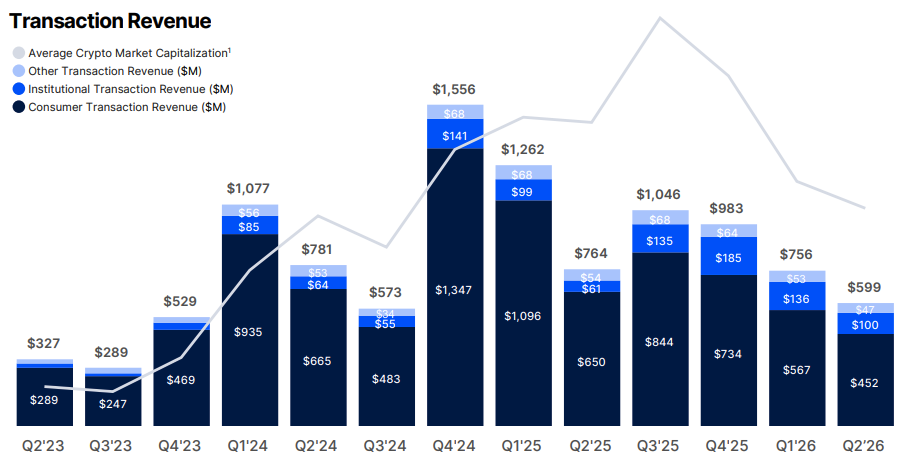
Coinbase Q2 2026 Trading Revenue

Even with such dismal figures, retail trading revenue remained the largest single source of income in Coinbase's Q2 report. The second largest revenue source was stablecoin revenue, reaching $292 million. Given the report's disclosure that Coinbase's crypto trading market share reached a new high of 10.3% in Q2, why is its trading revenue still plummeting? Could it be, as some analysts suggest, that users haven't left, but simply due to weak crypto market sentiment reducing retail trading desire?

But the truth is that Coinbase played a word game, because according to its calculation method, this figure includes new products like derivatives trading, predictive markets, and tokenized stocks, not limited to cryptocurrency spot trading market share. Therefore, Coinbase's crypto trading market share grew from 9.1% in Q1 to the current 10.3%, with this 1% growth primarily contributed by new businesses.
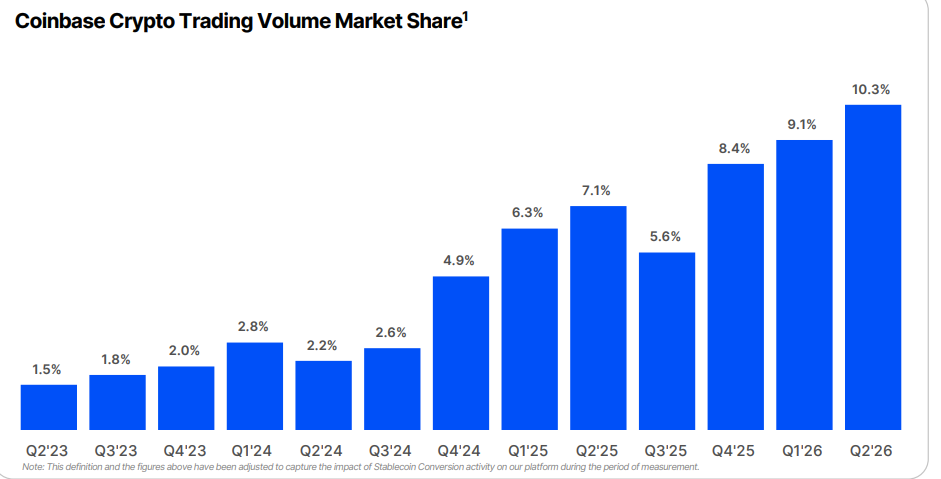
Quarterly Change in Coinbase's Crypto Trading Market Share

According to the report, growth in predictive markets has partially offset the revenue impact from sluggish retail crypto spot trading volume. But per Coinbase's calculations, while predictive market revenue grew over 2 times quarter-over-quarter compared to Q1, its annualized revenue is only $100 million, implying actual revenue may be less than $30 million. Therefore, its offsetting effect on lost retail trading revenue can only be described as a drop in the bucket.

In summary, crypto spot trading remains the pillar of Coinbase's revenue. Although Coinbase is making every effort to develop other businesses to build the so-called "Exchange for Everything" and has achieved growth, its growth speed and revenue levels have not satisfied the market and investors. In established market landscapes like predictive markets, crypto derivatives, and tokenized stock trading, Coinbase, as a new entrant, has relatively low competitiveness. Its prospect of relying on new businesses for significant growth to achieve financial profitability currently does not look optimistic.

Cyclical Stock or Growth Stock

However, to be fair, the current valuation of Coinbase depends on whether it is viewed as a cyclical stock or a growth stock.

If viewed as a cyclical stock, Coinbase's revenue is indeed constrained by the current crypto bear market cycle. New businesses have not freed it from cyclical limitations, while user attrition and declining competitiveness among exchanges are also evident problems.

Therefore, from this perspective, the drop in Coinbase's stock price is justified. It even seems that everything Coinbase is currently doing is to survive until the bull market cycle. Brian Armstrong said during the earnings call, "I believe Bitcoin will come back strong, it has always gone through cycles like this, the price always goes up and down. But we must have a diversified revenue strategy, that's the core of the exchange's operational strategy." The implication is, when the bull market comes, everything will get better.

If Coinbase is viewed as a future growth stock, then it is currently even undervalued.

First, looking at the revenue composition, although Coinbase hasn't yet achieved revenue diversification and crypto spot trading remains its main revenue business, the revenue sources show a trend towards diversification. The report shows that Coinbase's current revenue is decoupled from Bitcoin trading fees, with 88% of net revenue coming from non-Bitcoin spot trading. In 2020, Bitcoin trading fees accounted for over 55%. Additionally, Coinbase's Q2 subscription and service revenue reached $555 million, accounting for 48% of net revenue, nearly on par with trading revenue ($599 million).
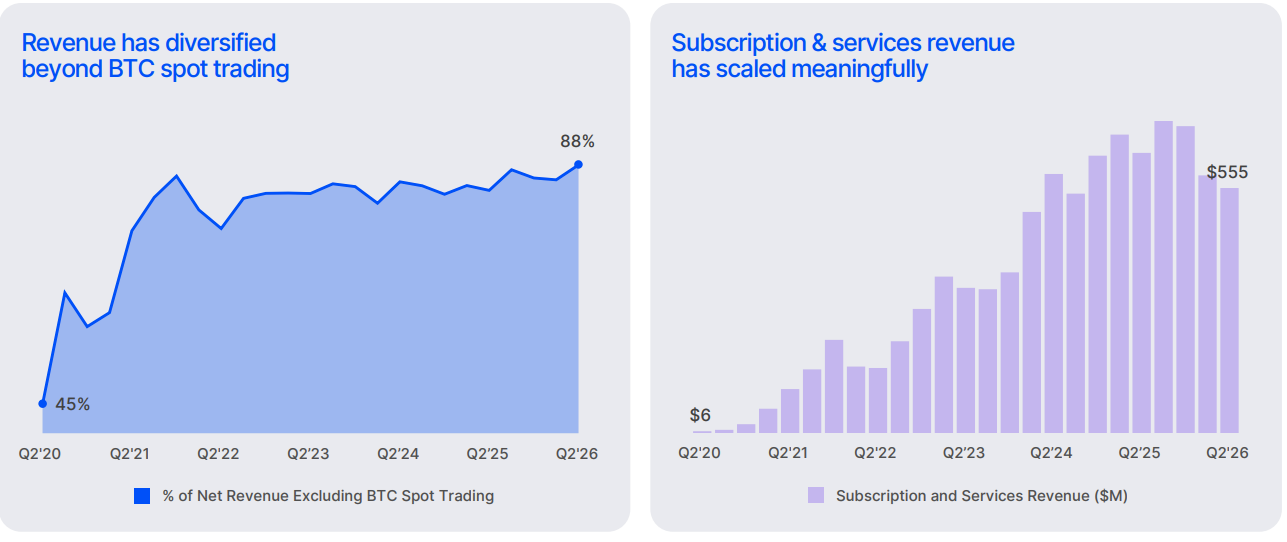
Coinbase Bitcoin Trading Fee Revenue Share vs. Subscription & Service Quarterly Revenue Growth

Furthermore, the number of paid Coinbase One subscribers hit a record high this quarter, with subscription fee revenue growing to $114 million. Crypto derivatives trading volume in Q2 did not decrease but remained largely flat compared to Q1 at $4.221 trillion. Coinbase has acquired Deribit and can now offer crypto derivatives trading to international users, potentially leading to a significant increase in market trading volume.
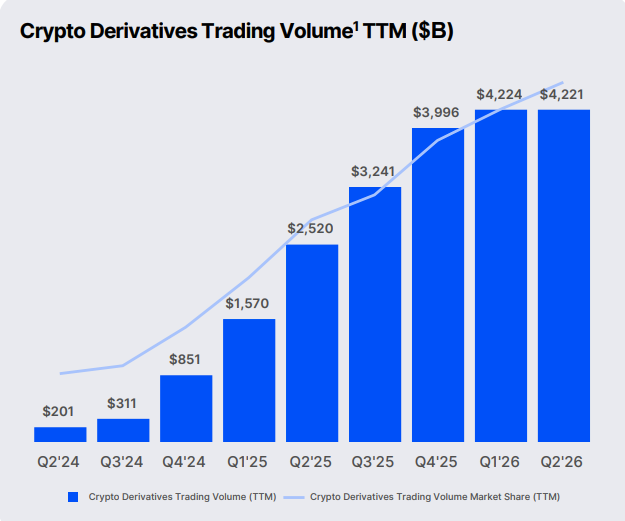
Therefore, from a developmental perspective, perhaps by Q3 2026 or Q1 2027, the total revenue from Coinbase's other businesses will replace crypto spot revenue's decisive position in its revenue mix. Coinbase's envisioned "Exchange for Everything" concept also doesn't mean it must excel in every field (e.g., predictive markets, crypto derivatives, tokenized stocks). Most investors don't have such expectations either; achieving profitability and diversified revenue already meets expectations.

Because the future potential investors see in Coinbase lies primarily in its stablecoin business and agent economy.

During the earnings call, CFO Alesia Haas again emphasized that Coinbase's revenue-sharing agreement with Circle will continue. Coinbase's Q2 2026 stablecoin revenue reached $292 million, remaining its second-largest revenue source. Meanwhile, the amount of USDC held on Coinbase platforms and products reached a new high, with over 30% of circulating USDC stored on Coinbase. Moreover, Coinbase disclosed in the report that over the past year, Coinbase has captured 50% of USDC's total economic value. Broader on-chain collaborations and product integrations in the future will also drive wider adoption of USDC.

At the same time, Coinbase doesn't want to rely solely on USDC and is becoming a multi-stablecoin platform. Coinbase is a founding member of OUSD, and the variety of stablecoins supported on the platform continues to increase.

Regarding the on-chain agent economy, Coinbase is a leader in the Agentic Finance (AIFi) space. Currently, according to the report, over 99% of on-chain agent transactions are completed using USDC, and over 90% of agent stablecoin transactions occur on Base. In Q2 2026, over 97% of on-chain agent transactions used Coinbase's x402 protocol.

Moreover, Base's leading position in the agent economy won't be easily shaken by low-price competition from new market entrants because it's already cheap enough. Brian Armstrong said during the earnings call, "Base settles for under $0.01 and in under 1 second. From that perspective, it's very competitive."

Although Base's leadership in the agent economy hasn't yet contributed significantly to Coinbase's revenue, this segment holds immense future commercial value. The agent economy is currently recognized as the optimal intersection of blockchain and AI. Future agent economies will require payment settlement systems and identity systems, which is precisely where Base and the x402 protocol come into play. According to Coinbase's estimates, by 2030, agents will handle $3-5 trillion in agent transactions. If Base can capture 40% of that market share, even with a 0.1% transaction fee, the revenue could reach tens of billions of dollars.

While Coinbase's current business situation is not optimistic, the future is not entirely bleak either. It depends on the perspective and investment horizon from which investors view it.


Related Questions

QWhat were the key financial performance highlights of Coinbase in Q2 2026?

AIn Q2 2026, Coinbase reported total revenue of $1.22 billion, a 19% year-over-year and 14% quarter-over-quarter decline, missing market expectations. Transaction revenue was $599 million, also below expectations. The company reported a net loss of $359 million, marking its third consecutive quarterly net loss. Subscription and services revenue grew to $555 million, representing 48% of net revenue.

QAccording to the article, what are the two primary ways to view Coinbase's valuation, and what defines each view?

AThe article presents two primary valuation perspectives. As a cyclical stock, Coinbase's performance is tied to crypto market cycles, with current struggles attributed to the bear market. As a growth stock, it is considered undervalued, with potential seen in its diversification away from reliance on Bitcoin trading fees, the growth of subscription services, and its strategic position in future-oriented businesses like stablecoins and the on-chain agent economy.

QWhat is the significance of Coinbase's stablecoin revenue and its partnership with Circle?

AStablecoin revenue was Coinbase's second-largest income source in Q2 2026 at $292 million. The CFO, Alesia Haas, reaffirmed the continuation of the revenue-sharing agreement with Circle for USDC. Over 30% of circulating USDC is held on Coinbase, and the company captured 50% of USDC's total economic value in the past year, highlighting the strategic importance and financial contribution of this partnership.

QHow does the article explain the discrepancy between Coinbase's reported record-high market share and its declining transaction revenue?

AThe article attributes the discrepancy to Coinbase's definition of 'crypto trading market share,' which includes new products like derivatives, prediction markets, and tokenized stocks, not just cryptocurrency spot trading. The 1% growth from 9.1% to 10.3% was largely driven by these new businesses, which did not offset the significant decline in core consumer crypto spot trading volume and revenue.

QWhat future growth potential does the article identify for Coinbase, particularly in the on-chain agent economy?

AThe article identifies significant future growth potential for Coinbase in the on-chain agent economy, where it is described as a leader. Over 90% of agent stablecoin transactions occur on Base, and over 97% use Coinbase's x402 protocol. This is seen as a key intersection of blockchain and AI. If Base captures 40% of a projected $3-5 trillion agent transaction market by 2030, even a small fee could generate billions in revenue.

Related Reads

Must-Watch Events Next Week|CLARITY Act Could Face Senate Vote; SpaceX, Circle to Report Earnings (8.3-8.9)

**Summary: Key Events and Developments to Watch (August 3-9)** The upcoming week is marked by significant financial disclosures, key legislative deadlines, and notable product updates. **Major Financial Events:** Several companies are scheduled to release their Q2 2026 earnings. American Bitcoin (ABTC) will report on August 3, followed by SpaceX and Hut 8 Mining Corp. on August 4, and Circle on August 5. Notably, a significant portion of SpaceX shares (up to 12% of total shares) will be unlocked on August 6 following their earnings release. **Key Legislative Deadline:** The U.S. Senate faces an August 7 deadline to secure 60 votes for the CLARITY Act, a bipartisan bill aiming to establish a federal regulatory framework for cryptocurrencies. The Senate may hold a full vote on the bill during the week. **Economic Data:** The U.S. July Non-Farm Payrolls report will be released on August 7, providing crucial labor market data. **Technology & Product Updates:** * **Shutdowns:** DeFi portfolio tracker Zapper and wallet app Ctrl Wallet will cease operations on August 3. * **Upgrades:** LayerZero will deprecate its v1 relayers on August 3. XRP Ledger's new version 3.3.0, featuring five new functions, is expected next week. * **AI:** Elon Musk announced that the advanced Grok 4.6 AI model is set for release around August 7. * **Bitcoin:** The BIP-110 forced signaling for a potential Bitcoin network change is scheduled to begin around August 8. **Other Notable Events:** Chinese robotics firm Unitree Tech has set its preliminary price inquiry for its IPO for August 5. South Korean exchange Upbit will delist AQT and AERGO tokens on August 3.

marsbit55m ago

Must-Watch Events Next Week|CLARITY Act Could Face Senate Vote; SpaceX, Circle to Report Earnings (8.3-8.9)

marsbit55m ago

Stocks Are Plummeting More Sharply Than Cryptocurrencies. Where Has the Money Gone?

Stock Markets Plunge Deeper Than Cryptocurrencies: Where Did the Money Go? In late July, Seoul's Kospi index triggered circuit breakers for two consecutive days, plummeting over 40% from its June high. The collapse was led by heavyweight stocks like SK Hynix, whose record profits still disappointed investors, and devastating leveraged ETFs, with one major product losing over 83% of its value. This signaled a global, forced deleveraging targeting the most crowded trades. Interestingly, while stocks exhibited extreme volatility akin to crypto markets, Bitcoin rose nearly 15% in July after a prior steep drop. Analysis shows the money fleeing equities did not flow into Bitcoin. Instead, Bitcoin had already absorbed its sell-off in May-June, when U.S. spot Bitcoin ETFs saw historic outflows. The true safe-haven beneficiary was gold, whose price rose over 20% year-on-year, highlighting a decoupling between Bitcoin and gold as "digital gold." The sell-off was a targeted unwinding of leveraged positions in tech and semiconductors, accelerated by broker-dealer risk management and shifts in the AI narrative, including new competition from Chinese memory chipmakers. The retreat path was clear: from high-valuation tech stocks to cash and U.S. Treasuries, then to gold. For Bitcoin to attract sustained institutional inflows, conditions like eased global liquidity pressure, a "soft-landing" Fed rate cut, and U.S. regulatory clarity via legislation like the stalled CLARITY Act are needed. Currently, Bitcoin is not a safe haven but an already-cleared asset. Its low correlation with tech stocks, however, makes it a potential diversification play for institutional portfolios once the storm passes. The money isn't here yet, but the positioning is underway.

marsbit55m ago

Stocks Are Plummeting More Sharply Than Cryptocurrencies. Where Has the Money Gone?

marsbit55m ago

In Conversation with Ray Dalio: We Are Currently in an AI Bubble, with 1% of My Portfolio in Bitcoin

Ray Dalio, founder of Bridgewater Associates, warns in an interview that the current AI boom shows classic bubble characteristics, which could lead to significant economic downturns as seen in past cycles like 1929 or 2000. He explains that speculative enthusiasm, fueled by debt and overvaluation, often precedes a crash when rising rates or taxation force asset sales, causing widespread losses and recession. Dalio also outlines his "Big Cycle" theory, describing an approximate 80-year pattern where widening wealth gaps, massive government deficits, and shifting geopolitical power (like China's rise) create internal conflict and global instability. He emphasizes that we are in a late-cycle, transitional phase where traditional powers like the US and UK face decline. For personal wealth protection, Dalio advises diversification beyond cash into assets like stocks, bonds, real estate, and particularly gold, which he prefers over Bitcoin. While he holds about 1% of his portfolio in Bitcoin as a non-printable hard asset, he views gold as more secure from technological or governmental threats. Regarding AI's impact, Dalio believes it will disproportionately benefit capital owners, worsening inequality by replacing both physical and cognitive labor. He suggests that human intuition and emotional intelligence, combined with AI, will be key for future workers. On taxation, Dalio argues that wealth taxes are impractical and risk triggering asset sell-offs, reducing productive investment. He points to the UK as a cautionary example of debt, low productivity, and political strife. Geopolitically, Dalio foresees a more regionalized world, with the US showing weakness in prolonged conflicts like with Iran, akin to past imperial declines. The ideal outcome, he suggests, is coexisting powerful blocs (e.g., Americas, China-Asia Pacific) without major war.

marsbit4h ago

In Conversation with Ray Dalio: We Are Currently in an AI Bubble, with 1% of My Portfolio in Bitcoin

marsbit4h ago

Daily 7.2 Trillion KRW: Foreign Capital's Record Net Buying on Friday! Wall Street Says Headwinds for Korean Stock Fund Flows Have Subsided

South Korean stock market sees a dramatic shift in fund flows. On July 31, foreign investors made a record net purchase of approximately KRW 7.2 trillion in KOSPI stocks, marking a fundamental reversal from the persistent large-scale net outflows seen in previous months. This contributed to a significant narrowing of foreign net selling in July to KRW 9.8 trillion, down sharply from KRW 48.4 trillion in June and KRW 44.5 trillion in May. Simultaneously, domestic institutional pressure eased. South Korean pension funds and asset managers turned to a net buying position in July, purchasing KRW 1.0 trillion worth of KOSPI shares, contrasting with net sales in May and June. Market volatility is expected to be dampened by new financial regulations. Effective July 31, the Financial Services Commission tightened access for retail investors to single-stock leveraged ETFs by raising the minimum cash deposit requirement. Trading volumes for these products subsequently dropped to about 50% of their monthly average. Citigroup Research maintains its year-end KOSPI target of 10,000 points. The firm cites several supportive factors: the substantial easing of headwinds from capital outflows, a robust fundamental outlook for the semiconductor sector, historically low market valuations, strong economic fundamentals, and the potential for policy support from financial authorities if needed.

marsbit4h ago

Daily 7.2 Trillion KRW: Foreign Capital's Record Net Buying on Friday! Wall Street Says Headwinds for Korean Stock Fund Flows Have Subsided

marsbit4h ago

Trading

Spot
活动图片




