Annualized Revenue Exceeds $20 Billion, Kalshi Aims to Become the First Prediction Platform IPO?

Foresight NewsPublished on 2026-06-22Last updated on 2026-06-22

Abstract

Kalshi, a leading U.S. prediction markets platform, is reportedly in early, informal discussions for an Initial Public Offering (IPO). The company's annualized revenue now exceeds $2 billion, fueled by its dominance of over 90% of the domestic prediction market activity. This growth stems from a surge in trading volume—reaching a total of $52.7 billion—and an increase in fee rates, largely driven by sports event contracts like the NBA playoffs and the 2026 FIFA World Cup. Monthly active users are approximately 2 million. Kalshi recently raised $1 billion in a funding round led by Coatue Management, valuing the company at $22 billion. It has also expanded its offerings to include Bitcoin perpetual contracts and plans to launch a dedicated trading platform, Kalshi Pro. However, Kalshi's path to an IPO faces significant regulatory hurdles. The core risk involves jurisdictional conflicts, as multiple U.S. states are challenging its operations under local gambling laws. For instance, Arizona has filed criminal charges against the platform, while states like Kentucky have filed lawsuits. Kalshi and the Commodity Futures Trading Commission (CFTC) argue that its event contracts fall under exclusive federal jurisdiction as "swaps." The outcomes of these ongoing legal battles could critically impact Kalshi's core revenue and its IPO timeline. Analysts suggest that while an IPO could theoretically occur by late 2026, a more likely timeframe is late 2027 or 2028, contingent on resolvi...


Author: Ma He, Foresight News


On June 19, according to The Information, Kalshi's annualized revenue has surpassed $20 billion, and the company has initiated early, informal discussions with several investment banks regarding an initial public offering (IPO). Just one month prior, Kalshi completed a new $10 billion funding round led by Coatue Management, propelling its valuation to $220 billion. This was the company's third funding round within seven months, with other investors including Sequoia Capital, a16z, IVP, Paradigm, Morgan Stanley, and ARK Invest.


These IPO discussions are at a very early, informal stage. Company executives have only had preliminary contact with investment banks, and there is considerable distance before formal registration documents are submitted.


Total Trading Volume $52.7 Billion, Approximately 2 Million Monthly Active Users


According to Kalshidata, as of June 22, Kalshi's total trading volume has risen to $52.7 billion, with a daily average trading volume of $29.27 million. In October 2025, its daily average volume began to increase exponentially.
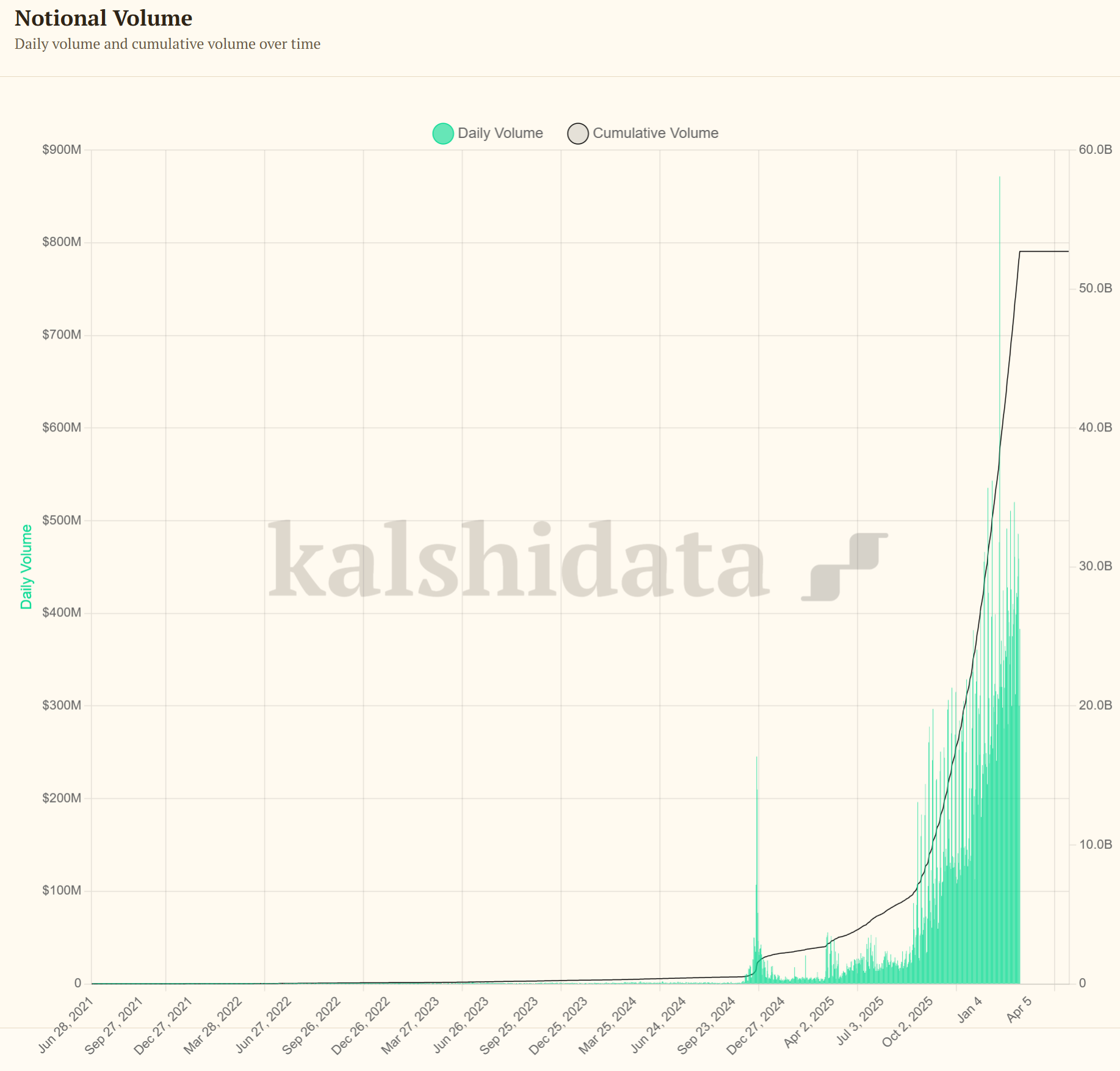


Kalshi currently holds over 90% share of the US prediction market activity. Kalshi's revenue explosion primarily stems from the simultaneous increase in trading volume and effective fee rates. Over the past year, its annualized trading volume has climbed from approximately $52 billion to $178 billion. Sports event contracts contribute the vast majority of revenue. NBA playoffs, 2026 FIFA World Cup-related markets, and the partnership with the National Hockey League (NHL) have attracted many traders.


In December 2025, Kalshi's annualized revenue was still around $600 million. By May this year, Kalshi had approximately 2 million monthly active users and annualized revenue exceeding $1.5 billion.


Additionally, Kalshi recently launched Bitcoin perpetual contracts and will roll out its perpetual contract trading platform, Kalshi Pro, this summer.


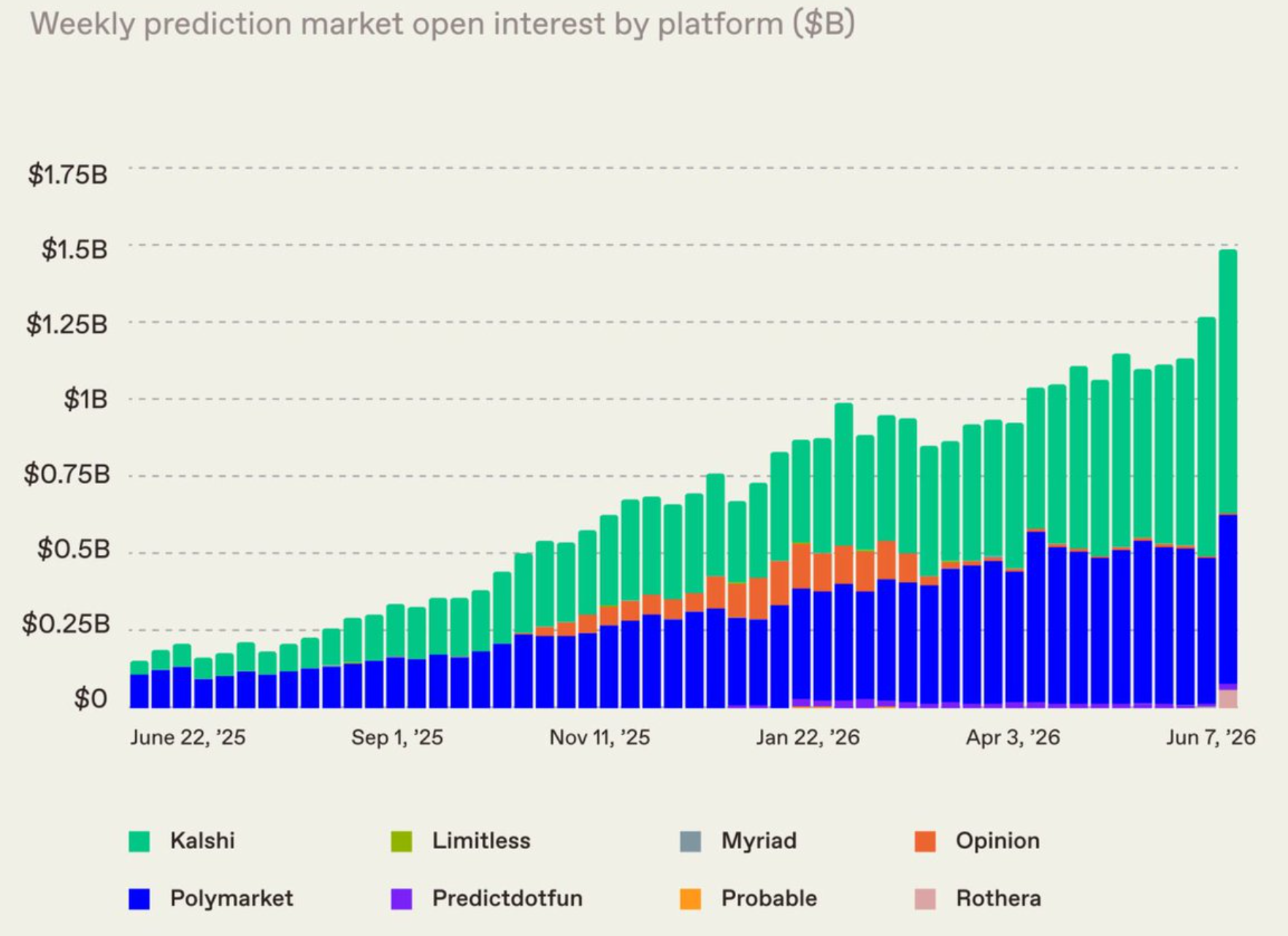
Since May 2026, Kalshi has maintained a high and rising level of open interest, while Polymarket has not shown significant change.


Litigation Battle Becomes the Biggest Variable


Kalshi's IPO path is not without obstacles, with its core risks concentrated in jurisdictional conflicts.


Kalshi maintains that its event contracts are "swaps" under the exclusive jurisdiction of the CFTC, and state-level gambling laws should not apply. Since 2026, multiple states have engaged in a tug-of-war with Kalshi. A New Jersey court sided with Kalshi regarding its sports contracts, and a Tennessee federal court granted a preliminary injunction in February 2026, finding that federal law may take precedence.


Conversely, a Massachusetts court previously ruled that Kalshi is subject to state gambling laws, and Arizona even filed criminal charges against Kalshi. The charges stated that Kalshi may call itself a prediction market, but it essentially operates illegal gambling and accepts wagers on Arizona elections, both violations of Arizona law. No company has the right to decide which laws to follow.
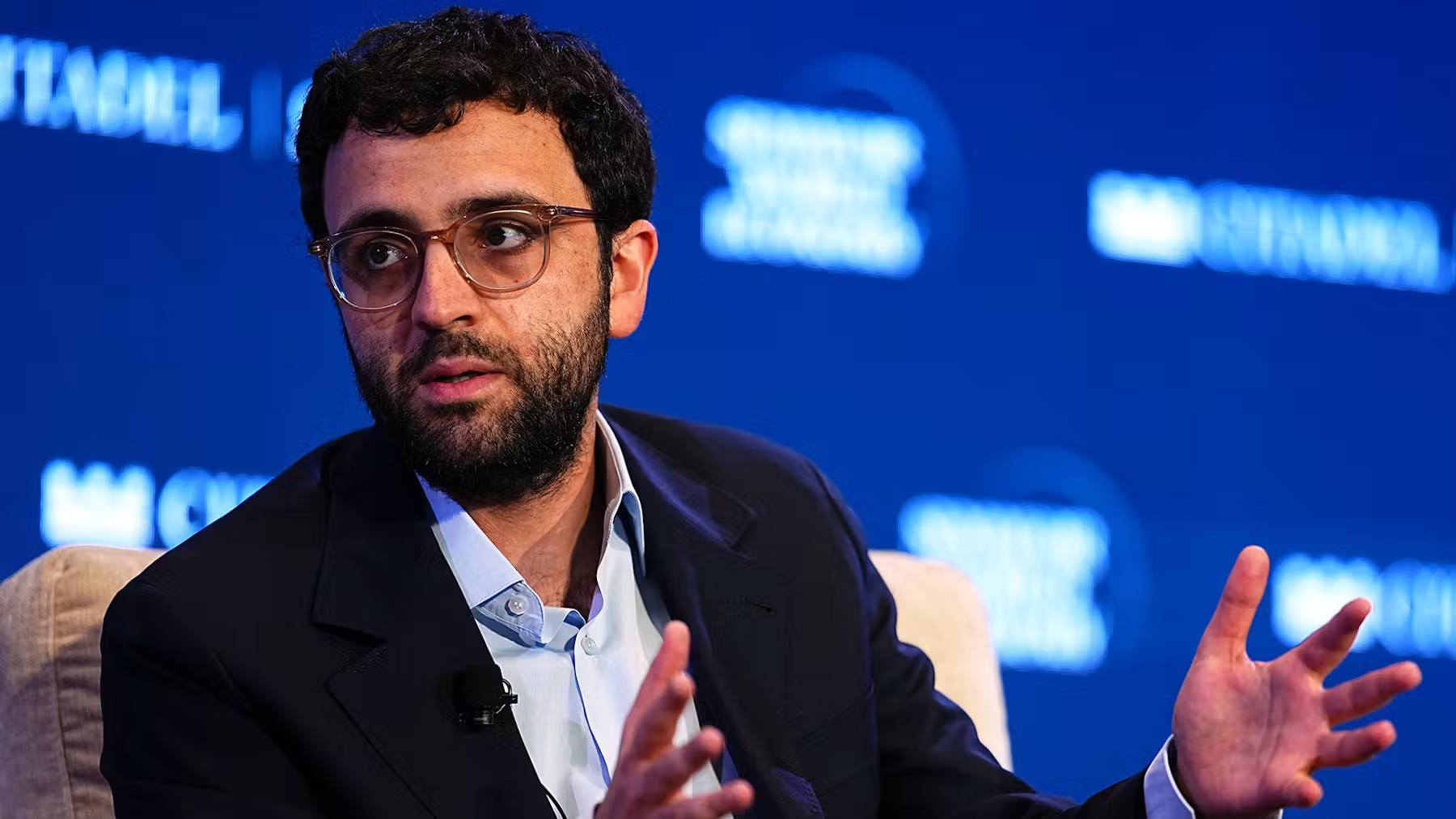

Tarek Mansour


Kalshi CEO Tarek Mansour responded: "The Arizona Attorney General's charges are baseless and a clear overreach. If they can bring these criminal charges against Kalshi, they could bring the same charges against traditional derivatives on the Chicago Mercantile Exchange and NASDAQ, including options trading, interest rate swaps, and grain futures. We have filed a lawsuit against Arizona in federal court. However, instead of allowing the federal court to adjudicate the case on its merits, the state Attorney General is attempting to circumvent due process by filing bogus charges in state court. We will not be intimidated."


The CFTC has adopted an aggressive defensive posture, filing federal lawsuits against states like Arizona, Connecticut, and Illinois, asserting that its "exclusive jurisdiction" should not be eroded by state laws. Simultaneously, both the CFTC and Kalshi have taken enforcement actions against market manipulation and insider trading.


On June 18, 2026, Kentucky Attorney General Russell Coleman sued Kalshi and Polymarket, accusing them of operating unlicensed sports betting and naming partners like Coinbase, Robinhood, and Webull as related parties.


The outcomes of these lawsuits will directly impact Kalshi's sports revenue stream. If ultimately unfavorable rulings affect core products, its business model and IPO will face significant pressure.


Ideally, moving from early IPO discussions to listing takes 6-9 months. Kalshi only began informal discussions in June 2026, so theoretically, the earliest possible IPO date would be December 2026. However, this requires zero delays in all steps, resolution of litigation issues, and SEC cooperation.


Multiple institutions anticipate that Kalshi's IPO could happen as early as late 2027 or 2028.


Since 2025, large fintech company IPOs exceeding $1 billion in scale have been common. For companies with similar or larger revenue scales, initial fundraising often ranges from several hundred million to over ten billion dollars. In 2025, Circle went public with an $8 billion valuation and annualized revenue around $2 billion, raising a total of approximately $1.05 billion.


Currently, with a $22 billion valuation, Kalshi has become a unicorn, trading at about 11x its annualized revenue ($2 billion revenue). If revenue continues to grow by the time of the IPO (driven by sports events, election cycles) and the US stock market maintains some liquidity, its fundraising amount could far exceed $1 billion. As for the specific figure, it remains worth close attention.


Trending Cryptos

Related Questions

QAccording to the article, what is Kalshi's annualized revenue and what is its current valuation?

AAccording to the article, Kalshi's annualized revenue has exceeded $2 billion. Its valuation, following a recent funding round, has jumped to $22 billion.

QWhat is the primary risk factor mentioned for Kalshi's potential IPO?

AThe primary risk factor for Kalshi's IPO is jurisdictional conflicts with multiple U.S. states over whether its event contracts constitute illegal gambling under state law or regulated swaps under federal CFTC jurisdiction. Unfavorable legal rulings could threaten its core business model.

QWhich type of event contracts reportedly contributes the majority of Kalshi's revenue?

ASports-related event contracts reportedly contribute the vast majority of Kalshi's revenue, from markets like the NBA playoffs, the 2026 FIFA World Cup, and its partnership with the NHL.

QWhat new financial product did Kalshi recently launch, and what platform is it planning to launch this summer?

AKalshi recently launched a Bitcoin perpetual contract. It is planning to launch a perpetual contracts trading platform called Kalshi Pro in the upcoming summer.

QWhat is the theoretical earliest possible IPO date for Kalshi mentioned in the article, and what are the more realistic estimates from analysts?

ATheoretically, the earliest possible IPO date for Kalshi could be December 2026 if all processes proceed with zero delays, including resolving legal issues. However, multiple institutions expect a more realistic timeline, with the earliest possible IPO occurring in late 2027 or 2028.

Related Reads

Beyond the Model Lies the Harness: Deepseek Enters the Arena, Why Has the Main Battlefield of China's AI Competition Shifted?

In mid-to-late May 2026, Deepseek internally established a new Harness team focused on code agent products, internally benchmarked against Anthropic's Claude Code. This move, marked by the formula "Model + Harness = Agent" in their job postings, signals a major shift in China's AI competition: the main battlefield is transitioning from developing large models to building toolchains and achieving workplace integration. Deepseek's direct involvement in Harness development aims to secure control over interface design and training data feedback loops, moving beyond open-sourcing powerful models. Harness, the runtime infrastructure for AI agents, handles everything beyond model reasoning—task orchestration, tool calling, context management, safety checks, and error recovery. It is crucial because agent products are not just outputs of model capability but also training grounds for it. Real-world task failures recorded by Harness can feed back into model training, creating a flywheel effect. Engineering Harness is more critical than optimizing prompts, as poor context management or error handling can drastically reduce agent success rates in multi-step, real-world scenarios. This shift is not isolated. Other major Chinese tech companies are also pursuing differentiated toolchain strategies. Tencent leverages its enterprise ecosystem (WeChat Work, Tencent Cloud) to build connectors for organizational-level AI collaboration and complex task delivery. Alibaba focuses on lowering automation barriers on the web with a front-end, browser-based GUI Agent framework, PageAgent. This diversification shows the industry recognizes that success lies not in a perfect general agent, but in vertically focused solutions built with robust engineering. The trend is validated by overseas success, such as Poland's Viktor, an AI coworker on Slack achieving $20M ARR by autonomously executing complex, multi-step tasks. This proves a shift in enterprise willingness to pay—from "AI-assisted generation" to "AI-autonomous execution." As Harness matures to provide safety guards and reliability, AI transitions from a human-supervised intern to an independent outsourcer. The competition now faces key engineering challenges: preventing "token explosion" through intelligent context compression, and building "thick frameworks" with features like sandbox isolation and checkpoint recovery for enterprise-grade stability. Geopolitical restrictions on tools like Claude Code further create a significant market vacuum for domestic solutions like Deepseek's Harness. For enterprises and developers, the focus must shift from comparing model benchmarks to evaluating a vendor's engineering capabilities, error recovery mechanisms, context management, and ecosystem compatibility when choosing AI products and platforms.

marsbit59m ago

Beyond the Model Lies the Harness: Deepseek Enters the Arena, Why Has the Main Battlefield of China's AI Competition Shifted?

marsbit59m ago

Trading

Spot
Futures

Hot Articles

Discussions

Welcome to the HTX Community. Here, you can stay informed about the latest platform developments and gain access to professional market insights. Users' opinions on the price of S (S) are presented below.

活动图片