From $1.6 Billion to a 30-Story Fall: The Final Fate of an Algorithmic Stablecoin Operator

marsbitPublished on 2026-08-10Last updated on 2026-08-10

Abstract

From $1.6 Billion to a 30-Story Fall: The Final Outcome of a Stablecoin "Whale" On August 7, 2026, Chinese-Canadian crypto investor Harry Yeh (founder of Quantum Fintech Group) was found dead outside a luxury apartment in Asunción, Paraguay, having reportedly fallen from the 30th floor. The scene, where he was found naked and covered in a black plastic bag with his apartment in disarray, prompted an investigation exploring accident, suicide, and homicide. Yeh was a notable early investor in the crypto space, entering in 2013. His major moment came in late 2021 when he took over the troubled algorithmic stablecoin project Tomb Finance on Fantom. Through leveraged tactics and promotion, he drove its Total Value Locked (TVL) to a peak of $1.6 billion in January 2022, though the project's tokens later collapsed. He subsequently promoted LIF3, positioning it as an improved successor. Publicly, Yeh maintained a high-profile image, showcasing a lavish lifestyle on social media. His death adds to a series of non-normal deaths among high-net-worth crypto participants in recent years, including the founders of failed exchange Thodex and other investors. The incident underscores the extreme volatility and potential personal risks within the cryptocurrency industry, highlighting the need for greater emphasis on off-chain security and mental health. The investigation into his death remains ongoing.

Written by: Ma He, Foresight News

On August 7, 2026, local Paraguayan media La Tribuna reported that the body of a Chinese man was discovered outside the luxury apartment building Jade Park in the Trinidad district of Asunción. The preliminary identity was confirmed as Harry Chun Tak Yeh (social media account @ harryyeh), founder and managing partner of Quantum Fintech Group.

According to the local police bulletin, his fall was initially estimated to have occurred in the early hours of last Tuesday local time, from the 30th floor of the building, one of the tallest in the neighborhood. His body was completely naked and covered by a black plastic bag. Investigators later examined his associated 30th-floor apartment, finding the door open and the interior in severe disarray. Another apartment on the 27th floor of the same building, also linked to him, was secured for forensic evidence. Harry Yeh's 29-year-old Brazilian girlfriend, who lived on a lower floor, told authorities she knew nothing about the incident.

Paraguay's homicide unit and forensic department have collected evidence and transferred it to the prosecutor's office. The prosecutor's office is currently investigating multiple possibilities including accident, suspected suicide, and homicide. The body has been sent to the judicial morgue for an autopsy. As of now, there is no official final conclusion.

Investor in Multiple Projects

His official website harryyeh . com introduced Harry Yeh as Managing Director of Quantum Fintech Group, a company focused on investment management in the cryptocurrency, blockchain, and digital asset space, seeking excess returns for clients and partners. The website explicitly states that during his tenure running the company, he founded and became the seed investor of LIF3 and L3 Reserve. LIF3 is a full-chain DeFi ecosystem, while L3 Reserve is the issuer of L3 USD, positioned as a variably collateralized stable asset.
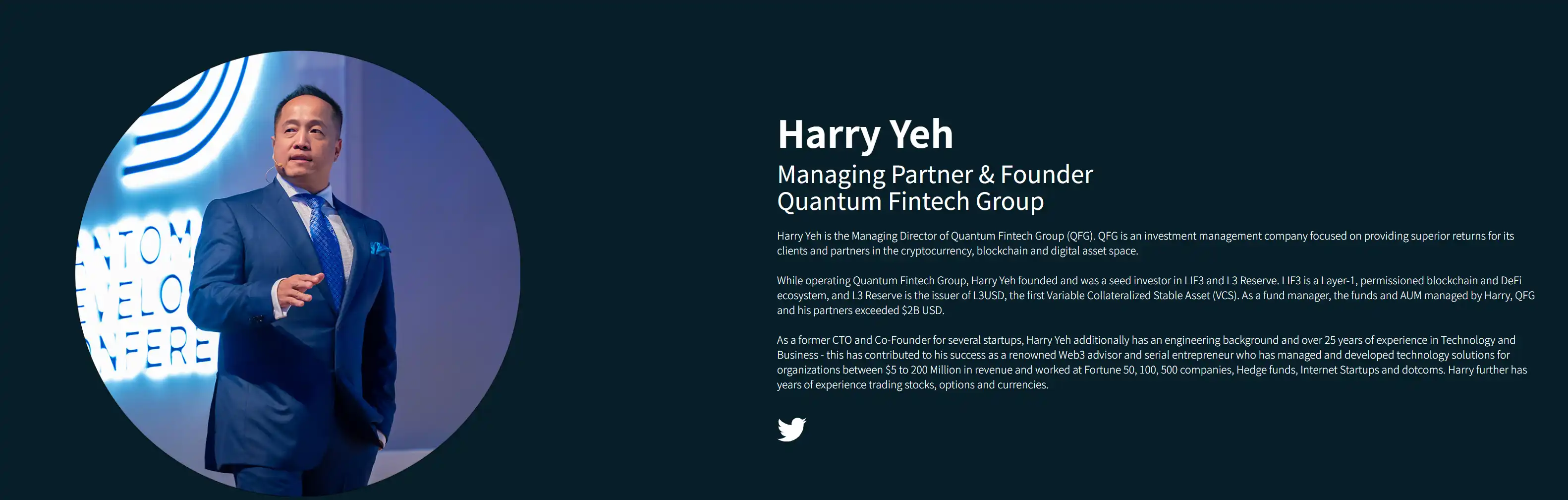
The website shows that Harry Yeh had over 25 years of experience in technology and business, having served as CTO and co-founder of several startups, and had years of experience trading stocks, options, and foreign exchange. Public records indicate he was born in Hong Kong and moved to Canada as a child.

In 2013, when the Bitcoin price was around $60, he entered the market and launched his first fund with approximately $250,000. He initially conducted OTC trading, market-making, and related fund management through Binary Fintech Group.

2021 was a key turning point. In September of that year, Tomb Finance (an algorithmic stablecoin-like project deployed on Fantom, involving tokens like TOMB, TSHARE, TBOND) suffered a liquidation panic due to social engineering exploiting the 'Gatekeeper Tax'—a selling tax established to prevent whale withdrawals. Harry Yeh announced that he and his team would take over, and detailed a plan on September 11. Subsequently, through leverage and aggressive PR, he pushed Tomb Finance's TVL to a historical peak of $1.6 billion in January 2022. However, the project's tokens have since approached zero, and its last X post was in February 2025.
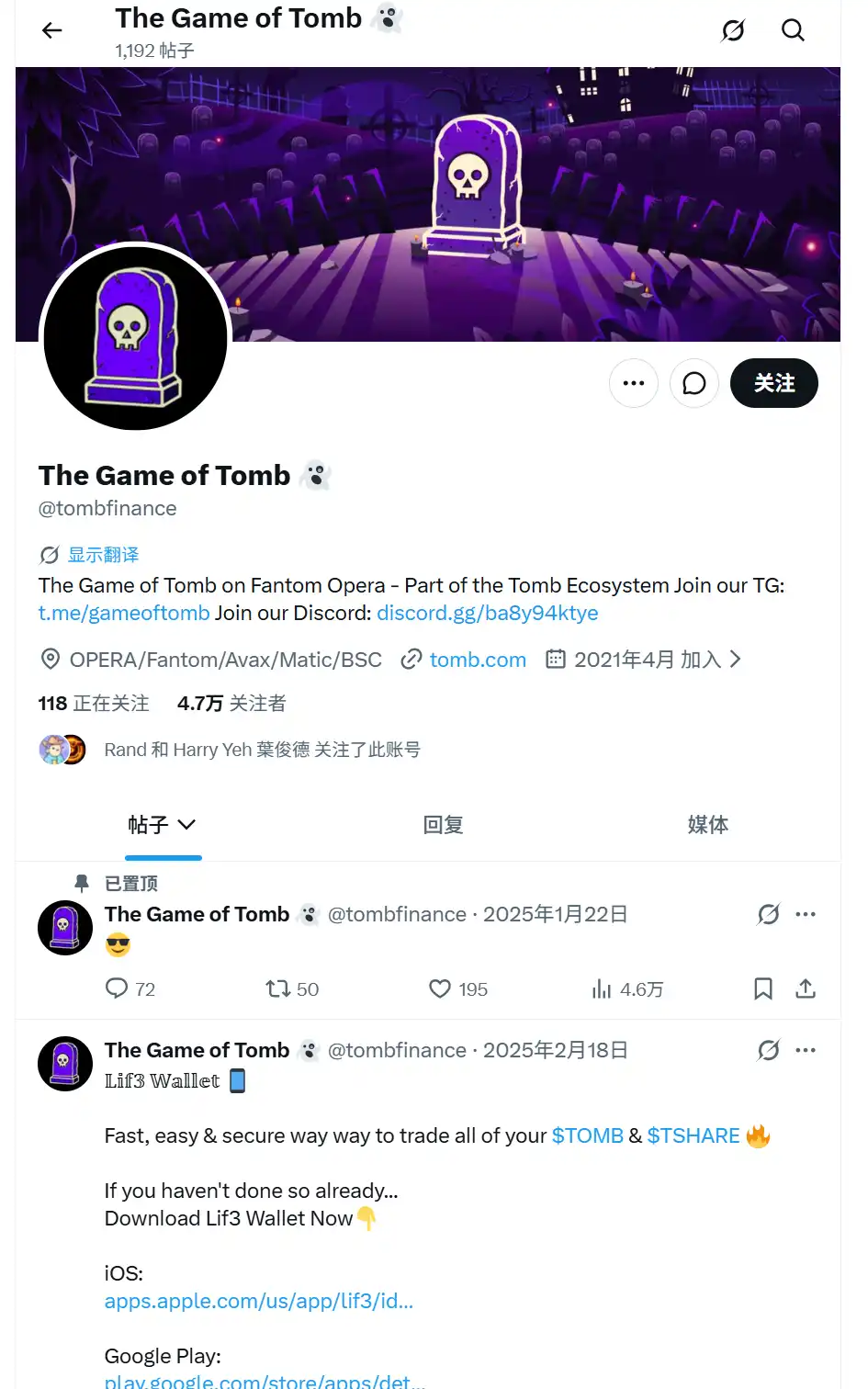
Concurrently, he was a significant early supporter and promoter of the Fantom ecosystem, frequently expressing public optimism for FTM and sharing views at related conferences.

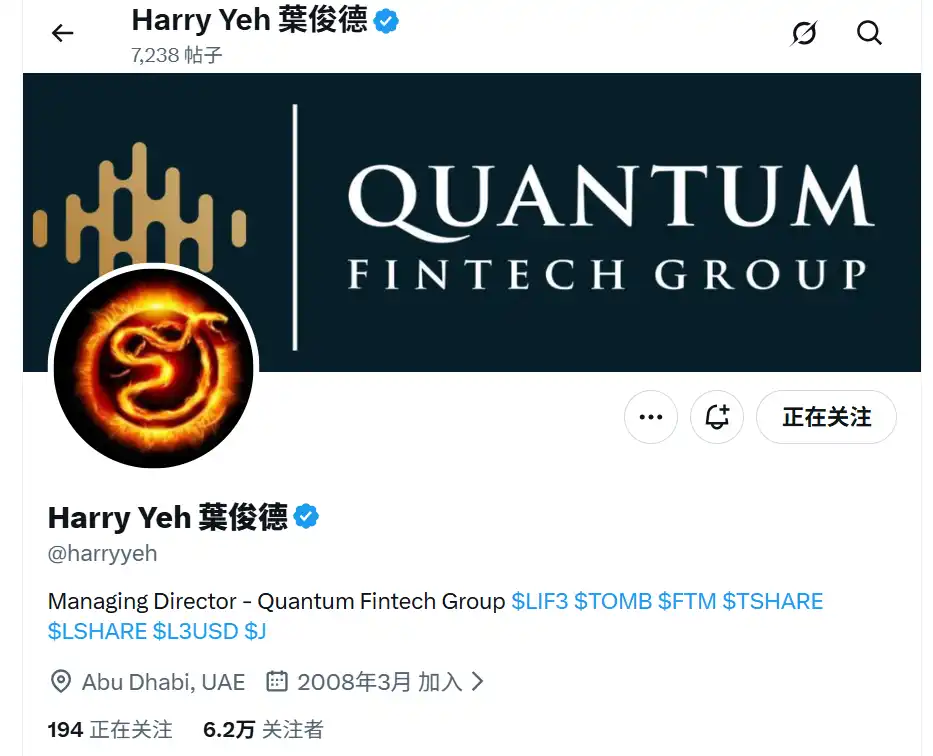
From 2022 onward, he began promoting LIF3. The project was positioned as an improvement and extension of Tomb, emphasizing accessibility and security, offering functions like trading, yield farming, liquidity provision, and derivatives. His X social media account was long tagged with identifiers for tokens like LIF3, TOMB, FTM, TSHARE, and L3 USD.
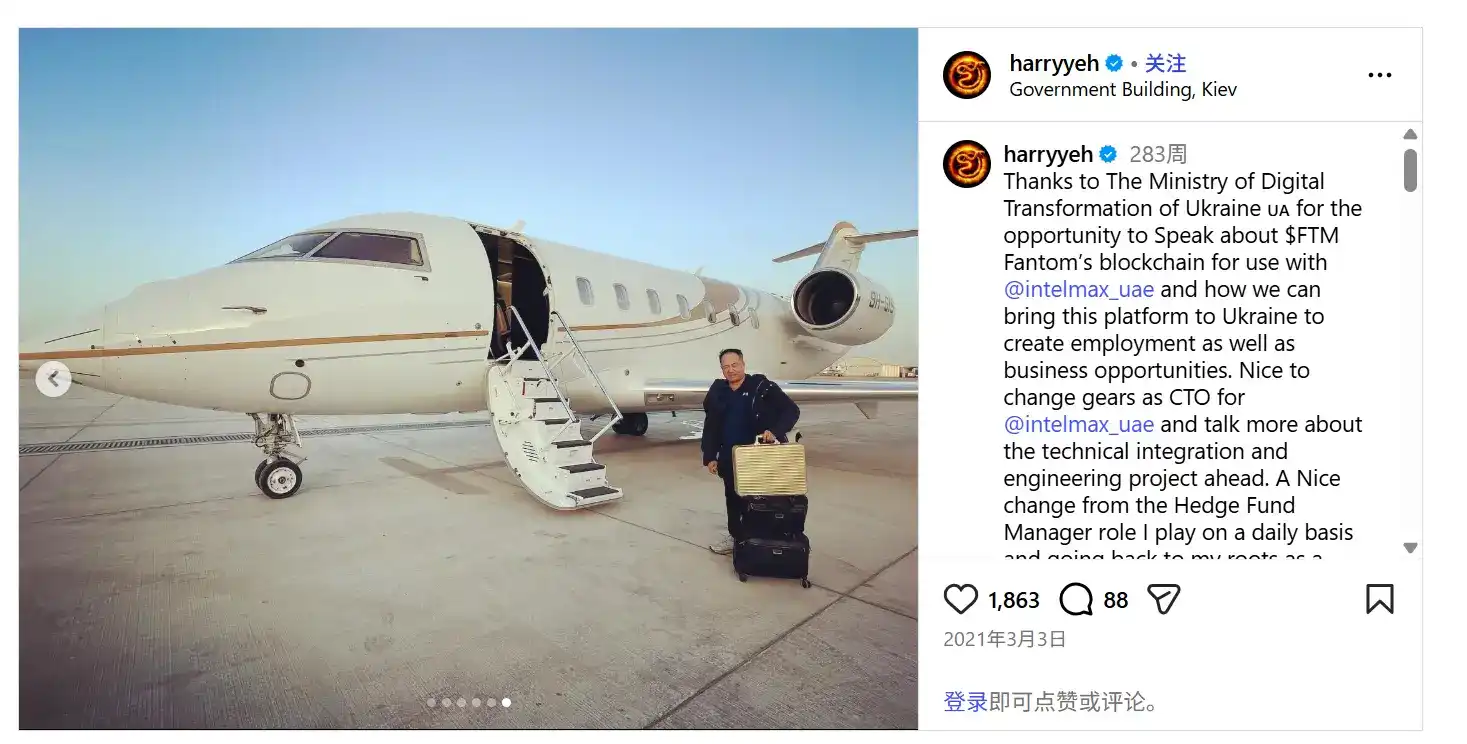
His public persona was relatively high-profile. While he didn't flaunt a lavish lifestyle on X, on Instagram, he frequently showcased private jets and luxury yachts. His reputation in the crypto community was divided. Early on, some saw him as an OG helping the ecosystem expand rapidly, while later, many voices questioned the sustainability and team transparency of his projects.
The crypto industry is no stranger to high-net-worth participants meeting unnatural deaths.

In 2025, Faruk Fatih Özer, founder of the defunct Turkish exchange Thodex, died in prison. His lawyer stated he had recently isolated himself and refused to see family, with preliminary judicial findings leaning towards suicide. The same year, Ukrainian crypto-related figure Konstantin Galish (Kostya Kudo) was found shot to death in his own car in Kyiv. Police mentioned suicidal tendencies and a farewell message, coinciding with a major market downturn. In early 2026, a Hong Kong man fell from his residence after reportedly losing about $1.2 million in crypto investments, with police classifying it as a fall from height.

In these cases, official conclusions and community speculation often coexist. The Harry Yeh incident remains in its early investigative stages. The scene details (naked, plastic bag, apartment in disarray) indeed raise questions about a simple accident or straightforward suicide, but any definitive characterization is premature before autopsy results and more evidence are released.

On-chain wealth can accumulate quickly, but off-chain security, privacy, and mental health are matters requiring greater attention from every crypto participant.


Related Questions

QWho was Harry Chun Tak Yeh (Harry Yeh) and what was his role in the cryptocurrency space?

AHarry Chun Tak Yeh (叶俊德) was the founder and managing partner of Quantum Fintech Group, a firm focused on investment management in crypto, blockchain, and digital assets. He was a key early supporter and promoter of the Fantom ecosystem and was known for taking over and managing the Tomb Finance protocol on Fantom. He also founded and was a seed investor in the LIF3 DeFi ecosystem and the L3 Reserve stable asset project.

QWhat is Tomb Finance, and what was Harry Yeh's involvement with it in 2021?

ATomb Finance was an algorithmic stablecoin-like project deployed on the Fantom blockchain, involving TOMB, TSHARE, and TBOND tokens. In September 2021, it experienced a panic due to a social engineering exploit related to its Gatekeeper Tax. Harry Yeh announced that he and his team would take over the protocol, and through leverage and PR efforts, they pushed its Total Value Locked (TVL) to a historical high of $1.6 billion by January 2022. The project's tokens have since declined significantly in value.

QWhat were the unusual circumstances surrounding Harry Yeh's death according to the police report?

AAccording to the police report, Harry Yeh's body was found outside the Jade Park luxury apartment building in Asunción, Paraguay, on August 7, 2026. The preliminary assessment was that he fell from the 30th floor. The body was found completely naked and covered with a black plastic bag. His apartment on the 30th floor was found with the door open and in severe disarray, and another apartment on the 27th floor linked to him was also examined by forensics. His Brazilian girlfriend, living on a lower floor, stated she knew nothing about the incident.

QWhat are some other recent cases mentioned in the article where individuals in the crypto space died under tragic or suspicious circumstances?

AThe article mentions several other cases: In 2025, Faruk Fatih Özer, the founder of the collapsed Turkish exchange Thodex, died in prison, with his lawyer suggesting suicide. In the same year, Ukrainian crypto figure Konstantin Galish (Kostya Kudo) was found shot dead in his car in Kyiv, with police indicating suicide tendencies and a farewell note following a market downturn. In early 2026, a man in Hong Kong died from a fall after reportedly losing around $1.2 million in crypto investments, with police attributing it to a fall from height.

QWhat contrasting public personas did Harry Yeh present, and how did the crypto community view him?

AHarry Yeh presented contrasting public personas. On platform X, he maintained a professional focus, often tagging tokens related to his projects. However, on Instagram, he frequently showcased a luxurious lifestyle involving private jets and yachts. The crypto community's perception of him was divided. In his early involvement, some viewed him as an OG who helped expand the ecosystem rapidly. Later, a significant number of voices raised concerns about the sustainability of his projects and the transparency of his teams.

Related Reads

The CEO of Silicon Valley's Trillion-Dollar AI Empire is Actually a Two-Faced 'Doomsday Prophet'

Dario Amodei, CEO of the trillion-dollar AI company Anthropic, is portrayed as a paradoxical "doomsday prophet." He has spent a decade warning that AI poses an existential threat to humanity, exhibiting extreme caution such as air-gapping computers and personally delivering printed memos. He famously rejected a "charm offensive" PR campaign, instead authorizing ads depicting tombstones to highlight AI's dangers. Yet, simultaneously, he is aggressively accelerating AI development, believing the "singularity" is inevitable. He sees building the most powerful AI as the only way to control and steer it away from catastrophe, a philosophy described as "stepping on the gas while looking for the brake." His leadership is more that of a religious visionary than a conventional CEO, focusing on grand visions of AI and societal impact while delegating daily operations. This has fostered a cult-like, mission-driven culture at Anthropic. Despite Anthropic's staggering commercial success—a valuation nearing a trillion dollars with explosive revenue growth—investors are unnerved. They fear Amodei is fundamentally indifferent to money, preferring to discuss AI extinction risks over business metrics. The central tension lies in whether this "doomsday prophet" can maintain his safety-first creed while managing a capital-fueled juggernaut, a high-stakes gamble where humanity itself is the ultimate stakeholder.

marsbit18m ago

The CEO of Silicon Valley's Trillion-Dollar AI Empire is Actually a Two-Faced 'Doomsday Prophet'

marsbit18m ago

Trading

Spot
活动图片