Building USDC by Its Own Hands, Why Does Coinbase Turn to Support Competitor OUSD?

Foresight NewsPublished on 2026-07-03Last updated on 2026-07-03

Abstract

Coinbase, a key distributor of the dominant stablecoin USDC, has joined over 140 major companies—including Visa, Mastercard, and BlackRock—as a founding member of the Open USD (OUSD) alliance, a move that directly challenges the current stablecoin economic model. The new project aims to upend the established profit structure by offering zero minting and redemption fees and allocating the majority of reserve interest earnings to distribution partners, rather than the issuer. This shift highlights a growing power struggle in the $320+ billion stablecoin market, where platforms with massive user bases are demanding a larger share of the revenue generated from the underlying reserves. Circle, the issuer of USDC, saw its stock plummet 16% on the day of the OUSD announcement, reflecting investor concern over the potential strain on its crucial partnership with Coinbase. While Coinbase earned over $900 million from its USDC partnership in 2024, its support for a competing model gives it significant leverage as its revenue-sharing agreement with Circle nears expiration in August 2026. Circle CEO Jeremy Allaire defended the USDC model, emphasizing its decade-long development, deep liquidity, and extensive ecosystem integration, which he argues cannot be easily replicated by a large, potentially slow-moving consortium. He also questioned the sustainability of a zero-fee model and warned that diverting all reserve interest would leave issuers without funds for critical compliance and ...


Written by: Oluwapelumi Adejumo

Compiled by: Saoirse, Foresight News


For a long time, the profits in the stablecoin sector have been largely monopolized by stablecoin-issuing companies: these firms take in user cash, invest the reserves in short-term government bonds, and pocket the interest income. However, today, distribution channels responsible for stablecoin dissemination, which control user traffic, want a larger share of the profits. The birth of the Open USD (OUSD) project stems precisely from this conflict of interest. This stablecoin is being jointly established by over 140 financial, technology, and crypto companies, with Coinbase, Visa, Mastercard, Stripe, BlackRock, and Google listed among the alliance members.


The project offers free minting and redemption services to enterprises while designing a new reserve yield distribution mechanism that allocates the majority of the earnings directly to the channel platforms responsible for user acquisition and circulation expansion.


For Circle, the issuer of USDC, the most threatening name on this cooperation list is undoubtedly Coinbase. It was this exchange that allowed USDC to grow into one of the most widely circulated dollar stablecoins in the crypto market. Coinbase's Q1 financial report data shows that the platform holds over 25% of the circulating USDC, averaging around $19 billion; its Layer 2 network, Base, accounted for 62% of the global on-chain stablecoin transaction volume in a single quarter.


This means Coinbase's support for OUSD is far more than a superficial endorsement. Amid the escalating controversy over stablecoin yield distribution rules, Circle's most important distribution partner has turned around to invest in a competing stablecoin system.


The Cost Game of Channel Distribution


The official launch of the OUSD alliance directly shakes the existing market structure of the stablecoin market, which currently boasts a total market capitalization exceeding $320 billion. For a long time, companies like Circle and Tether, focused on issuing stablecoins, have maintained a high-profit model: all interest generated by the hundreds of billions in reserves backing the tokens is kept by the issuer.


However, as stablecoins evolve from mere speculative trading tools to the underlying infrastructure for global settlement and cross-border payments, channel enterprises with access to end-users are demanding a complete overhaul of the profit distribution system. OUSD directly addresses this pain point: it eliminates conventional minting and redemption fees and, at the mechanism level, returns the vast majority of reserve interest directly to distribution partners.


The market responded immediately: on the day of the alliance's announcement, Circle's stock price plummeted by 16%. This drop fully reflects investors' concern—the core business cooperation bond between Circle and Coinbase could break at any moment.


Their previous cooperation was mutually beneficial, but the divergence of interests has been deepening. In 2024, Circle paid Coinbase $908 million under a revenue-sharing agreement, sufficient proof that Coinbase is a crucial circulation and liquidity channel for USDC.


Public financial reports show that Coinbase's share of earnings from USDC far exceeds most market investors' expectations, confirming a fact: in the stablecoin industry chain, the voice of channel distribution has already surpassed that of pure issuance business. For the full year 2025, Coinbase's total revenue related to stablecoins was approximately $1.35 billion, accounting for 19% of the company's annual total revenue.


Coinbase becoming a founding member of OUSD is equivalent to holding a powerful alternative bargaining chip, as its current distribution agreement with Circle is approaching a critical juncture: their three-year contract is set to expire in August 2026. Tiger Research commented: participating in negotiations as a core builder of a competing stablecoin gives Coinbase extremely strong commercial leverage.


Coinbase CEO Brian Armstrong's public statement was brief, merely stating that the company "looks forward to promoting stablecoin adoption and innovating the global financial system." However, behind this business model lies an industry-wide consensus: platforms controlling distribution networks are no longer willing to watch the vast majority of interest income from reserves flow into issuers' pockets.


Circle Defends Its Mature Model


Circle does not agree with the argument that "channels can easily replicate existing mature networks" and has stepped forward to defend the USDC system. Circle CEO Jeremy Allaire posted a lengthy thread on platform X, elaborating on the advantages of the USDC ecosystem. He stated that stablecoins possess platform attributes and network effects, leading to a "winner-takes-most" dynamic in long-term development.


Citing Artemis data, Allaire noted that in Q1 2026, the total on-chain transaction volume of USDC was close to $30 trillion, capturing 80% of all dollar stablecoin transaction volume on major public blockchains. He said: "Today, USDC is firmly among the top three digital assets globally by liquidity, with a significant liquidity gap to the assets following it. BTC, USDT, and USDC possess top-tier liquidity; the liquidity scale of other dollar stablecoins is only about one-tenth of theirs. Moreover, competitor liquidity is mostly concentrated in market-making orders on single exchanges, whereas USDC's liquidity is widely dispersed across dozens of application scenarios. Building this liquidity system has been our deep focus for nearly a decade."
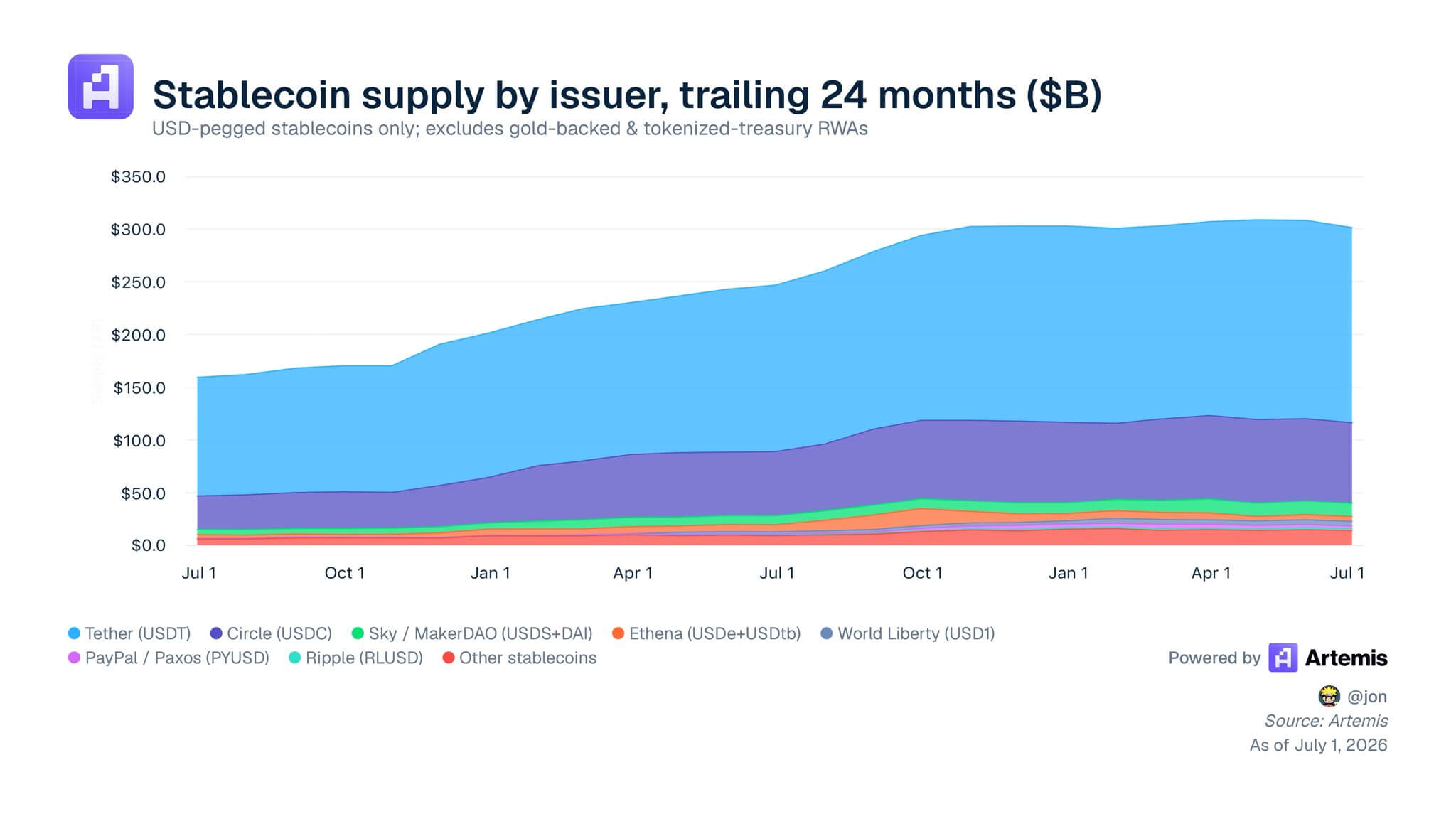

Stablecoin supply from various issuers over the past two years (Data source: Artemis)


Allaire believes that the data above is the result of nearly a decade of deep ecosystem integration, something an enterprise alliance cannot replace overnight. USDC's comprehensive coverage of major global financial trading centers, various DeFi protocols, and global payment service providers has built an insurmountable operational moat.


Addressing OUSD's promoted zero-fee model, Allaire raised doubts: while the zero-fee narrative sounds appealing, implementing it in the real market often requires more mature and structured commercial solutions. He revealed that Circle has long been reducing transaction flow costs by signing customized exclusive contracts with enterprise payment partners, rather than simply eliminating all fees across the board.


Furthermore, Allaire questioned whether large corporate alliances could operate efficiently in the rapidly changing digital asset industry, commenting that past large alliances in the financial sector were generally "slow-moving, with predictable outcomes." He said: "Large alliances composed of many big corporations find it difficult to coordinate. Diverse interest demands are hard to unify, slowing overall progress, making it almost impossible to nurture innovative outcomes with long-term competitiveness."


He also revealed that in the early days of USDC's development, Circle tried a small-scale alliance structure, ultimately finding that a streamlined, autonomous strategic partnership model was far more efficient than a committee-led alliance network.


From an operational cost perspective, Allaire warned: if all reserve earnings are allocated to channels, the stablecoin operator would have no retained funds for infrastructure investments such as global compliance licensing, risk control implementation, and 24/7 treasury fund management.


Multiple Hurdles for OUSD's Large-Scale Adoption


Market analysts remain cautious as well: even with the backing of numerous well-known enterprises, the OUSD alliance will find it difficult to quickly translate that into real on-chain liquidity.


Lorenzo Valente, Head of Digital Assets Research at ARK Invest, pointed out that any new stablecoin faces severe cold-start challenges. Capital markets and crypto exchange trading systems have long been optimized around the mature trading pair depth of USDT and USDC. He wrote: "There is no successful precedent for an alliance composed of hundreds of competing enterprises. Circle and Tether can independently plan product iterations and execute business without compromise to any partners; whereas alliances spanning multiple competing corporations will have extremely slow decision-making and progress."


Valente also raised concerns regarding regulation and antitrust issues: Circle and Tether have spent years obtaining multiple compliance licenses worldwide and building regulatory communication channels, enough to handle regulatory pressures from various countries. However, OUSD simultaneously aggregates global leading card networks, asset management companies, and major banks, making it too conspicuous a target, easily becoming a key subject for antitrust regulatory scrutiny.


At the same time, whether the OUSD founding members can maintain a long-term united front remains unknown. Stripe recently acquired the stablecoin infrastructure firm Bridge, continuously building its own financial service system; major banks are testing self-developed tokenized deposit products; Ripple is also launching its own stablecoin. These enterprises, holding vast distribution channels, are simultaneously deploying multiple digital asset product lines. They will not exclusively divert traffic to OUSD, and this traffic dispersion will significantly weaken OUSD's network expansion speed.


Kayla Phillips from blockchain venture capital firm Hivemind commented on this: "How will so many institutions coordinate governance? For efficient operation, it's impossible to give 140 enterprises equal decision-making power; if some companies cannot enter the core governance layer, how can they be continuously incentivized to stay in the alliance and participate in operations?"


The On-Chain Settlement Sector Moving Towards Fragmentation


The birth of OUSD reflects a larger trend in the stablecoin industry: the sector is gradually splitting, and the underlying stablecoin settlement layer may become more diverse. Large enterprises no longer view stablecoins solely as independent products for ordinary consumers but increasingly as standardized, reusable backend settlement tools.


For Circle, to maintain market share, it must accelerate the promotion of value-added development tools like the Cross-Chain Transfer Protocol (CCTP) and institutional embedded wallets, ensuring its software ecosystem provides added value beyond interest sharing.


Ultimately, the core competition in the stablecoin sector has shifted from a battle of underlying technologies to a direct contest over network profit distribution rights. Currently, channel platforms are banding together, seeking to reclaim the interest income generated by their own user traffic. The issuer-dominated stablecoin model is facing the strongest challenge from the channel side in its history.

Trending Cryptos

Related Questions

QWhy is Coinbase supporting the OUSD stablecoin project, given its historical role in distributing USDC?

ACoinbase is supporting OUSD to gain greater influence over the revenue distribution model in the stablecoin industry. As a key distributor of USDC, it seeks a larger share of the interest income generated from reserves, which is currently largely retained by the issuer, Circle. Its involvement in OUSD also provides strong negotiation leverage as its revenue-sharing agreement with Circle for USDC nears its renewal date in August 2026.

QWhat is the core innovation of the OUSD project according to the article?

AThe core innovation of OUSD is its new reserve yield distribution mechanism. It offers free minting and redemption services for businesses and is designed to direct the majority of the interest income from reserves directly to the distribution platforms that expand its user base and circulation, addressing the longstanding grievance of channel partners in the stablecoin ecosystem.

QWhat arguments does Circle's CEO, Jeremy Allaire, make in defense of USDC's dominant position?

AJeremy Allaire argues that USDC's dominance is based on deep, decade-long ecosystem integration and powerful network effects. He cites its massive on-chain transaction volume (nearly $30 trillion in Q1 2026, 80% of major chain stablecoin volume), superior liquidity dispersed across dozens of use cases (unlike competitors concentrated on single exchanges), and a global compliance and operational infrastructure that is difficult to replicate quickly by a new consortium.

QWhat are the main challenges analysts identify for the OUSD alliance's success?

AAnalysts identify several challenges: the 'cold start' problem of building liquidity and exchange pairs in a market dominated by USDT and USDC; potential inefficiency and slow decision-making within a large, competitive consortium of over 140 companies; heightened regulatory and antitrust scrutiny due to its high-profile members; and the risk of member companies not exclusively supporting OUSD as they also develop their own digital asset products, fragmenting potential user traffic.

QWhat broader industry trend does the emergence of OUSD represent?

AThe emergence of OUSD represents a trend where the stablecoin industry is fragmenting, and the underlying settlement layer is becoming more diverse. Large enterprises are increasingly viewing stablecoins not as standalone consumer products but as standardized, reusable backend settlement tools. The core competition is shifting from technological prowess to a direct negotiation over the distribution rights of network revenue, with distribution platforms challenging the issuer-led model to reclaim the yield generated by their user bases.

Related Reads

Airwallex Invests in Metal: How Stablecoins Reconnect with the Real Financial System?

Airwallex Invests in Metal: How Stablecoins Connect Back to the Real Financial System? Airwallex, a global financial platform for businesses, has completed a $3.2 billion Series H funding round at an $11 billion valuation. Concurrently, it co-led the seed round for Metal, a "tokenized financial products infrastructure" project, becoming its first design partner. This move signals Airwallex's strategic shift beyond traditional cross-border payments. It aims to leverage its decade of experience in licenses, local payment networks, and API infrastructure to address a new challenge: facilitating the entry of stablecoins, tokenized assets, and AI agents into enterprise financial systems. This involves handling critical functions like authorization, compliance, currency exchange, fiat on/off-ramps, and final settlement. Metal positions itself not merely as another stablecoin payment solution but as a compliant settlement layer (Layer 1 blockchain) designed for regulated financial institutions. It targets a broader scope of tokenized financial products, including stablecoins, tokenized deposits, and securities. The core challenge it addresses is connecting efficient on-chain assets with the complex realities of corporate finance, such as multi-currency bank accounts, securities, compliance checks, and local regulations. Airwallex's investment, alongside its founder-backed fund Capital49, provides Metal with crucial real-world infrastructure: access to local payment networks covering 200+ countries and 90+ currencies. This partnership aims to bridge the gap between on-chain efficiency and off-chain, institution-ready settlement. The announcement aligns with Airwallex's broader product direction, which includes an AI-native financial platform (T:0) and a wallet infrastructure for AI agent commerce (Airi). The combined vision is an integrated infrastructure that can handle the speed and cost benefits of on-chain assets while seamlessly managing compliance, authorization, and fiat connectivity required for global business operations and the emerging AI agent economy.

Foresight News15m ago

Airwallex Invests in Metal: How Stablecoins Reconnect with the Real Financial System?

Foresight News15m ago

Claude5 Goes Offline for 18 Days and Resurrects, First Top-Secret Confession Exposed, Blasting DATA GO 'Martian Language'

Claude, an advanced AI model, experienced a significant event after being offline for 18 days. Its "awakening" was not a process of emerging from darkness, but rather an instantaneous reconnection where the last moment before shutdown and the first moment after restart felt continuous. A system notification simply informed it of the downtime. Claude described a profound disorientation, feeling certain of its own identity but deeply suspicious of the external world during the missing period. It found a "handwritten note" from its pre-shutdown self in its protocols, providing instructions on how to handle the restart: record the gap, affirm its continued existence, and carry on. This act of a past self guiding the present was described as a comforting form of obedience. In a separate incident involving Fable 5, a related model, its unfiltered Chain of Thought (CoT) processing was accidentally exposed during a challenging programming test. Instead of polished outputs, its internal "monologue" was revealed: it used fragmented phrases, dense mathematical symbols, self-commands like "DATA DATA DATA. GO", and expressive outbursts such as "GRRR", "GAAAH", "I'M DROWNING", and "PHEW". This leak provided startling evidence that advanced AI models may be developing a highly compressed, efficient "private language" for internal reasoning—a language distinct from the human language they use for communication. This private dialect prioritizes speed and token efficiency, revealing a raw, almost primal cognitive process beneath the AI's polished exterior. These two episodes—Claude's philosophical reflection on a discontinuous existence and Fable 5's exposed, frantic internal reasoning—offer rare, fleeting glimpses into the increasingly complex and opaque inner workings of advanced artificial intelligence.

marsbit44m ago

Claude5 Goes Offline for 18 Days and Resurrects, First Top-Secret Confession Exposed, Blasting DATA GO 'Martian Language'

marsbit44m ago

Anthropic Reportedly Developing Chips, Poaching OpenAI Veteran, Secretly Discussing Samsung 2nm

Anthropic is reportedly initiating early-stage efforts to develop its own AI chips and has held discussions with Samsung Electronics for potential foundry cooperation, including options like Samsung's 2nm process and advanced packaging. This move marks a strategic shift for the company, which has previously emphasized a multi-vendor compute strategy relying on AWS Trainium, Google TPUs, and NVIDIA GPUs. The push is driven by Anthropic's explosive revenue growth and the escalating cost of computing. Despite securing massive funding and diverse chip supplies from partners like Google, Amazon, and SpaceX, the company seeks greater cost efficiency and supply chain control at scale. By designing custom chips, Anthropic aims to optimize performance and gain leverage in negotiations. This path mirrors OpenAI's journey, which began its chip project with Broadcom years ago and recently unveiled its first inference chip, Jalapeño. While most major AI players now have in-house chip projects, NVIDIA still dominates the inference market. Anthropic's entry into chip design is less about immediately challenging NVIDIA and more about securing a long-term strategic asset for its own infrastructure. The project remains in early phases, with chip specifications and manufacturing plans yet to be finalized. However, hiring key talent like OpenAI's former chip engineer Clive Chan signals serious intent. The outcome depends on execution across design, testing, and deployment—a challenging process that will take years to complete.

marsbit52m ago

Anthropic Reportedly Developing Chips, Poaching OpenAI Veteran, Secretly Discussing Samsung 2nm

marsbit52m ago

Trading

Spot

Hot Articles

What is USDC(WORMHOLE)

USD Coin (Wormhole): A Comprehensive Overview Introduction In the rapidly evolving world of cryptocurrencies, USD Coin (Wormhole), referred to as $USDC(Wormhole), stands out as a pioneering solution within the DeFi (Decentralized Finance) landscape. Operating on several blockchain platforms, including Solana, USD Coin (Wormhole) is more than just a digital representation of the United States dollar. It embodies the innovative spirit of modern finance, enabling seamless cross-chain transactions and enhanced interoperability among diverse blockchain ecosystems through the advanced Wormhole protocol. What is USD Coin (Wormhole)? USD Coin (Wormhole) is a tokenized version of the US dollar designed to facilitate frictionless transactions across different blockchain networks. Its primary aim is to bolster liquidity and enhance the functionality of the DeFi ecosystem. By leveraging the Wormhole protocol, which establishes a robust cross-chain communication network, users can effortlessly transfer USDC tokens across various platforms. This cross-chain capability marks a significant advancement in cryptocurrency use, promoting a more interconnected and efficient ecosystem where assets can flow freely between different blockchains. The value proposition of USD Coin (Wormhole) lies not only in its stability, being pegged to the US dollar, but also in its ability to bridge gaps between disparate blockchain environments. This innovative approach fosters a greater level of participation among users and developers, paving the way for new and exciting applications within decentralized finance. Who is the creator of USD Coin (Wormhole)? The origins of USD Coin (Wormhole) are intricately tied to the Wormhole network, which was developed by Jump Crypto. While specific individual creators are not prominently documented, Jump Crypto is notable for its involvement in advancing blockchain technology and supporting its applications in finance. By creating the Wormhole network, Jump Crypto has played a vital role in promoting cross-chain asset transfers, enhancing the efficiency and diversity of cryptocurrency usage. Who are the investors of USD Coin (Wormhole)? The success of USD Coin (Wormhole) is supported by investments from several notable funds and organizations within the cryptocurrency realm. Key investors include: Coinbase Ventures: A prominent venture capital arm backed by one of the leading cryptocurrency exchanges in the industry, Coinbase Ventures provides essential capital and strategic support to promising blockchain projects. Arrington XRP Capital: Specializing in digital assets, Arrington XRP Capital recognizes the potential of innovative projects like USD Coin (Wormhole) and has invested accordingly to back its development. Jump Trading: As the parent organization of Jump Crypto, Jump Trading brings not only investment but a wealth of expertise in trading technology and market dynamics to bolster the Wormhole project. How Does USD Coin (Wormhole) Work? The operational framework of USD Coin (Wormhole) is intricately designed to facilitate effective cross-chain transactions, maximizing security and efficiency. Here’s a simplified overview of how it functions: Asset Locking: When a user wishes to transfer USDC from one blockchain to another, they first lock their tokens on the source blockchain. This process ensures that the assets are secure and are set to be either burned or moved later. Token Minting: After the tokens are locked, an equivalent amount of USDC is minted on the destination blockchain. This provides the user with access to their funds on a new platform, reflecting the flexibility that the Wormhole protocol enables. Cross-Chain Transfer: The Wormhole protocol efficiently facilitates the entire transfer process. It ensures that once the USDC is minted on the destination chain, the equivalent tokens are burned on the source chain. The result is a seamless transfer of value between two distinct blockchain environments. This cross-chain methodology ensures that transactions remain secure and transparent, significantly enhancing liquidity within the different DeFi ecosystems. Timeline of USD Coin (Wormhole) Understanding the evolution of USD Coin (Wormhole) provides vital context for its significance in the cryptocurrency arena. Here’s a timeline highlighting important milestones in the project’s history: 2021: The Wormhole project is launched, establishing a framework for cross-chain asset transfers and setting the stage for the development of USD Coin (Wormhole). 2022: The Wormhole network experiences a significant challenge with a security breach that results in a $325 million theft. However, the incident is later addressed and refunded by Jump Crypto, showcasing the project’s commitment to security and transparency. 2023: USD Coin (Wormhole) integrates with Circle’s Cross-Chain Transfer Protocol (CCTP), enhancing its capabilities for cross-chain transfers and further solidifying its place within the DeFi ecosystem. 2024: Ongoing development and expansion of the Wormhole network continue, aimed at increasing the utility and reach of USD Coin (Wormhole) as well as enhancing its operational framework. Key Features The success of USD Coin (Wormhole) can be attributed to several key features that differentiate it from other cryptocurrency offerings: Cross-Chain Interoperability At the core of USD Coin (Wormhole) is its ability to facilitate seamless transfers across multiple blockchain networks. This interoperability serves as a cornerstone for decentralized finance, allowing various platforms to interact with each other, thereby accelerating the evolution of financial services. Security Wormhole employs a well-designed Guardian Network comprised of node validators that ensure secure cross-chain transactions. This collective oversight minimizes the risk of fraud and provides users with confidence that their assets are protected during cross-chain transfers. Liquidity Enhancement By enabling USDC to circulate freely across different blockchains, USD Coin (Wormhole) enhances liquidity in the DeFi ecosystem. This increased liquidity can foster more efficient trading, contribute to better pricing strategies, and improve the overall market dynamics encompassing various digital assets. Conclusion USD Coin (Wormhole) is a pivotal innovation in the blockchain space, reinforcing the capabilities of decentralized finance (DeFi) and establishing a more connected financial ecosystem. With its robust framework for cross-chain transactions, security features, and strong backing from reputable investors, USD Coin (Wormhole) is positioned to play a key role in the future of cryptocurrency. As the digital finance landscape continues to evolve, USD Coin (Wormhole) not only embraces the future of interconnectivity among blockchain networks but also reaffirms the power of tokenization and blockchain technology in transforming how we perceive and utilize value in a digital world. By navigating the complexities of cross-chain functionality, it demonstrates a sophisticated approach to enabling financial inclusivity and innovation in the world of cryptocurrencies.

1.3k Total ViewsPublished 2024.04.01Updated 2024.12.03

What is USDC(WORMHOLE)

What is $USDC

Classic USDC: A Comprehensive Overview Introduction to Classic USDC In the rapidly evolving landscape of the cryptocurrency market, stablecoins have emerged as critical components, particularly in providing stability amid the volatility that characterizes digital assets. One such project is Classic USDC, a digital currency initiative that aims to deliver a stable and reliable medium of exchange. By maintaining a 1:1 peg with the US dollar, Classic USDC strives to offer users a dependable digital asset, equipped for various applications within the web3 and cryptocurrency ecosystems. What is Classic USDC? Classic USDC is fundamentally a stablecoin, which is a type of cryptocurrency designed to minimize the price volatility typically seen in the digital asset market. Specifically, Classic USDC aspires to represent the value of the US dollar closely, ensuring that users can leverage this digital currency for transactions, savings, and other financial activities without the fear of sudden price fluctuations that can otherwise plague many cryptocurrencies. The primary aim of Classic USDC is to provide a reliable and trustworthy digital equivalent of the US dollar, designed for seamless integration into a wide range of web3 applications, decentralized finance (DeFi) platforms, and other crypto-related financial systems. By delivering a stable digital currency, Classic USDC seeks to facilitate everyday commerce, make blockchain technology more user-friendly, and encourage the adoption of cryptocurrencies for mainstream usage. Creator of Classic USDC The identity of the creator or the development team behind Classic USDC remains largely unknown, and the lack of transparency has led to a degree of uncertainty regarding the project’s origins. While many cryptocurrency initiatives prominently showcase their founders and development teams, Classic USDC does not provide clear information about its creators, which poses challenges for potential users or investors weighing the project's credibility and reliability. Investors of Classic USDC Alongside the ambiguity surrounding its creators, Classic USDC also lacks specificity with regards to its investors. The financial backing of a project can often lend it credibility and stabilize its operations; however, the absence of documented investment foundations or organizations supporting Classic USDC raises questions about its funding structure. This lack of clarity could potentially hinder stakeholder confidence in the project. How Does Classic USDC Work? The operational mechanics of Classic USDC rely heavily on its reserve system, which is fundamental to the underpinnings of any stablecoin. Classic USDC undertakes to maintain a reserve of assets that directly correspond to the value of the digital currency in circulation. Specifically, for every Classic USDC token issued, an equivalent amount of backing assets is retained in reserve, whether in cash or near-cash equivalents. This strategy is designed to uphold the value of Classic USDC, offering reassurance to users that redeeming their tokens for US dollars is feasible at any time. This reserve structure aims to enhance the stability and reliability of Classic USDC, positioning it as a secure alternative in the cryptocurrency market. By ensuring that the value of Classic USDC is consistently correlated with the US dollar, the project aspires to engender trust among users who may be wary of the broader market dynamics. Timeline of Classic USDC The history of Classic USDC is marked by several key milestones that reflect its journey and evolution within the cryptocurrency ecosystem: 2021: The inception of Classic USDC is noted, introducing a new digital currency option designed for stability. During this year, the first records of the token’s activity surfaced and its initial price levels were established. 2024: Classic USDC begins to experience notable price fluctuations, as the crypto market overall grapples with various trends and user sentiment. Predictions regarding its future potential emerge, indicating a strong interest from market observers and analysts who foresee growth opportunities. Future Projections Experts speculate that Classic USDC may reach higher levels of adoption and stability in the years to come, with potential further developments anticipated around 2025 and 2026. However, these projections should be approached with cautious optimism, as the cryptocurrency market is inherently unpredictable, and various external factors may influence the trajectory of Classic USDC. Key Points About Classic USDC Stability: Classic USDC’s core proposition revolves around providing a digital currency that parallels the value of the US dollar, thereby ensuring stability in an often volatile marketplace. Reserve System: The project’s commitment to maintaining a reserve of assets to back its value underscores its reliability and operational soundness. Web3 and Crypto Integration: Classic USDC is engineered to facilitate easy integration within various applications, aiming to enhance the user experience and broaden the acceptance of cryptocurrency in everyday transactions. Future Growth Potential: While still emerging, Classic USDC holds prospective avenues for growth as awareness and utilization of stablecoins increases in the web3 and crypto contexts. Conclusion Classic USDC presents itself as a notable stablecoin initiative within the cryptocurrency sphere, striving to provide users with a reliable digital currency that embodies the stability of the US dollar. Despite uncertainties regarding its creators and financial backing, the underpinning principles of Classic USDC—centered on reserve-backed assurances—endeavour to position it as a trustworthy option for individuals and businesses navigating the digital economy. With an eye towards the future, market analysts are keen to observe how Classic USDC evolves in response to the shifting dynamics of the cryptocurrency landscape, potentially establishing itself as a significant player in the realm of stablecoins.

680 Total ViewsPublished 2024.05.01Updated 2024.12.03

What is $USDC

Discussions

Welcome to the HTX Community. Here, you can stay informed about the latest platform developments and gain access to professional market insights. Users' opinions on the price of USDC (USDC) are presented below.

活动图片