Assessing Sonic’s [S] 12% price drop and why more selling may be next

ambcryptoPublished on 2026-06-26Last updated on 2026-06-26

Abstract

Sonic (S) has dropped 12% in 24 hours, with further declines anticipated. Despite a notable 23% surge in daily active users and over 228,000 on-chain transactions, key metrics suggest selling pressure is driving the activity. Total Value Locked (TVL) fell by $4.47 million to around $16.07 million, indicating capital outflows. While DEX volume spiked to $3.27 million and overall trading volume rose 51% to $26.8 million, this high volume alongside a falling price points to dominant selling momentum. Spot market data shows slight positive net inflows of about $20,000, hinting at minor accumulation, but this buying pressure is currently insufficient to counter the selling or fuel a near-term price recovery.

Sonic SVM [S] has shed 12% of its value over the past 24 hours in one of the steepest losses across the market. That’s not all though as at press time, the decline looked likely to extend further as the week wears on.

A convergence of off-chain and on-chain metrics seemed to build the case for a deeper drop. Hence, investors may have to offload more of their S holdings at discounted prices.

Sonic’s users and on-chain activity surge in tandem

On-chain activity across the Sonic blockchain has spiked notably over the past week, with two metrics standing out in particular—Daily Active Users (DAU) and the volume of chain transactions.

At the time of writing, the data revealed a clear surge in users on the network, with the count climbing week-over-week from 6,200 to 7,600. This hinted at an increase of roughly 22.6% in just seven days.
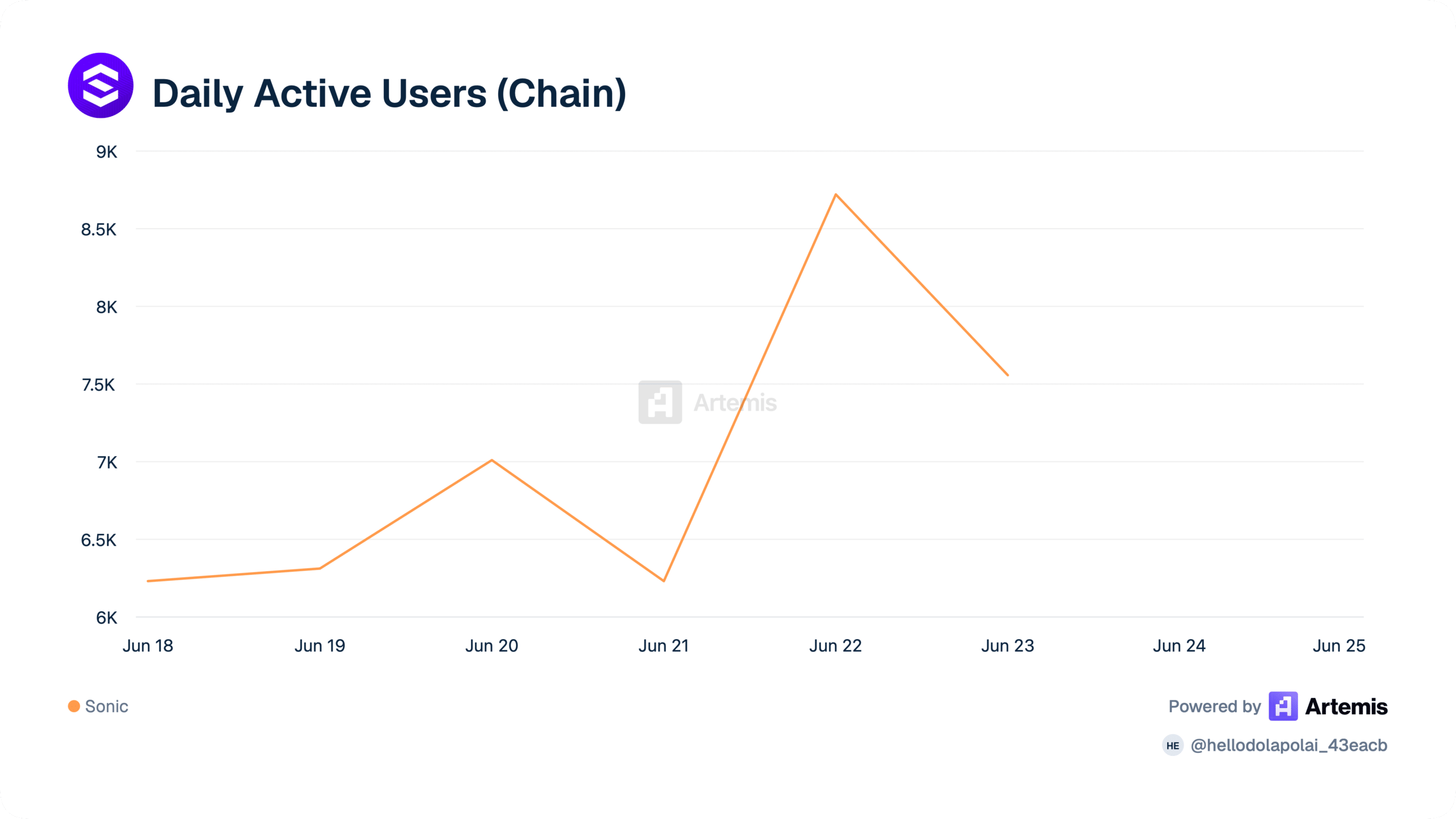
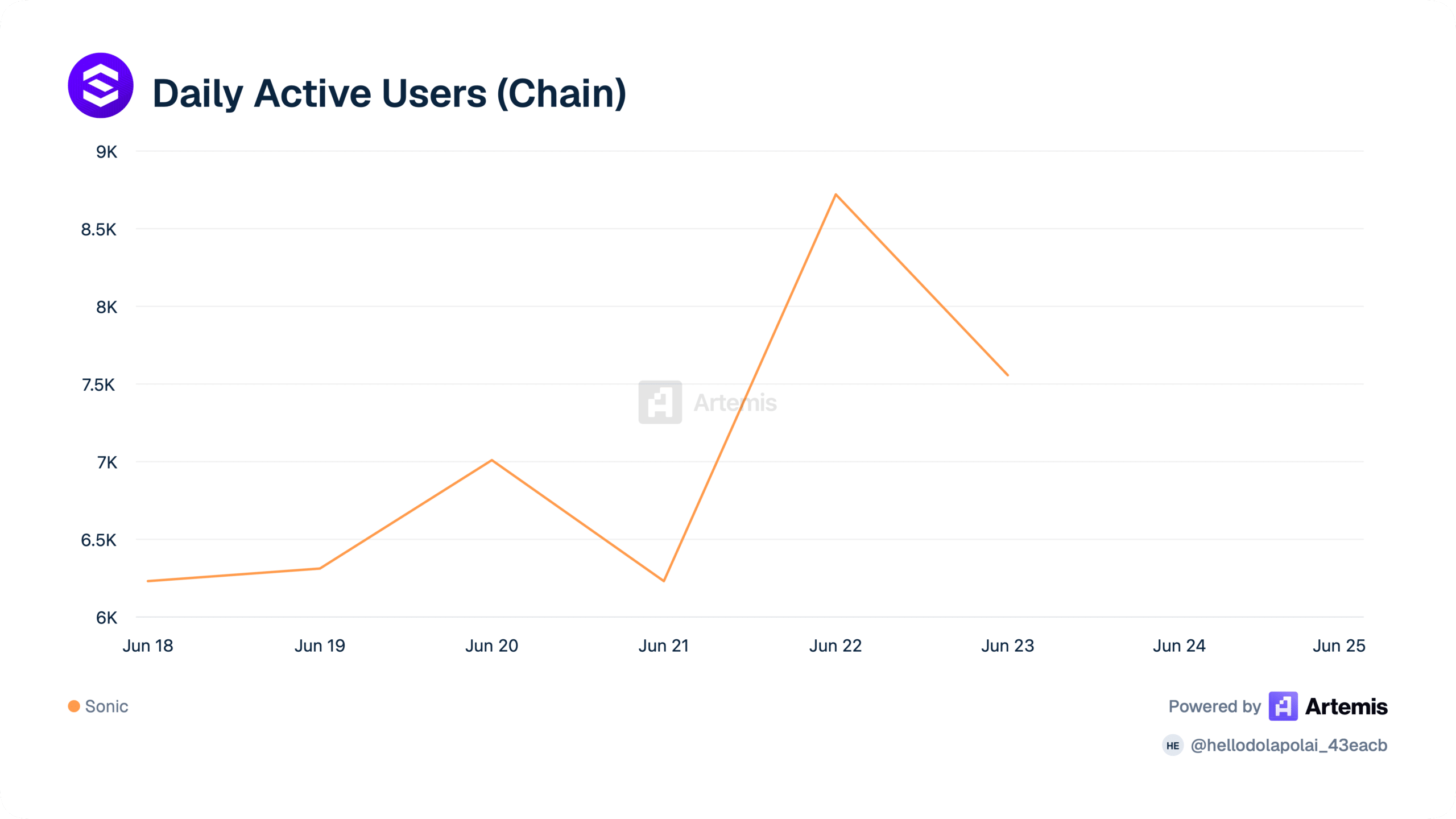
Source: Artemis

This kind of surge rarely happens in isolation and tends to pull broader chain activity higher with it. Sonic has followed that pattern closely with a matching jump in its transaction count.

Artemis data highlighted on-chain transactions at 228,000 too – A figure that underscores how active participants have remained across the network, despite the price weakness.

A build-up like this would normally signal price strength. And yet, the opposite may be playing out since S has dropped by 25% over the past 30 days. In fact, a closer look at the numbers might tie the recent rise in on-chain activity to selling, rather than to fresh demand.

Sonic’s on-chain activity is tracking outflows, not inflows

The uptick in on-chain activity can be correlated with capital leaving the network rather than flowing into it. This finding could reframe what the surge actually represents.

One of the clearest markers of this liquidity drain is total value locked (TVL). It declined over the very same period that users and transactions were climbing.

TVL measures how much capital sits deposited on a blockchain and often serves as a gauge of investor outlook, with inflows pointing to longer-term conviction and a greater willingness to hold, while outflows signal that short-term selling pressure could be building beneath the surface.
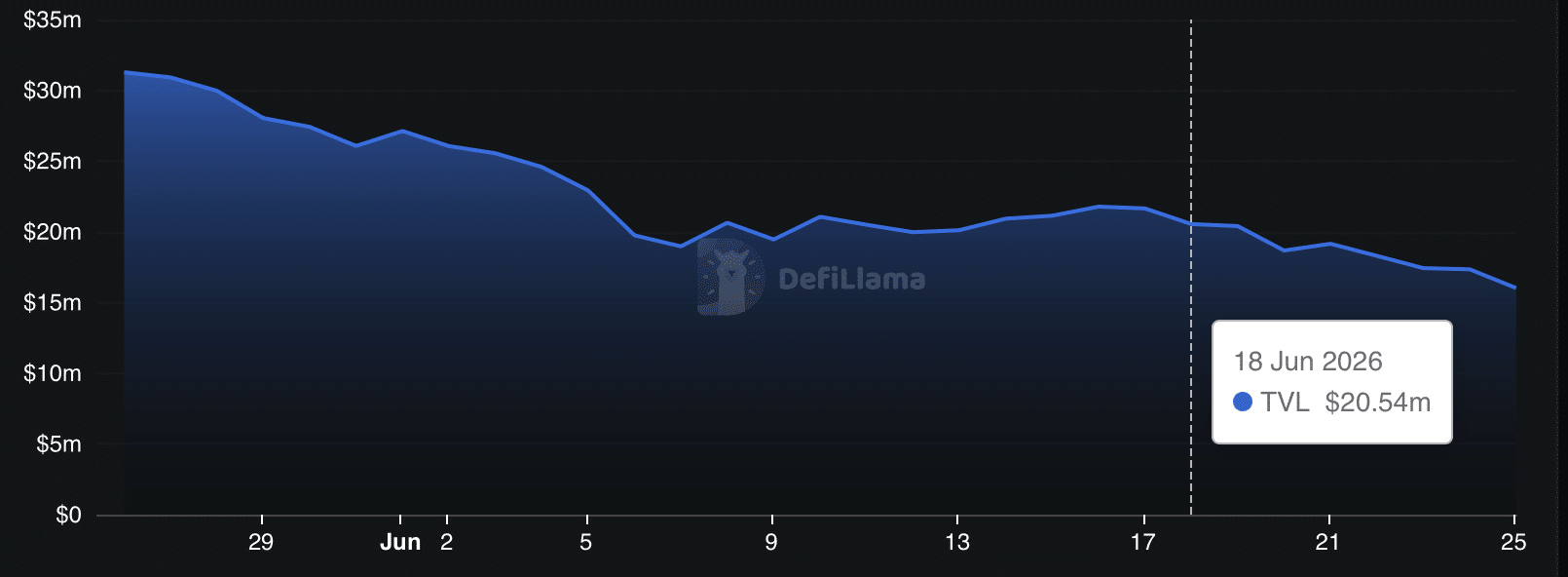
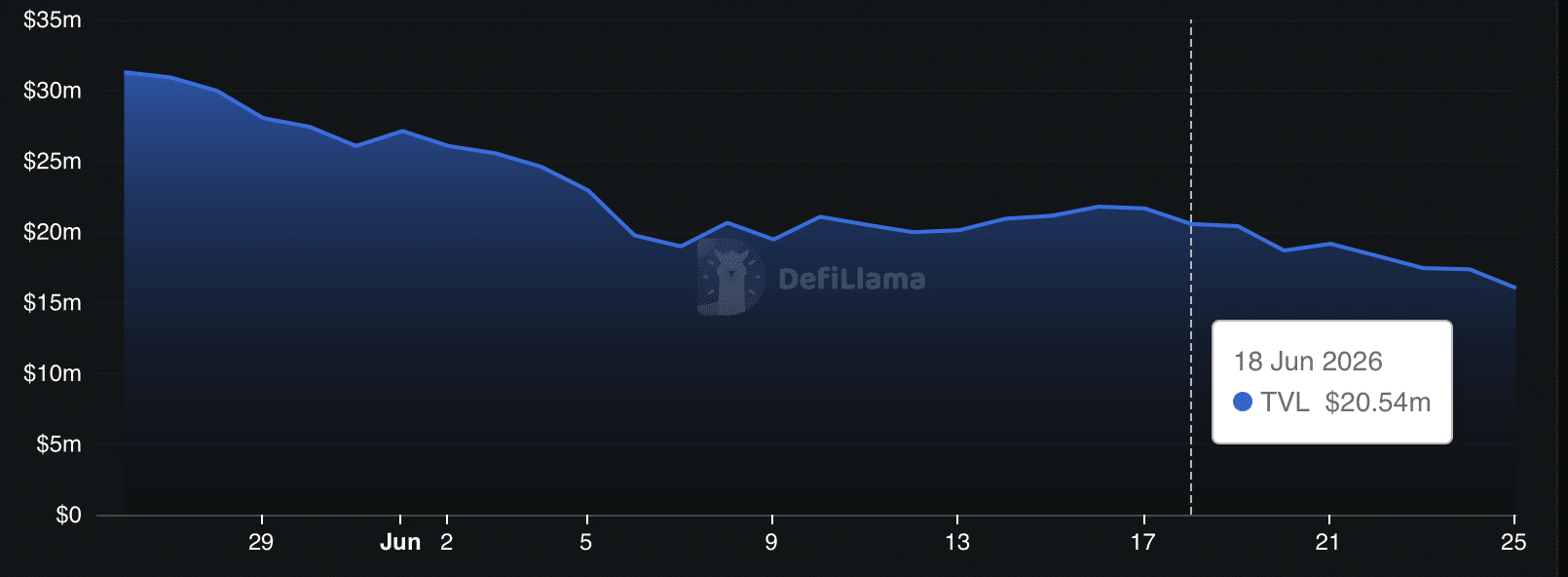
Source: DeFiLlama

At the time of writing, $4.47 million had left Sonic’s TVL, dragging it down to roughly $16.07 million. This, even as decentralized exchange (DEX) volume pushed it in the other direction.

DeFiLlama data also highlighted DEX volume surging to $3.27 million—its second-highest reading of the month and third-highest since March—while Sonic’s own trading volume sat around 51% higher on the day at $26.8 million.

A hike in volume set against a falling price points to selling momentum holding the upper hand. Traders may be ready to keep pressing in that direction for as long as volume stays elevated at press time levels.

Are buyers holding back?

Activity in the spot market, by contrast, has stayed largely muted, with little meaningful buying or selling moving through it.

Spot netflows for the week has nonetheless leaned supportive and could allude to buyers quietly accumulating, carrying a net inflow of roughly $20,000 on total buys of about $231,000 across the week. However, any meaningful rebound from here would demand that buying scale up far more sharply.

For now, buying pressure remains too thin to fuel a sustained upward move in the near term.


Final Summary

  • Sonic’s DAUs rose 23% and transactions topped 228,000, but TVL saw outflows.
  • Positive spot netflow hinted at light accumulation, too thin to absorb the selling, leaving S exposed to more downside.


Trending Cryptos

Related Questions

QAccording to the article, what is the main reason Sonic (S) price dropped 12% and may continue to decline?

AThe price drop and potential for further decline are attributed to on-chain activity surging due to capital outflows (evidenced by a decrease in Total Value Locked) rather than new demand, indicating underlying selling pressure despite increased user numbers and transactions.

QWhat two key on-chain metrics for Sonic showed significant growth recently, and by how much did Daily Active Users increase?

AThe two key metrics were Daily Active Users (DAU) and the volume of chain transactions. Daily Active Users increased by approximately 22.6% week-over-week, climbing from 6,200 to 7,600.

QHow does the article interpret the relationship between Sonic's rising DEX/on-chain volume and its falling price?

AThe article interprets the rise in trading volume (including DEX volume hitting $3.27M) concurrent with a falling price as a signal that selling momentum is dominant, suggesting traders are actively selling rather than buying.

QWhat does the change in Sonic's Total Value Locked (TVL) indicate about investor behavior according to the analysis?

AThe decrease in Total Value Locked (TVL) by $4.47 million to around $16.07 million indicates capital is leaving the network, signaling a build-up of short-term selling pressure and a lack of longer-term holding conviction among investors.

QDoes the article suggest buying pressure is currently strong enough to reverse Sonic's price trend? Why or why not?

ANo, the article suggests buying pressure is not strong enough. While spot netflows showed a slight positive inflow ($20k on ~$231k buys), this accumulation is described as 'too thin to absorb the selling' and insufficient to fuel a sustained upward price move in the near term.

Related Reads

How to Detect AI-Generated Videos? A Review of Dynamic, Traceable, and Explainable Detection Systems

**How to Detect AI-Generated Videos: A Survey on Dynamic, Traceable, and Explainable Detection Systems** With rapid advances in AI video generation (e.g., Sora, Veo), creating highly realistic, multi-minute videos is now possible, widening the gap with detection research. Current AI video detection, often limited to unreliable binary classifications, is insufficient. This survey, accepted at ACL 2026, reframes the goal as **"factual fidelity verification"**—checking if a video's content (who, when, where, what) aligns with the real world perceptually and cognitively. It categorizes AI-generated videos into three paradigms: **Local Manipulation Videos (LMV**, e.g., face swaps), **Audio-Visual Editing (AVE**, e.g., lip-syncing), and **Generative Video Synthesis (GVS**, fully synthetic videos like Sora's). Detection challenges evolve from visual artifacts in LMV to multi-modal inconsistencies in AVE and higher-level world knowledge violations in GVS. The core proposal is a **Vision-Language Dual-View framework** with four hierarchical layers: 1. **Layer 1 (Intrinsic Visual Cues):** Analyzes low-level signal statistics, noise patterns, and physiological signals. 2. **Layer 2 (Spatiotemporal Consistency):** Checks for temporal coherence in object motion and scene dynamics. 3. **Layer 3 (Cross-Modal Consistency):** Verifies alignment between video, audio, and text within the video. 4. **Layer 4 (Language-Guided World-Level Reasoning):** Uses external knowledge, facts, and physical laws to judge semantic plausibility and factual correctness. The survey traces a shift in detection focus from lower layers (1 & 2) toward higher, language-involved layers (3 & 4). It also reviews evolving evaluation metrics and datasets tailored for each video paradigm. The conclusion advocates for a **dynamic, evidence-first detection system** that moves beyond simple classification. Future trustworthy detection requires combining visual evidence (from CV) with semantic reasoning and explanation (from NLP & multimodal AI), ultimately creating traceable and explainable judgments about a video's adherence to real-world constraints.

marsbit10m ago

How to Detect AI-Generated Videos? A Review of Dynamic, Traceable, and Explainable Detection Systems

marsbit10m ago

It Turns Out the First Real-World Application of AI x Crypto is in Security Auditing

The article explores the surprising trend where AI's first major impact on crypto has been in security auditing, not in areas like trading or analytics. It details how AI-powered tools are dramatically lowering the barrier to finding smart contract vulnerabilities, enabling attackers to scan thousands of contracts and execute exploits within minutes. This has rendered traditional, manually-produced audit reports with their month-long validity periods increasingly obsolete, creating a critical "structural crack" in the old security model. Cases like Drift Protocol and KelpDAO show that even extensively audited protocols can be hacked through social engineering, operational flaws, or infrastructure misconfigurations beyond pure code review. Attackers are also using AI to find and exploit vulnerabilities in years-old, deployed contracts. Notably, OpenZeppelin's co-founder has expressed a grim view that "all DeFi is insecure" due to AI's asymmetric advantage. In response, the audit industry is undergoing a fundamental shift. While there's a short-term spike in defensive re-audits, the long-term business model is changing. Firms are developing AI-assisted systems and moving from one-time report deliveries towards embedded, continuous services like real-time monitoring and formal verification. Examples include AI tools uncovering critical, previously missed vulnerabilities in heavily audited protocols like Curve Finance and Zcash. The conclusion is that security must become a continuous investment, not a one-time checkbox, and audit firms must rapidly evolve their tools and service models to survive.

marsbit17m ago

It Turns Out the First Real-World Application of AI x Crypto is in Security Auditing

marsbit17m ago

Never expected that the first tangible application of AI x Crypto is in security auditing

Unexpectedly, the initial major application of AI in the Crypto sphere has turned out to be security auditing. In 2026, DeFi has faced significant security challenges, with 121 hacking incidents resulting in approximately $942 million in losses. While AI was expected to first impact areas like quantitative trading, its initial breakthrough has instead transformed security auditing by drastically lowering the cost and skill barrier for finding smart contract vulnerabilities. The traditional audit model is facing obsolescence. Advanced AI models, such as Claude Mythos, enable attackers to scan thousands of contracts and identify vulnerability patterns at scale, compressing the time from discovery to execution to mere minutes. This renders the month-long validity of traditional audit reports ineffective. Notably, attacks now frequently target well-audited, established protocols by exploiting business logic flaws, operational security weaknesses, and even years-old historical contracts, demonstrating that old audit reports offer zero protection. This pressure is forcing a fundamental shift in the industry. In the short term, a wave of defensive re-auditing is occurring, driven by projects seeking to meet new AI-era security standards and regulatory requirements. In the long run, audit firms' business models are diverging. The one-time report delivery model is declining in value, as evidenced by platforms like Code4rena shutting down. Leading firms are now pivoting towards AI-powered defense, integrating continuous monitoring, real-time on-chain risk detection, and embedding security directly into the development phase, as seen with tools like OpenZeppelin's Skills system. Ultimately, the era of "audit once, secure forever" is over. Security must become a continuous, embedded infrastructure investment for projects. For audit companies, survival depends on proactively transforming from traditional service providers into platforms offering AI-native, ongoing security solutions.

链捕手24m ago

Never expected that the first tangible application of AI x Crypto is in security auditing

链捕手24m ago

Trading

Spot

Hot Articles

Discussions

Welcome to the HTX Community. Here, you can stay informed about the latest platform developments and gain access to professional market insights. Users' opinions on the price of S (S) are presented below.

活动图片