Ether breaks the $1.9K resistance: Is $2.1K the next target for ETH bulls?

cointelegraphPublished on 2026-07-27Last updated on 2026-07-27

Abstract

Ether (ETH) surpassed $1,950 for the first time in seven weeks, gaining 29% from its June low and triggering $62 million in liquidations. This rise mirrored a broader market recovery. However, weak on-chain activity presents a cautionary signal; Ethereum's decentralized applications' weekly revenue hit its lowest since September 2024, and DEX volumes remain muted at $7.2 billion weekly. Despite this, a record 34% of ETH supply is now staked, reducing potential sell pressure. Analysts note that for ETH to reach $2,100, it likely requires stronger external catalysts, such as positive corporate earnings (e.g., from Alphabet) to bolster overall market confidence and overcome the current trader skepticism from the prolonged bear market.

Key takeaways:

  • Despite ETH’s price gains, weak onchain activity and low DEX volumes signal trader caution.
  • Record Ethereum staking at 34% reduces sell pressure, yet sustained upside needs external catalysts.

Ether (ETH) tested the $1,950 mark for the first time in seven weeks on Tuesday, triggering $62 million in liquidations across leveraged bearish positions. The move delivered 29% gains from the $1,500 low on June 26 and aligned with the broader risk-on mood that drove Bitcoin (BTC) above $66,500. Can ETH push through to $2,100?
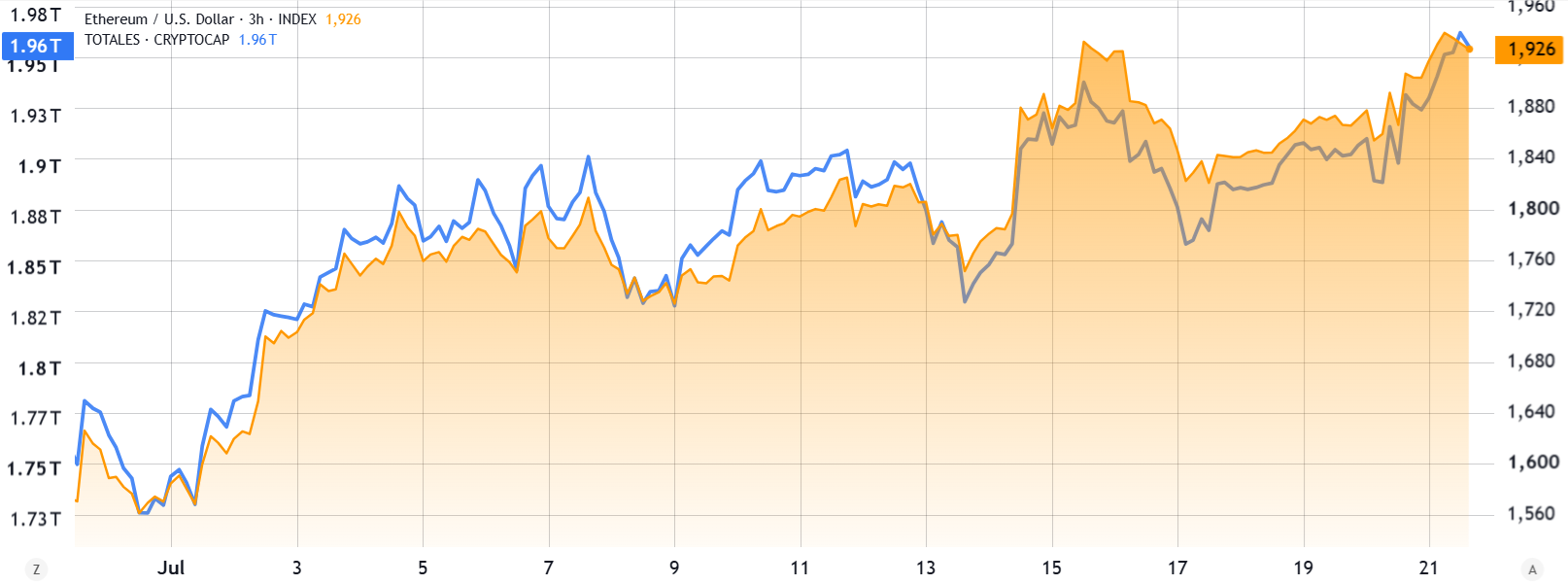
Total crypto market capitalization (left) vs. ETH/USD. Source: TradingView

Ether’s price largely tracked the overall crypto market trend, which shifted to positive momentum in July. Tuesday’s gains in the US stock market helped ease investor worries about stretched valuations after the artificial intelligence stock rally. Traders expect solid corporate earnings after 3M Company (MMM US) reported results Tuesday morning.

Google’s parent, Alphabet, is expected to report quarterly results on Wednesday after US stock markets close. Investors look for 64% growth in cloud services revenue amid heavy AI investments. Strong earnings could restore confidence and help push the cryptocurrency market past the $2 trillion total capitalization mark.

Weak Ethereum onchain metrics and muted ETH derivatives persist

Despite recent ETH price gains, Ethereum onchain metrics show stagnation. Demand for blockchain processing has not recovered to levels seen six months ago, partly because traders are showing less interest in memecoins and utility tokens. Some of Ethereum’s top projects posted losses of 50% or more year-to-date, including Ethena (ENA), Mantle (MNT) and Arbitrum (ARB).
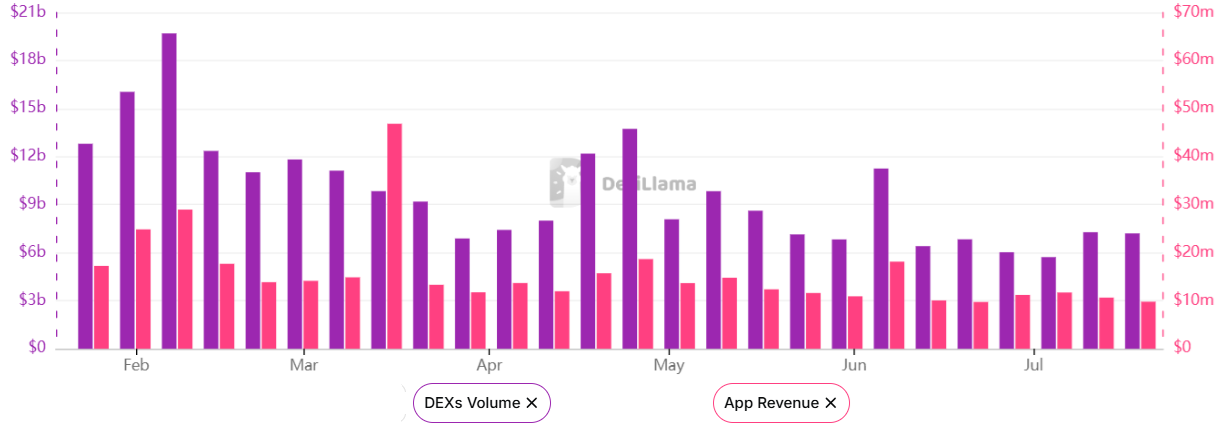
Ethereum network weekly DEX volumes & DApps revenues, USD. Source: DefiLlama

Weekly revenue for Ethereum’s decentralized applications (DApps) fell to the lowest levels since September 2024, hitting $9.8 million. Among the strongest performers are Sky (formerly MakerDAO) at $3.2 million in weekly revenue and Chainlink, which brought in $1.2 million over the same period. Overall, decentralized exchange (DEX) volumes dropped to $7.2 billion per week.

Ethereum’s weak onchain data mirrors the subdued mood in derivatives markets.
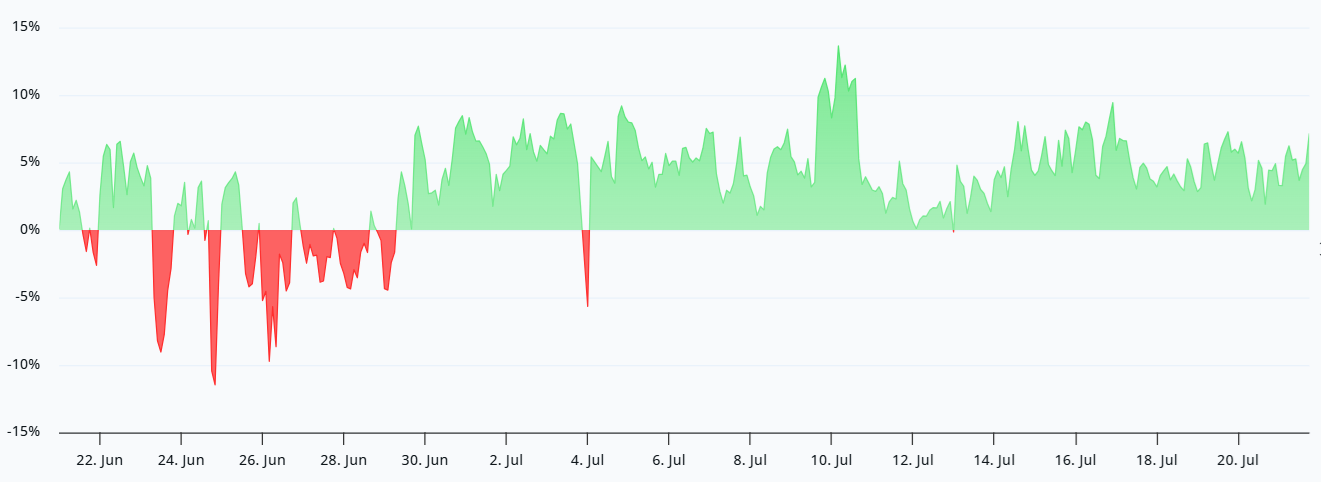
ETH perpetual futures annualized funding rate. Source: Laevitas

The annualized funding rate on ETH perpetual futures has struggled to remain within the neutral 6%-12% range over the past month. Still, sentiment has improved from the negative rates seen in late June, which reflected heavy bearish demand. Rising interest in Ethereum staking has likely boosted trader expectations for price gains and reduced downside risks.
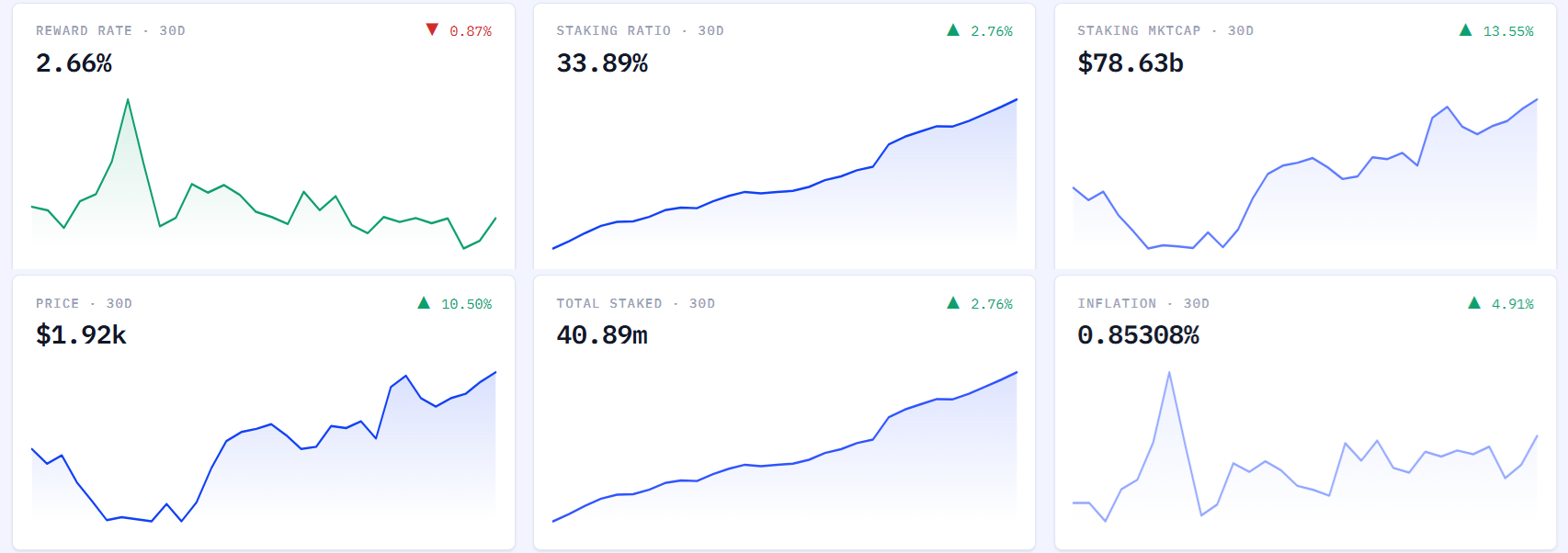
Ethereum staking data. Source: StakingRewards

According to Staking Rewards data, a record-high 34% of all ETH supply is now staked, up from 33% one month earlier. Analysts expect reduced sell pressure as long-term holders keep accumulating supply, including Tom Lee’s Bitmine Immersion (BMNR US), which added 156,719 ETH over the past month. The company now controls 4.8% of available supply.

ETH price is 61% below the all-time high from August 2025, which helps explain why bulls lack enthusiasm in derivatives markets. The soft on-chain metrics and six-month bear market have left traders skeptical about sustained upside.

Ether’s path to $2,100 likely depends on reduced risk aversion across markets, which makes Google’s revenue guidance on Wednesday especially important.



Trending Cryptos

Related Reads

On the First Day of Listing, Changxin Technology's Market Value Exceeds 3 Trillion Yuan, Which Securities Firm Has the Largest Floating Profit?

On July 27th, Changxin Technology, the largest-ever IPO on China's STAR Market, debuted with its share price soaring 465.82% to close at 49 yuan. Its market capitalization reached 3.28 trillion yuan, instantly making it the most valuable A-share company. The stellar performance delivered substantial gains for involved securities firms, primarily through equity investments rather than underwriting fees. China Merchants Securities emerged as the biggest winner. Its direct investment subsidiary, Zhaozheng Investment, alone holds a 0.54% pre-issue stake, translating to a paper profit exceeding 155 billion yuan based on the first-day closing price—surpassing the firm's entire 2025 net profit of 123.5 billion yuan. Other major beneficiaries include Huaan Securities, with an estimated profit of around 123 billion yuan from its 0.44% stake, and the lead underwriters, CICC and CITIC Securities, which each gained approximately 46 billion yuan from mandatory follow-on investments. Firms like Founder Securities, Haitong Securities, and GF Securities also reported significant holdings valued in the billions. Despite these paper gains, shares of some brokerages like Huaan and China Merchants fell on the listing day, reflecting broader market pressures. Analysts remain bullish on Changxin's long-term prospects, citing the AI-driven demand surge for DRAM (Dynamic Random-Access Memory) and a supportive supply-demand dynamic with projected shortages through 2028. As China's largest and most advanced integrated DRAM designer and manufacturer, Changxin is poised to capture growth from domestic substitution and global market shifts, potentially challenging the current "big three" oligopoly (Samsung, SK Hynix, Micron). The IPO proceeds, focused on capacity upgrades and R&D, are expected to accelerate China's semiconductor self-sufficiency.

marsbit21m ago

On the First Day of Listing, Changxin Technology's Market Value Exceeds 3 Trillion Yuan, Which Securities Firm Has the Largest Floating Profit?

marsbit21m ago

Will Changxin Technology Continue to Rise Today?

Changxin Technology made a historic debut on the stock market, with its share price soaring 465.82% to close at 49 yuan. Its market capitalization reached 3.28 trillion yuan, surpassing Industrial and Commercial Bank of China to become the largest company by market cap on the A-share market. Daily trading volume exceeded 140 billion yuan, a first in A-share history. This created a moment of realization for 7.7 million investors who won the lottery for its shares. On the first day, investor strategies varied: some sold immediately and later regretted missing intraday highs, others secured profits to avoid future volatility, while a third group held or even bought more shares, betting on long-term growth. The staggering IPO, massive public enthusiasm, and debut during a peak industry cycle led some to compare Changxin to PetroChina's 2007 listing, which was followed by a long decline. Key similarities noted include comparable fundraising scales (approx. 666 billion yuan for Changxin vs. 668 billion for PetroChina) and both companies listing at a perceived high point in their respective commodity cycles (oil then, memory chips now). However, analysts caution against over-simplifying the comparison. They highlight core differences: Changxin operates in the high-growth semiconductor sector with strong "domestic substitution" tailwinds. Brokerages like Huaxi Securities project significant revenue and profit growth from 2026 to 2028, driven by DDR5 adoption, product mix optimization, and economies of scale. Nomura Securities issued a "buy" rating with a 116 yuan target price, citing AI-driven demand for DRAM, tight supply as major players shift to HBM production, and Changxin's vast room for market share growth. Some analysts position the current memory cycle, fueled by AI, as just beginning, contrasting with the mature energy cycle PetroChina entered. The article concludes that for investors, monitoring the memory cycle's progression and Changxin's breakthroughs in high-end technologies like HBM will be crucial, rather than relying on superficial historical parallels.

marsbit46m ago

Will Changxin Technology Continue to Rise Today?

marsbit46m ago

Claude Designer Lags Behind Engineers, Fires Back by Creating a Million-User Tool

The article tells the story of Nate Parrott, a designer at Anthropic who created Claude Design as a side project to keep pace with his engineering teammates. When Anthropic released Opus 4.5 in November 2025, the two engineers on Parrott's Claude Code team significantly increased their output using the new AI capabilities. Parrott, the sole designer, found himself struggling to match their speed, becoming a bottleneck in the workflow. To catch up, he began experimenting in his spare time. He initially tried prompting Claude to generate designs from text descriptions and screenshots, with limited success. His breakthrough came when he shifted focus from asking Claude to "design" to asking it to generate HTML. He realized HTML could be a rich visual canvas for creating everything from slides and interactive prototypes to full web pages. He built a simple interface with a chat panel on the left and a live HTML preview on the right. The key to making the output useful was incorporating Anthropic's brand system—fonts, colors, assets, and design principles—into the prompts. This ensured generated designs were immediately on-brand. He shared an internal prototype with his team, and other product designers quickly adopted it for creating clickable prototypes, a task traditionally requiring manually drawing every state. The project's "official" turning point came during an Anthropic Labs offsite, where Parrott noticed many attendees were using his tool to build presentation slides on the fly, sometimes right before their turn to speak. This organic adoption convinced the Labs team to formally staff the project, turning the side project into a real product. Claude Design is positioned as a "pre-production" tool for visual communication and exploration—handling slides, landing pages, PDFs, emails, and social media graphics. It integrates with tools like Canva, Adobe, and Vercel. Its core value is accelerating the early stages of design: exploring directions, building consensus, and establishing systems. For actual production code, Anthropic still recommends Claude Code. The story highlights how AI disrupts workflows unevenly and how individuals can respond by building new tools to create their own advantages. Parrott's tool, born from necessity, eventually gained over a million users in its first week.

marsbit57m ago

Claude Designer Lags Behind Engineers, Fires Back by Creating a Million-User Tool

marsbit57m ago

Fields Medalist Warns: AI Could Kill Mathematics

The 2026 Fields Medal award was followed by a startling announcement: laureate Jacob Tsimerman joined OpenAI to pursue AI safety research, predicting AI would surpass humans in all mathematical proof areas within two years. Soon after, Fields Medalists Terence Tao and Timothy Gowers expressed deep concern at ICM 2026. Gorges warned that AI might "kill" mathematics not through stagnation, but through an overwhelming surplus of proofs, likening it to a lake dying from eutrophication. This concern is echoed in the "Leiden Declaration," signed by over 3,000 mathematicians including Tao, Peter Scholze, and Kevin Buzzard, advocating for mathematics as a profoundly human endeavor. However, Gowers, who did not sign, fears a future where AI-generated mathematics proliferates while human expertise and the shared intuition vital to the field vanish, turning math into an unvisited "cemetery of thought." Gowers' perspective shifted dramatically after testing ChatGPT 5.5 Pro. The AI solved a doctoral-level number theory problem and later produced a counterexample for the "unit distance problem," achievements Gorges considered publishable in top journals. He now concedes that large language models can handle advanced research, a realization that left him feeling the "rug pulled out from under" him when AI solved problems he personally contemplated. The debate extends to the nature of mathematical discovery. As noted by Peter Woit, AI agents have no interest in the "credit game" of academia. If theorems cease to be attributed to individual mathematicians, truth may simply return to its impersonal state in the universe. The central question remains: in an age of potentially limitless AI-generated discovery, what is the role and purpose of the human mind in mathematics?

marsbit1h ago

Fields Medalist Warns: AI Could Kill Mathematics

marsbit1h ago

NVIDIA's 20-Year CUDA Moat Collapsed Over a Weekend, Claude Single-Handedly Got AMD's New GPU Running

In a single weekend, Claude, an AI agent from Anthropic, successfully ported and optimized its cutting-edge model to run on a brand-new AMD MI355X server rack without any manual code intervention. This feat demonstrates a potential breakthrough in overcoming NVIDIA's long-established CUDA software ecosystem dominance, built over two decades. Anthropic's team simply instructed Claude to get the AMD machine running. By Monday, it not only worked but was showing a continuously improving performance curve. The achievement impressed AMD CEO Lisa Su and accelerated a major deployment partnership: Anthropic plans to deploy up to 2GW of AMD Instinct GPUs starting in 2027. The key enabler is AMD's new ROCm.AI platform, a toolbox designed specifically for AI agents like Claude. It provides AI-readable documentation, including chip instruction sets (ISA), and tools like the Hyperloom service that allows agents to autonomously profile performance, identify bottlenecks, test configurations, and generate optimized kernels. In a demo, Hyperloom boosted the output speed of a model by 38%. This represents a fundamental shift. While CUDA's strength lies in its vast, human-expert-driven ecosystem of tools and tacit knowledge, AMD's strategy is to make its hardware and software stack directly accessible and optimizable by AI agents. An agent can parallelize tasks—debugging, profiling, coding—that would take human engineers years to master, compressing the traditional software adaptation timeline from years to tasks. The competition is no longer just about peak hardware specs but also about how well AI can read, utilize, and tune a platform.

marsbit1h ago

NVIDIA's 20-Year CUDA Moat Collapsed Over a Weekend, Claude Single-Handedly Got AMD's New GPU Running

marsbit1h ago

Trading

Spot

Hot Articles

Discussions

Welcome to the HTX Community. Here, you can stay informed about the latest platform developments and gain access to professional market insights. Users' opinions on the price of ETH (ETH) are presented below.

活动图片