A 'Overlooked' Market Event: Joint US-Japan-South Korea Intervention, Rare US Treasury Involvement, and Bessent's Quiet 'Market Rescue'?

marsbitPublished on 2026-08-03Last updated on 2026-08-03

Abstract

Summary: The United States, Japan, and South Korea executed their largest coordinated foreign exchange intervention in nearly 30 years. The action targeted depreciation pressure on the Japanese yen and South Korean won. This move is seen as a significant effort by the US to stabilize the financial markets of its key allies and prevent the spillover of risks. Key details: * Japan reportedly intervened on July 30 using approximately 8.45 trillion yen (about $52.8 billion). South Korean authorities also intervened that day, selling dollars to support the won. * Notably, the US Treasury Department intervened directly in yen markets for the first time in roughly 30 years. The New York Fed, reportedly acting on behalf of the Treasury, sold euros to buy yen via Goldman Sachs and Morgan Stanley on July 31. Analysts view the use of the euro-yen pair as a way to alleviate yen pressure without adding selling pressure to the US dollar. * Prior to the action, the New York Fed conducted "rate checks" on both USD/JPY and EUR/JPY, a newer signaling tool that falls between verbal and physical intervention. The intervention is interpreted as going beyond traditional currency stabilization. Analysts, such as Michael Hartnett of Bank of America, suggest it resembles a "Price Keeping Operation" for the AI era. The core US objectives are perceived to be: 1. Preventing rapid yen depreciation from triggering a sharp rise in Japanese government bond yields. 2. Containing financial stress f...

Original Author: Li Jia

Original Source: Wall Street News Agency

This week, the United States, Japan, and South Korea jointly conducted the largest coordinated foreign exchange intervention in nearly three decades. This action not only targeted the depreciation pressures on the Japanese yen and the South Korean won but was also seen as an important US measure to stabilize the financial markets of its Japanese and South Korean allies and prevent risk spillover.

This action covered two major Asian currencies, the yen and the won. Both Japanese and South Korean foreign exchange authorities supported their currencies by selling US dollars; the US intervened in the yen exchange rate through non-dollar channels, selling euros and buying yen to ease yen depreciation pressure and avoid putting pressure on the dollar.

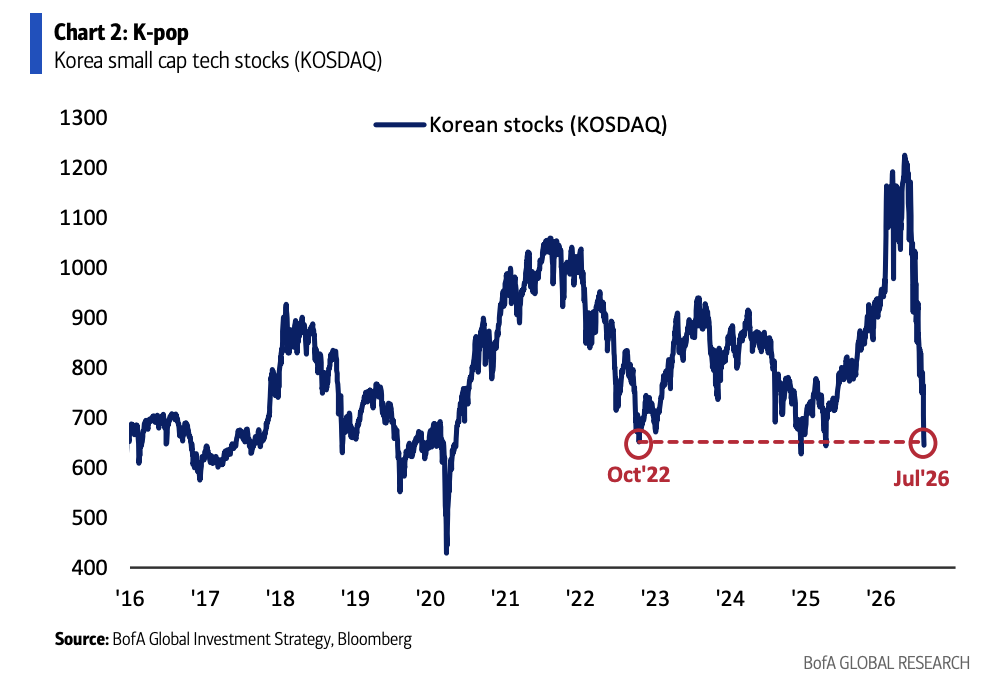
Currently, Japanese and South Korean markets remain under pressure: the South Korean KOSDAQ index fell to its lowest point since October 2022, with significant adjustments in the technology sector; the exchange rates of the Japanese yen and the South Korean won against the US dollar also weakened consecutively, raising market concerns that further depreciation could trigger chain reactions in Asian assets.

Unlike past interventions aimed solely at stabilizing exchange rates, this coordinated action was viewed by the market as a "market rescue" operation targeting Japanese and South Korean financial markets. Amid persistent pressure on Japanese and South Korean stock markets and significant adjustments in the technology sector, the United States hopes to boost market confidence and prevent further risk transmission by stabilizing exchange rate expectations.

Both Japan and South Korea are key participants in the US semiconductor and AI supply chains. Stabilizing their asset markets helps reduce the possibility of financial risks spreading to the technology industrial chain and the US market.

US, Japan, South Korea Rarely Coordinate to Intervene in FX Market; Yen, Won Surge

According to the UK's Financial Times, on July 31st, the US Treasury, via the New York Federal Reserve, commissioned Goldman Sachs and Morgan Stanley to sell euros and buy yen, marking the first direct US participation in yen intervention in nearly 30 years.

Previously, it was reported that Japanese authorities had used approximately 8.45 trillion yen (about $52.8 billion) to intervene in the FX market on July 30th alone. Additionally, according to Reuters, South Korean foreign exchange authorities also made a rare move into the market to sell US dollars on the same day, pushing the won up 2% in a single day to a nine-month high.

Driven by the tripartite joint effort, the USD/JPY pair quickly fell from above 162 to the 157-159 range, with the yen clearly moving away from its 40-year lows. South Korea's Vice Finance Minister Moon Ji-sung stated that South Korea is maintaining close coordination with the US and Japan; Japan's Vice Minister of Finance for International Affairs, Atsushi Mimura, also noted that US support had gone "beyond mere moral support."

US First Directly Participates in Yen Intervention, Sending Policy Signal

The US Treasury's direct intervention in the yen exchange rate is the market's most noted change. Unlike the past, which relied mainly on verbal warnings, the US has this time, unusually, participated in yen intervention through actual transactions.

According to the Financial Times citing informed sources, the New York Fed implemented the intervention through Goldman Sachs and Morgan Stanley selling euros and buying yen. Before the action, the US Treasury had signaled to several Wall Street institutions about a possible intervention and maintained communication with the European Central Bank.

Formal market entry was preceded by the New York Fed releasing policy signals for two consecutive days. On Thursday, the New York Fed conducted a "rate check" on USD/JPY, i.e., asking dealers for current tradable exchange rates without immediately executing trades; on Friday, it shifted to a "rate check" on EUR/JPY. The market widely regarded this operation as a precursor to formal intervention.
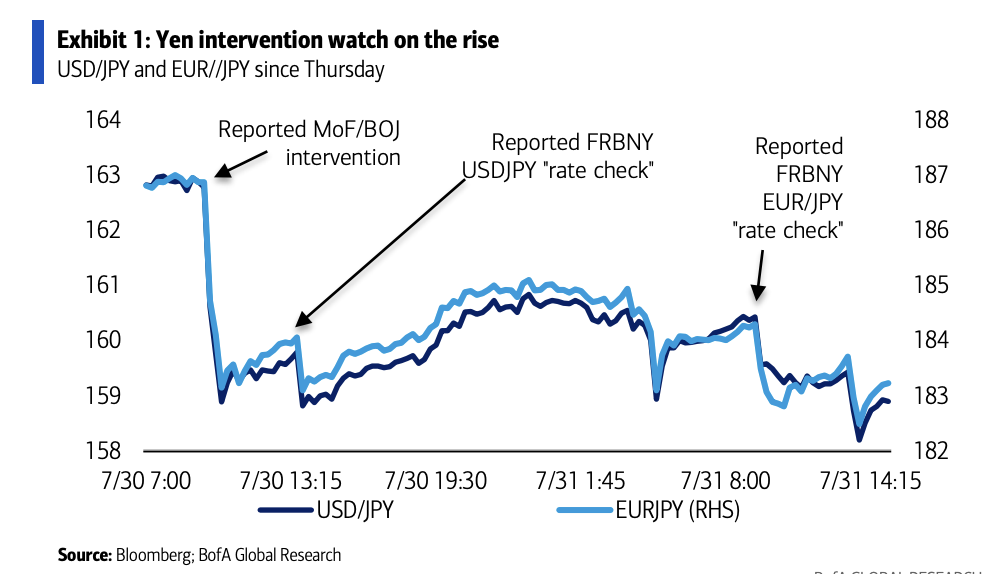
New York Fed's "Rate Check" Operation Explores New FX Intervention Method

Alex Cohen, a forex strategist at Bank of America Securities, stated in a report that the "rate check" falls between verbal intervention and actual intervention. It is a new tool the US Treasury began using this year to signal policy to the market without actually deploying funds. However, he also cautioned that without follow-up actual actions for support, the market may still test the authorities' policy credibility again.

Notably, the New York Fed partially chose the EUR/JPY pair for operation this time, not USD/JPY. Analysis suggests that this shows the US may hope to exert influence through non-dollar currency channels, easing yen depreciation pressure while avoiding putting additional pressure on the US dollar.

On the Japanese side, they had already intervened in the FX market on a large scale earlier. According to official data and market estimates, Japanese authorities used about 8.45 trillion yen (approximately $52.8 billion) on July 30th to support the yen, marking another large-scale intervention following the cumulative injection of about 11.7 trillion yen from April to May this year.

US Goal Not Solely to Stabilize Exchange Rate, But to Maintain Asset Stability of AI Allies

The significance of the US intervention this time may go beyond traditional FX intervention.

Bank of America strategist Michael Hartnett stated in his latest report that this US-Japan-South Korea coordination resembles an "AI-era Price Keeping Operation (PKO)," with the core objective of preventing assets of AI industrial chain allies like Japan and South Korea from remaining under persistent pressure.

Hartnett believes that the US hopes to mitigate three types of risks: First, preventing rapid yen depreciation from driving sharp increases in Japanese government bond yields; Second, avoiding the spread of financial stress to Asian markets like South Korea and Japan; Third, reducing the impact of disorderly capital flows on the US bond market.

Recently, pressure in the South Korean market has clearly increased. The KOSDAQ index fell to its lowest point since October 2022, and shares of major South Korean securities firms have also been adjusting continuously.

Meanwhile, the AI investment boom has not shown clear signs of cooling down. Bank of America data shows that semiconductor ETFs have attracted approximately $53 billion in net inflows this year. Although the Philadelphia Semiconductor Index (SOX) recently retreated, investors continue to bet on the long-term growth of the AI industrial chain.

Hartnett believes that the coordinated intervention coinciding with market adjustments may indicate that previous highly leveraged trading is coming to an end. However, current policies are more about controlling market volatility rather than changing the trend through liquidity policies.
Trending Cryptos

Related Questions

QAccording to the article, what is a key difference between this coordinated intervention by the US, Japan, and South Korea and past actions?

AUnlike past actions focused solely on currency stabilization, this intervention is perceived as a broader 'market rescue' operation. It aims to stabilize Japanese and South Korean financial markets, boost confidence, and prevent risk spillover, particularly to safeguard critical AI and semiconductor supply chain partners.

QHow did the U.S. Treasury Department directly intervene in the yen market, and why was this method considered significant?

AThe U.S. Treasury, through the New York Fed, directed Goldman Sachs and Morgan Stanley to sell euros and buy yen. This was significant because it was the first direct U.S. participation in yen intervention in nearly 30 years, moving beyond verbal warnings to actual market transactions.

QWhat new policy tool did the New York Federal Reserve use prior to the intervention, and what was its purpose?

AThe New York Fed conducted 'rate checks' on USD/JPY and then EUR/JPY exchange rates. This tool, described as intermediate between verbal and actual intervention, is used to signal policy intent to the market without committing funds, serving as a precursor to potential formal action.

QWhat major risk does the article suggest the U.S. is trying to mitigate by stabilizing Japanese and South Korean assets?

AThe article suggests the U.S. aims to mitigate the risk of financial stress in Japan and South Korea spilling over to their AI and semiconductor supply chains, which are crucial to the U.S., and to prevent disorderly capital flows from impacting the U.S. bond market.

QHow much did the Japanese authorities reportedly spend to support the yen on July 30, and how does this compare to their previous interventions?

AJapanese authorities reportedly spent approximately 8.45 trillion yen (about $52.8 billion) on July 30. This follows a cumulative intervention of about 11.7 trillion yen between April and May of the same year, indicating another large-scale operation.

Related Reads

Rubin Ultra Makes Major Cuts, Even Nvidia Can't Handle Memory Price Hikes?

NVIDIA's Rubin Ultra, the top-tier variant of the newly announced Rubin AI accelerators, has reportedly seen significant specification downgrades, according to an industry report from SemiAnalysis. Initially designed with four compute dies (4-die), the Rubin Ultra is now said to be reduced to a 2-die design. Key changes highlighted in the report include: * **No increase in peak theoretical compute performance**, remaining at 35 PFLOPs like the standard Rubin. * **Severe reduction in memory capacity** to 192GB using 8-Hi HBM stacks, which is less than the standard Rubin's 288GB using 12-Hi stacks. * **Negligible memory bandwidth improvement** of only 1 TB/s. * **Slightly higher chip-level power consumption**. * The **primary upgrade is a massive increase in scale-up interconnect capacity**, supporting connections for up to 576 GPUs via NVLink, compared to 72 for the standard Rubin. The report suggests the redesign is primarily a cost-optimization move driven by the sharp rise in HBM (High-Bandwidth Memory) prices. By reducing the expensive HBM content and shifting investment towards enhanced system-scale networking, NVIDIA aims to maintain the platform's value for large-scale AI training clusters while managing soaring material costs. The news reportedly triggered a sell-off in South Korean memory stocks, with SK Hynix and Samsung shares falling around 8%, as markets grew concerned that NVIDIA—a major HBM buyer—might be reducing its reliance on high-capacity memory, potentially capping future pricing power for memory makers.

Odaily星球日报7m ago

Rubin Ultra Makes Major Cuts, Even Nvidia Can't Handle Memory Price Hikes?

Odaily星球日报7m ago

Can Generative Models Finally Be Trained End-to-End? The Core Is a For Loop

This article introduces a novel training paradigm for generative models called Explorative Modeling (XM), which enables true end-to-end training. Traditionally, powerful generative models like autoregressive and diffusion models are not trained end-to-end. They are trained to predict a single small step but require iterative multi-step sampling for inference. This "exposure bias" leads to error accumulation and limits performance. The core challenge XM addresses is "mode blurring." In generative tasks, a single input (e.g., "generate a dog") corresponds to many valid outputs (multiple modes). Standard training objectives like reconstruction loss force the model to average these modes, producing unrealistic, blurry outputs. To avoid this, existing models break generation into many small, almost deterministic steps, sacrificing end-to-end training. XM tackles this by restructuring the training loop itself. Its key insight is to amplify "generative expressivity." For each training input, instead of generating one sample, the model generates K candidate outputs. Only the candidate closest to the real data is used for computing the loss and updating the model via backpropagation. This simple "best-of-K" mechanism is implemented as a short for-loop. By exploring multiple possibilities, the model learns to distribute its guesses across different modes rather than collapsing to their uninformative average. The paper demonstrates that "exploration" acts as a new, powerful scaling axis. Gains from XM increase with model size, data scale, and compute. Experiments show improvements in FID scores for image generation and significant efficiency gains, sometimes outperforming larger models without exploration. When pushed to the limit, XM enables fully single-step, end-to-end generative models. In robotics tasks, an "Explorative Policy" matched the performance of a 100-step Diffusion Policy with a single forward pass, drastically improving inference speed. While the best-of-K concept is not entirely new, the authors' contribution lies in formally understanding it as a direct method to boost generative expressivity without fragmenting the generation process. This work suggests that as models scale, enhancing exploration during training may become crucial for overcoming fundamental performance bottlenecks.

marsbit1h ago

Can Generative Models Finally Be Trained End-to-End? The Core Is a For Loop

marsbit1h ago

Trading

Spot

Hot Articles

Discussions

Welcome to the HTX Community. Here, you can stay informed about the latest platform developments and gain access to professional market insights. Users' opinions on the price of S (S) are presented below.

活动图片