Author: Rita
Tide Research Introduction
Morgan Stanley analyst Joseph Moore updated his research report on Marvell Technology (MRVL) on May 28. Marvell had just delivered a record-setting quarterly report, and management significantly raised its full-year outlook, with Wall Street nearly unanimously bullish. Moore was among the few who didn't follow suit, maintaining an Equal-Weight (Neutral) rating while raising the price target from $172 to $195 – both adjustments were below the stock price at the time. He believes the AI opportunity is real, but the current price already reflects it. Those holding MRVL or looking for targets in the AI chip and optical interconnect chain should listen to the contrarian logic. We've provided an edited summary and analysis.
Three Key Takeaways
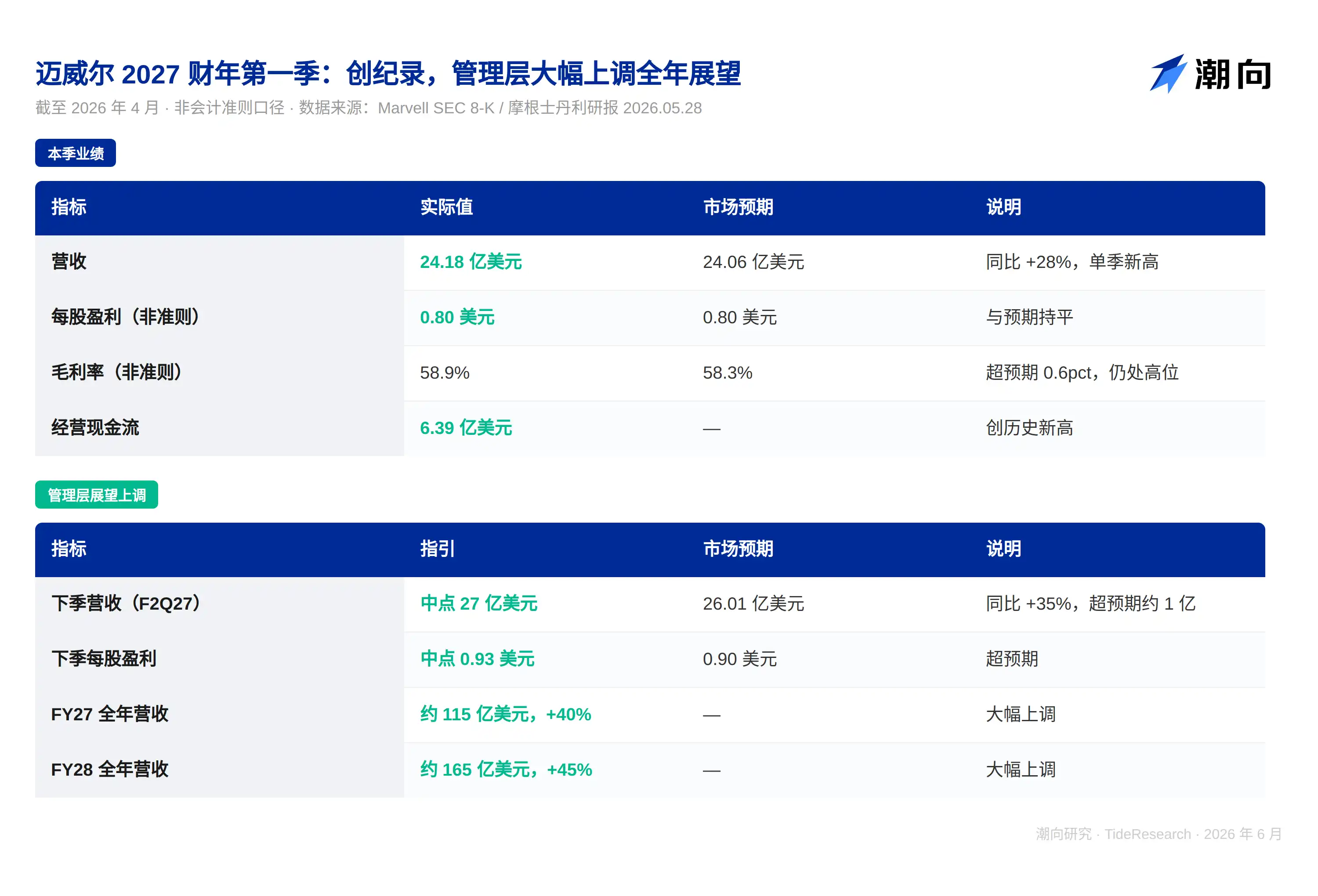
1 Record quarterly results, management significantly raises full-year outlook. For the quarter ended April 2026 (Marvell's FY27 Q1), revenue was $2.418 billion, up about 28% year-over-year, slightly exceeding market expectations of $2.406 billion. EPS was $0.80, in line with expectations. More crucial is the forward view: management raised its FY27 full-year revenue outlook to approximately $11.5 billion, representing about 40% growth, and further raised FY28 expectations to around $16.5 billion, about 45% growth. The next quarter's revenue guidance midpoint is $2.7 billion, up 35% YoY, exceeding market expectations by about $100 million.
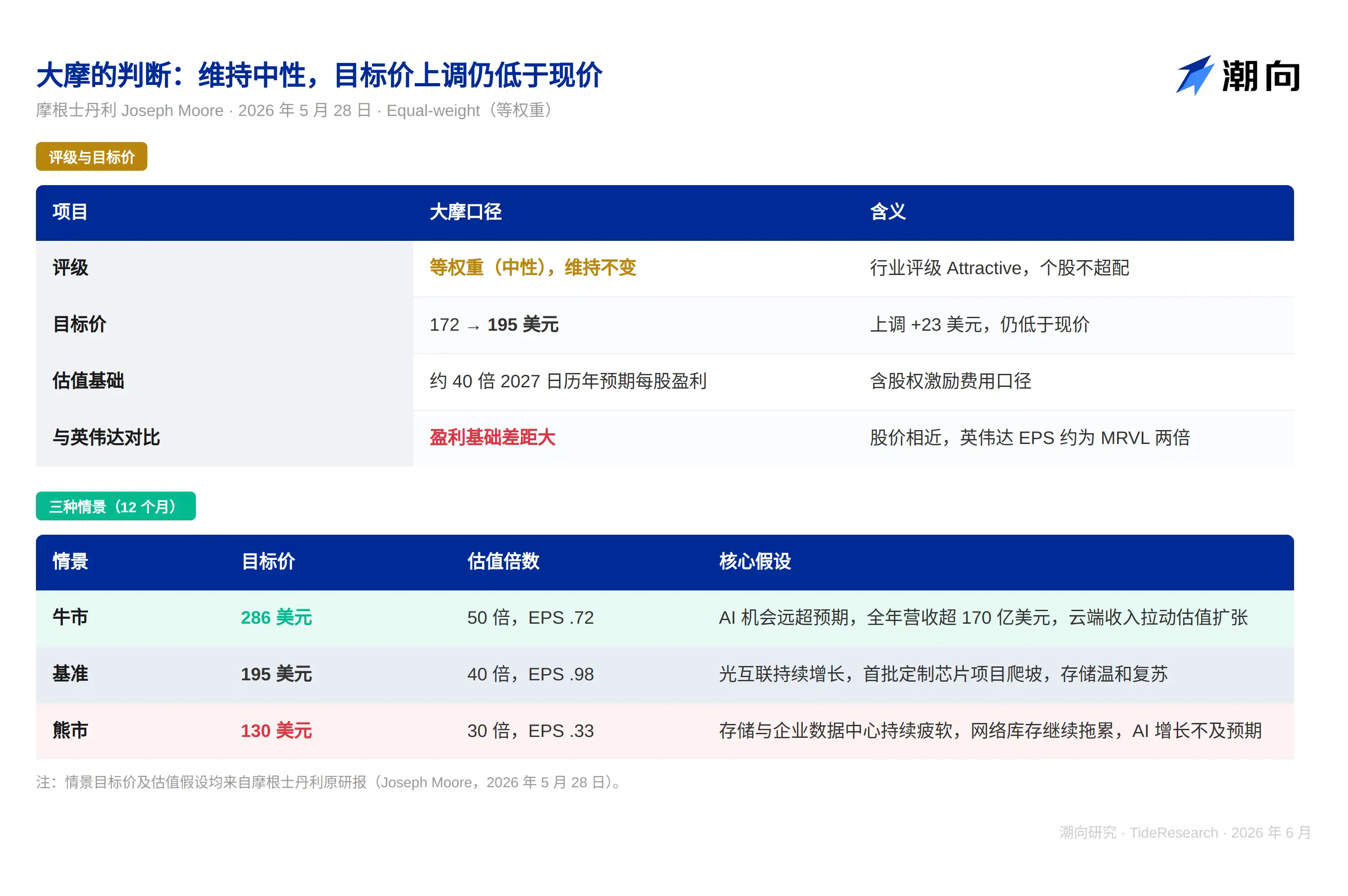
2 Moore assigns Neutral because the stock price already prices in the growth. The $195 price target corresponds to approximately 40x the calendar year 2027 estimated EPS (including stock-based compensation). Moore compared Marvell to his top pick, Nvidia: their stock prices are similar (~$198 vs. ~$212), but Nvidia's next fiscal year EPS is about $13, more than double Marvell's ~$6. Moore believes for Marvell to hold at this price level, it needs to consistently show earnings revisions upward, evidence of gaining network share, or certainty of large-scale custom chip shipments – none of which are concrete yet.
3 AI growth has two legs, one running, one climbing. The fast runner is optical interconnect. Moore raised his FY27 growth expectation for this segment from about 50% to over 70%, with the optical module product line expected to reach an annualized revenue run rate of $1 billion in the coming quarters. Still climbing the ramp is custom AI chips (ASICs designed specifically for cloud providers). Moore's confidence in FY28 is increasing, but a major new customer won't enter volume production until FY28, so this revenue stream isn't yet visible.
The Logic of Equal-Weight: The Opportunity is Real, The Price is Too
Moore does not question Marvell's AI opportunity; he raised estimates for all three major growth drivers. The problem is the stock price has already run ahead.
Behind the 40x P/E multiple lie several assumptions that must simultaneously materialize: continued optical interconnect volume growth, custom chips transitioning from ramp-up to large-scale shipments, and stabilization/recovery in the storage and enterprise businesses. If any of these three falters, this valuation multiple becomes difficult to sustain.
Moore specifically compared Marvell to Nvidia in his report. With similar stock prices, Nvidia's next-fiscal-year EPS is more than double Marvell's, meaning the earnings base bought for the same money is vastly different. This is one of the core reasons for his Neutral rating.
What Part of the AI Chain Does Marvell Occupy?
Marvell doesn't make GPUs. It handles moving data *between* GPUs and between racks. The larger the AI training cluster, the more data needs to be transferred between chips, and the tighter the demand for high-speed optical interconnect. This is currently Marvell's strongest segment, and Moore has the highest visibility here – the optical module product line (from the Inphi acquisition) is expected to reach a $1 billion annualized run rate in the coming quarters. Another growth point is scale-up optics within clusters, growing from about $150 million to over $300 million.
Custom chips represent another logic. Cloud providers wanting to reduce reliance on a single GPU supplier engage Marvell to design their own AI-specific chips. Moore's confidence in FY28 is increasing, stemming from three areas: the existing custom chip business, companion sales, and a major new customer slated for volume production in FY28. However, volume production is next year, so this revenue is not yet visible this year.
Weighing on the other side are Storage, Enterprise Data Center, and traditional networking, which are still working through inventory digestion with no clear near-term catalyst for recovery.
What Morgan Stanley is Betting On, Not Betting On, and Watching
It is betting that Marvell's optical interconnect thesis holds and AI data center demand continues, reflected in the price target increase and long-term outlook revisions. It is *not* betting that the current stock price has significant upside, hence Moore's choice of Neutral over Overweight.
Key signals to watch are threefold: whether the optical module product line can reach the $1 billion annualized revenue run rate as expected in the coming quarters; whether the new major customer's custom chip project can ramp to volume production smoothly in FY28; and when signs of recovery appear in the Storage and Enterprise businesses. If any of these three underperforms expectations, the 40x valuation needs to be recalculated.

This article is Tide Research's compilation and interpretation of a third-party brokerage research report. The ratings, price targets, earnings forecasts, and related judgments cited herein are the views of the respective analyst and represent only the stance of their affiliated institution. They do not represent the views of Tide Research and do not constitute any investment advice.
Please note three points while reading: First, price targets are analysts' expectations for approximately the next 12 months; they are forecasts, not promises, and are subject to frequent adjustments based on performance and market conditions. Second, sell-side research reports are inherently biased towards bullishness, and some covered companies may have investment banking relationships with the brokerage. Third, the value of a research report lies in its core logic and underlying assumptions, not in a single price target. Focus on the logic, not just the price.
The market involves risks; decisions should be made independently. This article should not be used as the basis for trading any securities.
Data Sources: Marvell FY27 Q1 Earnings Report (SEC 8-K) · Morgan Stanley Research Report (Joseph Moore, May 28, 2026) · Public Analyst Rating Aggregators (MarketBeat, GuruFocus, Benzinga)
Tide Research · TideResearch · June 2026