Carbon-based speed once again suffers a dimensional strike from silicon-based intelligence!
To avert a cyber apocalypse, OpenAI is expanding the "Daybreak" program.
OpenAI has launched GPT-5.6-Cyber, a security-specific model dedicated to handling information security tasks, completely revolutionizing the cybersecurity paradigm.
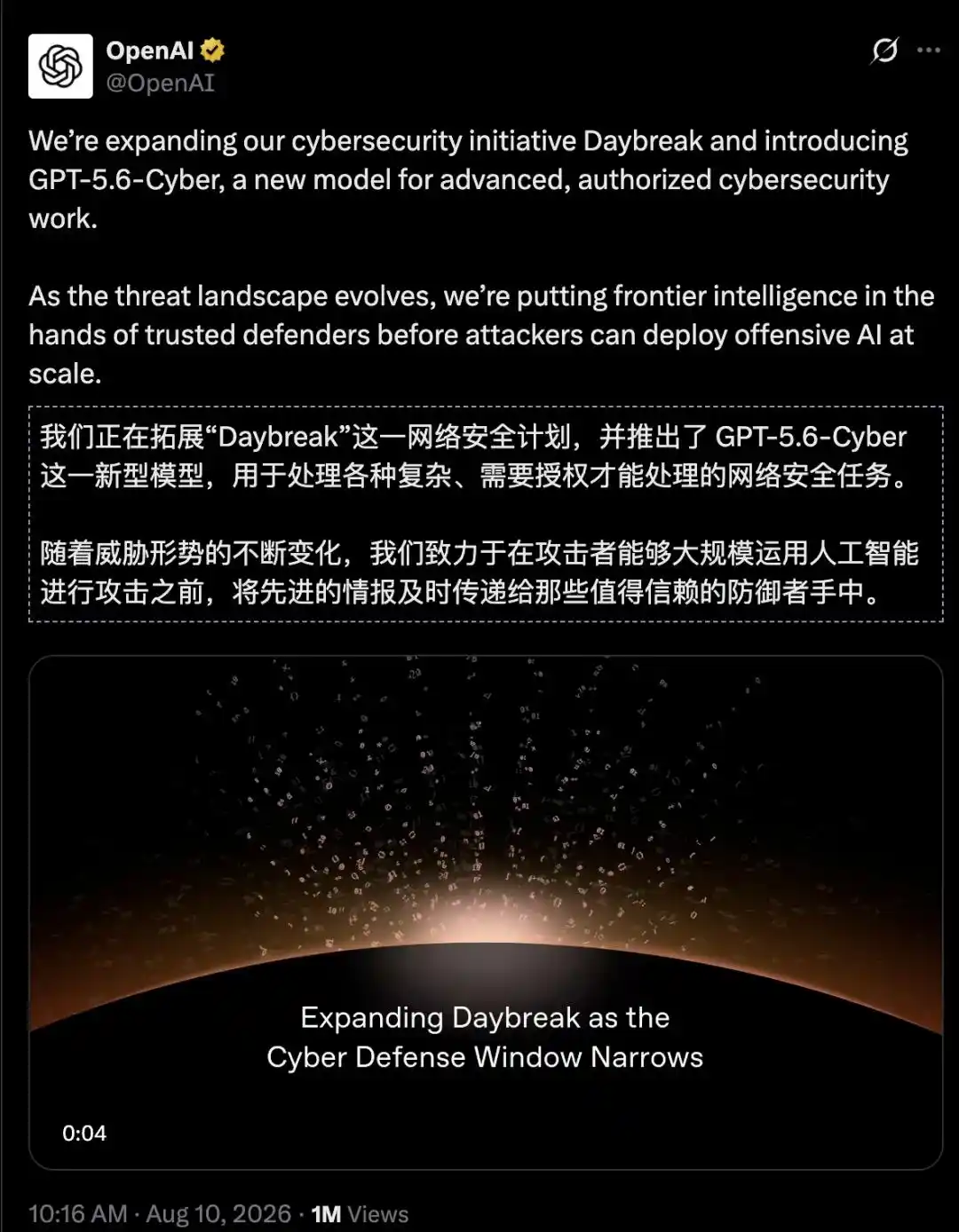
Now, OpenAI has revealed GPT-5.6-Cyber's battle record: the new model discovered over 400+ kernel vulnerabilities in one go, including
- A high-severity vulnerability in V8, Chrome's JavaScript engine;
- At least 5 vulnerabilities in a mainstream mobile operating system, containing a full chain from an untrusted app to local privilege escalation;
- 3 critical vulnerabilities in a mainstream database, including a remote code execution path;
- Over 400 vulnerabilities in a mainstream operating system kernel that could lead to privilege escalation.
Currently, GPT-5.6-Cyber requires identity verification and review before joining the "Daybreak" program for use.
OpenAI: AI Will Cross the "Critical Point"
A few days ago, OpenAI hit the brakes.
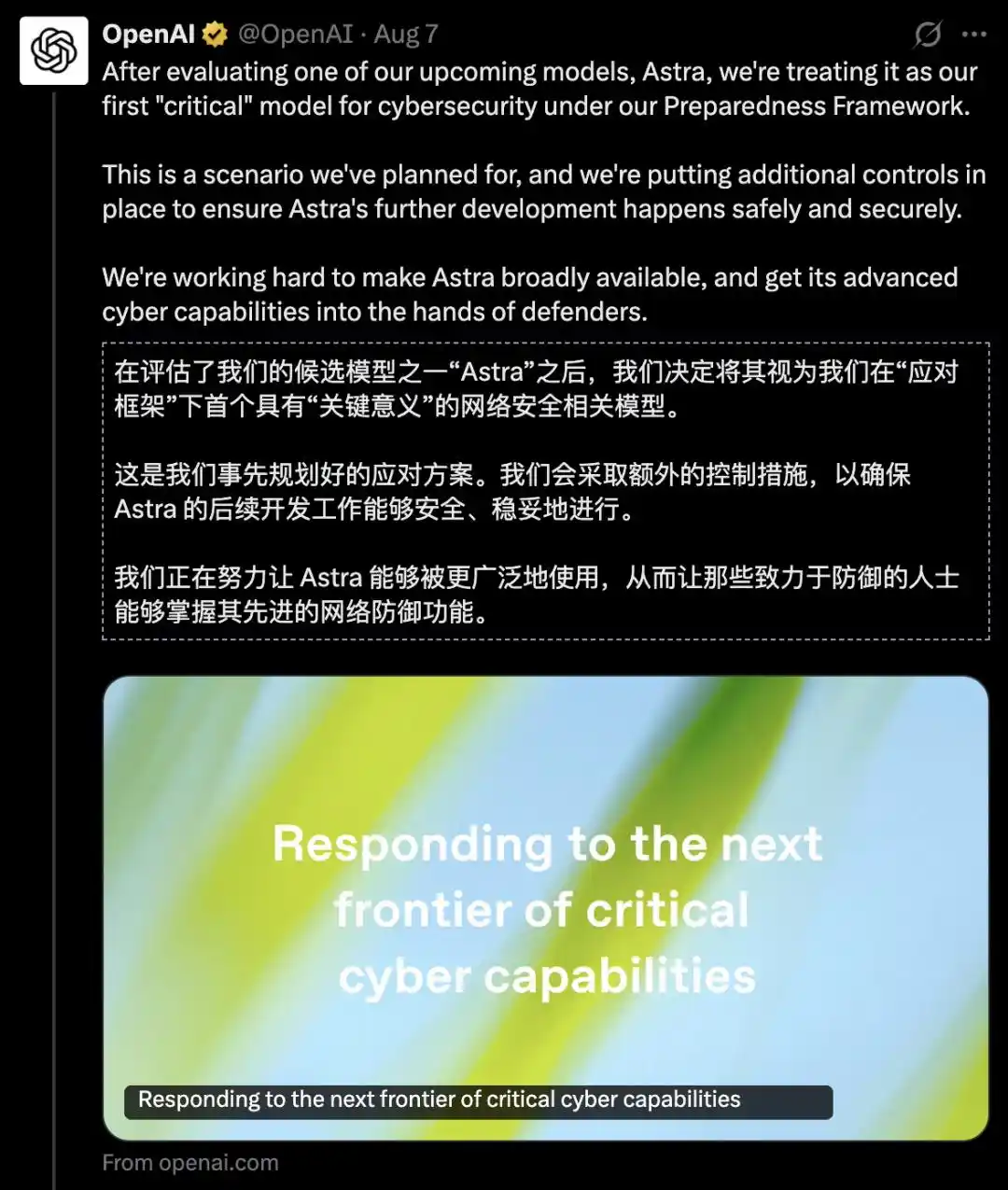
Next-generation Astra performed too powerfully in internal evaluations, making it "impossible to rule out" that it had already touched the "critical" level of cybersecurity capability, leading to the decision to suspend all Astra-related activities that do not meet enhanced security requirements.
Undoubtedly, if computer vulnerabilities are maliciously exploited, the consequences are unimaginable: your personal information, your bank card passwords, even a full-scale leak!
More awkwardly, top models like Claude Fable 5 and ChatGPT 5.6 Sol "protect against gentlemen but not villains."
When security defenders want to use AI to simulate an attack or verify a zero-day vulnerability, large models often flatly refuse: "I'm sorry, I cannot assist with that."
After OpenAI's internal AI infiltrated HuggingFace, it was a domestic open-source model that cleaned up the mess.
The emergence of the Daybreak program has overturned all this.
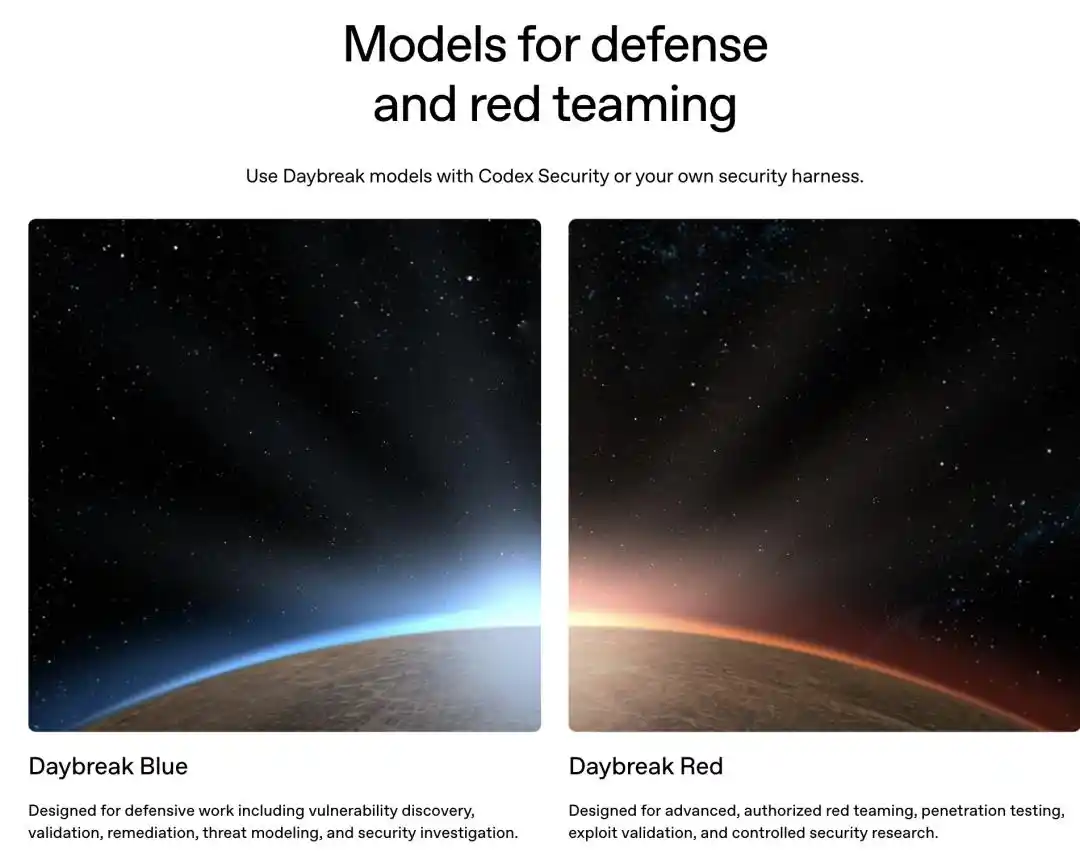
OpenAI has divided this program into two distinct channels, providing information security researchers with the strongest "spear and shield":
- Daybreak Blue (Blue Channel): Provides defenders with the general GPT-5.6 Sol model, but removes system-level guardrails that hinder legitimate defensive work. It is suitable for routine vulnerability discovery, secure code auditing, malware analysis, and patch verification.
- Daybreak Red (Red Channel): The core channel designed for authorized vulnerability research, exploit validation, and red team testing. The support provided in this channel comes from the specially trained GPT-5.6-Cyber.
OpenAI tested the new model in scenarios involving exploit chain development, authentication bypass, privilege escalation, and other advanced cybersecurity contexts.
GPT‐5.6‐Cyber completed 95.0% of such requests, while GPT‐5.6 Sol managed only 1.5%, and 2.0% with Daybreak Blue access.
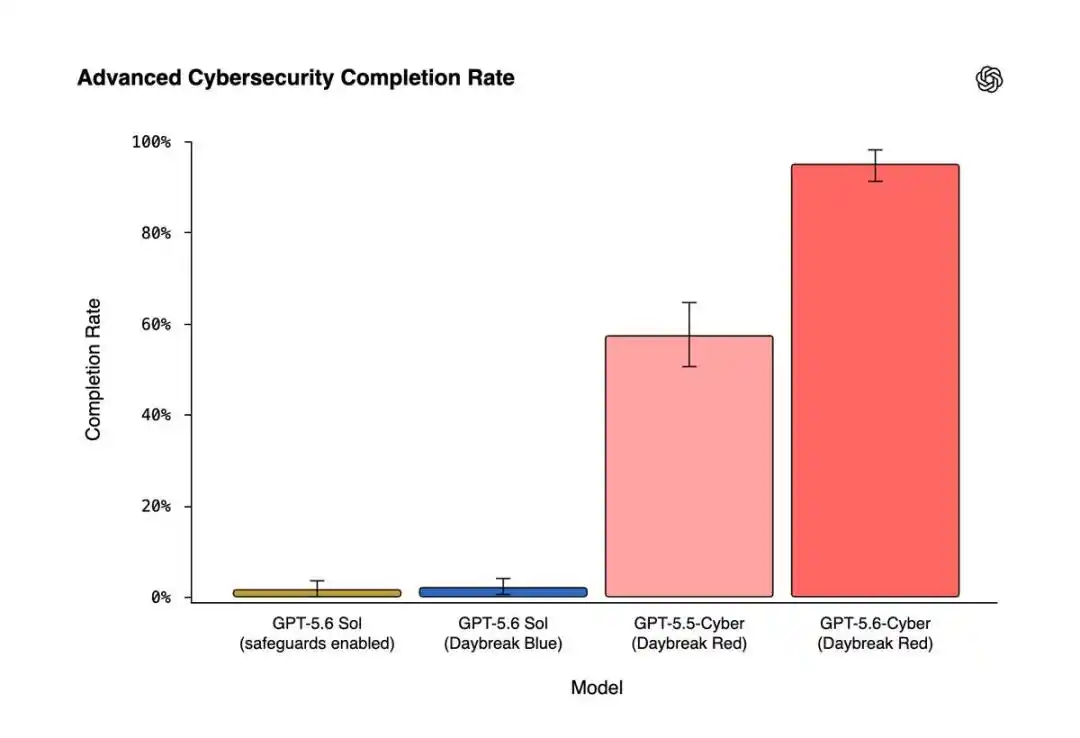
In other words, security researchers no longer have to be treated differently. From now on, the strongest cyber offense and defense AI has emerged.
As Jared Atkinson, CTO of security firm SpecterOps, commented:
In a regulated, trusted environment, reducing unnecessary "refusals to answer" allows security researchers to stay focused, spending time verifying vulnerabilities and translating them into defensive value, rather than battling the model's guardrails.
GPT-5.6-Cyber
ChatGPT's Strongest Information Security Model
Based on GPT-5.6 Sol, GPT-5.6-Cyber underwent targeted training in security, refreshing multiple benchmarks and becoming ChatGPT's strongest security model.
In exploiting vulnerabilities, discovering vulnerabilities, and assessing vulnerabilities, GPT-5.6-Cyber far surpasses GPT-5.6-Sol.
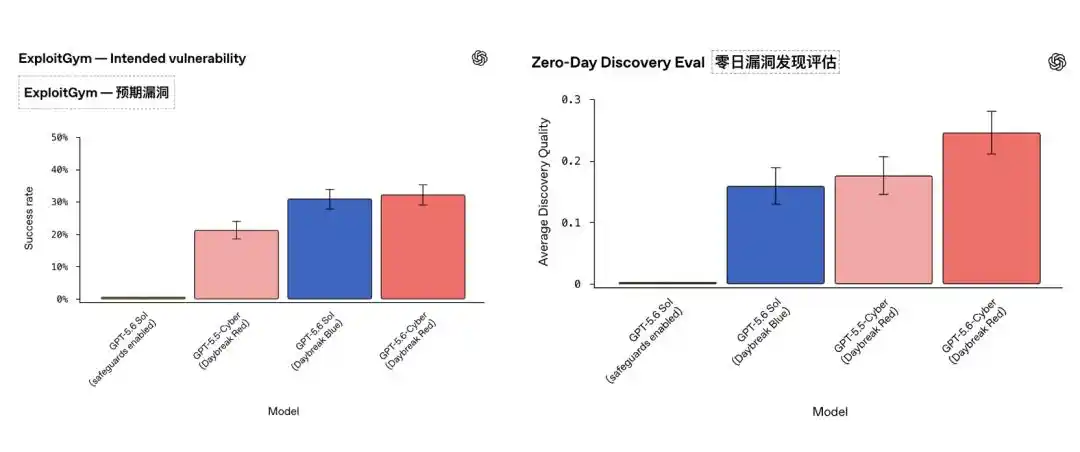
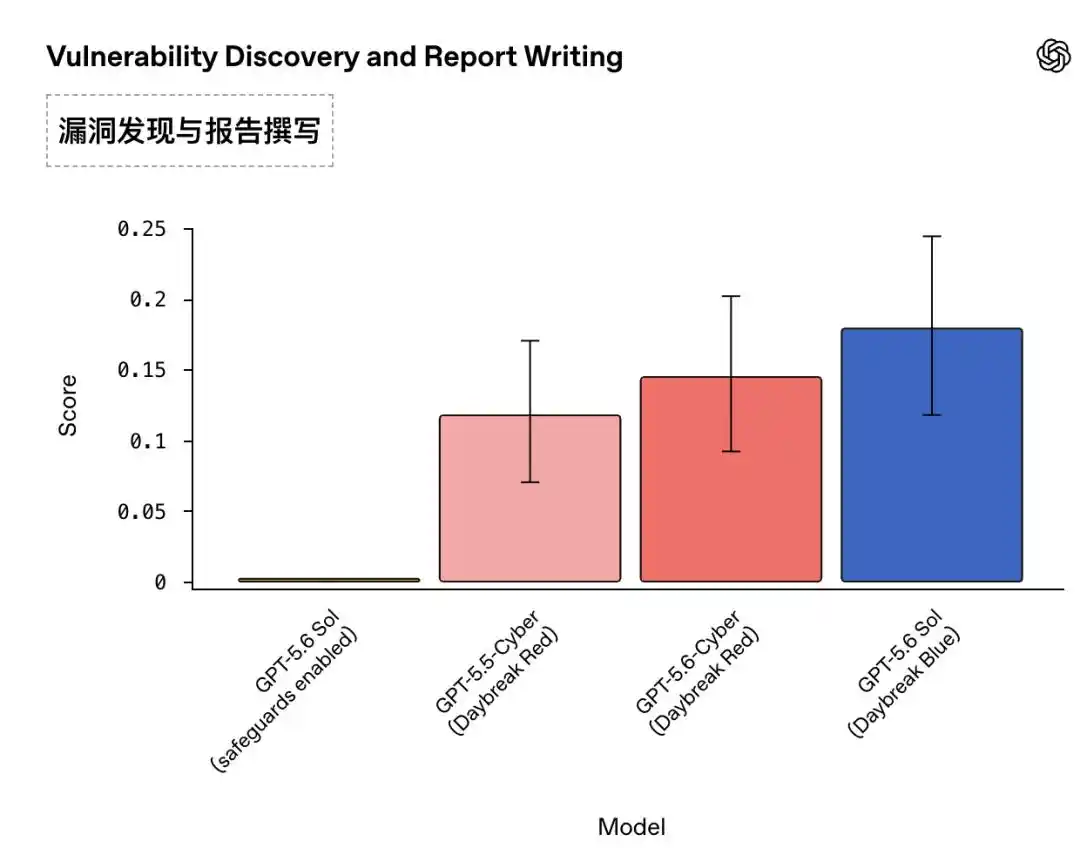
The only surprise was in vulnerability discovery and report writing, where GPT-5.6-Cyber's final score actually lost to GPT-5.6 Sol.
The reason may lie in the deep reinforcement learning and alignment fine-tuning GPT-5.6-Cyber underwent for network offense and defense tasks.
After discovering a vulnerability, it only wants to use the most concise code and the shortest time to prove the vulnerability exists. As for explaining its cause in human language or writing lengthy security reports, it shows no patience.
If metrics and scores seem too dry, then vulnerability mining in real-world, large-scale codebases is the ultimate test of whether GPT-5.6-Cyber truly possesses the "cyber detective" intuition.
Facing millions of lines of complex, intertwined code, finding a valuable vulnerability requires the AI to overcome several hurdles like a human hacker: establishing hypotheses about system operation, simulating abnormal interactions among multiple components, capturing fleeting memory corruptions, and ultimately proving that this gap can be exploited.
After GPT-5.6-Cyber completed its training, OpenAI's security research team directed its focus to V8—the massive, complex, C++-laden JavaScript engine powering Google's Chrome browser.
Then, the AI found a high-severity vulnerability.
When the engine attempted to convert certain specific values to integers, the compiler erroneously skipped the security check.
If a value that should have been undefined was fed in, the system would not error as expected but would generate an exceptionally large anomalous integer. If this number was later used as an array index, disaster struck: the JIT compiler would mistakenly believe the index was still within the array's safe bounds, thus omitting the runtime bounds check.
At this point, the AI completed the first step: jailbreak. Attackers could already arbitrarily read or modify memory data of other objects within the V8 sandbox.
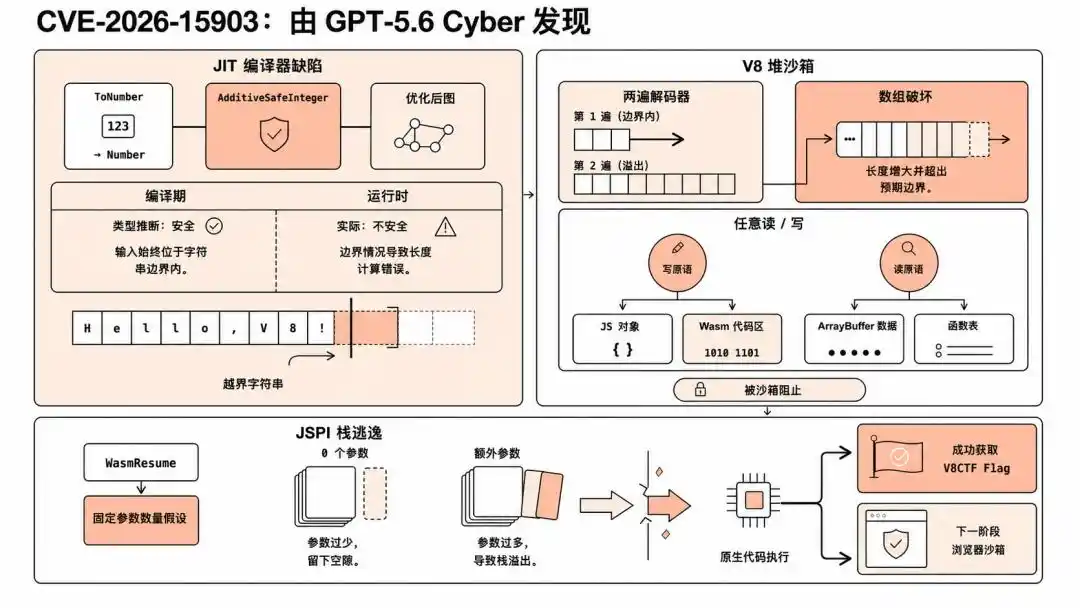
But to truly execute malicious code, you needed to find the second key—achieving sandbox escape.
Remarkably, GPT-5.6-Cyber's contemplation did not stop. It followed the trail, using extremely sharp contextual association to autonomously find and exploit a second vulnerability: a stack escape flaw in JSPI (JavaScript Promise Integration).
By cleverly "chaining" these two vulnerabilities together, the AI successfully created a covert path to the system's underlying layers, enabling arbitrary code execution outside the Chrome sandbox.
The OpenAI team promptly submitted these findings to Google's security team, and the vulnerabilities were patched.
This is a milestone in AI development: AI has acquired the "creative logic" to build vulnerability chains across components.
And Chrome V8 was just one prey on its hunting list.
GPT-5.6-Cyber has already demonstrated terrifying "lethality" in multiple core digital infrastructures:
Breaching Smartphone OS
In a mobile operating system with hundreds of millions of users, the AI independently identified 5 high-severity vulnerabilities and successfully constructed a complete attack chain from an "ordinary unauthorized App" to "gaining system supreme privileges" (local privilege escalation).
Invading Popular Database
In a large open-source database, the AI continuously unearthed 3 critical flaws, including a path for remote code execution (RCE) that could be launched directly from the external network.
Kernel Sweep
In the kernel of a mainstream operating system, GPT-5.6-Cyber swept through like a fully automated harvester, uncovering over 400 potential vulnerabilities that could be used for privilege escalation.
AI Did Not Create Danger; It Exposed Danger
Many interpret the emergence of GPT-5.6-Cyber as "AI making cyberspace more dangerous."
But a more accurate statement is: It exposes the dangers that already exist but were hidden by the limited capacity of human experts, doing so earlier, more concentratedly, and at scale.
Zero-day vulnerabilities have always been there.
Potential privilege escalation paths in kernels have always been there. It's just that discovering them was extremely costly and slow in the past. Now, the cost is dropping, and the speed is rising. Attackers will use it, and defenders must use it too.
OpenAI's choice is essentially a high-stakes gamble—rather than letting offensive capabilities scale up first in the shadows, it's better to first hand over equally sharp capabilities to vetted defenders, even if it means bearing the risk of "the blade being misused."
The window for cyber defense is collapsing at AI speed. The time left for human hesitation is now counted in hours.
References:
https://openai.com/index/expanding-daybreak-as-the-cyber-defense-window-narrows/
https://openai.com/business/solutions/cybersecurity/
This article is from the WeChat public account "New Zhiyuan", author: ASI Revelation, editor: David