In the mining farms, the loudest noise still comes from the mining rigs; yet in the Q2 financial reports, the AI business of most crypto mining companies is becoming increasingly prominent.
MARA recorded a net loss of $611.3 million for the quarter, which included $343 million in unrealized fair value losses on Bitcoin. On the other hand, Core Scientific's high-density colocation revenue increased from $10.6 million in the same period last year to $136.7 million, becoming the company's primary revenue source.
On one side, there is the contraction in mining revenue and the fair value losses on held coins due to falling cryptocurrency prices; on the other side, there is the long-term rent recognized upon the delivery of data center facilities. These financial reports simultaneously present two sets of report cards: one belonging to the Bitcoin mining rigs that are still 'putting food on the table,' and the other to the gradually ramping-up AI data centers.
The market is no longer short of multi-billion-dollar contracts. What needs to be verified next is how much capacity the mining companies have delivered, how much rent they have recognized, and ultimately, how much profit remains after deducting construction investments, depreciation, and interest expenses.
Mining More Doesn't Equal Earning More
The most direct pressure in Q2 came from the Bitcoin price.
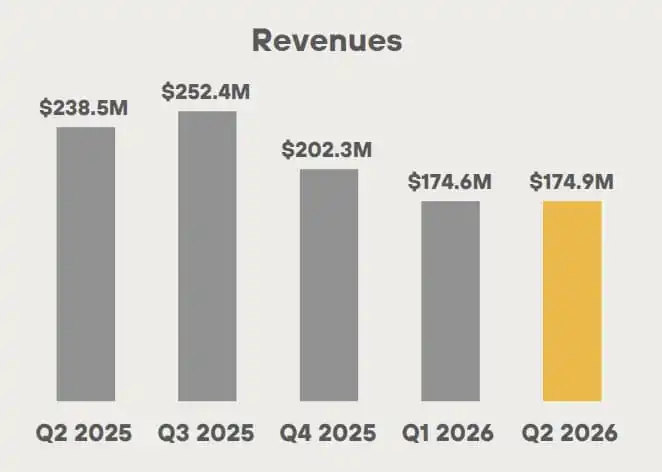
MARA mined 2,422 Bitcoins during the quarter, a slight increase from 2,358 Bitcoins in the same period last year, but its revenue still fell 27% year-over-year to $174.9 million. MARA's net loss for the quarter was $611.3 million, which also included $343 million in unrealized Bitcoin fair value losses. In other words, increased production could only partially offset the price decline and could not fully safeguard revenue.
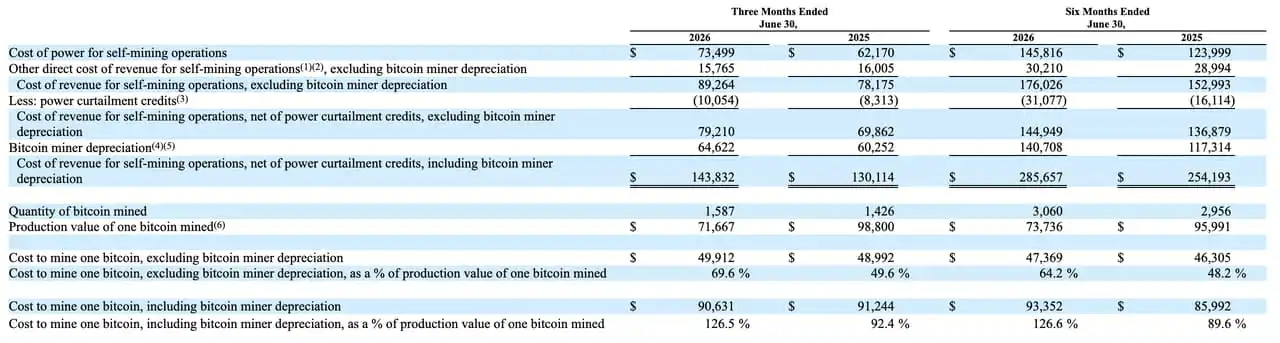
Riot Platforms presents a more typical case. The company produced 1,587 Bitcoins in Q2, an increase of about 11% year-over-year, but its mining revenue actually fell from $140.9 million to $113.7 million. The main reasons were the same: a decline in the average Bitcoin price and an increase in the global network hash rate. The production value per Bitcoin decreased from $98,800 to $71,667, while the mining cost per Bitcoin excluding rig depreciation increased from $48,992 to $49,912. Consequently, the cost-to-production-value ratio rose from 49.6% to 69.6%.
This doesn't mean the mining model is no longer viable, but rather that scale, machine efficiency, and electricity costs must work in tandem. American Bitcoin mined approximately 932 Bitcoins in Q2, a sequential increase of about 14%; mining revenue was approximately $67 million, up about 8% sequentially. Its mining cost per Bitcoin was around $36,500, with a gross margin close to 50%.
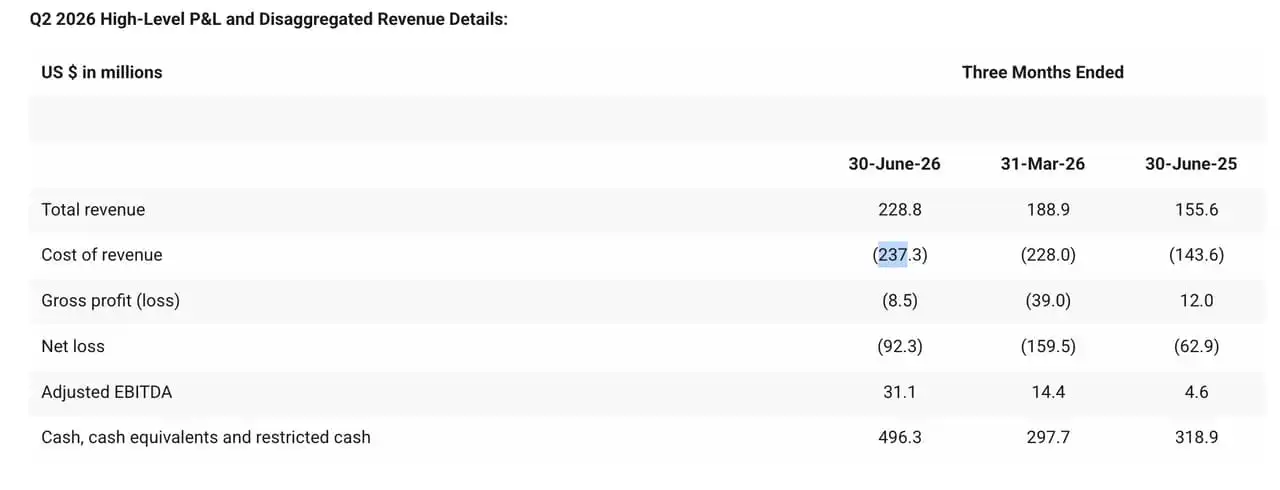
Bitdeer, however, shows another side: hash rate and production can expand rapidly, but profits may not follow synchronously. The company mined 2,694 Bitcoins in Q2, compared to 565 in the same period last year; total revenue increased 47% year-over-year to $228.8 million, with self-mining revenue contributing $168.4 million. However, the company's cost of revenue for the quarter reached $237.3 million, resulting in a gross loss of $8.5 million and a net loss of $92.3 million. Looking solely at production and revenue, it's easy to overlook that electricity costs, depreciation, and expansion costs had already exceeded current-period revenue.
AI Revenue Has Emerged, but Companies Are Not Starting from the Same Line
What is truly changing the industry landscape is that some miners have shifted from 'selling the Bitcoins they mine' to 'renting out power and data center space.'
Core Scientific is the most evident example of progress. The company's total revenue in Q2 was $164.2 million, of which high-density colocation revenue reached $136.7 million, accounting for approximately 83% of total revenue; self-mining revenue was only $21.5 million. In the same period last year, Core Scientific's colocation revenue was only $10.6 million. This signifies that its primary revenue source has shifted from mining to data center colocation, not merely the announcement of a future project.

A similar structural shift has occurred at TeraWulf. The company's Q2 revenue was $44.73 million, of which HPC leasing revenue was $31.93 million, accounting for about 71%, while digital asset revenue was $12.83 million. In contrast, in 2025, mining still constituted 90% (approximately $150 million) of TeraWulf's total revenue of $168.5 million, although it had already recorded its first HPC leasing revenue ($16.9 million) that year. The company has clearly stated that capital allocation and operational focus will primarily revolve around HPC data centers, and some existing mining farm infrastructure is also being repurposed.
Riot's transition is still in the ramp-up phase. Its Q2 total revenue was $174.2 million, up 14% year-over-year; of this, data center revenue was $23.2 million, while mining revenue remained at $113.7 million. It's worth noting that Riot's data center revenue includes $4.9 million in leasing revenue and $18.3 million in customer data center construction revenue – both are actual revenues recognized in the quarter's financials – but they are not yet sufficient to replace the mining business.
Cipher Digital reminds the market that 'commencing construction' and 'already generating HPC revenue' are two different things. The company's Q2 revenue was approximately $24.84 million, entirely from Bitcoin mining, with adjusted EBITDA at negative $30 million and a net loss of $267 million. Cipher only began delivering the first capacity of its Black Pearl project and started billing rent in early August, so this revenue was not yet reflected in Q2.
Hut 8's Q2 revenue increased from $41.3 million in the same period last year to $74.9 million, of which $72.5 million was categorized under Computing Operations. However, this category simultaneously includes ASIC computing, AI cloud, and traditional cloud services, meaning the entire $72.5 million cannot be directly labeled as AI revenue. Hut 8 still recorded a net loss of $177.1 million for Q2, of which $138.6 million was due to unrealized losses from digital assets.

AI Mega-Deals Dominate Headlines, but Revenue Realization Takes Time
The most common misinterpretation during miners' transition is mistaking the total value of long-term contracts for realized revenue.
Core Scientific disclosed leased customer power capacity of approximately 1.1GW, corresponding to potential contract revenue exceeding $24 billion, but its recognized colocation revenue for Q2 remained at $136.7 million; TeraWulf signed a 20-year lease with Anthropic post-quarter with an initial contract value of approximately $19 billion, but the company's Q2 HPC leasing revenue was only $31.9 million; Riot signed a 191MW data center lease post-quarter with an initial value of approximately $9.1 billion, while its Q2 data center revenue was $23.2 million.
These figures are not contradictory. The total contract value represents the potential revenue over the entire base lease term, typically recognized quarter-by-quarter into the financial statements only after the data center is built, delivered in phases, and billing commences. Project delays, construction cost variations, financing arrangements, and customer fulfillment can all affect the actual recognition pace. Therefore, when comparing miners' AI businesses, it's essential to distinguish at least three things: how much contract value has been signed, how much capacity has been delivered, and how much revenue was recognized in the current quarter.
Net profit also cannot be read in isolation from accounting items. For example, Core Scientific's Q2 net loss of $1.1553 billion was mainly affected by changes in the fair value of warrants; Cipher's net loss of $267.5 million included $150.5 million in fair value losses on warrants; MARA's loss was impacted by Bitcoin price revaluation. In contrast, Bitdeer's gross loss for the quarter reflects a situation where the cost of revenue already exceeded revenue, which is a different nature of loss.
Miners Are Evolving into Three Types of Companies
The Q2 financial reports show that listed mining companies can no longer be measured by the same standard.
American Bitcoin still primarily focuses on expanding hash rate, increasing production, and lowering the cost per coin; Core Scientific and TeraWulf already have a significant proportion of colocation or HPC revenue entering their current-period financials; companies like Riot and Cipher are in the intermediate stage of gradually delivering new projects.
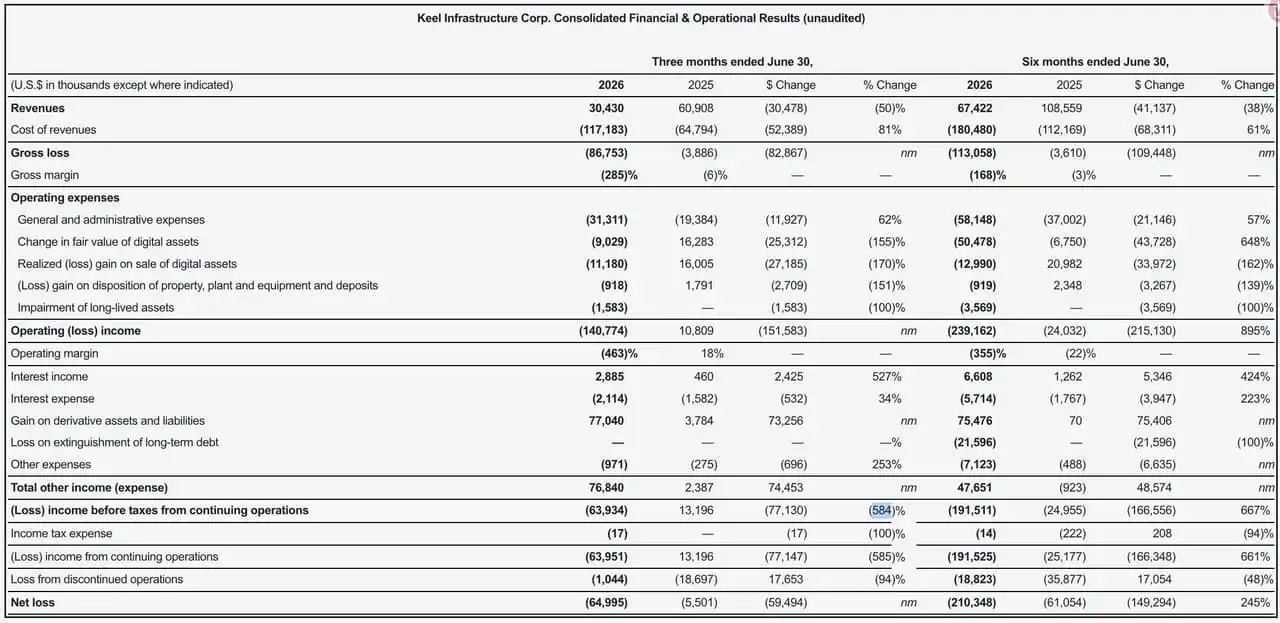
Keel Infrastructure has taken an even more drastic path. This company, renamed from Bitfarms, has completed the shutdown of its US Bitcoin mining operations. Its Q2 revenue was approximately $30.43 million, down 50% year-over-year, due to the Bitcoin price decline and the closure of cryptocurrency mining operations in the Moses Lake area, USA, in April 2026; adjusted EBITDA was negative $23.7 million. The company has chosen to become an HPC infrastructure developer, but the new business has not yet formed a revenue stream sufficient to replace mining.
Therefore, what is truly noteworthy this quarter is not whether miners are all talking about AI, but rather the stage they have reached: some still rely on mining rigs to boost production, some have started collecting monthly data center rent, and others are experiencing a transitional period where old revenue streams are disappearing while new ones have not yet taken over.
The mining rigs are still roaring, but what will determine financial performance in the next phase is becoming: who possesses stable power, who can deliver data center capacity on time, and who can truly turn a long-term contract into current-period revenue.