Swooping to Third Place, Rothera Disrupts Prediction Market Landscape

Odaily星球日报Published on 2026-06-22Last updated on 2026-06-22

Abstract

The article "Rothera Shakes Up Prediction Market Landscape, Debuts at No. 3" details the rapid rise of Rothera, Robinhood's newly launched in-house prediction market platform. Originally, Robinhood acted as a major distribution channel for Kalshi, routing 25-35% of its user orders to Kalshi for execution, which involved revenue sharing. Rothera allows Robinhood to capture this value internally by migrating orders, particularly for events like the World Cup, to its own platform. This has led to explosive growth for Rothera, with weekly trading volume soaring from $21.9 million to $559 million in just two weeks, making it the third-largest prediction market behind Kalshi and Polymarket. Analysts estimate Robinhood's prediction market business could generate $10 billion in annual revenue, surpassing its crypto revenue peak. This growth represents a direct challenge to Kalshi, which is now seeking new distribution channels, including talks with investment banks for a potential IPO, to integrate its platform with institutional client networks. The key takeaway is a shift in the competitive landscape: success is increasingly defined not just by product offerings but by controlling the user distribution channels and value capture, as demonstrated by Rothera's swift ascent.

Original | Odaily Planet Daily (@OdailyChina)

Author | Azuma (@azuma_eth)

Last week, Odaily Planet Daily published an article titled "The First Prediction Market Concept Stock Has Emerged!", which mainly discussed how Robinhood is intercepting orders, which previously needed to be executed via Kalshi, by building its own prediction market, Rothera. This allows Robinhood to reduce revenue sharing with Kalshi and retain profits within its own ecosystem.

Although we anticipated that Rothera wouldn't face the cold start problems common among other competitors, its data performance over the past week still far exceeded our initial expectations. It's hard to imagine that a platform launched just half a month ago could directly soar to third place in the highly competitive prediction market sector, trailing only behind the two giants, Kalshi and Polymarket.
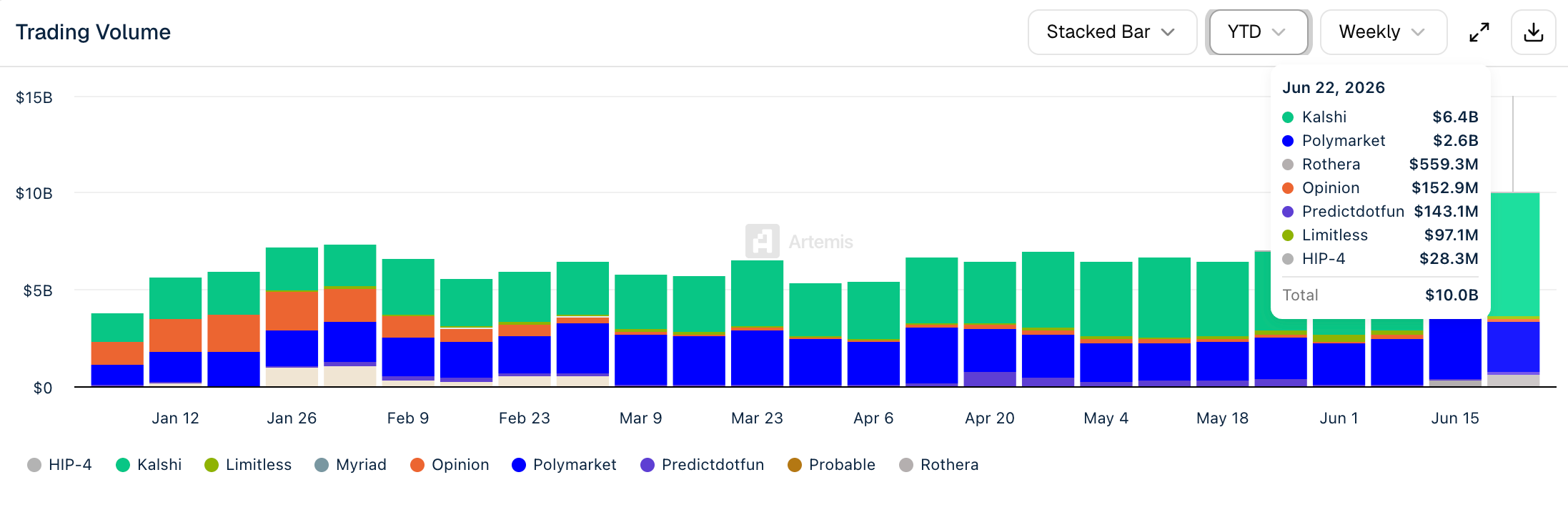
Data from Artemis shows that for the week ending June 8th, Rothera, as a new platform, had a weekly trading volume of only $21.9 million, still lagging significantly behind second-tier platforms like Opinion, Predict, and Limitless. However, for the week ending June 15th, Rothera's weekly trading volume directly jumped to third place in the industry, reaching $276 million. In the latest week ending June 22nd, Rothera's weekly trading volume increased to $559 million, nearly one-fifth of Polymarket's volume.

A Case of Atypical Growth (Can skip if you read the previous article)

It's important to clarify that Rothera's rise is essentially not driven by creating new incremental users (though some users may have joined due to the World Cup), but rather by the migration of existing orders, not the creation of new users.

Over the past year or so, Robinhood has been one of the most important distribution channels for Kalshi. Leveraging tens of millions of retail users and established stock, options, and cryptocurrency trading gateways, Robinhood directed a large volume of orders to Kalshi. Piper Sandler analysts previously estimated that trades completed through the Robinhood channel accounted for about 25%-35% of Kalshi's total trading volume.

The issue was that while these orders originated from Robinhood users, they didn't belong to Robinhood itself. Under the previous partnership model, Robinhood functioned more as a front-end traffic portal, while Kalshi was the infrastructure provider responsible for order matching, clearing, and settlement. Revenue generated from each trade needed to be shared between the two parties.

Rothera is Robinhood's weapon to break this revenue-sharing model. Since early this month, Robinhood has begun migrating some World Cup-related event contracts to be executed internally on Rothera. This means that a significant number of orders that might have previously flowed to Kalshi are now retained within Robinhood's own ecosystem.

Therefore, in a sense, the surge in Rothera's trading volume is less of a threat to other prediction markets like Polymarket, Predict, or Limitless, and more of a direct "siphon" of volume from Kalshi.

Robinhood's Value Capture

The most direct impact of Rothera's rapid growth is the strengthening of Robinhood's ability to capture value from prediction market-related orders on its platform.

According to Hood House, an investment research media outlet that has long tracked Robinhood, statistics based on public data show that as of June 20th, Robinhood's prediction market business collectively traded 34,700 contracts in a single day, corresponding to an estimated daily revenue of about $4.9 million.
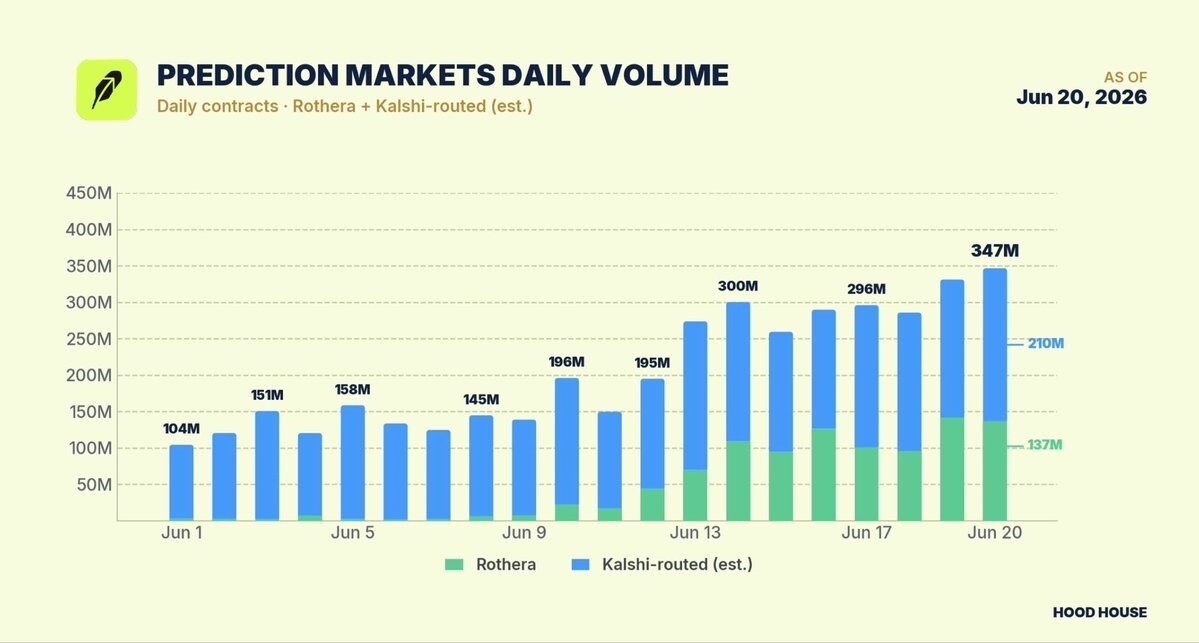
Hood House subsequently disclosed their calculation logic:

  • Rothera (primarily hosting World Cup-related markets) achieved a daily trading volume of 137 million contracts, corresponding to a trading value of approximately $47 million.
  • As a comparison, Kalshi's total daily trading volume was about 1.5 billion contracts, corresponding to a trading value of approximately $416 million. Excluding World Cup-related markets, Kalshi's trading volume was about 1 billion contracts, corresponding to a trading value of about $260 million.
  • Considering that Robinhood users are still estimated to contribute around 20% of Kalshi's non-World Cup market trading volume (conservative estimate), this means that approximately 210 million contracts and $52 million in trading volume from Kalshi's non-World Cup event contracts were completed through Robinhood.

Based on this, Hood House further made an aggressive projection, stating that if this growth rate continues, Robinhood's prediction market business has the potential to achieve revenue on the scale of billions of dollars this year. This figure even surpasses the historical peak of Robinhood's cryptocurrency-related revenue, which was approximately $900 million in 2025.

Kalshi's Counter Strategy: Finding New Channels

Faced with Rothera's rapid rise, Kalshi has clearly recognized the problem.

For Kalshi, Robinhood was both a partner and one of its most important sources of traffic. However, as Robinhood begins migrating more and more orders to its own platform, the relationship between the two has shifted to direct competition.

Recent news disclosed by The Information might reveal Kalshi's response strategy. Sources familiar with the matter revealed that Kalshi has begun early, informal discussions with several investment banks regarding a potential future IPO. More notably, Kalshi has made a specific demand in its communications with these banks: to be prioritized for underwriting roles in the future IPO, these institutions need to prioritize completing technical integration of their systems with Kalshi. This would enable their institutional clients to directly participate in trading event contracts on Kalshi's platform.

In other words, Kalshi is using the prospect of an IPO as an opportunity to seek new distribution channels, aiming to integrate prediction markets into the client networks of banks, brokerages, and other financial institutions. This might also represent a subtle shift in the competitive dynamics of the prediction market industry. In the past, the focus was on who could offer more contracts or design better products. Now, as prediction markets gradually integrate into the mainstream financial system, the focus of competition is shifting to another dimension: those who control the user gateway can more effectively control value.

The rise of Rothera has already demonstrated the significance of distribution capabilities. Swooping to third place seems effortless, and challenging Kalshi and Polymarket in the future might not seem like such a difficult task.


Related Questions

QWhat is the main reason behind the rapid growth of Rothera's trading volume, according to the article?

AThe rapid growth of Rothera's trading volume is primarily attributed to a migration of existing orders rather than the creation of new users. Specifically, Robinhood has begun directing orders related to World Cup contracts, which previously would have been executed on Kalshi, to its own platform, Rothera.

QWhich two prediction market platforms are currently ranked ahead of Rothera in terms of trading volume?

AAccording to the article, the two prediction market platforms currently ranked ahead of Rothera are Kalshi and Polymarket.

QWhat strategy is Kalshi reportedly employing to counter the threat from Rothera?

AKalshi is reportedly seeking new distribution channels by engaging with investment banks for a potential future IPO. A key requirement in these discussions is that the banks must first integrate their systems with Kalshi's platform to allow their institutional clients direct access to trade event contracts on Kalshi.

QWhat significant change in the focus of competition within the prediction market industry does the article highlight?

AThe article highlights that the focus of competition is shifting from merely providing more contracts or better product design to controlling user access points. It emphasizes that whoever masters distribution channels and user entry points can more effectively capture value.

QWhat potential annual revenue for Robinhood's prediction market business is mentioned in the article, and how does it compare to its historical crypto revenue?

AThe article mentions an aggressive estimate that Robinhood's prediction market business has the opportunity to reach an annual revenue scale in the billions of dollars this year. This figure is suggested to potentially exceed the historical peak of Robinhood's crypto-related revenue, which was approximately $900 million in 2025.

Related Reads

Report Interpretation: J.P. Morgan Details Micron's Pre-Earnings Sentiment, Current Hardware Sector Dynamics

Morgan Stanley analyst Joshua Meyers' report (June 21, 2026) highlights key trends in the hardware and semiconductor sector ahead of Micron's earnings. The core takeaways are: 1. **Micron & Memory:** Memory remains a high-conviction long theme, driven by strong AI demand and rising ASPs. However, investor focus is shifting to the sustainability of Micron's >80% gross margins and the specifics of potential new long-term supply agreements (SCAs). 2. **Hardware Supply Chain:** AI-related demand for servers, networking, and storage remains robust, but company performance is diverging. Celestica (CLS) shows improved margin confidence, Western Digital and Seagate benefit from pricing, Fabrinet (FN) sees predictable AI optics growth, and Teradyne (TER) anticipates a new Google customer. 3. **AI Capex & WFE Forecasts:** JPMorgan increased its Wafer Fab Equipment (WFE) market growth forecasts to 28% in 2026 and 29% in 2027. AI infrastructure financing is evolving, with higher project-level debt reducing constraints on capex expansion. The report signals that while the AI-driven hardware cycle is strong, the market is entering a phase focused on execution verification (e.g., Micron's SCA details, Fabrinet's ramp with Amazon) and valuation sustainability. Key near-term signals include Micron's guidance, Arista Networks' outlook, and the pace of demand normalization post potential tariff-related pull-ins.

marsbit3h ago

Report Interpretation: J.P. Morgan Details Micron's Pre-Earnings Sentiment, Current Hardware Sector Dynamics

marsbit3h ago

Research Report Analysis: The Fed's New Chair's Debut – New Leader, But Same Script?

Report Analysis: Federal Reserve's New Chair Debut – A New Captain, But the Same Script? Morgan Stanley's chief global economist Seth B. Carpenter analyzes the first FOMC meeting under new Fed Chair Kevin Warsh in a June 21 report. Warsh deliberately avoided providing forward guidance on interest rates, aligning with his philosophy. However, market expectations for a rate hike this year were reinforced. Key signals lie elsewhere: inflation may fall more than expected, and quantitative tightening (QT) could be more aggressive than anticipated. The FOMC's "dot plot" suggests only one rate hike in 2026. Carpenter argues that if inflation undershoots forecasts, the logic for even a single hike weakens, especially as projections indicate potential rate cuts in 2027. On QT, Warsh's stance is clear. Carpenter notes that measures like halving the Treasury's account balance could shrink the Fed's balance sheet by around $500 billion with minimal market impact. Combined with adjustments to reserve interest and liquidity rules, the ultimate QT scale may exceed expectations, though its market effect might be less disruptive unless the Fed actively sells Mortgage-Backed Securities (MBS). While Warsh initiated a review of the Fed's policy framework, the 2% inflation target remains intact for now. The report concludes that the market may be overestimating the significance of reduced forward guidance and the near-term rate hike risk, while potentially underestimating the scope and manageable nature of the coming balance sheet reduction. The key debates will hinge on upcoming core PCE data, the specifics of the QT path, and the framework review's findings.

marsbit3h ago

Research Report Analysis: The Fed's New Chair's Debut – New Leader, But Same Script?

marsbit3h ago

Critical Game Week: BTC Retracement Confirmation vs. HYPE Support Battle | Guest Analysis

This weekly analysis outlines a critical juncture for BTC and HYPE markets, focusing on key price level confirmations. **BTC Analysis:** BTC is at a pivotal point after a five-wave rally from the June 5th low of $59,100. The price has broken below a short-term rising channel's lower boundary, with the current move seen as a pullback to test this breakdown. Failure to reclaim this level could lead to a retest of the $59,000-$60,000 support zone. The core scenario hinges on this channel retest outcome. * **Key Levels:** Resistance at $64,500-$65,000 (channel boundary) and $69,500-$70,500. Support at $59,000-$60,000 and $55,000. * **Strategy:** A core bearish stance is maintained (20% short from last week), with short-term plans for tactical trades. Three detailed contingency plans (A/B/C) are provided for short positions on resistance tests or breakdowns, emphasizing strict stop-loss discipline. **HYPE Analysis:** HYPE shows strong momentum but is currently in a corrective phase after hitting a new high of $76.94. The price is retesting the crucial $64-$66 support area. * **Key Levels:** Resistance near $77 and $80-$82. Support at $64-$66 and $52-$54. * **Strategy:** The short-term approach is "buy on dips, avoid chasing rallies." A long position is considered only if clear stabilization signals appear at the $64-$66 or deeper $52-$54 support zones, with tight risk controls. **General Risk Management:** A standardized trailing stop-loss protocol is emphasized: set initial stop, breakeven at +1% profit, then trail stops upward to lock in gains. *Disclaimer: All analysis is presented as a personal trading framework, not investment advice. Market conditions are complex and require dynamic adjustment.*

marsbit3h ago

Critical Game Week: BTC Retracement Confirmation vs. HYPE Support Battle | Guest Analysis

marsbit3h ago

Research Report Interpretation: Citi Attends AWS Summit, Bullish on Cloud Business Acceleration but Data Governance Remains Key Variable

Citi analyst Tyler Radke's team attended the AWS New York Summit (June 17-18), engaging with over 10 clients and partners. In a June 19 report, they highlighted the summit's focus on scaling agent AI for enterprise deployment. Citi maintains a "Buy" rating on Amazon, forecasting AWS revenue growth to accelerate to 37% in FY27 from 30% in FY26, noting this estimate may be conservative. Key takeaways: 1. **AWS Strategy Shift:** AWS is moving from proof-of-concepts to scalable deployment. New offerings like AWS Context (building enterprise knowledge graphs), Amazon Quick (cross-application AI assistant), and security tool Continuum address core enterprise pain points for AI adoption. 2. **Data Infrastructure Beneficiaries:** Data infrastructure companies like Snowflake, Elastic, Oracle, and ClickHouse are seen as direct beneficiaries of scaling AI workloads, as evidenced by strong growth and use cases presented. 3. **Critical Role of Data Governance:** As AI agents scale from hundreds to thousands, effective data governance becomes the key variable for deploying AI in core business processes. AWS Context represents AWS's strategic extension from providing compute/models to offering a data governance infrastructure layer. The report emphasizes that without solving data governance, AI will remain confined to pilot projects. The investment thesis focuses on AWS revenue acceleration and data infrastructure vendors' growth, while monitoring signals like AWS's quarterly revenue growth, Bedrock AgentCore task volume, and pricing impacts on companies like Elastic.

marsbit3h ago

Research Report Interpretation: Citi Attends AWS Summit, Bullish on Cloud Business Acceleration but Data Governance Remains Key Variable

marsbit3h ago

Trading

Spot
Futures
活动图片