Dash Launches ZK-Privacy Based on Zcash

cryptonews.ruPublished on 2026-07-30Last updated on 2026-07-30

Abstract

Dash has launched ZK-based privacy features built on Zcash's Orchard protocol. This is now integrated directly into the Dash Platform's consensus (v4.0.0), providing a native, non-custodial privacy model alongside the existing CoinJoin system. It offers optional confidentiality, hiding sender, receiver, amount, and balance within a shielded pool. The implementation adapts Zcash's Orchard protocol (using Halo 2 without a trusted setup) to Dash Platform, handling state transitions, GroveDB storage, fees, and wallet sync. A critical double-spend vulnerability discovered in Orchard prior to release was patched using updated libraries, with Dash adding a SumTree structure for extra security. Users can privately transfer Platform Credits (pegged 1:100 billion to DASH) and move funds to/from the main Dash Core chain. Wallet synchronization, which is required to detect incoming private transactions, took about 21 seconds in testing, noted as significantly faster than a comparable Zcash wallet. Future plans include extending shielded pools to native Platform tokens and NFTs, aiming to combine ZK-privacy with token issuance and direct exchangeability with Dash. Mobile wallet support for the new feature is expected soon.

In February, we wrote about Dash's plans to integrate Orchard. At that time, it was about a future release and the prospect of private user tokens.

Now the first part of the plan has been implemented: in Dash Platform v4.0.0, shielded operations have become part of the consensus. This is not an external mixer, not a custodial service, and not an experimental smart contract — privacy is built directly into the protocol.

For Dash, historically associated with CoinJoin, this is not a replacement for the old mechanism, but a second model of privacy. CoinJoin continues to work on the main network, while Platform uses ZK-proofs instead of mixing rounds with multiple participants. This approach is better suited for fast mobile wallets. At the same time, regular Dash transactions remain transparent: confidentiality is optional.

The shielded pool hides the balance, sender, recipient, and transfer amount within the pool. The network verifies that funds exist, belong to the sender, and are not double-spent, but does so without revealing the operation's contents.

A user can deposit credits into the pool from a transparent Platform address, conduct a private transfer, and return the funds back. For DASH holders, two other routes are more important: ShieldFromAssetLock sends funds to the shielded pool directly from Core, and ShieldedWithdrawal withdraws them to a specified Core address. To avoid linking the withdrawal to previous activity, the wallet must use a new address.
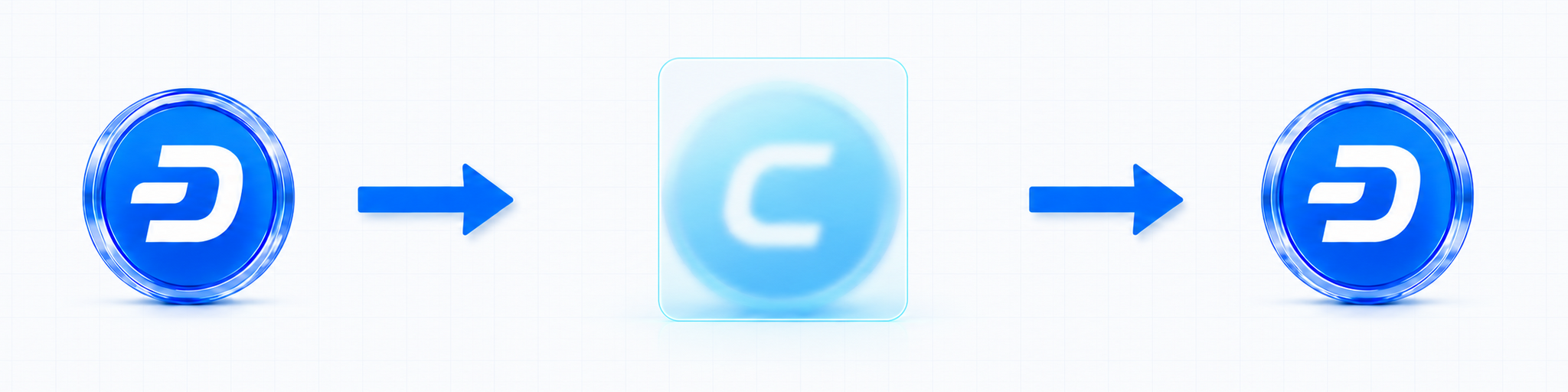
Platform Credits are the internal accounting unit of Dash Platform, linked to Dash by a fixed ratio: one Dash corresponds to 100 billion credits.

How the Privacy Works — Without Unnecessary Math

Dash did not create a new ZK-scheme from scratch. The implementation is based on Orchard, Zcash's shielded protocol built on Halo 2 without a trusted setup. Dash's engineering work involved adapting it to Platform: custom state transitions, storage in GroveDB, fees, wallet synchronization, and the route back to Core.

Shortly before the release, a critical vulnerability was discovered in Orchard, potentially allowing double spending within the pool. The Zcash team fixed the proof scheme, and the Dash Core Group updated its implementation to the revised libraries even before the release of Platform 4.0. An additional layer of control in Dash is provided by SumTree: this structure stores and verifies the pool's state, preventing hidden inflation from going unnoticed.

One of the main problems with shielded systems is wallet synchronization. To detect incoming funds, the application receives encrypted notes and locally checks which ones its key can decrypt. The server does not learn which transfers belong to the user.

In the test version of the application, we created a new wallet and started synchronization: it took about 21 seconds, which is significantly faster than synchronizing the Zodl wallet for ZCash.

The release of mobile wallets supporting the new technology is expected soon.

Currently, the pool only works with Platform Credits. However, Dash has already announced plans to add separate shielded pools for native Platform tokens.

Private user assets are not a new concept. Dash's strength lies in the specific combination of capabilities: ZK-privacy, token and NFT issuance, and the ability to exchange created assets for Dash and back. Thanks to this, each asset gains a direct link to the already established coin, and through it — to the external market.

end-content

Trending Cryptos

Related Questions

QWhat is the main news about Dash mentioned in the article?

ADash has launched ZK-privacy (shielded operations) built directly into its protocol, specifically in Dash Platform v4.0.0, based on Zcash's Orchard protocol.

QHow does the new shielded privacy model in Dash Platform differ from its previous CoinJoin method?

AThe new model uses Zero-Knowledge (ZK) proofs for privacy, making it better suited for fast mobile wallets. It is built directly into the protocol, unlike CoinJoin which is a mixing service in the main network. Both models coexist, with the new shielded pool offering optional privacy for Platform Credits.

QWhat are the two new transaction routes mentioned for DASH holders to interact with the shielded pool?

AThe two new routes are 'ShieldFromAssetLock', which sends funds into the shielded pool directly from Dash Core, and 'ShieldedWithdrawal', which withdraws funds from the shielded pool to a specified Dash Core address.

QWhat was a key security issue addressed before the launch of Dash Platform v4.0.0?

AA critical vulnerability was discovered in the Orchard protocol that could potentially allow double-spending within the shielded pool. The Zcash team fixed the proof scheme, and the Dash Core Group updated its implementation to the patched libraries before release.

QWhat future development for Dash Platform's shielded pools is announced in the article?

ADash announced plans to add separate shielded pools for native tokens on the Dash Platform, enabling private user-created assets like tokens and NFTs with a direct link to the DASH cryptocurrency and the external market.

Related Reads

Welcome to the New Crypto World: Only This Time, The Place Where You Lose Money Is Called the Stock Market

Welcome to the New Crypto World: Only This Time, the Place to Lose Money is Called the Stock Market. The article depicts a future (2026) where global stock markets, particularly tech stocks, are exhibiting behaviors and risks reminiscent of the cryptocurrency world. The narrative centers on a sharp crash in South Korea's KOSPI index and leading stocks like SK Hynix, highlighting widespread retail losses, leverage-induced liquidations, and extreme volatility. It argues that a significant shift in market dynamics is underway: pricing is increasingly driven by narratives (like the AI boom) over fundamental valuation, amplified by high leverage and the rapid, emotion-fueled consensus formed on social media. Former crypto traders, seeking new opportunities, brought their high-risk strategies—chasing narratives, using leverage—into equity markets, focusing on sectors like AI and semiconductors. Ironically, data suggests some major tech stocks have recently shown greater volatility and faster crashes than Bitcoin, which is becoming relatively more stable and "stock-like" through institutional adoption. The piece details how leveraged ETFs in Korea, particularly those tied to single stocks, created a vicious cycle of forced selling that exacerbated the market plunge. It concludes that while stocks retain underlying fundamentals, the *trading* of them has undergone a "de-rationalization": markets now prioritize themes, social media sentiment, and leveraged bets over traditional analysis. In a paradoxical twist, Bitcoin is striving to become more like a traditional asset, while a segment of the stock market is becoming more like crypto—a cycle of grand stories, crowded trades, easy leverage, and the pervasive, often misplaced, belief that one can exit before everyone else. The final, poignant wish from a Korean retail investor—to go back to life before trading and get their money back—underscores that markets offer no refunds.

marsbit2m ago

Welcome to the New Crypto World: Only This Time, The Place Where You Lose Money Is Called the Stock Market

marsbit2m ago

Feishu Has Become Doubao

This may be the most important day in the ten-year history of Feishu. On July 30, ByteDance announced a major restructuring via internal email. Feishu, an independent operation for a decade, will no longer function separately and will lose its independent sales and marketing teams. Its product team is being integrated into Doubao AI, and its Go-to-Market strategy merges into the Volcano Engine's To B system. This move signals a strategic pivot, not a failure of Feishu. The era where Feishu sought to be an all-encompassing super-app for productivity is ending. AI has become the dominant logic. Industry trends show a shift from building platform "entrances" to embedding AI directly into workflows, as seen with Microsoft Copilot and Google's Gemini. Data reveals the driver: over 90% of Feishu's new clients in Q2 2026 purchased its AI products. Enterprises are now buying integrated AI solutions, not standalone software. By integrating Feishu's deep enterprise workflow scenarios, Doubao evolves from a consumer-facing chatbot into a powerful enterprise productivity engine. This gives Doubao a critical asset: real-world business application. Concurrently, ByteDance established the "Creative Services Platform," unifying its previously fragmented sales fronts (Feishu, Doubao, Volcano Engine) into a single customer-facing entity. This represents ByteDance's first genuine shift to thinking like a true To B company, organizing around client needs rather than internal product silos. The restructuring underscores that AI is no longer just a business line but foundational infrastructure. Doubao is becoming the new organizational core, mirroring TikTok's past ascendancy. This demonstrates a profound shift: AI is beginning to reshape corporate structures, determining resource allocation and strategic priorities. ByteDance is likely just the first of many companies to undergo such an AI-driven reorganization.

marsbit13m ago

Feishu Has Become Doubao

marsbit13m ago

The Second Half of the RWA Issuance Race: Amidst the Utilization Dilemma, Trillions Worth of On-Chain Assets Awaken

RWA (Real-World Asset) tokenization has surged to a record $32 billion in on-chain value. However, a structural challenge has emerged: approximately 87% of these tokenized assets are inactive, not participating in DeFi lending or trading activities. This "utilization gap" highlights a key question: what happens after assets are brought on-chain? Data shows a stark contrast among major platforms. While Securitize leads in scale ($4.9B), it has a DeFi utilization rate of only 0.7%. Similarly, Ondo Finance ($3.5B) sees about 2.7% utilization. In contrast, Maple Finance, with a smaller $2.3B in assets, achieves a 62% utilization rate by embedding its assets directly into lending activities from the outset. Three primary factors contribute to low utilization: 1) **Asset Nature**: Tokenized treasuries are often held for yield, not traded. 2) **Regulatory Barriers**: Securities laws and KYC requirements restrict free movement into permissionless DeFi pools. 3) **Infrastructure Gaps**: A lack of deep secondary markets, real-time pricing, and mature clearing mechanisms hinders liquidity. The RWA narrative is now shifting from a "race to issue" to a "battle for application." While native lending protocols like Maple have inherent advantages, distribution channels are becoming critical. The success of products like SyrupUSDG on platforms like Robinhood Crypto demonstrates that access to existing user bases can accelerate adoption far more effectively than protocol-led efforts alone. The $32 billion milestone validates the feasibility of tokenization, but low utilization underscores that bringing assets on-chain is just the first step. The true test for the sector is enabling these assets to circulate, be utilized, and create new economic value within the DeFi ecosystem.

marsbit13m ago

The Second Half of the RWA Issuance Race: Amidst the Utilization Dilemma, Trillions Worth of On-Chain Assets Awaken

marsbit13m ago

Trading

Spot

Hot Articles

How to Buy DASH

Welcome to HTX.com! We've made purchasing DASH (DASH) simple and convenient. Follow our step-by-step guide to embark on your crypto journey.Step 1: Create Your HTX AccountUse your email or phone number to sign up for a free account on HTX. Experience a hassle-free registration journey and unlock all features.Get My AccountStep 2: Go to Buy Crypto and Choose Your Payment MethodCredit/Debit Card: Use your Visa or Mastercard to buy DASH (DASH) instantly.Balance: Use funds from your HTX account balance to trade seamlessly.Third Parties: We've added popular payment methods such as Google Pay and Apple Pay to enhance convenience.P2P: Trade directly with other users on HTX.Over-the-Counter (OTC): We offer tailor-made services and competitive exchange rates for traders.Step 3: Store Your DASH (DASH)After purchasing your DASH (DASH), store it in your HTX account. Alternatively, you can send it elsewhere via blockchain transfer or use it to trade other cryptocurrencies.Step 4: Trade DASH (DASH)Easily trade DASH (DASH) on HTX's spot market. Simply access your account, select your trading pair, execute your trades, and monitor in real-time. We offer a user-friendly experience for both beginners and seasoned traders.

3.2k Total ViewsPublished 2024.03.29Updated 2026.06.02

How to Buy DASH

Discussions

Welcome to the HTX Community. Here, you can stay informed about the latest platform developments and gain access to professional market insights. Users' opinions on the price of DASH (DASH) are presented below.

活动图片