Grayscale's "Chainlink" ETF Shrinks to $72 Million Following 18% Decline in LINK Price

cryptonews.ruPublished on 2026-08-08Last updated on 2026-08-08

Abstract

The Grayscale Chainlink Trust ETF (GLNK) held 10,030,901.11 $LINK tokens as of June 30, valued at $72.2 million, unchanged in token count but down in value from the previous quarter due to an 18% price drop. The quarterly report shows an unrealized loss of approximately $16.4 million for the trust. GLNK began trading on NYSE Arca in December 2025, converting a private trust into a publicly traded ETF following streamlined SEC listing rules established in September 2025. The launch was initially successful, attracting $41 million on its first day and reaching about $73 million in AUM by April. However, growth projections of $150-$600 million by mid-2026 have not materialized, with AUM stagnating around $72.2 million. This stagnation is attributed to the price decline of LINK, which erased new inflows, as the fund's value is solely tied to the token's price. Grayscale charges a 0.35% annual sponsor fee, a significant reduction from the previous 2.5% fee for the private trust. The report underscores the challenges faced by single-asset crypto funds in a volatile market, where performance is directly linked to the underlying asset's price movements.

In the quarterly report covering the three months ended June 30, it is stated that the Grayscale Chainlink Trust ETF (GLNK) holds 10,030,901.11 $LINK tokens as its sole asset. At the close of the fund's primary market, this holding was valued at $72.2 million: the token count remained unchanged from the previous quarter, but their dollar value plummeted due to Chainlink's price drop.
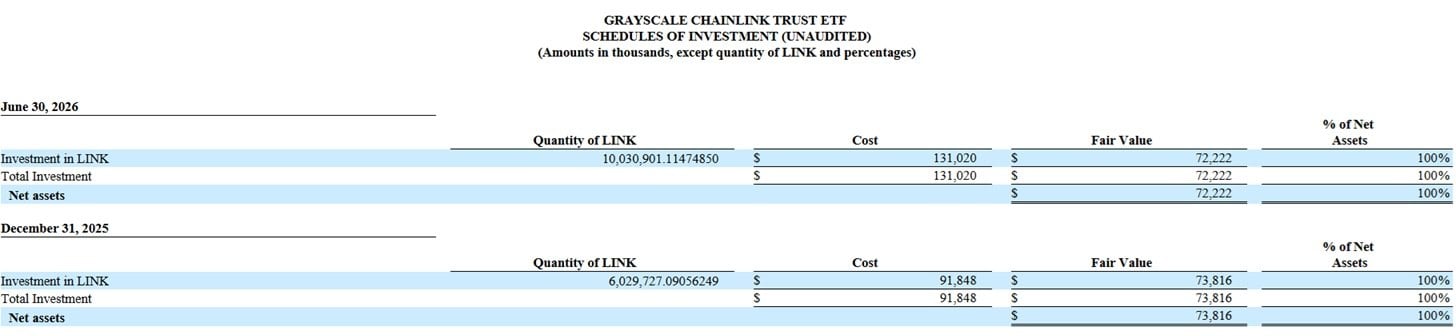
Image source: SEC.gov

Form 10-Q reports are standard disclosures that every U.S.-registered fund is required to file quarterly, and the GLNK documentation contains no new regulatory aspects. However, the figures presented reflect the situation of a token that has been struggling since institutional investors gained direct access to it. GLNK began trading on NYSE Arca on December 2, 2025, resulting in the conversion of a Delaware-based trust, which Grayscale had managed privately since 2020, into a fund whose shares can be purchased by anyone with a brokerage account.

The rapid launch of GLNK is tied to a rule change less than a year ago. In September 2025, the Securities and Exchange Commission (SEC) approved general listing standards for crypto exchange-traded products, allowing exchanges like NYSE Arca to list qualifying converted crypto trusts without the individual filing procedure that previously took the better part of a year. Grayscale leveraged this accelerated process to bring GLNK, along with several other single-asset converted trusts, to market within months.

A Difficult Quarter for $LINK

The most telling metric in the report is the token price at the end of the quarter, which was $7.25 (June 30), down from $8.77 at the time of the previous 10-Q filing in May. This is an 18% drop over three months, which reduced the trust's net asset value (NAV) per share to $6.38. Grayscale's own calculations show the scale of the losses: just this quarter, the company incurred an unrealized loss of approximately $16.4 million on its $LINK holding (even with an unchanged token count).
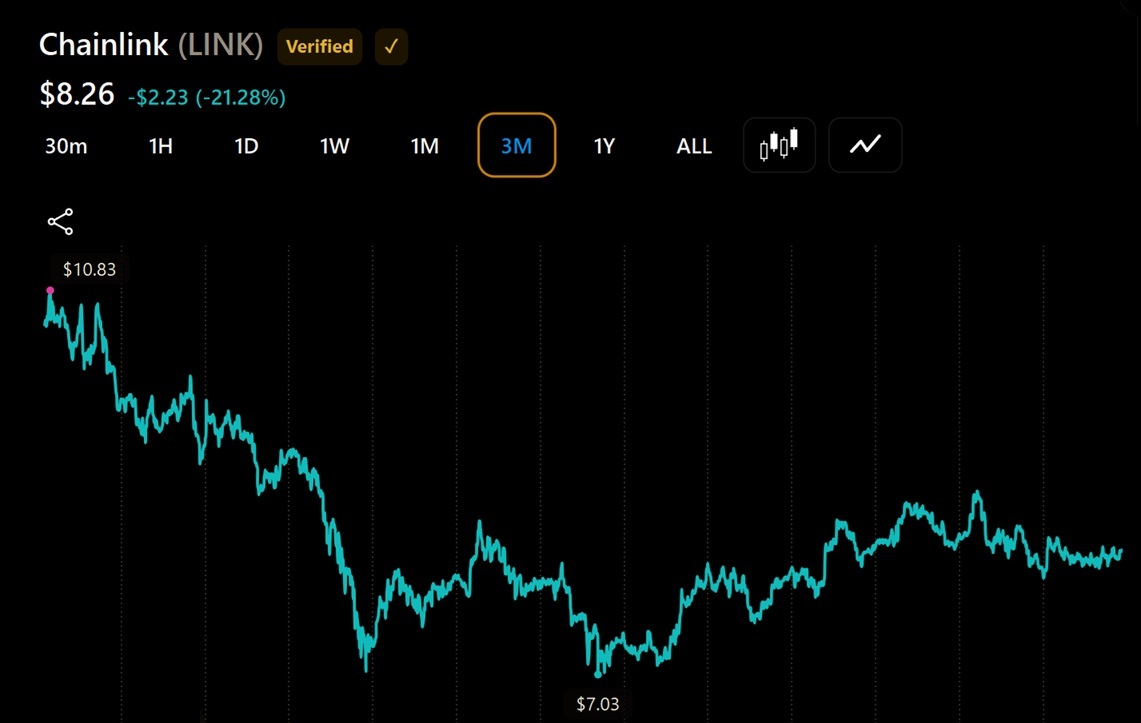
Chainlink—an oracle network that provides external data and price information for smart contracts on Ethereum and other blockchains—has exhibited volatile behavior since the launch of GLNK. And $LINK is not the only such case, given that most altcoins tied to blockchain infrastructure have been hit hard this year, despite bitcoin ETFs showing a partial recovery in recent weeks.

For a single-asset trust like GLNK, there is no diversification safety net, as the fund's fate hinges entirely on the price movement of $LINK—for better or worse.

A Growth Story That Stalled

By crypto ETF standards, the launch of GLNK was successful. On its first trading day, the fund attracted $41 million in inflows, causing its assets under management to grow to approximately $64 million within 48 hours. By April, assets under management (AUM) had risen to about $73 million, and some analysts projected that by mid-2026, the fund could reach $150–300 million in a base-case scenario, and $400–600 million in an optimistic scenario.

These projections have not materialized, as the second-quarter reporting shows net assets at $72.2 million, virtually unchanged from April's figure and significantly below even the most conservative growth scenario. This did not happen because investors withdrew funds (since the number of $LINK tokens remained stable throughout the quarter), but simply because new inflows were offset by the 18% price decline.

Lower Fees, Same Strategy

The only metric in the report that remained unchanged is the sponsor fee. Grayscale charges 0.35% annually on GLNK's assets—this rate was fixed when the trust converted to an ETF in December 2025 (compared to the 2.5% the company charged accredited investors under the previous private trust structure).

Grayscale also waived a portion of this fee until early March 2026 to smooth the transition—a scheme the company has used with other trust-to-ETF conversions. For the six months ended June 30, GLNK sponsor fees amounted to approximately $136,000 based on the fund's average net assets, aligning with the stated annual rate of 0.35%. This is a small amount compared to the $16.4 million quarterly paper loss, but it shows how difficult these single-asset crypto funds can be to operate.

end-content
Trending Cryptos

Related Questions

QWhat was the total value of Grayscale's Chainlink ETF (GLNK) assets under management at the end of Q2 2026, and what was the primary cause of the change in its dollar value?

AThe total value of GLNK's assets under management at the end of Q2 2026 was $72.2 million. The primary cause of the decrease in its dollar value was an 18% drop in the price of the LINK token, despite the number of tokens held remaining unchanged.

QHow does GLNK's performance and structure make it a high-risk investment according to the article?

AGLNK is a single-asset trust whose fate depends entirely on the price movement of the LINK token. With no diversification, the fund is highly exposed to the volatility of LINK, as demonstrated by an $16.4 million unrealized loss in Q2 due solely to the token's price drop.

QWhat regulatory change enabled the rapid public listing of the Grayscale Chainlink Trust as an ETF on NYSE Arca in December 2025?

AIn September 2025, the SEC approved universal listing standards for crypto exchange-traded products. This allowed exchanges like NYSE Arca to list qualifying converted crypto trusts without the lengthy, individual filing process, enabling Grayscale to launch GLNK within months.

QWhy did GLNK's assets under management (AUM) stagnate around $72-$73 million in Q2 2026, failing to meet growth projections?

AGLNK's AUM stagnated because any new investor inflows during the quarter were completely offset by the 18% decline in the price of the LINK token. The number of LINK tokens held was stable, but their falling value prevented asset growth.

QWhat is the sponsor fee for the GLNK ETF, and how does it compare to the fee charged under its previous private trust structure?

AThe sponsor fee for the GLNK ETF is 0.35% annually. This is significantly lower than the 2.5% fee Grayscale charged accredited investors under the fund's previous private trust structure before its conversion in December 2025.

Related Reads

Vote on CLARITY Act in US Senate Scheduled for September 15

The U.S. Senate is scheduled to hold a key procedural cloture vote on the Digital Asset Market Clarity Act (CLARITY Act) on September 15. The motion was filed by Senate Majority Leader John Thune, aiming to advance the bill for floor consideration after lawmakers failed to reach an agreement before the August recess. The vote requires 60 votes to proceed, meaning Republican support from Democrats is necessary. The landmark crypto regulatory bill aims to establish a federal market structure for digital assets, clarify whether crypto assets qualify as securities or commodities, and delineate regulatory authority between the SEC and CFTC. However, negotiations have been stalled by disagreements over proposed ethics provisions, which would restrict government officials and their families from profiting from digital assets while in office, and rules governing stablecoin yields. To break the impasse, lawmakers are reportedly working on a bipartisan ethics amendment, partly addressing Democratic concerns about former President Trump's crypto-related financial interests. The outcome of the September 15 vote and the ability to resolve disputes over ethics and stablecoin rules before then will determine the bill's future. Passage would significantly shape U.S. digital asset regulation for years to come, though aligning SEC and CFTC operational standards post-enactment is expected to be a lengthy process.

cryptonews.ru1h ago

Vote on CLARITY Act in US Senate Scheduled for September 15

cryptonews.ru1h ago

Trading

Spot

Hot Articles

Discussions

Welcome to the HTX Community. Here, you can stay informed about the latest platform developments and gain access to professional market insights. Users' opinions on the price of S (S) are presented below.

活动图片