Crypto market’s weekly winners and losers – LDO, PUMP, LIT, PI

ambcryptoPublished on 2026-07-19Last updated on 2026-07-19

Abstract

The crypto market saw mixed performance this week, with technical rallies and profit-taking driving action. Weekly winners were led by Lido DAO (LDO), up 16% and approaching a key resistance zone. Pump.fun (PUMP) followed with a 13% gain but remains below critical resistance. Venice Token (VVV) posted a 12.3% relief rally after a prolonged downtrend. Notable altcoin gainers included IOTA (SN9) and Akedo (AKE). On the losing side, Lighter (LIT) fell 16%, entering a cooldown phase after a strong rally. Pi Network (PI) declined 2.7%, breaking below key support to a new all-time low. Arbitrum (ARB) dropped as bulls failed to reclaim the $0.10 resistance. Other significant losers included Cash Cat (CASHCAT) and LAB. Overall, the week featured sharp swings, with recovery attempts in some assets and extended declines in others, highlighting ongoing market rotation and volatility.

This week, the crypto market was mixed.

Bitcoin traded sideways while several altcoins saw strong price swings. A handful of tokens posted solid weekly gains, while others extended their losses after failing to hold key support levels.

Overall, the week was driven by technical rallies, profit-taking, and continued rotation into select altcoins.

Weekly winners

Lido DAO [LDO] nears a key resistance zone

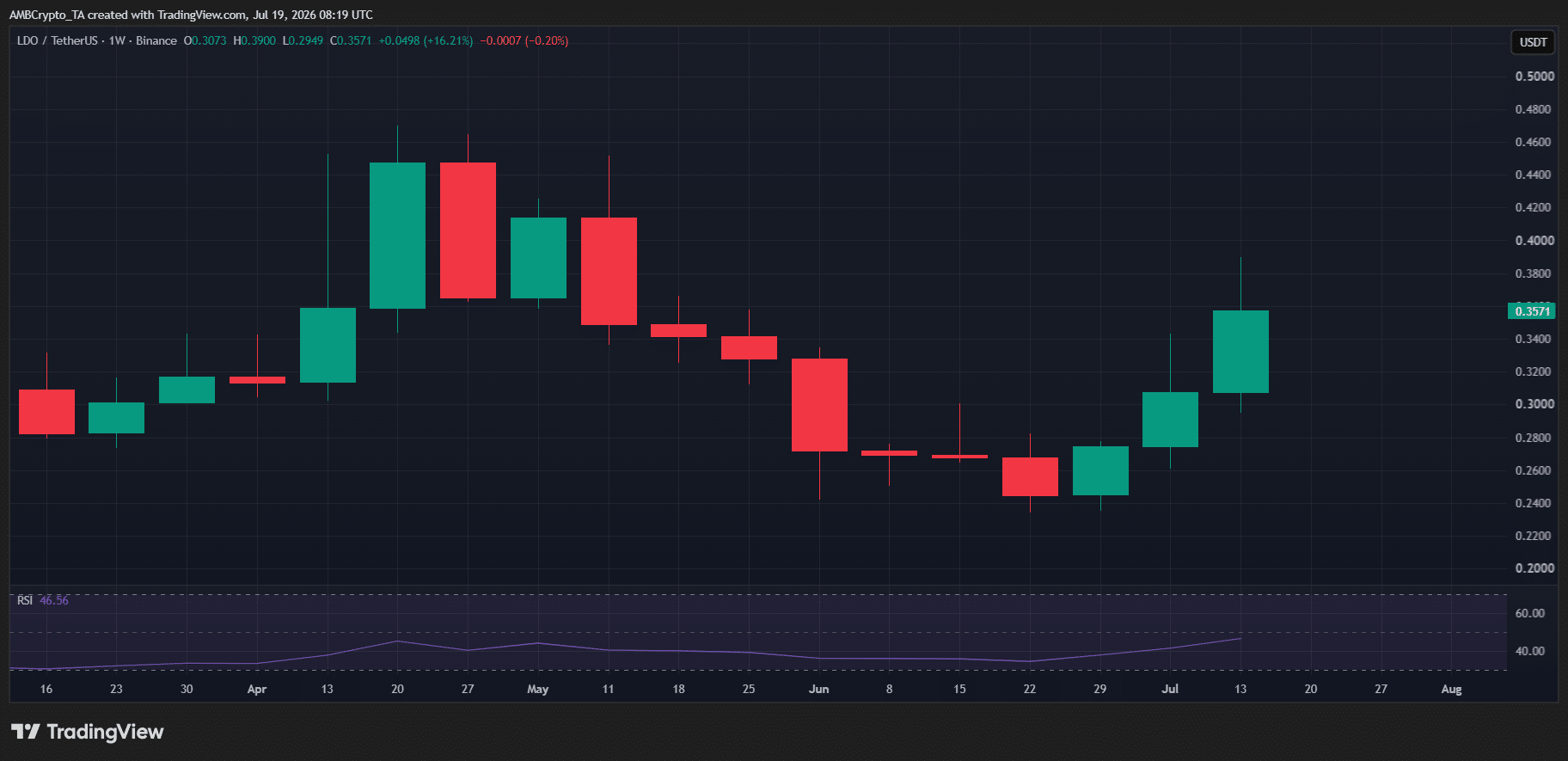
Lido DAO [LDO] led this week’s movers with a 16% rally. Notably, this comes after two straight weeks of upside, pushing LDO’s total gains to 25%. In just 21 days, the token has delivered a solid 40%+ recovery.

Why does this matter? Despite the recent move higher, LDO’s RSI is still far from the extreme overbought zone. This shows the rally has not yet entered a crowded phase, leaving room for further upside if momentum continues.

Technically, this suggests LDO’s move is more than just a random pump. The rally follows a sharp June sell-off, where LDO dropped toward $0.20 and broke below its Q1 lows. The current recovery shows buyers are stepping back in and attempting to reverse the previous downtrend.
Source: TradingView (LDO/USDT)

If this momentum continues, a breakout toward the $0.40 resistance zone could be on the table.

For context, LDO faced heavy selling pressure around this level during Q1, making it a critical area for bulls to reclaim. A successful breakout could strengthen the recovery narrative, while another rejection may trigger a period of consolidation as traders reassess the next move.

Is Pump.fun [PUMP] still far from reaching full FOMO?

Pump.fun [PUMP] emerged as the second-biggest weekly winner with a 13% rally. While the RSI remains neutral and PUMP has seen strong trading volume in recent sessions, calling this a full-fledged breakout setup may still be too early.

For over two months, PUMP has been trading below the key $0.002 resistance zone, making this the most important level for bulls to reclaim. However, every weekly push higher has so far been followed by a sharp cooldown phase, showing that accumulation is still not strong enough to support a larger breakout.

In short, though, PUMP is showing early signs of recovery, the structure still needs confirmation. Until buyers can consistently defend higher levels and break through the $0.002 resistance, the token remains in a consolidation phase rather than a confirmed breakout trend.

Venice Token [VVV] sees a much-needed weekly relief rally

Venice Token [VVV] took the third spot this week with a 12.3% rally. For VVV, this could be one of its most significant weeks since mid-Q2. From a technical standpoint, VVV has been stuck in a consistent downtrend over the past eight weeks, with every weekly close ending in the red.

However, this week’s gains have clearly pushed VVV back into the spotlight. More importantly, the recovery came right after VVV broke below the key $10 support level, suggesting buyers stepped in at a critical zone. In this context, the rally looks more strategic, with bulls attempting to defend lower levels and build a recovery base.

If this trend holds, VVV could have started its recovery phase. The next key challenge sits around $15, which will determine whether this rebound can turn into a stronger reversal or remain just a short-term relief rally.

Other notable winners

Outside the majors, altcoin movers also stole the spotlight this week.

IOTA [SN9] led the market with a staggering 5,267% gain, followed by Akedo [AKE], which surged 874%, while TENDIES [TENDIES] climbed 615%, rounding out the week’s top performers.

Weekly losers

Lighter [LIT] enters a textbook cooldown phase

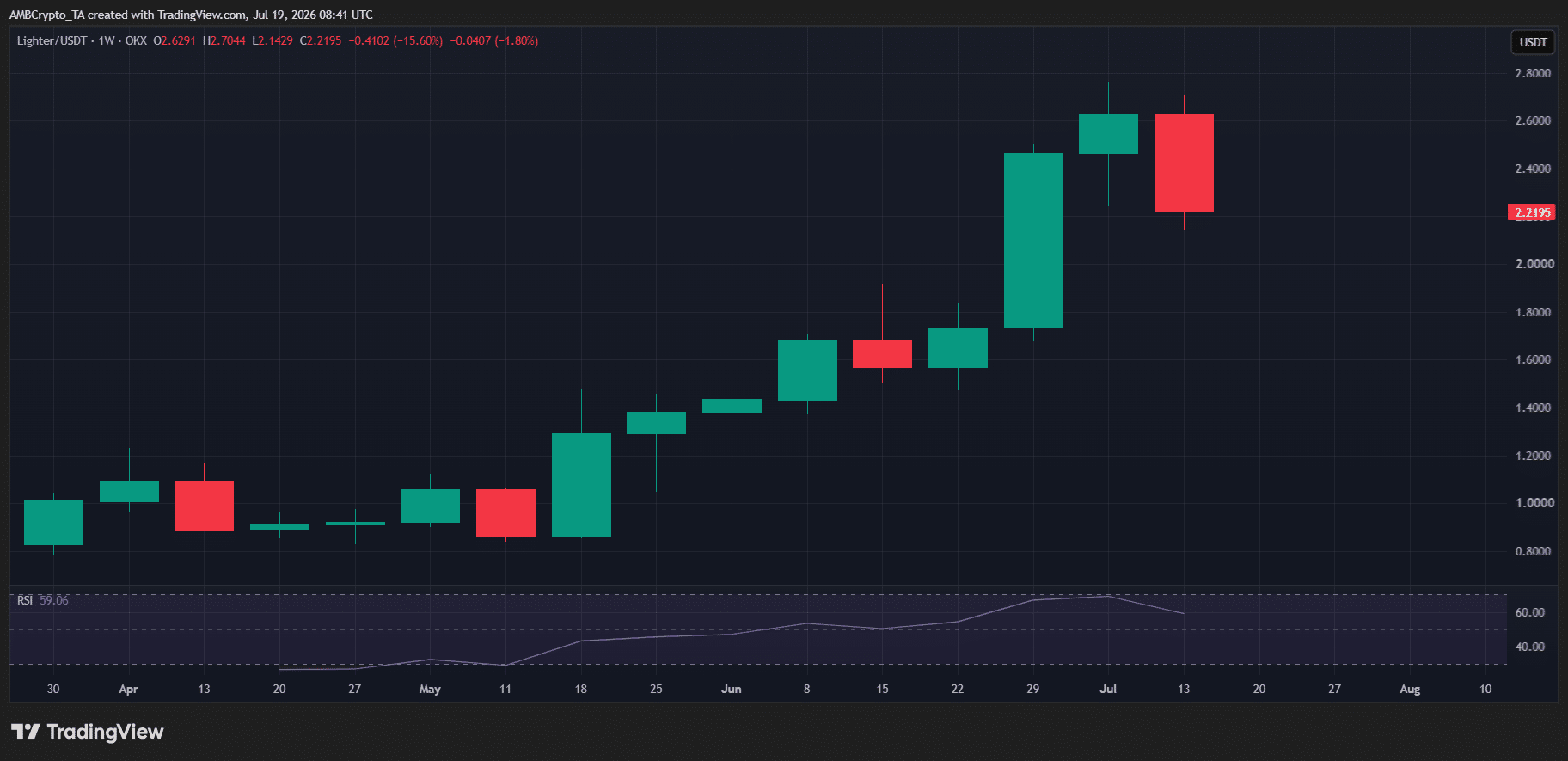
Lighter [LIT] led this week’s losses with a 16% decline. While LIT has seen similar pullbacks after strong weekly rallies since its mid-May breakout, this correction could be slightly different.

Notably, LIT’s drop comes after three straight weeks of upside, where the token rallied over 60% and reached a new all-time high of $2.70. More importantly, the breakout followed a successful retest of the $2 resistance zone, showing bulls were stepping in at key levels, a trend that has supported LIT’s Q2 rally.

However, this time, the RSI had climbed above 70, signaling an overheated move. The pullback toward 52 shows momentum has cooled, but it also suggests the market is resetting rather than losing strength.
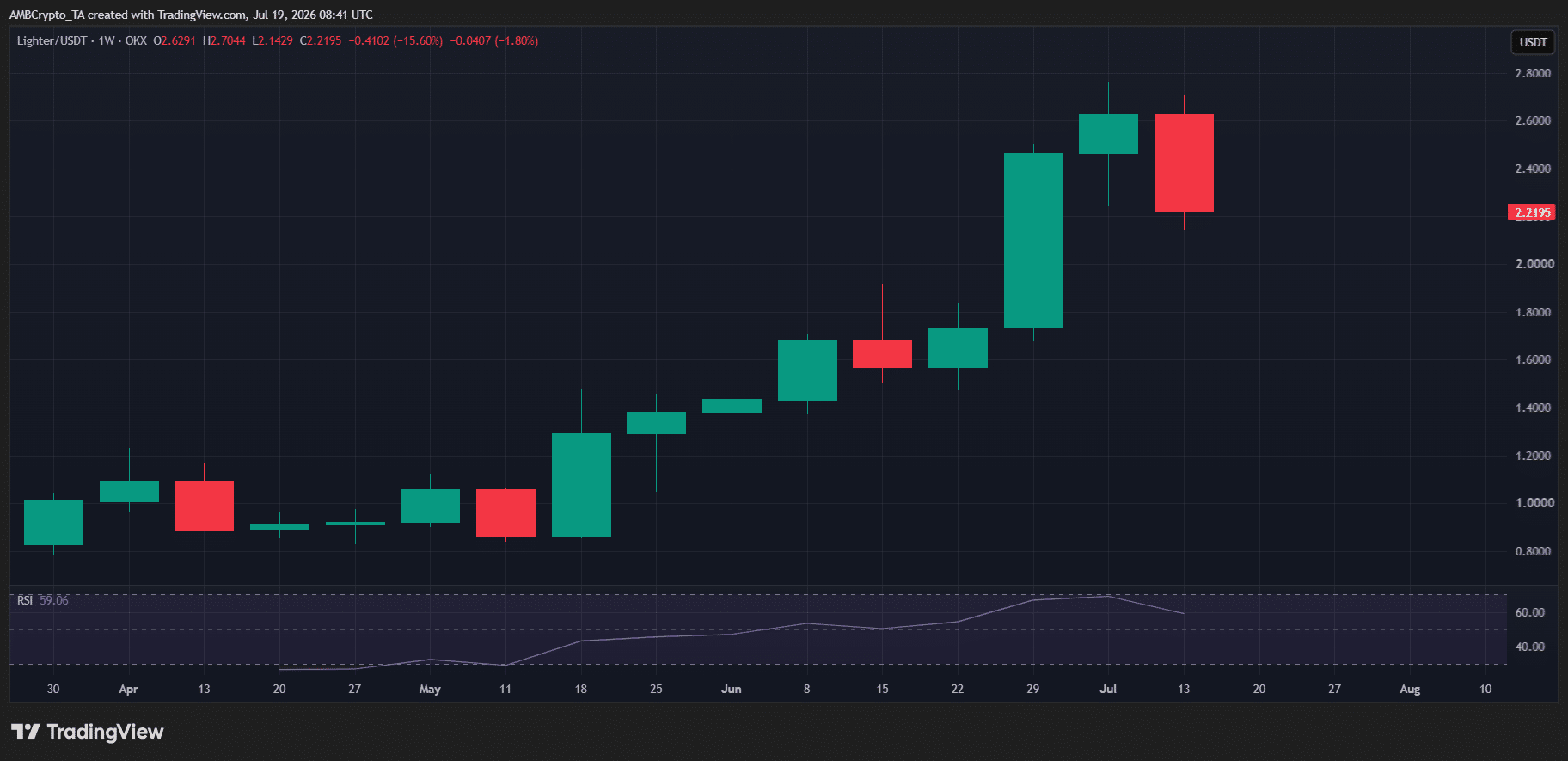
Source: TradingView (LIT/USDT)

Technically, however, this marks LIT’s strongest RSI pullback since its Q2 rally. In essence, this cooldown could become an important setup for LIT’s next move. If buyers step back in and the RSI starts recovering, this reset could fuel another upside attempt.

Otherwise, this could be the first real sign that LIT has formed a local top.

Pi Network [PI] broke below a key support zone

Pi Network [PI] emerged as the second-biggest loser this week with a 2.7% decline. While the drop looks modest compared to Lighter’s double-digit losses, PI’s chart looks much weaker, pointing to a stronger bearish bias.

Notably, this marks PI’s fourth straight week of losses. More importantly, the token broke below the key $0.10 support level, putting any near-term bounce under renewed selling pressure and printing a fresh all-time low.

Technically, PI remains firmly in a bearish structure. While the RSI has dropped into oversold territory, that alone doesn’t guarantee a recovery. Unless buyers reclaim the $0.10 level, any bounce could simply be a short-term relief rally rather than the start of a trend reversal, keeping PI as one of the weaker charts in the market right now.

Are Arbitrum [ARB] bulls losing their upper hand?

Arbitrum [ARB] took the third spot among this week’s biggest losers. Unlike PI, however, ARB’s chart hasn’t fully shifted into a bearish structure. The pullback comes after two straight weeks of gains, during which the token rallied more than 25%.

However, this week’s decline followed ARB’s failure to break above the key $0.10 resistance zone, a level that has capped price since the early May cycle. The rejection shows bulls are still struggling to reclaim this area, allowing sellers to regain short-term control.

Technically, ARB is at an important inflection point. If bulls can reclaim the $0.10 resistance zone, the recent pullback could turn into a healthy retest. Otherwise, continued rejection at this level may keep ARB stuck in a broader consolidation phase and hand bears the upper hand in the near term.

Other notable losers

In the broader market, downside volatility hit hard.

Cash Cat [CASHCAT] led the losers with a 72% decline, followed by LAB [LAB], which fell 66.5%, while ETHGas [GWEI] dropped 53.3% as bearish momentum intensified.

Conclusion

This week was a rollercoaster for crypto. Big pumps, sharp dips, and nonstop action. As always, stay sharp, do your own research, and trade smart.


Final Summary

  • Lido DAO [LDO], Pump.fun [PUMP], and Venice token [VVV] led the week in gains.
  • Lighter [LIT], Pi network[PI], and Arbitrum [ARB] saw significant declines.

Trending Cryptos

Related Questions

QWhich token led this week's biggest gainers, and what was its price performance?

ALido DAO [LDO] led this week's biggest gainers with a 16% rally. Over the last three weeks, it has gained 25%, and in the past 21 days, it has recovered over 40%.

QWhat is the key technical challenge for Lighter [LIT] following its pullback this week?

AFollowing its 16% pullback, the key technical challenge for Lighter [LIT] is whether the cooldown phase resets the market for another upside attempt or confirms a local top. The RSI has cooled from above 70 to around 52.

QWhy is the $0.002 level significant for Pump.fun [PUMP]?

AThe $0.002 level is a key resistance zone for Pump.fun [PUMP]. It has capped the token's price for over two months, and buyers need to consistently break through this level to confirm a breakout trend rather than remaining in consolidation.

QWhat factor makes Pi Network [PI]'s chart structure particularly weak despite its modest weekly loss?

APi Network [PI]'s chart structure is weak because it broke below the key $0.10 support level, printing a fresh all-time low. This marks its fourth consecutive week of losses, and the RSI being oversold does not guarantee a recovery without reclaiming that level.

QAccording to the article, what were the primary drivers of the crypto market's activity this week?

AThe primary drivers of the crypto market's activity this week were technical rallies, profit-taking, and continued rotation into select altcoins.

Related Reads

Dialogue with Jia Hang | Looking Back at Two Decades of Chinese Payment Going Global

**Summary: A Conversation with Jia Hang on Two Decades of China's Payment Globalization** Jia Hang, a veteran with over twenty years in payments, reflects on China's attempts to build a global payment network through three key phases: UnionPay (card networks), Alipay+ (digital wallets), and now, stablecoins. His journey began at UnionPay International, aiming to establish China's card network abroad. While successful in following Chinese tourists ("where Chinese go, UnionPay goes"), it struggled to achieve true global scale. The core lesson: card networks like Visa/Mastercard's unassailable advantage isn't just technical standards, but their deeply entrenched **governance and profit-sharing models** that create powerful network effects. Competing as the "same species" is nearly impossible. At Ant Group, he led Alipay+, a strategy to bypass card networks by interconnecting local e-wallets worldwide. While innovative, it faced a similar ceiling. Mobile QR payments and card swipes were essentially **the same species competing for the same pie**, lacking a disruptive value proposition for users or a sustainable new incentive model to replace the card networks' established flywheel. Today, at Singapore's DCS, Jia focuses on stablecoin-based payments. He argues stablecoins represent a fundamental shift. They are not competing with Visa for consumer payments but challenging the **traditional banking and account system for value movement**. Products like "U Cards" (stablecoin-linked payment cards) are transitional, leveraging existing card networks for acceptance while building new rails. The real potential lies in stablecoins enabling seamless, low-cost global value transfer, potentially reorganizing the financial infrastructure around **accounts rather than cards**. Jia believes stablecoin adoption for local retail payments, cross-border transactions, and as high-yield savings vehicles is becoming irreversible. This could gradually reduce reliance on traditional fiat channels, especially in regions with weak currencies or capital controls. The quest for the "next global payment network" continues, now centered on whether stablecoins can successfully bridge Web2 and Web3, establish new governance, and create compelling user value beyond mere cost reduction.

marsbit4m ago

Dialogue with Jia Hang | Looking Back at Two Decades of Chinese Payment Going Global

marsbit4m ago

Circle's Stock Price Plunges 76%, Hong Kong Dollar Stablecoin Set to Launch Within Two Weeks

Circle's stock price has plunged approximately 76% from its 2023 peak, reflecting a major market revaluation. Despite this, Circle President Heath Tarbert emphasized the company's focus on long-term execution and its dominant position with USDC's $73 billion circulation across 34 blockchains. The competitive landscape is intensifying. A new consortium-backed stablecoin, Open USD, is attempting to challenge incumbents by sharing reserve yields with partners. More significantly, Visa's new stablecoin platform, initially supporting Open USD while also being compatible with USDC, could erode Circle's network effects. In response, Circle is expanding into real-world payments through partnerships like the one with Japan's JCB. Separately, Tether (USDT) faces a two-year compliance window under new U.S. regulations, requiring it to adjust its reserve composition away from assets like Bitcoin and loans towards cash and U.S. Treasuries. Meanwhile, in Hong Kong, Standard Chartered-backed fintech firm Dian Dian is poised to launch a licensed HKD-pegged stablecoin (HKDAP), moving the industry into a phase where the real test is integrating licensed stablecoins into actual payment flows and corporate treasury systems. The sharp decline in Circle's stock underscores a broader shift: the stablecoin market is moving from a winner-takes-all dynamic to a multi-player competitive arena where execution, compliance, and real-world utility are becoming paramount.

marsbit4m ago

Circle's Stock Price Plunges 76%, Hong Kong Dollar Stablecoin Set to Launch Within Two Weeks

marsbit4m ago

Amidst Capital's Encirclement, Decentralization is the Sole Defense for Public Blockchains

In a landscape dominated by power and profit motives, the author argues that decentralization is not merely one desirable feature among many in blockchain design—it is the singular, non-negotiable defense against corporate and capital capture. The article adopts a Machiavellian, realist perspective on human institutions, positing that businesses will inevitably attempt to co-opt any valuable network to protect their profits and dominance. While external attacks like 51% forks are often discussed, the greater existential risk is internal capture—the gradual erosion of a protocol’s neutrality by vested interests, as seen historically with platforms like Visa and Google. The piece critiques permissioned chains, highly centralized “permissionless” layer-1s, and layer-2s without sufficient decentralization (e.g., single sequencers) as inherently vulnerable. These compromised systems, promoted by established financial players, are framed as delaying tactics to stifle truly open networks that threaten existing high-fee, inefficient business models. Real-world examples, such as closed enterprise consortiums that exclude competitors, illustrate how such systems cement oligopolies rather than foster innovation. The author concludes that while decentralized protocols like Ethereum are imperfect and costly to operate, they represent the only viable long-term equilibrium. In a market where value naturally flows to the most secure and neutral settlement layer, only maximally decentralized public blockchains can resist being subsumed by capital and powerful incumbents.

Foresight News15m ago

Amidst Capital's Encirclement, Decentralization is the Sole Defense for Public Blockchains

Foresight News15m ago

Who Decides the Rules of Bitcoin? BIP-110 Ignites Governance Debate

Bitcoin's governance is once again at the center of a heated debate, this time ignited by BIP-110, the "Reduced Data Temporary Softfork." This proposal aims to curb non-monetary data (like inscriptions and Runes) by introducing seven new consensus-layer restrictions over a year, such as limiting new output scripts to 34 bytes and restoring the OP_RETURN cap to 83 bytes. The controversy stems from BIP-110's fundamental shift: it moves the battle against "spam" from node relay and miner policies to the consensus layer, rendering currently valid transactions invalid. Supporters, arguing that default policy governance has failed (highlighted by Bitcoin Core v30's relaxation of OP_RETURN limits), see this as necessary to protect node resources and Bitcoin's monetary focus. Opponents, led by figures like Michael Saylor and Adam Back, warn it dangerously centralizes governance. Saylor listed 110 reasons against it, criticizing its low 55% miner activation threshold and potential for chain splits. Back emphasized Bitcoin's "permissionless" ethos, arguing no single group should impose value judgments via consensus rules. Further complicating matters, technical critiques suggest BIP-110 may be technically circumventable, and a "BlockSlop" vulnerability in its upgrade path poses a consensus risk. The debate has drawn in diverse stakeholders: miners (with pools like Ocean signaling support and Foundry polling clients), node operators (like Bitcoin Knots), and new players like corporate treasury holder MicroStrategy (Saylor), whose market influence adds a novel dimension. Ultimately, BIP-110 acts as a governance stress test, exposing the unresolved question: who decides Bitcoin's rules? It pits the authority of miners, node operators, developers, and capital holders against each other, with each side claiming to defend Bitcoin's core principles of neutrality and security.

marsbit31m ago

Who Decides the Rules of Bitcoin? BIP-110 Ignites Governance Debate

marsbit31m ago

Who Decides Bitcoin's Rules? BIP-110 Ignites Governance Debate

Title: Who Decides Bitcoin's Rules? BIP-110 Ignites Governance Debate A new technical proposal, BIP-110 (Reduced Data Temporary Softfork), has sparked a fundamental governance debate within the Bitcoin community. It aims to impose new consensus rules for one year to limit non-financial data (like inscriptions and Runes) on-chain, moving beyond simple node and miner policy filters to invalidate currently valid transactions. Supporters argue that default policies have failed due to workarounds, necessitating consensus-layer changes to protect Bitcoin's core monetary function from data spam. Critics, including Michael Saylor and Adam Back, contend this dangerously centralizes judgment, undermines permissionlessness, and sets a risky governance precedent. They advocate for market-based solutions like fees or Layer 2s instead. The debate exposes deeper tensions: miners are divided on activation; node operators assert their sovereignty; Bitcoin Core developers influence defaults without direct accountability; and large corporate holders like MicroStrategy now wield narrative influence. Technically, BIP-110 may not fully block data and carries a disclosed consensus bug risk. Ultimately, BIP-110 acts as a stress test, forcing the community to confront the unresolved question: who legitimately decides what Bitcoin is and how it evolves, amidst competing claims from miners, nodes, developers, and capital holders.

链捕手43m ago

Who Decides Bitcoin's Rules? BIP-110 Ignites Governance Debate

链捕手43m ago

Trading

Spot

Hot Articles

How to Buy PUMP

Welcome to HTX.com! We've made purchasing Pump.fun (PUMP) simple and convenient. Follow our step-by-step guide to embark on your crypto journey.Step 1: Create Your HTX AccountUse your email or phone number to sign up for a free account on HTX. Experience a hassle-free registration journey and unlock all features.Get My AccountStep 2: Go to Buy Crypto and Choose Your Payment MethodCredit/Debit Card: Use your Visa or Mastercard to buy Pump.fun (PUMP) instantly.Balance: Use funds from your HTX account balance to trade seamlessly.Third Parties: We've added popular payment methods such as Google Pay and Apple Pay to enhance convenience.P2P: Trade directly with other users on HTX.Over-the-Counter (OTC): We offer tailor-made services and competitive exchange rates for traders.Step 3: Store Your Pump.fun (PUMP)After purchasing your Pump.fun (PUMP), store it in your HTX account. Alternatively, you can send it elsewhere via blockchain transfer or use it to trade other cryptocurrencies.Step 4: Trade Pump.fun (PUMP)Easily trade Pump.fun (PUMP) on HTX's spot market. Simply access your account, select your trading pair, execute your trades, and monitor in real-time. We offer a user-friendly experience for both beginners and seasoned traders.

4.6k Total ViewsPublished 2024.03.29Updated 2026.07.09

How to Buy PUMP

Discussions

Welcome to the HTX Community. Here, you can stay informed about the latest platform developments and gain access to professional market insights. Users' opinions on the price of PUMP (PUMP) are presented below.

活动图片