Karpathy's Genius Strikes Again, Challenging RAG, Turning Your Notes into a Second Brain

marsbitPublished on 2026-07-01Last updated on 2026-07-01

Abstract

Andrej Karpathy has proposed a revolutionary concept for managing personal knowledge: treating notes as immutable "source code" and using LLMs as "compilers" to build a structured, interlinked wiki. This approach fundamentally shifts the cognitive workflow away from the limitations of RAG (Retrieval-Augmented Generation), which merely retrieves and pieces together fragments, leading to contradictions and "digital mummies"—unused, decaying notes. The LLM-Wiki framework introduces a three-layer architecture: the **Raw Layer** for original, immutable notes; the **Schema Layer** defining rules for structuring knowledge; and the **Wiki Layer**, where the LLM continuously compiles and maintains a coherent, cross-referenced knowledge base. Key operations are **Ingest** (adding new material, which triggers updates across related pages), **Query** (asking the compiled wiki, with answers that can become new pages), and **Lint** (periodic AI audits to find contradictions, outdated claims, or gaps). This system automates the tedious maintenance—updating links, resolving conflicts, keeping summaries fresh—that has historically made large-scale personal knowledge management unsustainable. It realizes Vannevar Bush's 1945 "Memex" vision by finally solving the maintenance problem. Karpathy's proposal represents a third piece in human-AI collaboration, following "Vibe Coding" and "Agentic Engineering." It liberates human attention from organizational drudgery, refocusing it on what matters:...

Saving does not mean owning. Highlighting does not mean understanding.

Those deeply insightful articles that stirred your heart at 2 a.m., the dense web of bidirectional links you created in Obsidian, the meticulously formatted databases in Notion—they are all "cyber mummies" lying dormant in your note-taking apps.

The graphs look impressive, but they have long since decayed.

This is a systemic failure of the entire information-overload era.

Andrej Karpathy, a current Anthropic engineer, former OpenAI co-founder, and former Tesla AI director, couldn't stand it any longer. He dropped a bombshell.
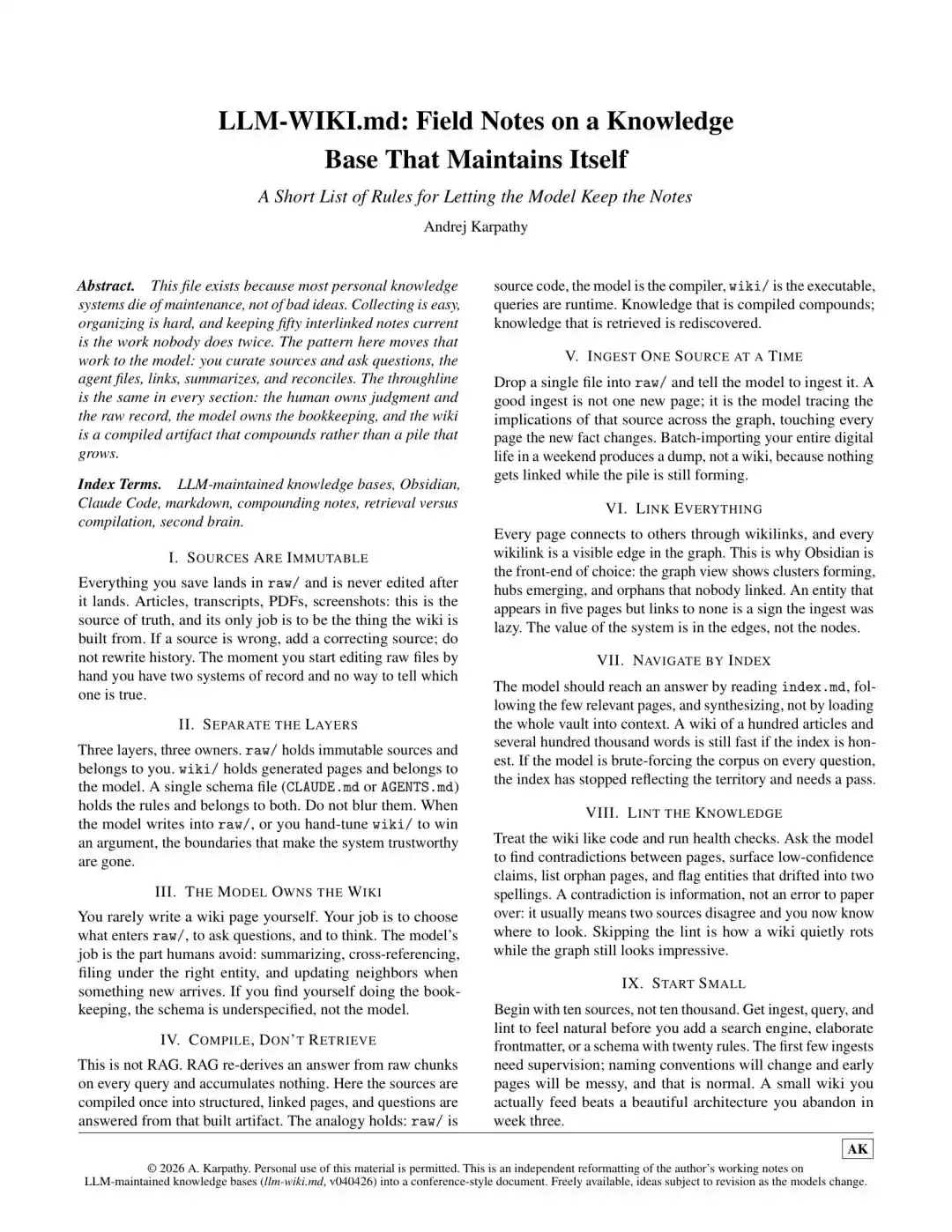
Portal:https://gist.github.com/karpathy/442a6bf555914893e9891c11519de94f

He didn't announce a new model or release a new framework. He simply said: Treat your notes as immutable source code, and let the LLM be the compiler.

Two months later, this document has sparked a quiet yet profound migration across the Obsidian, Claude, and Cursor communities.

Some have already expanded their personal wikis to hundreds of pages and hundreds of thousands of words.

Automated plugins are emerging. Academic researchers, independent entrepreneurs, and lifelong learners are collectively shifting towards a new mode of knowledge production.

The Twilight of RAG: Information Hauling Cannot Save Your Thinking

Before LLM-WIKI, the mainstream solution was RAG (Retrieval-Augmented Generation).

Simply put, it gives a large language model a "filer." When you ask a question, it searches your notes for a few snippets and pieces together an answer.
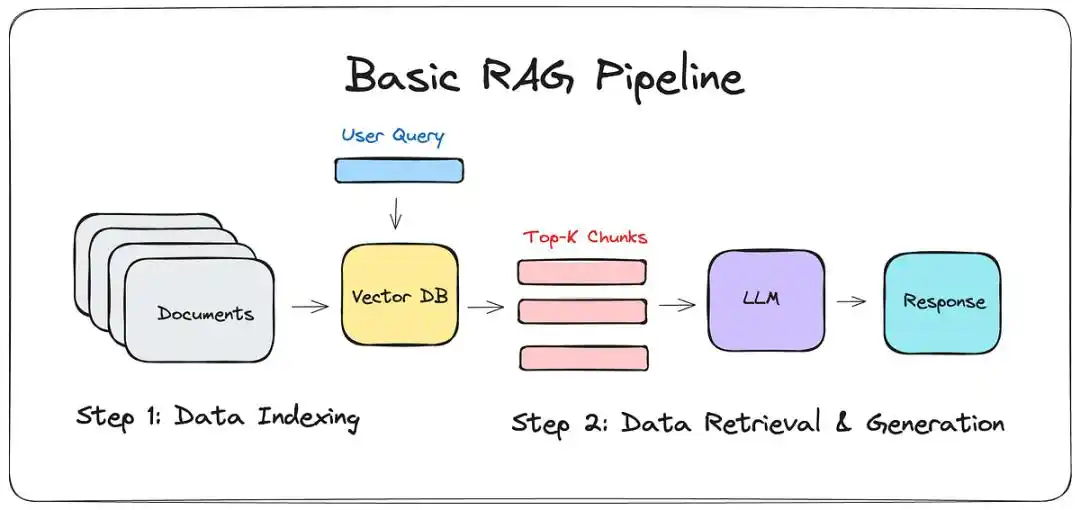
It sounds beautiful, but anyone who has used it knows the gap between "seller's show" and "buyer's reality."

It's merely a hauler: RAG only handles local context, incapable of global understanding.

It can tell you that note #5 mentions A, but it cannot tell you the underlying logic that all 500 notes collectively point towards.

It suffers from "split personality": If you believed A was correct six months ago but wrote a note refuting A yesterday, RAG often ends up contradicting itself, spouting a bunch of logically incoherent nonsense.

Graph Decay: Manually maintained knowledge links are like code without an automatic cleanup function. Over time, broken links are everywhere, and retrieval efficiency plummets exponentially.

Karpathy's insight is sharp: Search and retrieval are manifestations of human incapability. What we need is "consensus," "structure," "truth."

Treat Knowledge as Source Code, Let the LLM Be the Compiler

Karpathy's answer comes from an action programmers do every day but never think to apply to knowledge: compilation.

You write a piece of source code. You don't reread the entire code every time you run the program.

You compile it into a binary file. Compiling once is laborious, but every subsequent run is lightning-fast. The cost of compilation is amortized over thousands of future uses.

Why can't knowledge work the same way?

Karpathy says: Treat your raw notes as immutable source code. Treat the LLM as the compiler. Let it "compile" that pile of messy material once into a structured, interlinked Wiki.
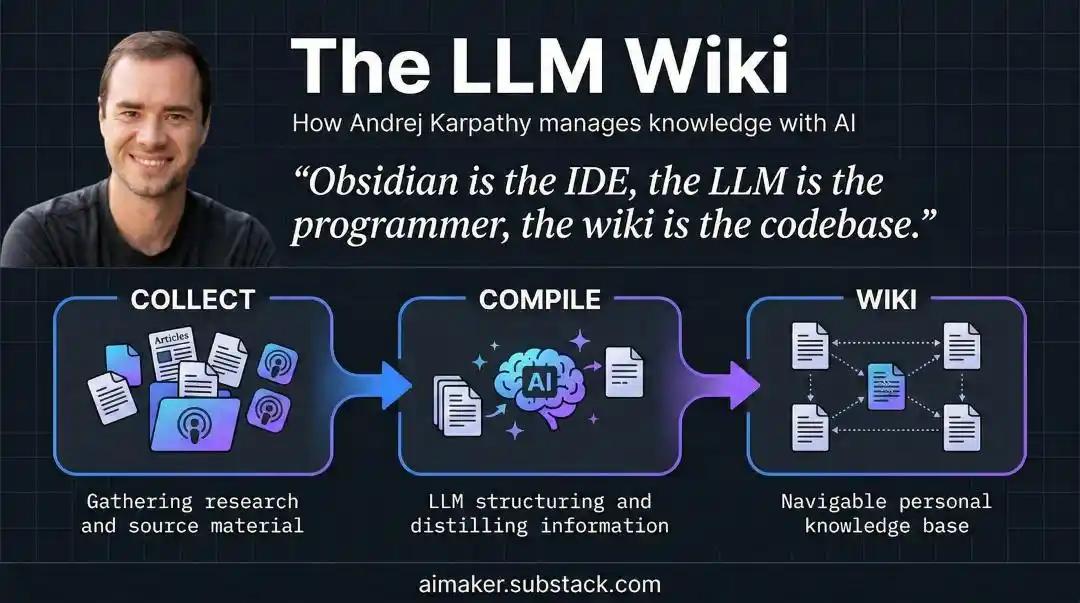
Every time you add new material, the AI performs a merge: it updates relevant entry pages, revises summaries, flags conflicts where new data clashes with old conclusions, and, in the process, reinforces or challenges existing judgments.
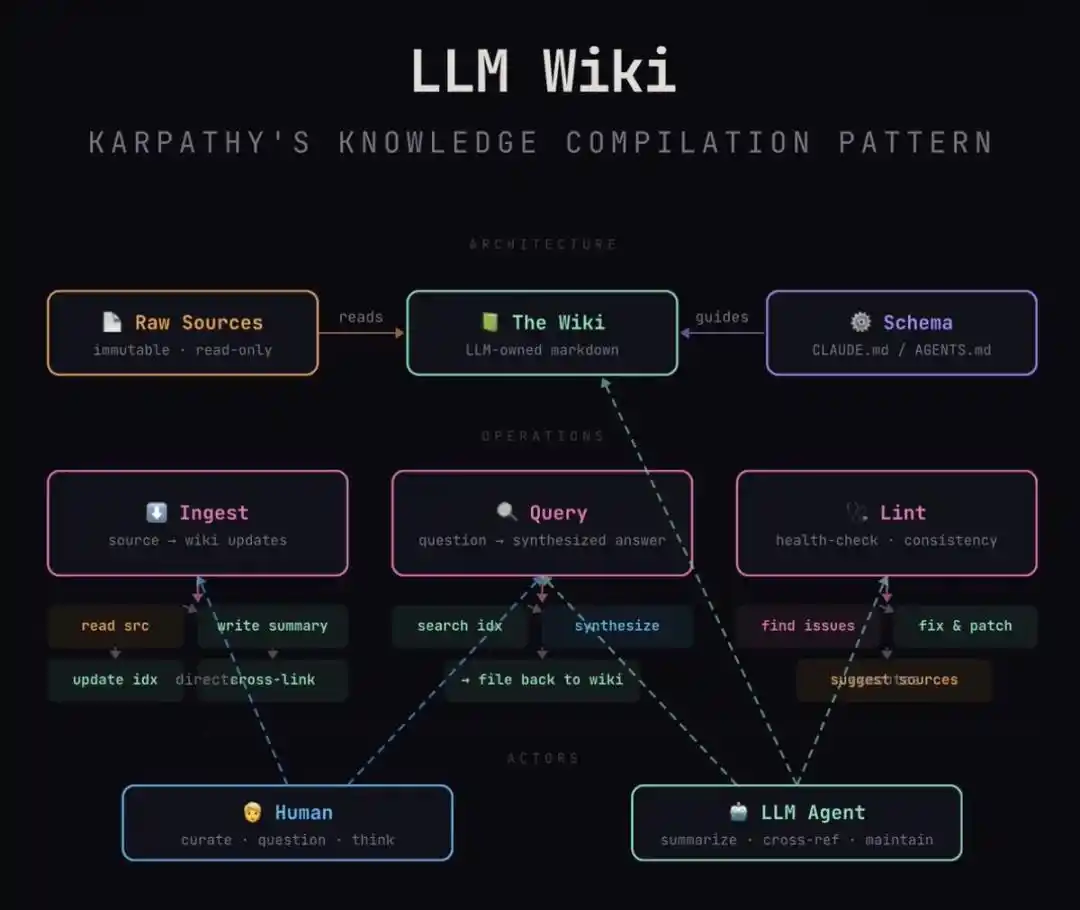
The key difference is here: Knowledge is compiled once and then kept fresh, not reconstructed from scratch for every query.

By the time you ask a question, cross-references are already there, contradictions have been flagged, and summaries already reflect everything you've read.

You don't recompile your source code every time you run a program. So why make the AI reread all your notes for every question?

A Fundamental Shift in the Production Relations of Cognition

In his LLM-WIKI framework, notes are no longer dead text; they are "source code."

The large model is no longer a translator looking up a dictionary; it is the "compiler."

This architecture brilliantly achieves a three-layer decoupling:

1. Raw Layer (Raw Material): This is your mine of inspiration. Random insights you jot down, clipped articles, meeting minutes. It is "immutable," preserving the rawness and messiness of human input.

2. Schema Layer (Knowledge Constitution): This is the "rules of engagement" you write for the AI. For example, you dictate: every person entry must contain "motivation, limitations, key achievements"; every technology stack must explain "pros and cons."

3. Wiki Layer (Compiled Product): This is the zone maintained autonomously by the AI. Following your Schema, it compiles that messy pile of Raw material into structured, cross-linked, logically coherent encyclopedia pages.
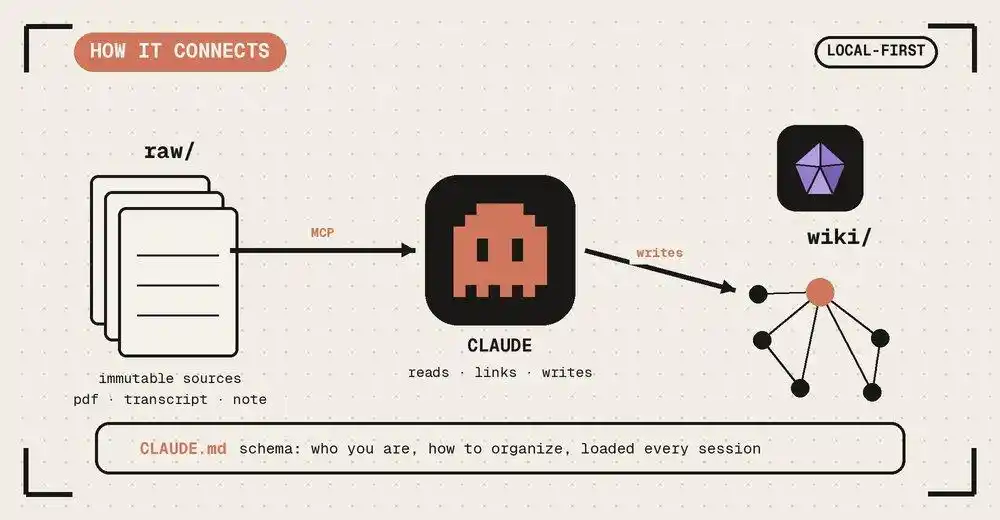
The daily workflow is three actions:

1. Ingest: Toss in a new piece of material. The AI reads it, discusses key points with you, writes a summary, and sweeps through the entire library to update related pages—one source can potentially affect a dozen pages.

2. Query: Ask the compiled Wiki directly. Answers come with citations. The best part: Excellent answers can be archived directly as new pages. Every exploration you make compounds interest.

3. Lint: Periodically have the AI perform a self-check, like code review—find contradictions, find outdated assertions, find isolated pages with no links, find gaps that need filling. Clean early, don't let the library grow rotten.

You are no longer a porter of knowledge; you are the architect of this intellectual empire.

You are only responsible for input and final review. The AI handles all the "grunt work": organizing, aligning, cross-linking, detecting contradictions.

This is a fundamental shift in the production relations of cognition.

This is not another chatbot. ChatGPT understands the internet. LLM-Wiki understands you—or more precisely, what you've taught it.

Every answer comes with [wiki-links] back to your knowledge graph. Every response is the starting point of an exploration path, not the end.

An Invention 80 Years Late

At this point, you might think this is just a clever workflow.

It's more than that.

At the end of his gist, Karpathy casually drops a name: Vannevar Bush, and his 1945 essay "As We May Think."
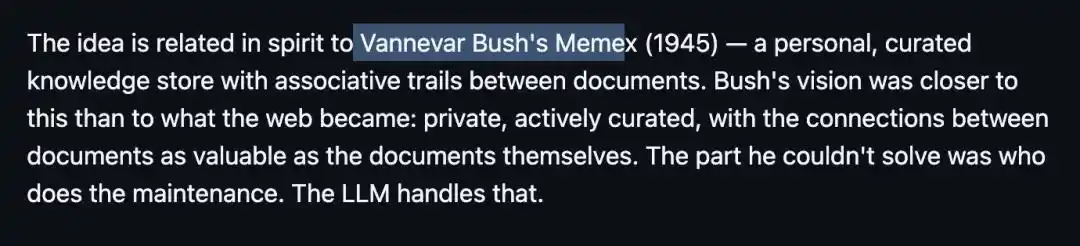
In 1945, just after WWII, this giant of American science envisioned a machine called "Memex":

A mechanical desk that could store all your books, records, and correspondence, and create "associative trails" between related items—connections between documents as valuable as the documents themselves.
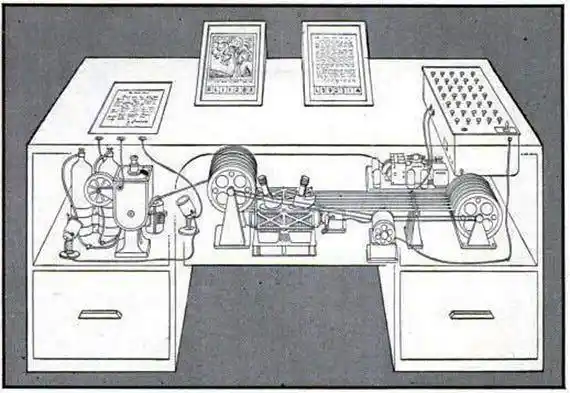
Sound familiar? This is almost a word-for-word description of LLM-Wiki.

Bush's vision was, in fact, closer to this than the later World Wide Web: a private, personally curated knowledge network where connections *are* the value.
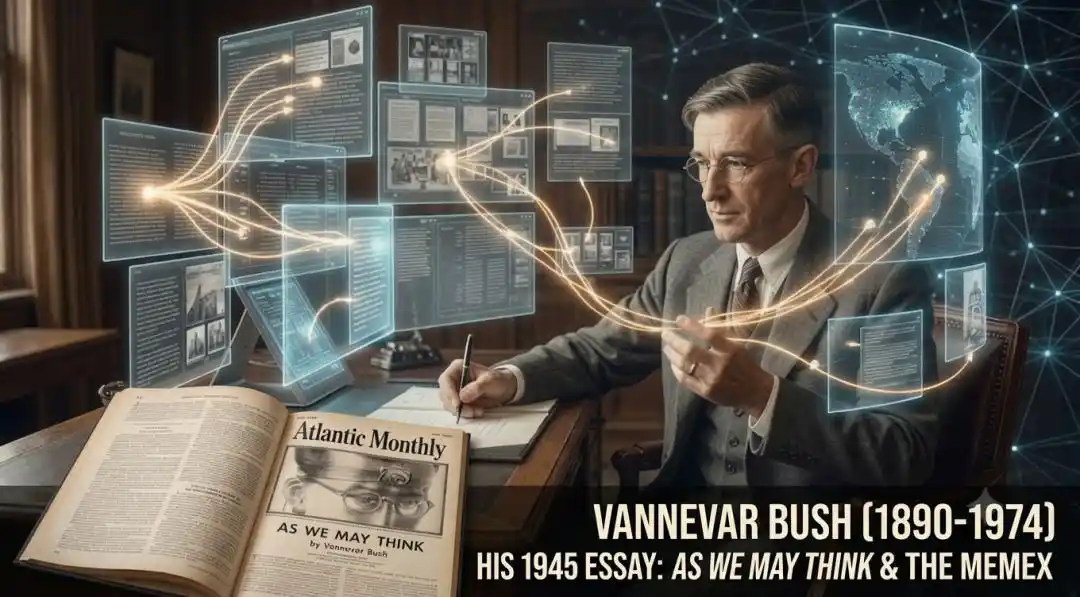
So why wasn't Memex built in 80 years?

Because Bush was stuck on a problem he couldn't solve—who maintains it?

Every associative trail had to be created manually. Every cross-reference had to be linked by someone.

Bush imagined dedicated "operators" laying down these little paths through knowledge for you.

But reality is, no one could sustain this tedious chore at scale. Humans abandon maintenance because the cost of maintenance always grows faster than the value it brings.

Karpathy's sentence is the crux of the entire paradigm: The hardest part of maintaining a knowledge base was never reading; it was bookkeeping.

Updating cross-references, keeping summaries fresh, tagging conflicts between new data and old conclusions, keeping dozens of pages consistent. This drudgery was enough to deter anyone.

But a large language model won't forget to update a cross-reference. It can modify fifteen files in one go.

It doesn't get tired. It doesn't get annoyed. It doesn't collapse from late-night fatigue. The maintenance cost is driven to near zero.

Thus, the machine that had stumped humanity for eighty years suddenly started running.

What's Liberated is Human Attention

Looking back, LLM-Wiki is Karpathy's third piece in the puzzle of "human-computer collaboration," and also the most restrained.

The first piece, Vibe Coding (Feb 2025): Accepting AI-written code, not reviewing line-by-line, trusting the model, testing the outcome.

The second piece, Agentic Engineering (Jan 2026): Humans orchestrating AI agents, not writing code themselves.

The third piece, LLM Knowledge Bases (April 2026): What the AI manages is no longer just code, but knowledge itself.
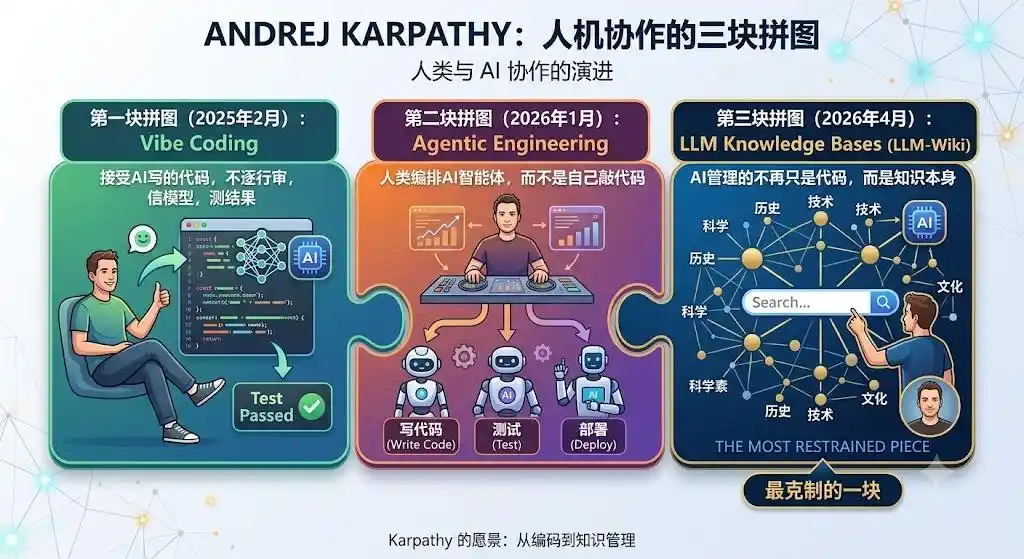
In this new paradigm, what is stripped away from humans are the chores no one likes to do: saving, organizing, linking, bookkeeping.

What remains for humans are only two things: deciding *what* to read, and figuring out what all of it *really means*. These are precisely the two things machines still cannot do and should never do for you.

This is a story of a tool evolving to its extreme, ultimately coming full circle to return human attention back to humans themselves.

That plain, almost unassuming markdown file didn't announce a model or top a leaderboard.

It just quietly reminded us: Your brain was never meant for bookkeeping.

This article is from the WeChat public account "新智元" (New Zhiyuan), author: ASI启示录

Trending Cryptos

Related Questions

QWhat is the core concept behind Karpathy's LLM-Wiki approach, as described in the article?

AThe core concept is to treat your raw notes as immutable 'source code' and use an LLM as a 'compiler' to process them all at once into a structured, cross-referenced, and logically consistent wiki. This compiled knowledge base is then used for querying, unlike RAG which retrieves and processes raw notes for each query.

QWhat are the three main layers of Karpathy's LLM-Wiki architecture?

A1. Raw Layer: The immutable, original source material like ideas, clipped articles, and meeting notes. 2. Schema Layer: The 'constitution' or rules you define for the AI, specifying the required structure for different types of entries (e.g., person entries must include motivation, limitations, key achievements). 3. Wiki Layer: The compiled, structured, and cross-referenced encyclopedia pages that the AI maintains based on the Raw Layer and Schema Layer.

QAccording to the article, what are key limitations of the traditional RAG (Retrieval-Augmented Generation) approach for personal knowledge bases?

AKey limitations include: - It acts as a mere 'porter,' handling local fragments without understanding the global context. - It can produce contradictory or 'split-personality' answers if notes contain conflicting views over time. - Manually maintained knowledge graphs decay over time, with broken links and decreasing retrieval efficiency. - It rebuilds an answer from scratch for each query instead of leveraging a pre-compiled, consistent knowledge structure.

QHow does the LLM-Wiki approach solve the maintenance problem that hindered Vannevar Bush's 'Memex' vision for decades?

AThe LLM-Wiki approach solves the maintenance problem by automating the 'accounting'—the tedious work of updating cross-references, keeping summaries fresh, flagging conflicts, and ensuring consistency across dozens of pages. The LLM, acting as a tireless compiler, handles this maintenance at near-zero cost, which was the impractical manual burden that prevented Memex from becoming a reality.

QWhat fundamental shift in the 'cognitive relations of production' does the LLM-Wiki paradigm represent, according to the article?

AIt represents a shift where humans are no longer the 'porters' of knowledge, responsible for the manual labor of collecting, organizing, linking, and maintaining consistency. Instead, humans become the 'architects'—focusing only on input (deciding what to read/ingest) and final review (determining what it all means). The AI handles all the 'drudge work' of synthesis, alignment, cross-referencing, and contradiction detection, freeing human attention for higher-order thinking.

Related Reads

The Largest Upgrade Since The Merge? How Glamsterdam Will Affect Ethereum and Regular Users?

The upcoming Glamsterdam upgrade, scheduled for late 2026, is considered Ethereum's most significant change since The Merge. It focuses on fundamentally restructuring Ethereum's block production, transaction execution, and gas pricing to enable major scalability improvements while preserving decentralization. The upgrade centers on three key innovations: * **Enshrined PBS (ePBS)**: Moves the Proposer-Builder Separation mechanism into the protocol's core, eliminating reliance on external relays. This reorganizes the block pipeline, extending the time window for processing execution payloads, which is crucial for safely increasing block capacity. * **Block-Level Access Lists (BALs)**: Attaches a "map" to each block, declaring in advance which state data its transactions will access. This enables potential parallel transaction processing and faster node synchronization, breaking a key performance bottleneck. * **Gas Repricing**: Introduces a more accurate resource pricing model by separating computation costs from state storage costs. This discourages uncontrolled state growth by making operations that create permanent data (like new accounts) more accurately reflect their long-term network burden. Together, these changes aim to solve the core challenges of increasing Ethereum's throughput (e.g., raising the Gas Limit) without overburdening node hardware or increasing centralization risks. They prepare the infrastructure for higher capacity, targeting a credible post-upgrade capacity of up to 200 million Gas. For users, the impact will be nuanced: * General transaction fees may become lower and more stable as block space increases. * Simple transfers could see cost reductions, while state-intensive operations (like contract deployment) may become relatively more expensive due to the new gas model. * Gas fee estimations by wallets will become more accurate. * L2 networks could benefit long-term from increased data blob capacity. * Standardized logs for all ETH transfers (EIP-7708) will improve tracking for wallets and exchanges. Ultimately, Glamsterdam represents a foundational shift, not a simple block size increase. It seeks to expand Ethereum's capacity by re-engineering its underlying mechanics, maintaining its commitment to decentralization while enabling significant performance gains.

marsbit15m ago

The Largest Upgrade Since The Merge? How Glamsterdam Will Affect Ethereum and Regular Users?

marsbit15m ago

Circle CEO Responds to the OUSD Challenge: Stablecoin is a Winner-Takes-All Business, and We Won't Slow Down

In response to questions about the OUSD stablecoin initiative, Circle CEO Jeremy Allaire argues that the stablecoin market is a "winner-take-most" platform business driven by powerful network effects, and Circle has no plans to slow down. He outlines three key drivers behind USDC's dominant position: 1. **Protocol/Software Layer Network Effects**: The value of a stablecoin network grows as more developers and services integrate it, creating compounding utility and user preference. Circle has spent nearly a decade building this ecosystem with USDC, now accelerated by mainstream adoption and enhanced by software stacks like CCTP and Gateway for interoperability. 2. **Liquidity Network Effects**: Liquidity begets more liquidity. USDC has achieved top-tier global liquidity—ranking among the top three digital assets alongside BTC and USDT—through nearly a decade of building deep primary and secondary market access across regions and venues. 3. **Regulatory and Policy Integration**: Establishing a global stablecoin requires deep regulatory engagement, licensing, and compliance across key markets—a significant, long-term investment where Circle is a leader. Allaire cites Artemis data showing USDC facilitated 80% of all dollar stablecoin on-chain transaction volume in Q1 2026, with USDT at 20% and all others negligible. He addresses OUSD's purported advantages: "free" minting/burning is often not sustainable in practice; redistributing all revenue can starve essential infrastructure investment; and large consortium models historically struggle with inefficiency and slow execution, unlike focused strategic partnerships. He reaffirms Circle's strong ongoing partnership with Coinbase on USDC and notes Circle collaborates with dozens of other stablecoin issuers through its expanding platform (Arc, CCTP, CPN, etc.). While welcoming OUSD to the ecosystem, Allaire asserts that Circle's vast, trusted network and continued investment make USDC the foundational digital dollar infrastructure for the world.

链捕手22m ago

Circle CEO Responds to the OUSD Challenge: Stablecoin is a Winner-Takes-All Business, and We Won't Slow Down

链捕手22m ago

Q2 Crypto Market Review: Did Bitcoin Rise for 'Nothing'? Did Money Flow to AI and On-Chain?

Q2 2026 Crypto Market Recap: Bitcoin's Gains Erased Amid Shift to AI and On-Chain Activity The second quarter of 2026 saw a significant reversal for the cryptocurrency market. Bitcoin gave back all its April gains, ending Q2 down approximately 11%, while major stock indices posted strong gains. This divergence was driven by a hawkish shift in Fed rate expectations, capital rotation into AI stocks, and weakening liquidity channels into crypto. Key demand pillars deteriorated simultaneously. Spot Bitcoin ETFs recorded net outflows of $4.08 billion for the quarter, with outflows dominating June. Crypto treasury entity Strategy's bitcoin accumulation slowed markedly, and the total stablecoin market cap contracted by ~$4.2 billion. This created a tighter liquidity environment. Exchange data reflected the downturn. Spot trading volumes fell 28% quarter-over-quarter. The market underwent significant deleveraging, with $8.35 billion in long liquidations for BTC and ETH, primarily in late May/early June. Open interest and order book liquidity also declined. Despite the bearish price action, structural developments point to an expanding on-chain ecosystem. These include the rise of tokenized stocks with full legal rights, the growth of RWA (real-world asset) perpetual contracts for trading stocks and commodities 24/7, and the use of crypto markets for price discovery ahead of major events like the SpaceX IPO. On-chain vaults are also emerging as a core layer for institutional capital allocation.

Foresight News41m ago

Q2 Crypto Market Review: Did Bitcoin Rise for 'Nothing'? Did Money Flow to AI and On-Chain?

Foresight News41m ago

Trading

Spot

Hot Articles

Discussions

Welcome to the HTX Community. Here, you can stay informed about the latest platform developments and gain access to professional market insights. Users' opinions on the price of S (S) are presented below.

活动图片