The RWA Boom on Hyperliquid Cuts Into the Profits That Support HYPE

cryptonews.ruPublished on 2026-08-10Last updated on 2026-08-10

Abstract

The article discusses how the Real-World Asset (RWA) trading boom on the Hyperliquid derivatives platform is paradoxically undermining the revenue that supports its native token, HYPE. While Hyperliquid is processing record trading volumes and open interest, particularly in tokenized stocks and commodities like Nvidia and Tesla, its protocol revenue has fallen 43% from its peak in Q3 2025. A key driver is the platform's HIP-3 proposal, which allows market makers to launch their own perpetual futures markets and keep up to half the trading fees. These markets now account for roughly half of Hyperliquid's volume, significantly increasing the share of revenue paid out to third parties instead of being retained. This revenue decline directly impacts the buyback mechanism for HYPE tokens. A fixed portion of trading fees funds a buyback-and-burn treasury, which purchased nearly half as much HYPE in Q2 2026 as it did at its peak. Consequently, HYPE's price has fallen and now trades at a high earnings multiple. The ecosystem also shows weakness, with HYPE comprising almost all its value, and faces pressure from token unlocks, regulatory warnings, and new competition like Robinhood Chain. Despite these challenges, Hyperliquid remains a major revenue generator in crypto, often compared to a foundational platform like AWS. However, if quarterly revenue continues its declining trend, the growth prospects for the HYPE token will likely weaken further.

Hyperliquid has never traded this many contracts and has never kept a smaller share of the profits from those contracts.

Open interest, the total value of leveraged positions traders hold at once, reached just over $11 billion on July 13, the platform's highest in 2026. Over the past 30 days, Hyperliquid's perpetual futures contract volume was nearly $178 billion. Hyperliquid now settles roughly 9% of all open perpetual positions globally, including centralized exchanges, up from less than 7% at the end of May.

Yet the platform's revenues are moving in the opposite direction. According to DefiLlama data, the protocol's gross revenue peaked at around $357 million in Q3 2025 and has declined each quarter since, reaching nearly $295 million, then around $217 million, then about $202 million in Q2 2026. This is a 43% drop from the peak, recorded alongside rising transaction counts.
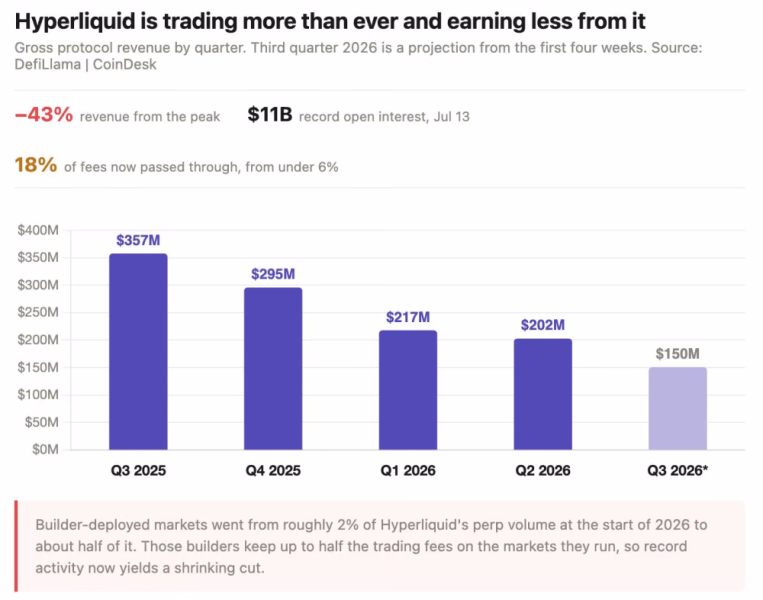
Figure 1.

A Hyperliquid Improvement Proposal (HIP-3) helps explain why Hyperliquid is keeping a smaller share of the activity it attracts. Since October 2025, anyone who stakes 500,000 $HYPE, about $28 million at current prices, can list their own perpetual futures order books on Hyperliquid and keep up to half the trading fees.

In early 2026, these maker-built markets accounted for about 2% of Hyperliquid's perpetual order volume. Now they account for roughly half.

This is reflected in the reporting. Maker rebate value, the portion of fees that Hyperliquid directly returns to market makers and to its own liquidity vault, was less than 6% of gross revenue in Q2 2025. A year later, it reached 18%.

Usage fees, which platforms like Phantom charge extra for order processing, brought in roughly $16 million in revenue in Q2 and accounted for roughly $16 million in losses for the same quarter. Every dollar from this passes through the system.
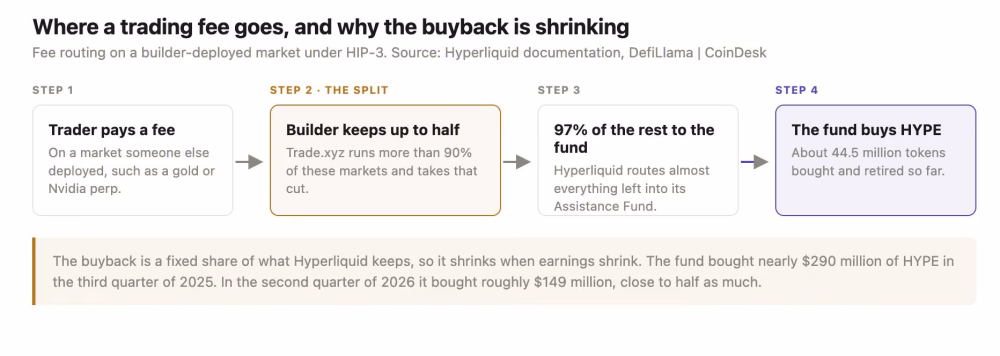
Figure 2.

Real-world assets, such as contracts on oil, gold, Nvidia, Tesla, the Nasdaq-100 index, and shares of companies preparing for IPO like SpaceX, reached a record $3.6 billion in open interest this month and overtook Bitcoin as the platform's largest market by that metric.

From July 13 to 19, tokenized stock and commodity trading volume was $25 billion, making up 52% of the weekly volume, surpassing crypto assets for the first time. The contracts settle in stablecoins, have no expiry, and trade through weekends when the NYSE is closed. A product like leveraged Nvidia stock at 2 a.m. on a Sunday has few other uses.

This growth is largely held up by one person. Trade.xyz accounts for over 90% of all HIP-3 open interest. This means Hyperliquid's record figures depend on the oracle choice, margin settings, and risk management of a single investor.

The risk in this arrangement surfaced on Monday this week when a single trade on a low-volume Korean premarket venue caused Trade.xyz's SK Hynix contract to drop 19% and triggered liquidations which the firm later agreed to cover.

Hyperliquid directs about 97% of trading fees to its assistance fund, which buys tokens on the open market and removes them from circulation, having taken about 44.5 million $HYPE out of total supply. The buyback is a fixed share of profits, so it shrinks when profits fall. The fund bought nearly $290 million worth of $HYPE in Q3 2025. In Q2 2026, it bought about $149 million worth, nearly half that amount.

On Friday, $HYPE traded around $55, down 5% for the week and about 28% below its June 16 record high around $77. Annualized earnings are around $785 million, roughly 16 times its circulating market cap and about 70 times on a fully diluted basis.

Over the past month, institutional holders including Multicoin Capital and Bitwise have moved significant volumes of $HYPE to exchanges.

The ecosystem around it is far weaker than a top-15 ranking suggests. Of the 48 tokens tracked by CoinGecko in the Hyperliquid category, $HYPE accounts for almost all the value. The next two, Ethena's USDe (about $4.5 billion) and USDT0 (roughly $4 billion), are stablecoins issued on other platforms and integrated. The largest token built specifically for this platform is PURR (about $53 million), less than half a percent of $HYPE. The market still prices $HYPE mostly on Hyperliquid platform exchange economics, not on a wide range of native applications.
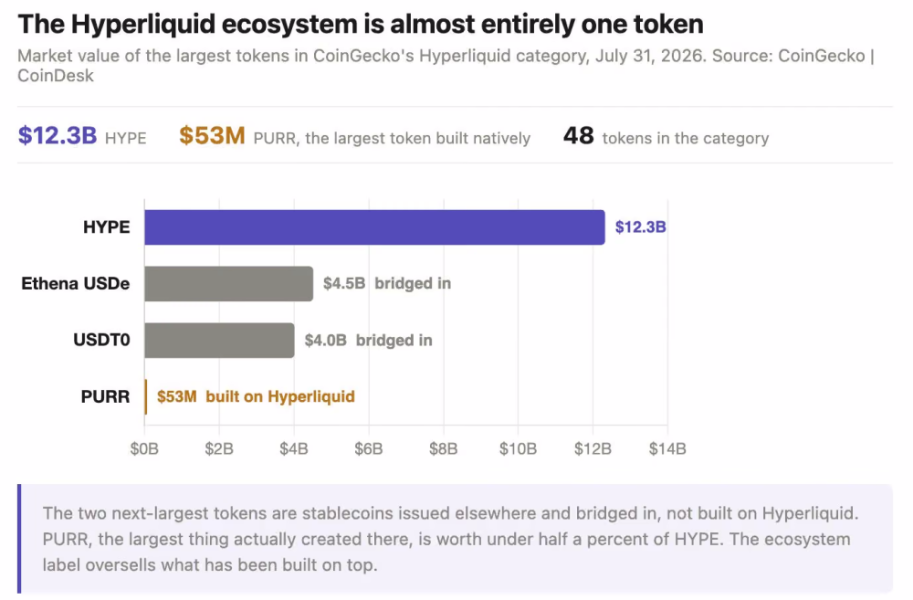
Figure 3.

Supply and regulators apply pressure from the other side. On August 6, nearly 10 million $HYPE, worth about $550 million at current prices, were unlocked for core participants. This is one of the monthly unlocks scheduled through 2027, out of a total circulating $HYPE supply of just 222 million.

In the week to July 17, spot $HYPE ETFs saw their first net outflows of roughly $7 million, ending a 9-week inflow streak. In late June, Singapore's MAS added the platform to its investor alert list, following earlier warnings from the UK, while CME and ICE executives urged the CFTC to reconsider its sanctions on commodity markets.

Meanwhile, competition has come from an unexpected side. The Robinhood Chain broker-dealer network, only a month old, processes over $600 million daily on decentralized exchanges trading meme coins and, by some measures, now draws more speculative activity than Hyperliquid.

None of this means the business is failing. According to ARK Research, as of July 31, Hyperliquid and Pump.fun together accounted for 67% of all crypto application revenue, and Grayscale compared the platform to Amazon Web Services—a platform where third-party developers build products and the operator takes a cut of all trades.

And therein lies the problem. For the first four weeks of Q3, Hyperliquid grossed about $45 million in revenue. At that pace, quarterly revenue would approach $150 million, marking a fourth consecutive decline, and with it, a weakening of $HYPE's growth potential.

end-content

Trending Cryptos

Related Questions

QDespite reaching record open interest and volumes, why are Hyperliquid's revenues declining?

AHyperliquid's revenues are declining because the platform is retaining a smaller share of the trading activity it attracts. Following HIP-3, market makers who stake 500,000 $HYPE can list their own perpetual futures and keep up to half of the fees. These market maker-led markets now constitute roughly half of Hyperliquid's perpetual order volume. Consequently, the cost of revenue (fees paid out to market makers and the liquidity treasury) rose to 18% of gross revenue in Q2 2026 from less than 6% a year earlier. This significantly reduces the net revenue flowing to Hyperliquid itself.

QWhat is the current dominant asset class on Hyperliquid by open interest, and what risk is highlighted about its growth?

AReal-world assets (RWAs), such as tokenized stocks, commodities, and indices, are now the dominant asset class on Hyperliquid by open interest, reaching a record $3.6 billion and surpassing Bitcoin. The major risk highlighted is that over 90% of this open interest in HIP-3 markets is concentrated with a single entity, Trade.xyz. This makes Hyperliquid's record performance heavily dependent on the oracle choices, margin settings, and risk management decisions of a single investor. The risk materialized when a single off-market trade caused a 19% drop in a SK Hynix contract on Trade.xyz, triggering liquidations.

QHow is the decline in Hyperliquid's revenue impacting the native token $HYPE?

AThe decline in revenue directly impacts $HYPE through its buyback mechanism. Hyperliquid directs about 97% of trading fees to a buyback fund that purchases and removes $HYPE from circulation. Since the buyback is a fixed share of profits, it shrinks as profits fall. The fund bought nearly $290 million worth of $HYPE in Q3 2025 but only about $149 million in Q2 2026—roughly half the amount. Consequently, this reduced buying pressure, alongside other factors like token unlocks and exchange transfers by institutional holders, has contributed to a lower token price.

QWhat competitive and regulatory challenges does Hyperliquid face?

AHyperliquid faces growing competition from new platforms like the Robinhood Chain, which, though only a month old, is processing over $600 million daily on DEXs trading memecoins and attracting significant speculative activity. On the regulatory front, Singapore's MAS added Hyperliquid to its investor alert list in late June, following earlier warnings from the UK. Additionally, executives from CME and ICE have urged the CFTC to revisit its sanctions on commodity markets, potentially affecting RWA trading. Spot $HYPE ETFs also saw their first net outflows in mid-July, ending a nine-week inflow streak.

QWhat does the article suggest about the health and valuation of the broader Hyperliquid ecosystem?

AThe article suggests that the broader Hyperliquid ecosystem is much weaker than its top-15 token ranking implies. Of the 48 tokens tracked by CoinGecko in the Hyperliquid category, $HYPE constitutes almost the entire value. The next two largest tokens (USDe and USDT0) are stablecoins from other platforms. The largest token developed specifically for Hyperliquid is PURR, with a market cap of only about $53 million—less than half a percent of $HYPE's value. This indicates that $HYPE's valuation is primarily based on the economics of the Hyperliquid exchange platform rather than a wide range of native applications built on its ecosystem.

Related Reads

Legendary Bloomberg Analyst Mike McGlone Makes New Comments on Bitcoin! 'We Are in a Bear Market'

Legendary Bloomberg analyst Mike McGlone has made new comments on Bitcoin, stating "We are in a bear market." This comes as the Bitcoin market enters a new phase following a sharp rise in institutional interest in spot ETFs. Recent data shows a massive $853 million inflow into spot Bitcoin ETFs in a short period. In a recent broadcast, industry experts Dave Weisberger, David Duong, and Mike McGlone discussed this market dynamic. David Duong, Director of Research at CoinShares, argued that the ETF inflows confirm institutional confidence and long-term interest in crypto. He noted that with lowered rate hike expectations, investors are turning to risk assets like Bitcoin, creating significant upward price pressure. Dave Weisberger, CEO of CoinRoute, highlighted the impact of ETF inflows on exchange activity and liquidity. He stated that declining OTC supply forces ETF issuers to buy directly on the market, technically supporting a strong breakout. However, Mike McGlone, Bloomberg Intelligence Senior Commodity Strategist, focused on broader macroeconomic risks. While acknowledging the short-term bullish momentum from ETFs, McGlone warned not to ignore global liquidity conditions and volatility in traditional markets. He assessed that although Bitcoin has signaled a technical breakout, a sustained rally depends on the overall macroeconomic balance and Fed actions, maintaining that BTC is currently in a bear market.

cryptonews.ru20m ago

Legendary Bloomberg Analyst Mike McGlone Makes New Comments on Bitcoin! 'We Are in a Bear Market'

cryptonews.ru20m ago

Trading

Spot

Hot Articles

How to Buy HYPE

Welcome to HTX.com! We've made purchasing Hyperliquid (HYPE) simple and convenient. Follow our step-by-step guide to embark on your crypto journey.Step 1: Create Your HTX AccountUse your email or phone number to sign up for a free account on HTX. Experience a hassle-free registration journey and unlock all features.Get My AccountStep 2: Go to Buy Crypto and Choose Your Payment MethodCredit/Debit Card: Use your Visa or Mastercard to buy Hyperliquid (HYPE) instantly.Balance: Use funds from your HTX account balance to trade seamlessly.Third Parties: We've added popular payment methods such as Google Pay and Apple Pay to enhance convenience.P2P: Trade directly with other users on HTX.Over-the-Counter (OTC): We offer tailor-made services and competitive exchange rates for traders.Step 3: Store Your Hyperliquid (HYPE)After purchasing your Hyperliquid (HYPE), store it in your HTX account. Alternatively, you can send it elsewhere via blockchain transfer or use it to trade other cryptocurrencies.Step 4: Trade Hyperliquid (HYPE)Easily trade Hyperliquid (HYPE) on HTX's spot market. Simply access your account, select your trading pair, execute your trades, and monitor in real-time. We offer a user-friendly experience for both beginners and seasoned traders.

6.1k Total ViewsPublished 2024.03.29Updated 2026.06.02

How to Buy HYPE

Discussions

Welcome to the HTX Community. Here, you can stay informed about the latest platform developments and gain access to professional market insights. Users' opinions on the price of HYPE (HYPE) are presented below.

活动图片