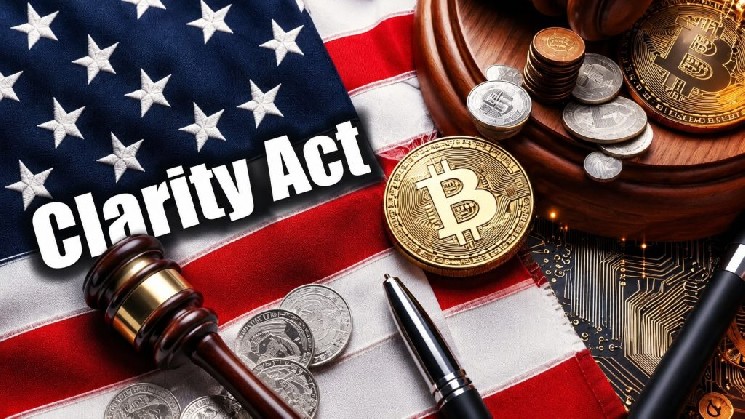
Senate Postpones Vote on CLARITY Act on Monday; Five Days Remain Before Deadline

cryptonews.ruPublished on 2026-08-03Last updated on 2026-08-03

Abstract

The US Senate has delayed a vote on the CLARITY Act, a House-passed bill aimed at establishing a regulatory framework for digital assets by dividing oversight between the SEC and CFTC. With only five days left before the August recess, and no vote scheduled for Monday, the bill faces a tight deadline for passage before legislators leave until September 14th. Supporters, including former Defense Secretary Mark Esper, frame the legislation as a national security imperative. However, internal disagreements among senators on enforcement powers, DeFi, AML rules, and stablecoin provisions are causing delays. Industry pressure from entities like Grayscale and Coinbase is intensifying for a pre-recess vote, warning that inaction threatens U.S. competitiveness. Critics, including some Democrats and New York Attorney General Letitia James, argue the bill contains security gaps, weakens state-level enforcement, and raises ethical concerns regarding former President Trump's crypto-related income. If the Senate fails to act by Friday, the bill risks being sidelined by other priorities in the busy election season, prolonging regulatory uncertainty for the crypto industry.

The Senate's schedule does not include a vote on the "Digital Asset Market Clarity Act" — a bill passed by the House of Representatives aimed at dividing cryptocurrency oversight between the Securities and Exchange Commission (SEC) and the Commodity Futures Trading Commission (CFTC). The upper chamber has until Friday to pass the CLARITY Act before lawmakers leave for their August recess, after which the Senate will not reconvene until September 14.
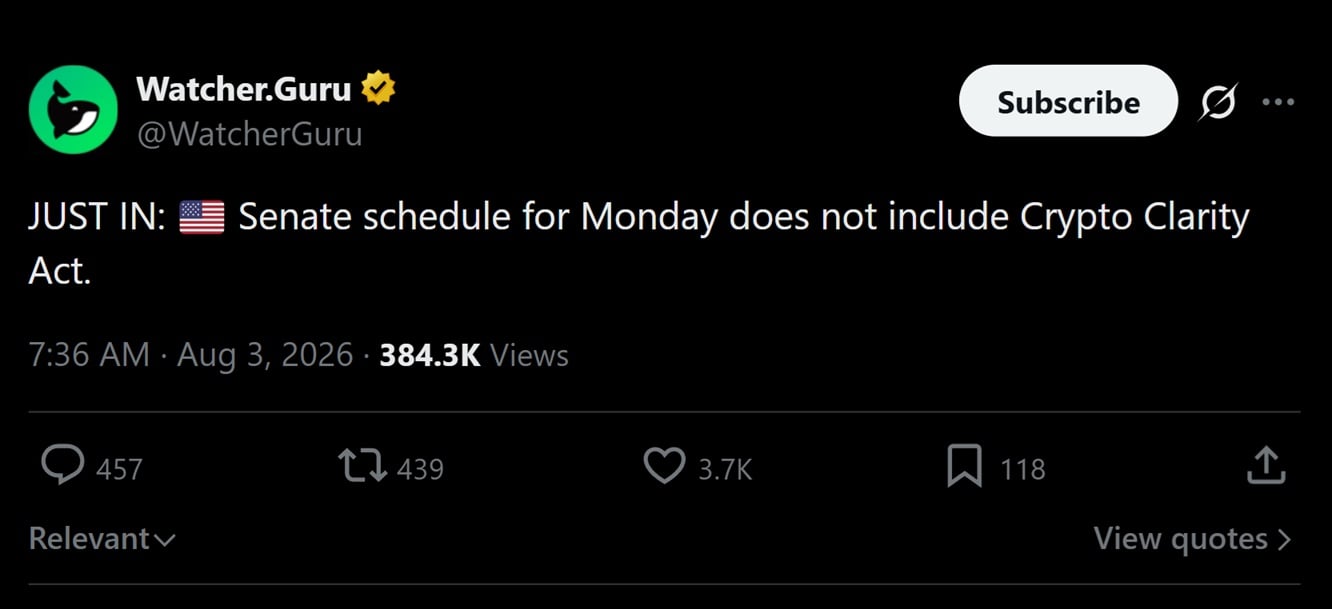
Image Source: X

Senate Majority Leader John Thune stated he intends to bring the bill up for discussion before the recess begins, which would force senators to officially declare their positions, even if the bill cannot overcome the 60-vote threshold needed to break a filibuster. However, the tight pre-recess schedule and unresolved disputes among senators regarding enforcement authority, decentralized finance, anti-money laundering rules, and stablecoin provisions prevent setting a precise date.

Esper Calls the Bill a National Security Imperative

The stakes rose this week when former Secretary of Defense Mark Esper, who joined Coinbase's Global Advisory Council in 2023, called the CLARITY Act a national security imperative and warned that this week may be the last real chance for its passage.

Supporters of the bill, who constitute the majority, argue that it strengthens national security by bringing digital assets into a clear regulatory framework, while an analysis by minority staff shows that the CLARITY Act does not address vulnerabilities exploited by criminals and foreign adversaries.
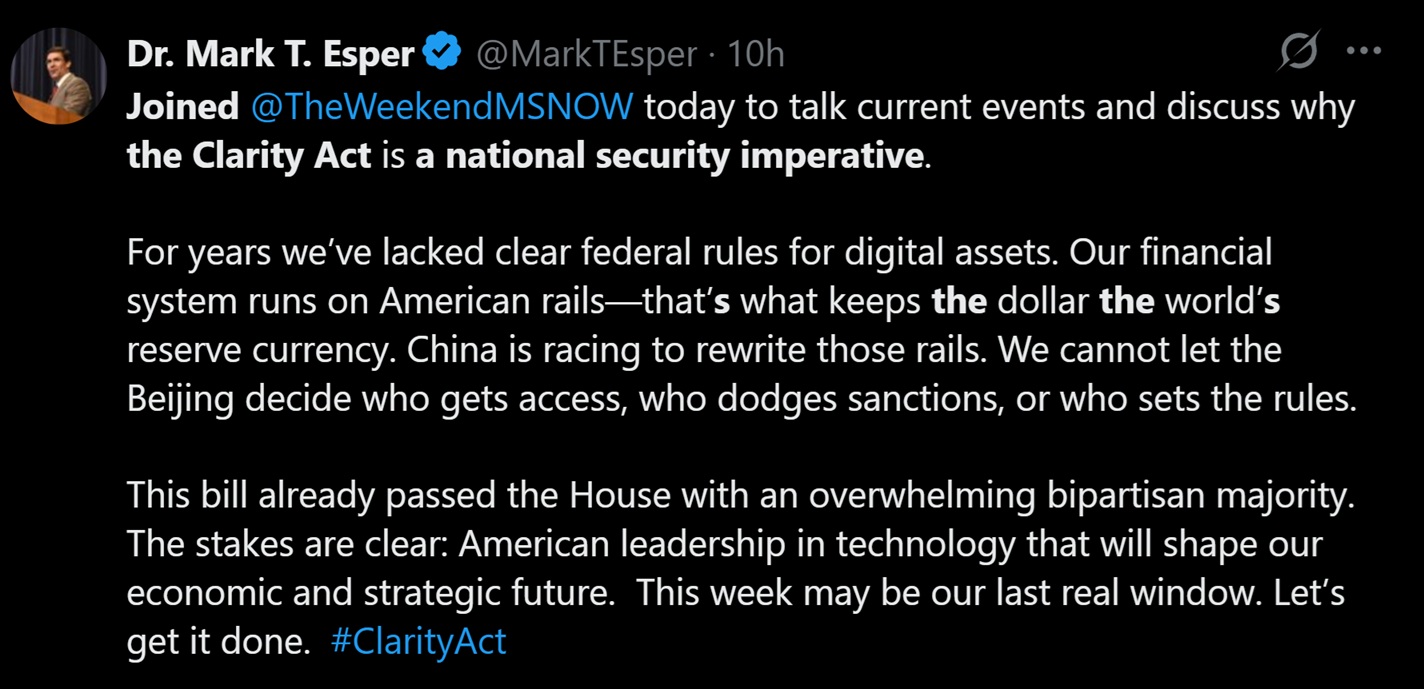
Image Source: X

The national security argument is not new to cryptocurrency debates in Washington, but Esper's involvement adds a recognizable, bipartisan-tinted voice to this increasingly partisan fight. Senator Mark Warner separately made closing what he sees as national security gaps related to decentralized finance a condition for his support.

Industry Pressure Mounts Ahead of Congressional Recess

Lobbying has intensified as time runs out: as recently reported by Bitcoin.com News, Grayscale urged Senate leaders to hold a vote on the CLARITY Act before the August recess, warning that further delay threatens U.S. competitiveness in digital assets. Additionally, according to Bitcoin.com News, the organization Stand With Crypto reported that bill supporters have contacted lawmakers a million times urging passage before the August 7th recess.

The bill's odds fluctuate under the pressure of the approaching deadline: Galaxy Research lowered its probability estimate for the CLARITY Act passing in 2026 from 50% to 30%. Furthermore, Treasury Secretary Scott Bessent strongly rebuked the bill's critics, demanding the Senate take immediate action, while an analysis by minority staff on the Senate Banking Committee reiterated Democratic objections that the bill leaves President Trump avenues to continue profiting from cryptocurrency ventures after disclosed information showed his crypto-related revenues amounted to about $1.4 billion in 2025.

Enforcement Concerns Add Another Layer of Complexity

Arguments related to state-level enforcement have been added to the national security case, as New York Attorney General Letitia James called on Congress to strengthen cryptocurrency regulation after the FBI reported over $11 billion in crypto-related losses (arguing that the pending CLARITY Act would actually weaken, not strengthen, state-level enforcement against digital asset fraud).

This criticism emerged alongside a separate report on a new threat to the bill from the Senate concerning the President's crypto income, further illustrating how the bill's remaining obstacles now span three areas: national security, state-level enforcement, and ethics.

What Happens if the Senate Doesn't Act by Friday

If the Senate does not act by Friday, the CLARITY Act will not be reconsidered until senators reconvene on September 14, pushing the debate onto the compressed midterm-year schedule, where cryptocurrency legislation risks being crowded out by other priorities. Bitcoin.com News reported that the bill now faces significant risk of getting lost entirely in the pre-election political scramble — a scenario that would force crypto companies to continue operating under the current patchwork of SEC and CFTC guidance for several more months.

Last week, Strategy and its Executive Chairman Michael Saylor expressed support for the bill, joining a growing list of industry figures including Coinbase and Grayscale publicly pressing for its passage. Whether this pressure will lead to consideration before Friday remains an open question hanging over cryptocurrency markets this week.


Trending Cryptos

Related Questions

QWhat is the main purpose of the CLARITY Act discussed in the article?

AThe main purpose of the CLARITY Act (Digital Asset Market Clarity Act) is to divide regulatory oversight of cryptocurrencies between the Securities and Exchange Commission (SEC) and the Commodity Futures Trading Commission (CFTC), bringing digital assets into a clear regulatory framework.

QWhat deadline does the US Senate face regarding the CLARITY Act, and what happens if they don't meet it?

AThe US Senate faces a deadline this Friday to pass the CLARITY Act before legislators leave for their August recess. If no decision is made by Friday, the bill will not be revisited until senators reconvene on September 14, risking it being lost in the political shuffle ahead of the midterm elections.

QWhy did former Secretary of Defense Mark Esper label the CLARITY Act a 'national security imperative'?

AFormer Secretary of Defense Mark Esper, who is a member of Coinbase's Global Advisory Council, labeled the CLARITY Act a national security imperative because he believes establishing a clear regulatory framework for digital assets strengthens national security. Proponents argue it mitigates vulnerabilities exploited by criminals and foreign adversaries.

QAccording to the article, what are some of the key unresolved disputes among senators that are delaying the CLARITY Act?

AKey unresolved disputes among senators delaying the CLARITY Act include disagreements over enforcement authority, regulations for decentralized finance (DeFi), anti-money laundering rules, and provisions related to stablecoins.

QWhat specific criticism did New York Attorney General Letitia James raise about the CLARITY Act?

ANew York Attorney General Letitia James criticized the CLARITY Act, arguing that it would actually weaken state-level enforcement against digital asset fraud rather than strengthen it, following an FBI report of over $11 billion in crypto-related losses.

Related Reads

Dan Koe: The Counterintuitive Truth—You Don't Need to Remember Everything You Read

Dan Koe: The Counterintuitive Truth — You Don't Need to Remember Everything You Read The central idea is that deliberately trying to remember information is often misguided. True learning isn't about memorizing facts but about having important knowledge surface naturally when needed through use. Most forgetting is normal, not a failure. The article reframes learning using a control theory framework—a four-step feedback loop: having a clear Goal, accurately Sensing your current state, Comparing the gap, and Acting to close it. Most learning stalls because people only do step 2 (blind input) without a goal to create the necessary "error signal" for focused action. The most effective method is to start with output, not input. Begin a meaningful personal project first, and learn only what's necessary to complete it. This project-driven, "just-in-time" learning ensures knowledge is contextual and retained. The concept of a "Second Brain" often fails because it becomes a digital graveyard—over-collected and under-utilized. The goal should be building a "Second Subconscious"—a dynamic system that proactively surfaces relevant ideas during creation, not a static storage vault. Tools like Obsidian+Claude or Eden can help by automating organization and enabling semantic search, but their value depends on linking knowledge to active projects. Ultimately, what matters is not what you store, but what you filter and internalize. Focus on ideas that shape your worldview, use projects as filters, and transform collected material through writing and sharing. AI should be used to reduce friction in research and editing, not to formulate your core views. In conclusion, remembering is a byproduct, not the goal. Knowledge that sticks comes from pursuing personal goals, applying it in real projects, and digesting it through creation. The tools are merely aids; the crucial step is to start doing meaningful work and let the necessary knowledge find you.

marsbit1h ago

Dan Koe: The Counterintuitive Truth—You Don't Need to Remember Everything You Read

marsbit1h ago

A New Era: The Fundamental Transformation of China's Entrepreneurs

A profound generational shift is underway among Chinese entrepreneurs. The wealth and influence once dominated by real estate and internet giants is now being claimed by a new wave of founders driving breakthroughs in AI, semiconductors, and robotics. This change is vividly reflected in 2026's wealth rankings. Figures like Zhang Yiming (ByteDance), Liang Wenfeng (DeepSeek), Chen Tianshi (Cambricon), and Wang Xingxing (Unitree Robotics) are ascending. Their wealth stems not from traditional business models but from market expectations for future technological competitiveness, with AI, chips, and smart hardware becoming the primary engines of wealth creation. Their common trait is a foundational focus on technology, often starting from the laboratory rather than a business plan. Examples include Chen Tianshi's decade-long push in AI chips, Liang Wenfeng's core algorithmic innovations at DeepSeek with a compact team, and Zhu Yiming's "no salary until profitable" 9-year journey to build Changxin Memory into a global DRAM player. This transition marks a fundamental shift in China's economic imperative: from commercial expansion and learning to indigenous innovation and deep industrial capability. While the previous generation built the foundational market and infrastructure, this new cohort is tasked with achieving global leadership in core technologies, moving China from "keeping pace" to pioneering original, breakthrough innovations that are industrialized at scale. The baton is being passed to those competing on the world stage through technological originality.

marsbit1h ago

A New Era: The Fundamental Transformation of China's Entrepreneurs

marsbit1h ago

Trading

Spot

Hot Articles

Discussions

Welcome to the HTX Community. Here, you can stay informed about the latest platform developments and gain access to professional market insights. Users' opinions on the price of S (S) are presented below.

活动图片