Author: Ma He, Foresight News
The target of signing the "Clarity Act" on July 4th has been missed, and the window for passage before the midterm elections is rapidly closing. While much of the Senate's work can proceed behind the scenes during the summer recess, House procedures are currently stalled.
Senator Bill Hagerty recently stated that the Senate is expected to release the final text of the Clarity Act imminently, allowing lawmakers and the digital asset industry to gain clarity on the bill before debate resumes. Additionally, this prepares for the debate and vote after Congress reconvenes on July 13th. With only about three weeks of effective working time remaining before the August recess, the bill still faces at least three unresolved disputes.
Resistance and Divisions
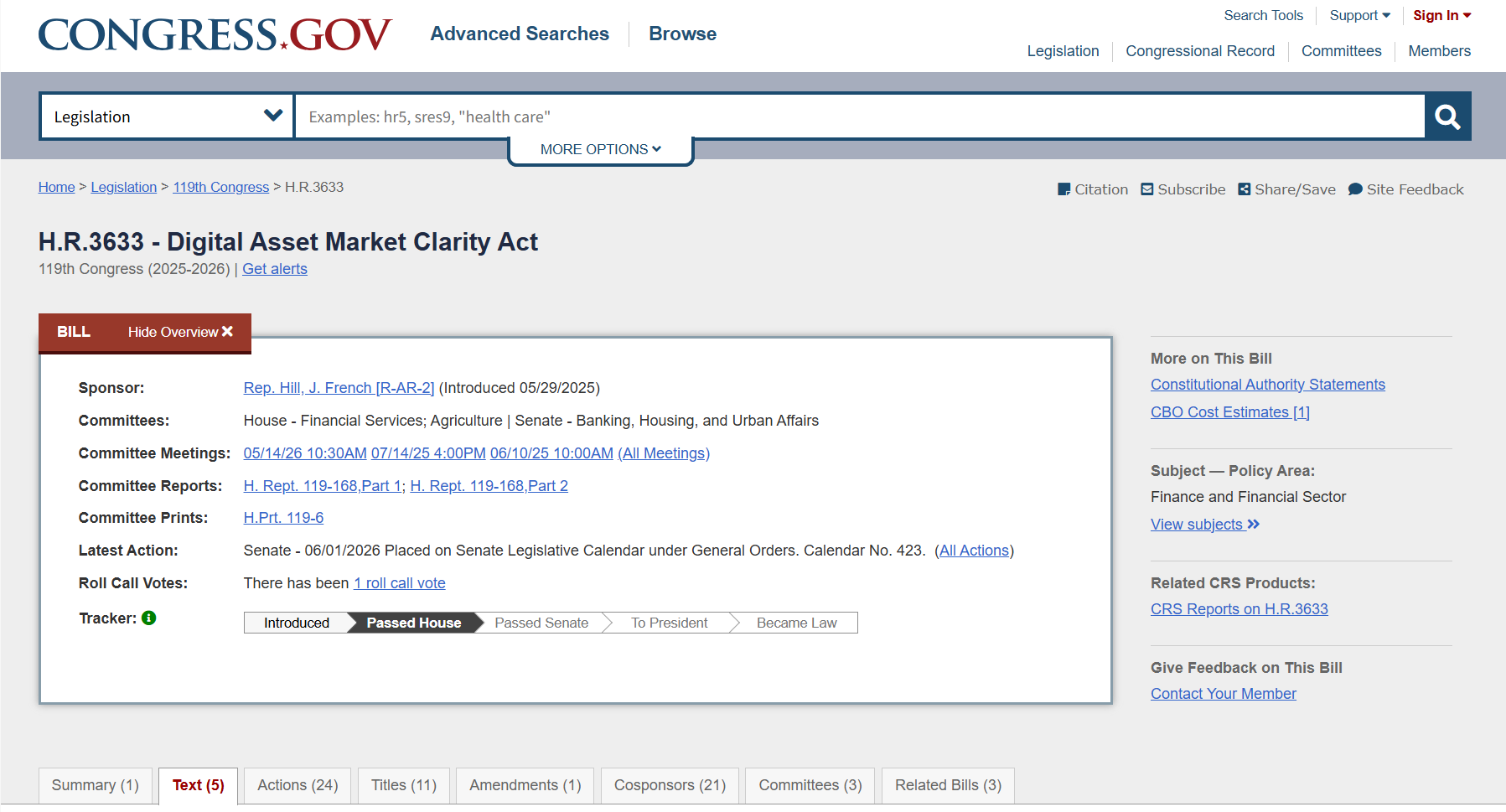
In May 2025, the Clarity Act was introduced by House Financial Services Committee Chairman French Hill (R-AR). In June of that year, the bill passed review by the Financial Services and Agriculture Committees, and passed a full House vote on July 17th. The bill was formally named the "Clarity Act of 2025."
The Clarity Act aims to establish the first comprehensive federal regulatory framework for the U.S. digital asset market, with its core being to clarify the jurisdictional boundaries between the SEC and CFTC. After 10 months and multiple rounds of bipartisan negotiations, the final Clarity Act comprises 309 pages, focusing on the regulatory boundaries of the SEC and CFTC, stablecoins, anti-money laundering, insider trading, exemption rules for non-controlling developers, and more.
On May 14th, the U.S. Senate Banking Committee passed the "Clarity Act" with a vote of 15 in favor and 9 against. Although the bill has recently been formally placed on the Senate legislative calendar, full floor consideration was not scheduled before the holiday due to lingering disagreements between the parties on stablecoin yield provisions, DeFi developer liability exemptions, and details on enforcement and ethics.
The crypto industry had hoped for a vote by late June or early July, with some Trump administration figures even viewing July 4th as a potential signing point.
However, closed-door bipartisan negotiations broke down around June 9th. A meeting involving Senators Kirsten Gillibrand, Ruben Gallego, Bernie Moreno, Cynthia Lummis, and Patrick Witt, Executive Director of the White House Crypto Council, on ethics issues failed to reach consensus. Republicans and the White House withdrew a provision authorizing state attorneys general to bring civil lawsuits over failures in Department of Justice ethics enforcement, leading to a split in negotiations.
Subsequently, while stablecoin yield provisions were temporarily settled through compromise at the committee stage, DeFi developer liability exemptions and law enforcement agency concerns, along with broader ethics and conflict-of-interest rules, remain major obstacles. Additionally, the issue of the Trump family's crypto asset disclosures has further amplified the sensitivity of the ethics provisions.
There are also positive factors, however.
The Major County Sheriffs of America (MCSA) has shifted its stance on the "Clarity Act" from opposition to neutral. In a letter to Senate Banking Committee Chairman Tim Scott and Senator Elizabeth Warren, the organization stated that its concerns regarding Section 604 of the bill have been partially addressed. Previously, the MCSA warned that this section could potentially weaken enforcement capabilities against illicit financial activities involving crypto assets.
The core of Section 604 lies in limiting liability determinations for developers of decentralized protocols. Supporters argue that developers should not bear intermediary liability for user actions; law enforcement agencies had previously worried this provision could create regulatory and enforcement "loopholes," impacting investigations into cases involving money laundering, ransomware, drugs, and terrorist financing.
Probability of Clarity Act Being Signed Into Law This Year Only 49%
The Clarity Act's current situation reflects the complexity of U.S. crypto legislation: a bipartisan foundation exists, administrative and industry driving forces are not weak, but specific clause interest games and procedural deadlines often create the greatest resistance in the final stretch. Passage in committee in May brought stage-specific optimism, while the breakdown of ethics negotiations in June and blockage before July 4th brought reality back into focus.
With the final text about to be released, the latest stance from law enforcement circles, and the opening of the critical three-week window after July 13th, the progress of negotiations in the coming days and weeks will directly determine whether this "game-changer" bill can be enacted in 2026.
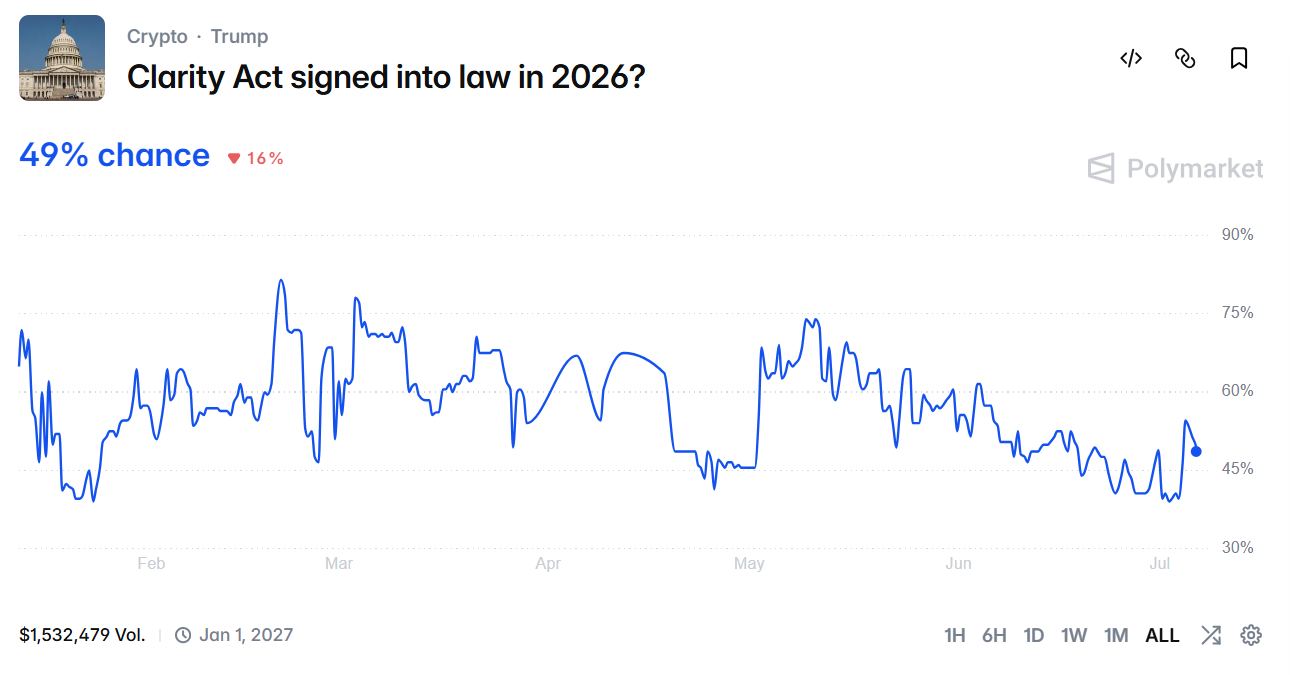
Currently, according to the latest data from Polymarket, the probability of Clarity being signed into law this year is only 49%. Its market probability has long fluctuated around 60%, reflecting a cautious yet still hopeful market attitude towards whether the Clarity Act can ultimately be signed into law within the year.
Investment bank Jefferies believes that if the bill passes smoothly, it will establish a clear regulatory framework for digital assets, accelerating the deployment of banks, asset managers, and exchanges into tokenized assets, custody, staking, lending, and other services, and promoting more crypto ETFs and crypto infrastructure company IPOs. If legislation is delayed, it may prolong regulatory uncertainty, causing traditional financial institutions to slow their blockchain business advancement.
The report predicts that the bill's progress will continue to affect the market performance of crypto-related stocks, including Circle, Coinbase, Bullish, and some crypto assets. Jefferies also notes that, in the long term, compared to regulatory changes, stablecoin issuer Circle faces greater challenges from competition with banks, fintechs, and payment companies.