Cardano Founder Says Bitcoin Has Entered ‘Shitcoin Land’

bitcoinistPublished on 2026-04-16Last updated on 2026-04-16

Abstract

Cardano founder Charles Hoskinson criticized Bitcoin's governance and response to quantum computing threats in a livestream titled "BIP 361: Welcome to ShitcoinLand, Bitcoin." He argued that Bitcoin's resistance to change has left it vulnerable, with over 34% of all Bitcoin (approximately 8 million BTC) exposed to potential theft by quantum computers due to revealed public keys. Hoskinson claimed BIP 361's proposed solution—a hard fork to freeze non-migrated coins—would render around 1.7 million BTC, including Satoshi's estimated 1.1 million, unspendable due to outdated wallet formats. He contrasted Bitcoin's rigid culture with governance models in Cardano, Polkadot, and Ethereum, which he says offer better mechanisms for protocol upgrades. Hoskinson acknowledged the quantum threat as real but argued Bitcoin's ideological inflexibility complicates a effective response.

Cardano founder Charles Hoskinson used one of his most confrontational videos in recent memory to argue that Bitcoin’s long-running resistance to structural change has left it exposed to the quantum computing threat now surfacing in debate around BIP 361. His core claim was blunt: Bitcoin’s governance culture, not just its cryptography, is now the problem.

In the livestream, titled “BIP 361: Welcome to ShitcoinLand, Bitcoin,” Hoskinson framed the proposal as an overdue admission from parts of the Bitcoin world that quantum risk is no longer theoretical. The Cardano founder pointed to language in the proposal stating that, as of March 1, 2026, more than 34% of all Bitcoin had revealed public keys on-chain, leaving those UTXOs vulnerable to theft by an attacker with a sufficiently powerful quantum computer. In his telling, that amounts to roughly 8 million BTC exposed to a future break in Bitcoin’s current signature assumptions.

Cardano Founder Attacks Bitcoin Developer Community

Hoskinson’s attack centered on two related claims. First, he argued that the response implied by BIP 361 would require a hard fork, even if described otherwise. Second, he said any forced migration to post-quantum addresses would create a deeper problem for coins held in older wallet formats that cannot be recovered through the kind of proof system he says the proposal imagines.

“There is some truth in here,” Hoskinson said. “As of March 1st, 2026, over 34% of all Bitcoin have revealed public key on chain... those UTXOs could be stolen by an attacker with sufficiently powerful quantum computer. 34% of all Bitcoin is vulnerable. About 8 million Bitcoin, give or take.”

That set up the heart of his criticism. According to Hoskinson, Bitcoin developers are now stuck between two bad outcomes: either leave vulnerable legacy coins exposed to theft in the 2030s, or force a migration that renders a large portion of older coins effectively unspendable. He repeatedly claimed that around 1.7 million BTC fall into that latter category, including roughly 1.1 million BTC he attributed to Satoshi Nakamoto, because they predate the wallet standards and seed phrase schemes that would make later recovery models possible.

“Users with frozen quantum vulnerable funds and an HD wallet seed phrase can construct a quantum safe proof to recover funds,” he said, paraphrasing the idea before rejecting it. “That’s a lie. And you know it. You know it. 1.7 million coins can’t do that. It’s not possible.”

Hoskinson then widened the argument beyond BIP 361 itself and into a broader critique of Bitcoin’s social structure. In his view, maximalist ideology turned a software system into a doctrine, making it far harder to adapt when technical tradeoffs become unavoidable. He argued that the industry had spent years dismissing alternative chains and governance models, only to arrive at a moment where Bitcoin may need exactly the kind of coordinated protocol change it long portrayed as unacceptable.

“What happened to there is only ever going to be 21 million coins and self-custody and Bitcoin never needs to change and everything’s perfect?” he asked. “Because here’s the thing, it’s not a bad proposal. It really isn’t. I understand why they wrote it. Because if they don’t do this, that money will be stolen in the 2030s.”

That tension gave the video its structure. The Cardano founder was not arguing that the quantum threat is imaginary. Quite the opposite. He treated it as real and potentially severe. But he said the proposed cure exposes a contradiction at the center of Bitcoin’s culture: once a portion of the supply becomes vulnerable, any meaningful fix runs directly into questions of confiscation, coordination, and legitimacy.

He contrasted that with networks such as Cardano, Polkadot, and Ethereum, arguing that formal governance systems at least provide a mechanism for resolving disputes over upgrades and tradeoffs. “If you had onchain governance, you could solve it,” he said. “We have it at Cardano. Polkadot has it... it’s a good idea.”

At press time, Cardano traded at $0.2499.
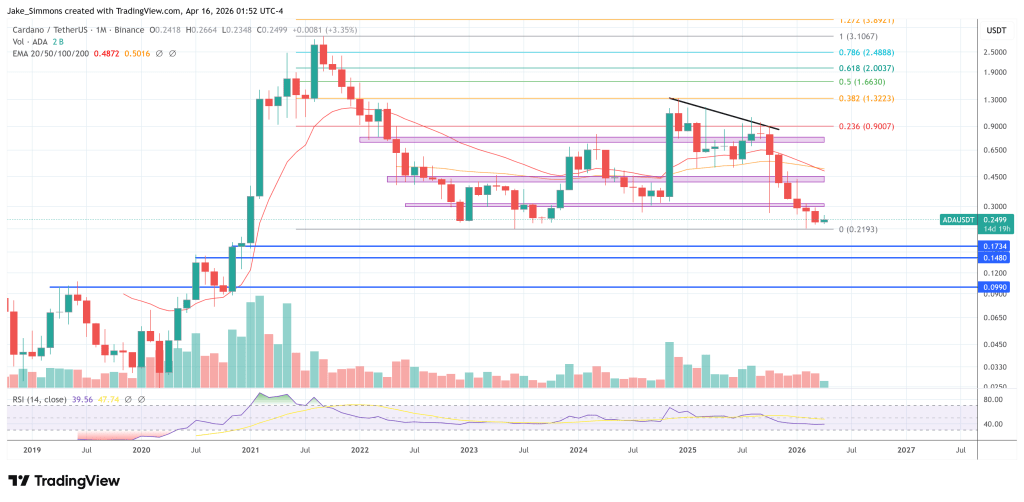
ADA hovers below key resistance, 1-monthly chart | Source: ADAUSDT on TradingView.com

Related Questions

QWhat is the core claim made by Charles Hoskinson regarding Bitcoin's vulnerability?

AHoskinson's core claim is that Bitcoin's governance culture, not just its cryptography, is now the problem, as its resistance to structural change has left it exposed to the quantum computing threat.

QAccording to the article, what specific percentage and amount of Bitcoin is vulnerable to a quantum attack as stated in BIP 361?

AAs of March 1, 2026, over 34% of all Bitcoin, which is about 8 million BTC, had revealed public keys on-chain, leaving those UTXOs vulnerable to a quantum attack.

QWhat are the two bad outcomes that Hoskinson says Bitcoin developers are stuck between?

AThe two bad outcomes are: 1) Leave vulnerable legacy coins exposed to theft in the 2030s, or 2) Force a migration that renders a large portion of older coins (around 1.7 million BTC) effectively unspendable.

QHow does Hoskinson contrast Bitcoin's approach with networks like Cardano and Polkadot?

AHe contrasts them by arguing that formal on-chain governance systems in networks like Cardano and Polkadot provide a mechanism for resolving disputes over upgrades and tradeoffs, which Bitcoin lacks.

QWhat is the proposed solution in BIP 361 for quantum-vulnerable funds, and what is Hoskinson's criticism of it?

ABIP 361 proposes freezing every bitcoin that doesn't migrate to a quantum-safe address within five years, allowing recovery via a proof system for users with an HD wallet seed phrase. Hoskinson criticizes this as a lie, stating that 1.7 million coins (including Satoshi's) cannot do this as they predate the necessary wallet standards.

Related Reads

Bitcoin Trading Strategy Breakdown: Celebrity Predictions and Classic Models All Fail, Only These Four Indicators Remain

Analysis of Bitcoin Trading Strategies: Why Celebrity Forecasts and Classic Models Fail, Leaving Only These Four Reliable Indicators This analysis examines the failure of common Bitcoin prediction methods and identifies four reliable indicators for constructing a trading strategy. The author reviewed all major BTC prediction approaches from 2017-2025, categorizing them into three groups: celebrity price targets (consistently over-optimistic), analytical models like Stock-to-Flow (broken post-2022), and on-chain signals. The key finding is that more data often creates confusion, not clarity. The strategy discards unreliable elements: celebrity predictions (incentivized to be extreme), pure models (invalidated by post-ETF market changes), and the Fear & Greed Index used alone (too many false signals). Four reliable indicators were selected: 1. **MVRV Z-Score:** Accurately identifies cycle bottoms when entering its green zone (e.g., 2018, 2020, 2022). Note: Its ability to call tops is now ineffective post-2024. 2. **SOPR (28-day MA):** Consistently signals bottoms when below 1.0, indicating holders are selling at a loss. 3. **ETF Net Flow:** A crucial post-2024 metric showing institutional momentum (e.g., sustained inflows = buying). 4. **Macro Liquidity (Fed policy & M2):** Sets the overall directional bias (e.g., bullish during easing cycles). The core strategy involves waiting for a multi-signal共振 (resonance). For example, a bottom signal requires MVRV in the green zone + SOPR < 1.0. A top signal requires overheated on-chain data + sustained ETF outflows. Macro policy sets the overall direction. The Fear & Greed Index is only used as a weighted confirmatory signal, never alone. Action is only taken when three or more indicators align. The author automated this into a monitoring system that sends Telegram alerts only when signals trigger. As of the article's date (April 15, 2026), the system showed a strong bottom signal: extreme fear (F&G=12), MVRV in the buy zone, and SOPR < 1.0. The only contrary signal was weak ETF flows. Historically, such triple on-chain共振 has preceded 100%+ returns. The conclusion emphasizes building a personal framework over relying on external predictions, allowing for iterative improvement and customization based on individual risk tolerance.

marsbit2h ago

Bitcoin Trading Strategy Breakdown: Celebrity Predictions and Classic Models All Fail, Only These Four Indicators Remain

marsbit2h ago

Trading

Spot
Futures

Hot Articles

What is $BITCOIN

DIGITAL GOLD ($BITCOIN): A Comprehensive Analysis Introduction to DIGITAL GOLD ($BITCOIN) DIGITAL GOLD ($BITCOIN) is a blockchain-based project operating on the Solana network, which aims to combine the characteristics of traditional precious metals with the innovation of decentralized technologies. While it shares a name with Bitcoin, often referred to as “digital gold” due to its perception as a store of value, DIGITAL GOLD is a separate token designed to create a unique ecosystem within the Web3 landscape. Its goal is to position itself as a viable alternative digital asset, although specifics regarding its applications and functionalities are still developing. What is DIGITAL GOLD ($BITCOIN)? DIGITAL GOLD ($BITCOIN) is a cryptocurrency token explicitly designed for use on the Solana blockchain. In contrast to Bitcoin, which provides a widely recognized value storage role, this token appears to focus on broader applications and characteristics. Notable aspects include: Blockchain Infrastructure: The token is built on the Solana blockchain, known for its capacity to handle high-speed and low-cost transactions. Supply Dynamics: DIGITAL GOLD has a maximum supply capped at 100 quadrillion tokens (100P $BITCOIN), although details regarding its circulating supply are currently undisclosed. Utility: While precise functionalities are not explicitly outlined, there are indications that the token could be utilized for various applications, potentially involving decentralized applications (dApps) or asset tokenization strategies. Who is the Creator of DIGITAL GOLD ($BITCOIN)? At present, the identity of the creators and development team behind DIGITAL GOLD ($BITCOIN) remains unknown. This situation is typical among many innovative projects within the blockchain space, particularly those aligning with decentralized finance and meme coin phenomena. While such anonymity may foster a community-driven culture, it intensifies concerns about governance and accountability. Who are the Investors of DIGITAL GOLD ($BITCOIN)? The available information indicates that DIGITAL GOLD ($BITCOIN) does not have any known institutional backers or prominent venture capital investments. The project seems to operate on a peer-to-peer model focused on community support and adoption rather than traditional funding routes. Its activity and liquidity are primarily situated on decentralized exchanges (DEXs), such as PumpSwap, rather than established centralized trading platforms, further highlighting its grassroots approach. How DIGITAL GOLD ($BITCOIN) Works The operational mechanics of DIGITAL GOLD ($BITCOIN) can be elaborated on based on its blockchain design and network attributes: Consensus Mechanism: By leveraging Solana’s unique proof-of-history (PoH) combined with a proof-of-stake (PoS) model, the project ensures efficient transaction validation contributing to the network's high performance. Tokenomics: While specific deflationary mechanisms have not been extensively detailed, the vast maximum token supply implies that it may cater to microtransactions or niche use cases that are still to be defined. Interoperability: There exists the potential for integration with Solana’s broader ecosystem, including various decentralized finance (DeFi) platforms. However, the details regarding specific integrations remain unspecified. Timeline of Key Events Here is a timeline that highlights significant milestones concerning DIGITAL GOLD ($BITCOIN): 2023: The initial deployment of the token occurs on the Solana blockchain, marked by its contract address. 2024: DIGITAL GOLD gains visibility as it becomes available for trading on decentralized exchanges like PumpSwap, allowing users to trade it against SOL. 2025: The project witnesses sporadic trading activity and potential interest in community-led engagements, although no noteworthy partnerships or technical advancements have been documented as of yet. Critical Analysis Strengths Scalability: The underlying Solana infrastructure supports high transaction volumes, which could enhance the utility of $BITCOIN in various transaction scenarios. Accessibility: The potential low trading price per token could attract retail investors, facilitating wider participation due to fractional ownership opportunities. Risks Lack of Transparency: The absence of publicly known backers, developers, or an audit process may yield skepticism regarding the project's sustainability and trustworthiness. Market Volatility: The trading activity is heavily reliant on speculative behavior, which can result in significant price volatility and uncertainty for investors. Conclusion DIGITAL GOLD ($BITCOIN) emerges as an intriguing yet ambiguous project within the rapidly evolving Solana ecosystem. While it attempts to leverage the “digital gold” narrative, its departure from Bitcoin's established role as a store of value underscores the need for a clearer differentiation of its intended utility and governance structure. Future acceptance and adoption will likely depend on addressing the current opacity and defining its operational and economic strategies more explicitly. Note: This report encompasses synthesised information available as of October 2023, and developments may have transpired beyond the research period.

363 Total ViewsPublished 2025.05.13Updated 2025.05.13

What is $BITCOIN

Discussions

Welcome to the HTX Community. Here, you can stay informed about the latest platform developments and gain access to professional market insights. Users' opinions on the price of BTC (BTC) are presented below.

活动图片