Quantum Threat Behind Bitcoin’s Decline? Analyst Points To Google Search Data

bitcoinistPublished on 2026-02-17Last updated on 2026-02-17

Abstract

Charles Edwards, founder of Capriole Investments, has highlighted a correlation between Bitcoin's price peak and a surge in Google searches for "Quantum Computing Bitcoin." Analysis of the data shows that public interest in the quantum computing threat to Bitcoin spiked significantly during the asset's recent bull run, suggesting that risk evaluation was at a maximum when the price was highest. Edwards posits that this awareness led to derisking, acting as a leading indicator for the subsequent price decline, stating "The Quantum threat drove Bitcoin down." While interest has decreased with the price drop, it remains elevated compared to earlier lows, indicating a higher baseline of concern. Analyst Willy Woo also noted that the long-term trend of Bitcoin's value against gold broke down as quantum computing risks entered public awareness. At the time of writing, Bitcoin is trading around $68,600.

The founder of Capriole Investments has pointed out how Google searches related to “Quantum Computing Bitcoin” peaked alongside the price top.

Bitcoin Saw Increased Interest In Quantum Threat During Bull Run

In a new post on X, Capriole Investments founder Charles Edwards has talked about the trend in the Google search interest around the Quantum Computing threat to Bitcoin.

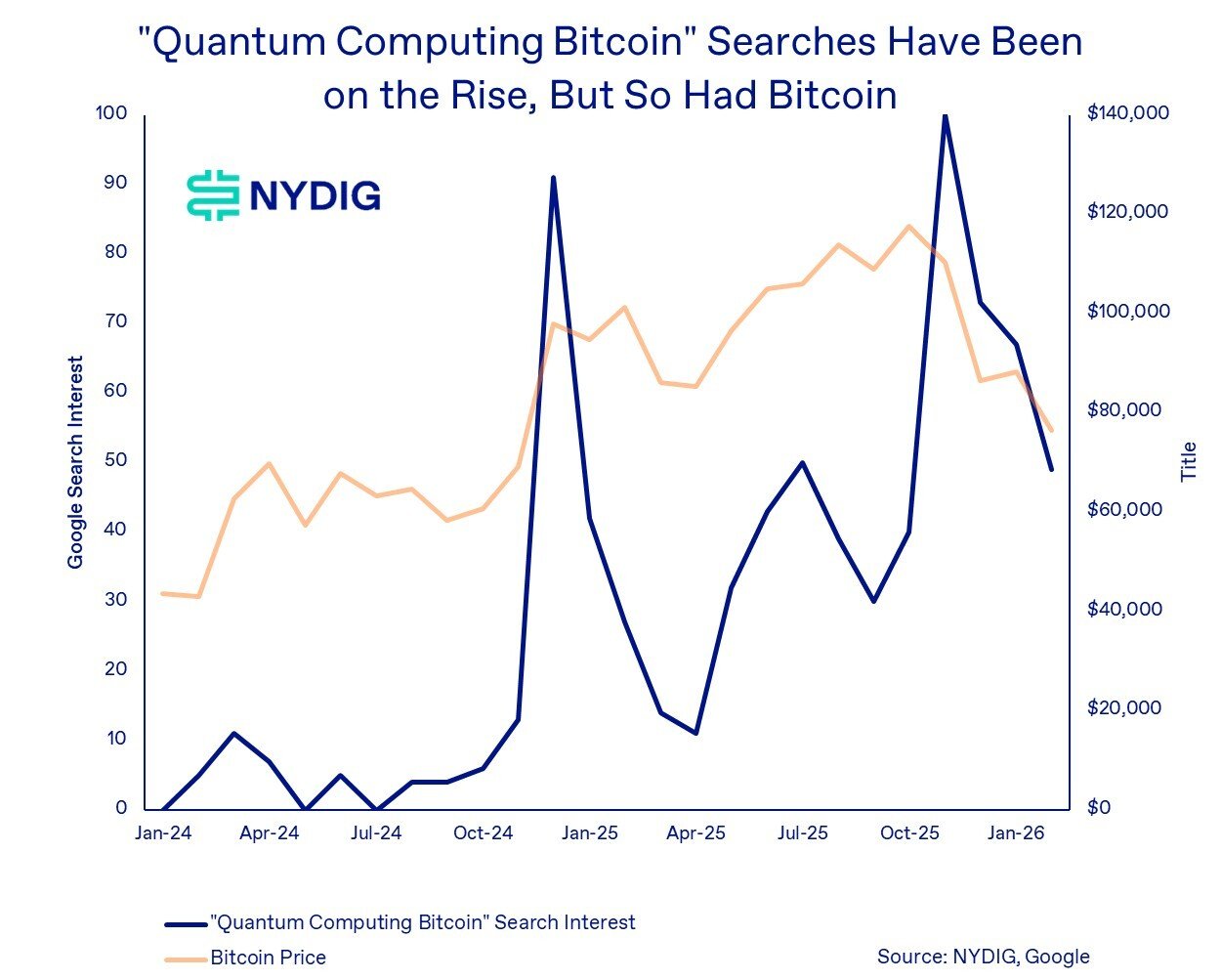
Below is the NYDIG chart cited by the analyst that lines up the Google search data for “Quantum Computing Bitcoin” against the cryptocurrency’s price trajectory.
Looks like interest in the search term hit a peak last year | Source: @caprioleio on X

As displayed in the graph, the Google search interest in the topic witnessed a sharp surge just as last year’s bull rally reached its peak. This would imply that the price appreciation brought with it risk evaluation around the Quantum Computing threat to the cryptocurrency.

Quantum Computing is an emerging technology that could, in theory, exploit the vulnerabilities present in old BTC wallets to access the tokens stored inside them and dump them on the market.

The timeline related to when Quantum Computing could become advanced enough to do this remains yet uncertain, but it has nonetheless raised concerns among many in the BTC community. Edwards has been one of the loudest voices when it comes to this issue, urging the community to work together on a solution as soon as possible.

Based on the Google search interest chart, the analyst has noted, “Evaluation of the risk was at a maxima when price was, resulting in derisking, a leading indicator to price falling.” Shortly after the peak in the metric, the asset observed a bearish shift that has today taken it below the $70,000 mark. “The Quantum threat drove Bitcoin down,” said Edwards.

From the graph, it’s also visible that a similar trajectory was visible during the price surge that occurred in late 2024. Back then, the topic saw slightly lower peak traction and faded quickly once the cryptocurrency slowed down.

Interest in the topic has gone down this time as well as Bitcoin has declined, but it still remains significantly above the low from early 2025, a potential sign that the floor interest in the risk has gone up. “The good news is, at least this means we are starting to get traction and attention in the right places to solve the problem (Strategy, Eth foundation etc),” noted the Capriole founder.

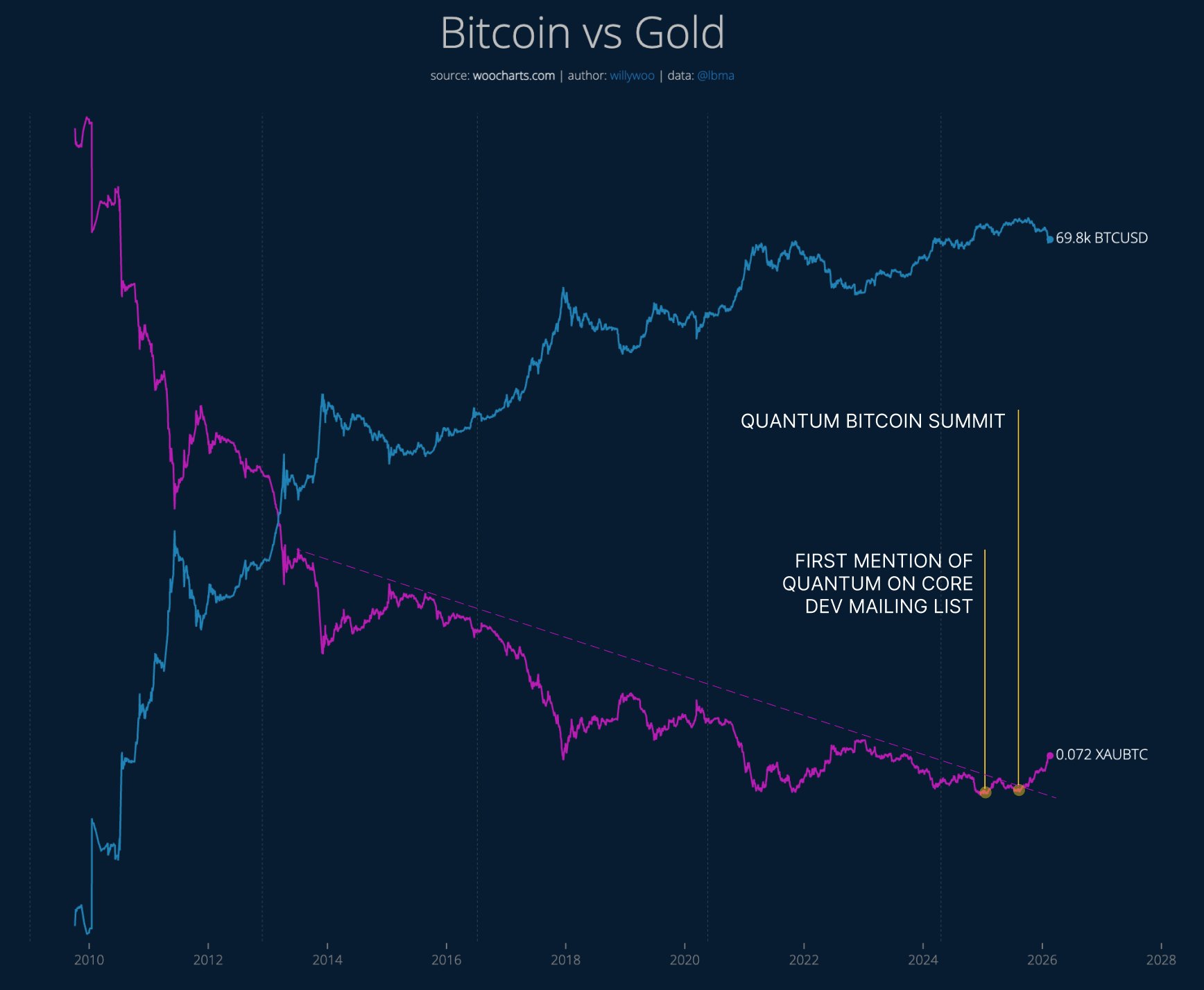
Analyst Willy Woo has also made an X post discussing the Quantum risk. As the chart shared by Woo illustrates, the Bitcoin vs Gold price has broken a twelve-year trend recently.
The trend in the XAUBTC ratio over the years | Source: @willywoo on X

The XAUBTC ratio was in a state of downtrend for twelve years, but its value saw a reversal last year and has since been rising. “The valuation trend broke down once QUANTUM came into awareness,” explained the analyst.

BTC Price

At the time of writing, Bitcoin is trading around $68,600, down 2.4% over the last week.

The price of the coin seems to have been moving sideways over the past few days | Source: BTCUSDT on TradingView

Related Questions

QWhat did the founder of Capriole Investments observe about Google search trends and Bitcoin's price?

ACharles Edwards observed that Google searches for 'Quantum Computing Bitcoin' peaked at the same time as Bitcoin's price top during the bull run.

QWhat is the potential threat that Quantum Computing poses to Bitcoin, according to the article?

AQuantum Computing could, in theory, exploit vulnerabilities in old Bitcoin wallets to access and steal the tokens stored inside them.

QHow did analyst Charles Edwards interpret the peak in search interest for the quantum threat?

AEdwards interpreted it as a sign that risk evaluation was at a maximum when the price was high, which acted as a leading indicator for the price to fall, stating 'The Quantum threat drove Bitcoin down.'

QWhat significant trend break did analyst Willy Woo point out in relation to the quantum risk?

AWilly Woo pointed out that the XAUBTC ratio (Bitcoin vs. Gold price) broke its twelve-year downtrend and began rising once quantum computing threat came into awareness.

QWhat is the current state of Bitcoin's price and the interest in the quantum threat as mentioned in the article?

AAt the time of writing, Bitcoin was trading around $68,600, down 2.4% over the week. Interest in the quantum threat has declined with the price but remains significantly above its early 2025 low.

Related Reads

Anthropic Tops Global AI Product Rankings, X Platform Launches 'Paid Partnership' Label: What's the Crypto World Abroad Talking About Today?

In the past 24 hours, the crypto market saw significant developments across multiple fronts. Key discussions centered on escalating Middle East geopolitical tensions following U.S.-Israel airstrikes on Iranian nuclear facilities, raising concerns over Monday’s risk asset volatility. Meanwhile, as BTC dominance rate continued to rise, expectations for an "altseason" were further delayed. In AI, Anthropic topped global app charts with its "Import Memory" feature, enabling users to migrate memory data from ChatGPT to Claude in seconds—a move seen as challenging OpenAI’s user lock-in, though debates persist over its practical impact. Separately, X platform introduced a "Paid Partnership" label to improve transparency for branded content, a change that could affect crypto influencers’ promotional strategies. On the ecosystem front, Solana advanced real-world adoption with banking integrations (SoFi), government digital visa payments (Bhutan), and RWA growth hitting a $1.71B market cap. Jupiter expanded into a full-scale financial platform, reporting $1T in annual trading volume and rapid growth in lending and perpetuals. Base’s Molten Cast launched as a coordination layer for AI agents, while Polymarket saw active betting on creator economy metrics like MrBeast video views. Hyperliquid emerged as a key weekend hedging venue during the Iran crisis, highlighting the role of 24/7 Perp DEX platforms in global risk management.

marsbit1h ago

Anthropic Tops Global AI Product Rankings, X Platform Launches 'Paid Partnership' Label: What's the Crypto World Abroad Talking About Today?

marsbit1h ago

Aave Founder: The Next Step for DeFi is Financing Solar Energy, Robotics, and Space

DeFi has already improved the supply side of capital allocation, with highly liquid on-chain assets that can be programmatically deployed for optimized risk-adjusted returns. Aave, in particular, has demonstrated its capacity to absorb hundreds of billions in liquidity. The next evolution of DeFi should focus on the demand side, rebalancing liquidity toward real-world infrastructure financing. Key future infrastructure sectors requiring capital deployment include solar farms, batteries, data centers & GPUs, robotics, electric transportation, nuclear energy, desalination, carbon capture, critical minerals, digital networks, and space infrastructure. Conservative estimates project a total capital expenditure opportunity of $100–200 trillion by 2050—dwarfing the combined assets under management of the world’s top ten banks. Aave can capture this opportunity through two primary models: yield-bearing stablecoins (YBS), which distribute off-chain yields to on-chain users, and direct collateralization of tokenized real-world assets. Both approaches align with Aave’s lending structure, where loans are backed by assets rather than user credit. Infrastructure assets typically offer attractive returns—ranging from 8% to 18%—with cash flows that mitigate redemption risks. By serving as a foundational liquidity layer, Aave can help finance the transition to a more abundant global economy, accelerating adoption by 10–15 years. This positions Aave not just as a DeFi protocol but as the core financial infrastructure for the future.

marsbit1h ago

Aave Founder: The Next Step for DeFi is Financing Solar Energy, Robotics, and Space

marsbit1h ago

Trading

Spot
Futures

Hot Articles

What is $BITCOIN

DIGITAL GOLD ($BITCOIN): A Comprehensive Analysis Introduction to DIGITAL GOLD ($BITCOIN) DIGITAL GOLD ($BITCOIN) is a blockchain-based project operating on the Solana network, which aims to combine the characteristics of traditional precious metals with the innovation of decentralized technologies. While it shares a name with Bitcoin, often referred to as “digital gold” due to its perception as a store of value, DIGITAL GOLD is a separate token designed to create a unique ecosystem within the Web3 landscape. Its goal is to position itself as a viable alternative digital asset, although specifics regarding its applications and functionalities are still developing. What is DIGITAL GOLD ($BITCOIN)? DIGITAL GOLD ($BITCOIN) is a cryptocurrency token explicitly designed for use on the Solana blockchain. In contrast to Bitcoin, which provides a widely recognized value storage role, this token appears to focus on broader applications and characteristics. Notable aspects include: Blockchain Infrastructure: The token is built on the Solana blockchain, known for its capacity to handle high-speed and low-cost transactions. Supply Dynamics: DIGITAL GOLD has a maximum supply capped at 100 quadrillion tokens (100P $BITCOIN), although details regarding its circulating supply are currently undisclosed. Utility: While precise functionalities are not explicitly outlined, there are indications that the token could be utilized for various applications, potentially involving decentralized applications (dApps) or asset tokenization strategies. Who is the Creator of DIGITAL GOLD ($BITCOIN)? At present, the identity of the creators and development team behind DIGITAL GOLD ($BITCOIN) remains unknown. This situation is typical among many innovative projects within the blockchain space, particularly those aligning with decentralized finance and meme coin phenomena. While such anonymity may foster a community-driven culture, it intensifies concerns about governance and accountability. Who are the Investors of DIGITAL GOLD ($BITCOIN)? The available information indicates that DIGITAL GOLD ($BITCOIN) does not have any known institutional backers or prominent venture capital investments. The project seems to operate on a peer-to-peer model focused on community support and adoption rather than traditional funding routes. Its activity and liquidity are primarily situated on decentralized exchanges (DEXs), such as PumpSwap, rather than established centralized trading platforms, further highlighting its grassroots approach. How DIGITAL GOLD ($BITCOIN) Works The operational mechanics of DIGITAL GOLD ($BITCOIN) can be elaborated on based on its blockchain design and network attributes: Consensus Mechanism: By leveraging Solana’s unique proof-of-history (PoH) combined with a proof-of-stake (PoS) model, the project ensures efficient transaction validation contributing to the network's high performance. Tokenomics: While specific deflationary mechanisms have not been extensively detailed, the vast maximum token supply implies that it may cater to microtransactions or niche use cases that are still to be defined. Interoperability: There exists the potential for integration with Solana’s broader ecosystem, including various decentralized finance (DeFi) platforms. However, the details regarding specific integrations remain unspecified. Timeline of Key Events Here is a timeline that highlights significant milestones concerning DIGITAL GOLD ($BITCOIN): 2023: The initial deployment of the token occurs on the Solana blockchain, marked by its contract address. 2024: DIGITAL GOLD gains visibility as it becomes available for trading on decentralized exchanges like PumpSwap, allowing users to trade it against SOL. 2025: The project witnesses sporadic trading activity and potential interest in community-led engagements, although no noteworthy partnerships or technical advancements have been documented as of yet. Critical Analysis Strengths Scalability: The underlying Solana infrastructure supports high transaction volumes, which could enhance the utility of $BITCOIN in various transaction scenarios. Accessibility: The potential low trading price per token could attract retail investors, facilitating wider participation due to fractional ownership opportunities. Risks Lack of Transparency: The absence of publicly known backers, developers, or an audit process may yield skepticism regarding the project's sustainability and trustworthiness. Market Volatility: The trading activity is heavily reliant on speculative behavior, which can result in significant price volatility and uncertainty for investors. Conclusion DIGITAL GOLD ($BITCOIN) emerges as an intriguing yet ambiguous project within the rapidly evolving Solana ecosystem. While it attempts to leverage the “digital gold” narrative, its departure from Bitcoin's established role as a store of value underscores the need for a clearer differentiation of its intended utility and governance structure. Future acceptance and adoption will likely depend on addressing the current opacity and defining its operational and economic strategies more explicitly. Note: This report encompasses synthesised information available as of October 2023, and developments may have transpired beyond the research period.

363 Total ViewsPublished 2025.05.13Updated 2025.05.13

Discussions

Welcome to the HTX Community. Here, you can stay informed about the latest platform developments and gain access to professional market insights. Users' opinions on the price of BTC (BTC) are presented below.

活动图片