Bitcoin Could Be Taiwan’s Lifeline In Conflict, Think Tank Suggests

bitcoinistPublished on 2026-04-03Last updated on 2026-04-03

Abstract

A Bitcoin Policy Institute report suggests Taiwan should build a national Bitcoin reserve as a strategic hedge against a potential Chinese military blockade or invasion. The argument centers on Bitcoin’s ability to remain accessible and transferable if traditional assets like gold or U.S. dollar reserves are frozen or immobilized. While Taiwan’s central bank previously rejected the idea due to Bitcoin’s volatility and custody challenges, the report warns that over 80% of Taiwan’s reserves are in dollar-denominated assets—exposing it to U.S. fiscal and monetary risks. Taiwan currently holds 210 seized Bitcoin (worth ~$14M), which would rank it seventh globally if recognized as a reserve asset. The central bank continues testing digital assets in a sandbox program but has not changed its official stance.

Taiwan’s justice ministry is sitting on 210 Bitcoin, seized from criminals and worth roughly $14 million. Most governments would treat that as a footnote. The Bitcoin Policy Institute thinks it should be a starting point.

A Case Built On Worst-Case Scenarios

In a report published Tuesday, BPI research fellow Jacob Langenkamp made the case that Taiwan should build a national Bitcoin reserve — not mainly as a financial play, but as protection against the possibility of a Chinese military blockade or invasion.

His argument is simple: if China cuts Taiwan off, gold cannot be moved and dollar reserves can be frozen. Bitcoin, he wrote, requires no physical transport and remains accessible regardless of what happens on the ground.

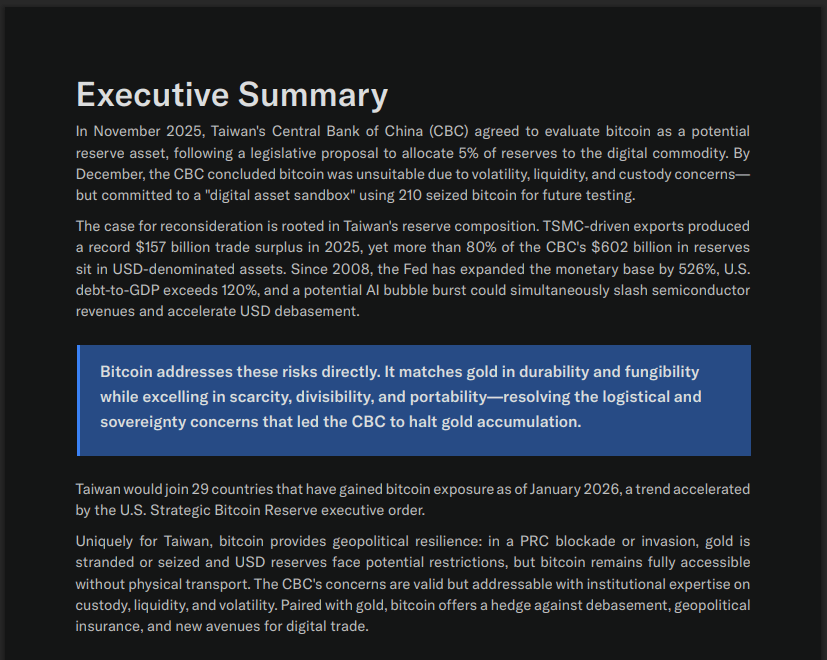
Taiwan’s central bank had already looked at the idea and walked away from it. In December, the bank concluded that Bitcoin was too volatile, too hard to store safely, and too thin in liquidity to serve as a reserve asset.
Source: Bitcoin Policy Institute

It pointed to the US dollar as the more sensible option. Langenkamp acknowledged those concerns are real — but argued they can be solved with the right institutional know-how on custody and risk management.

The Dollar Problem Analysts Say Taiwan Is Ignoring

The report’s broader warning centers on how exposed Taiwan already is to the US dollar. At least 80% of the central bank’s reserves are held in dollar-denominated assets, and most of its trade runs through the same currency.

Source: Bitcoin Policy Institute

Langenkamp listed several pressures that could erode the dollar’s value over time — rising US government debt, Federal Reserve money expansion, a possible downturn in AI-sector valuations, and shrinking semiconductor revenues.

Bitcoin, he argued, could pair with gold to offer a buffer against those risks, giving Taiwan’s central bank a hedge before other countries make the same move.

Taiwan’s central bank did not fully close the door after its December decision. Officials said the bank would continue testing digital asset technology through a sandbox program, using crypto the country already holds.

BTCUSD now trading at $66,310. Chart: TradingView

The Numbers Behind Taiwan’s Existing Holdings

The 210 Bitcoin figure came from lawmaker Ko Ju-Chun, who disclosed it on social media last year. According to data from crypto treasury tracker BitBo, those holdings — if officially counted — would rank Taiwan seventh among nations holding Bitcoin, just behind El Salvador and ahead of Finland. The country is not currently listed in BitBo’s national reserve rankings.

Whether Taiwan’s government acts on the BPI report remains to be seen. The think tank has no formal role in Taiwanese policy, and the central bank’s position has not changed.

But the report adds a new dimension to the global debate over Bitcoin as a state-level asset — one that goes beyond economics and into the question of what a country does when access to its own money is at risk.

Featured image from Unsplash, chart from TradingView

Related Questions

QWhat is the main argument made by the Bitcoin Policy Institute regarding Taiwan's financial reserves?

AThe Bitcoin Policy Institute argues that Taiwan should build a national Bitcoin reserve as a hedge against the risk of a Chinese military blockade or invasion, where traditional assets like gold and dollar reserves could be immobilized or frozen.

QWhat were the three main reasons Taiwan's central bank gave for rejecting Bitcoin as a reserve asset in December?

ATaiwan's central bank concluded that Bitcoin was too volatile, too difficult to store safely, and had insufficient liquidity to serve as a reserve asset.

QAccording to the report, what percentage of Taiwan's central bank reserves are held in US dollar-denominated assets?

AAt least 80% of Taiwan's central bank reserves are held in US dollar-denominated assets.

QHow many Bitcoin does Taiwan's justice ministry currently hold, and what is its approximate value?

ATaiwan's justice ministry is holding 210 Bitcoin, seized from criminals, which is worth approximately $14 million.

QWhat did the report list as potential pressures that could erode the value of the US dollar over time?

AThe report listed rising US government debt, Federal Reserve money expansion, a possible downturn in AI-sector valuations, and shrinking semiconductor revenues as pressures that could erode the dollar's value.

Related Reads

Circle's Pullback: Still Worth Buying?

Circle: Still Worth Buying After the Pullback? Circle, the issuer of the second-largest stablecoin USDC, is at a critical juncture. Its current valuation of $15-20B primarily reflects its interest income from $770B in USDC reserves. However, data suggests a potential transformation into a fee-based digital dollar infrastructure network. Key evidence for this shift includes: * USDC's on-chain transaction volume grew 247% in FY2025, far outpacing its 72% circulation growth, indicating it's being *used* more, not just held. * Adjusted for on-chain noise, USDC dominates real economic settlement volume (64% per Visa data), despite USDT having 2.4x its market cap. Circle's three-layer revenue structure is evolving: 1. **Interest Income (95% of current revenue):** Tied to USDC circulation and interest rates. Faces headwinds from potential Fed cuts and a revenue-sharing agreement with Coinbase. 2. **Payment & Transaction Fees:** The key to becoming an infrastructure play. The Circle Payments Network (CPN) is scaling rapidly ($5.7B annualized TPV), and non-interest revenue surged to $37M/quarter. 3. **Settlement Platform (Arc):** A long-term bet on becoming an institutional settlement standard, though its value remains unproven. Near-term catalysts include the Coinbase revenue-sharing agreement renewal (Aug 2026) and potential full OCC bank charter approval. A 3-5x return is plausible if USDC circulation grows at 40% CAGR. A 10x return requires multiple successes: CPN scaling, improved Coinbase terms, non-interest revenue exceeding 10% of total, and progress on Arc. Major risks include faster-than-expected interest rate declines, Tether achieving greater legitimacy, and competition from new yield-bearing stablecoins and payment giants like Stripe. The investment thesis hinges on tracking three metrics: USDC circulation growth, its velocity (via Visa data), and the growth of non-interest revenue. The data is leaning toward a successful transformation, but it is not yet guaranteed.

marsbit29m ago

Circle's Pullback: Still Worth Buying?

marsbit29m ago

Trading

Spot
Futures

Hot Articles

Discussions

Welcome to the HTX Community. Here, you can stay informed about the latest platform developments and gain access to professional market insights. Users' opinions on the price of S (S) are presented below.

活动图片