Author | Jeff Park (CIO, Bitwise)
Compiled by | Odaily Planet Daily (@OdailyChina)
Translator | DingDang (@XiaMiPP)
Editor's Note: On February 5th, the crypto market experienced another sharp decline, with over $2.6 billion in liquidations within 24 hours. Bitcoin briefly crashed to $60,000, yet the market seemed to lack a clear consensus on the cause of this drop. Bitwise CIO Jeff Park offers a new analytical framework from the perspective of options and hedging mechanisms.

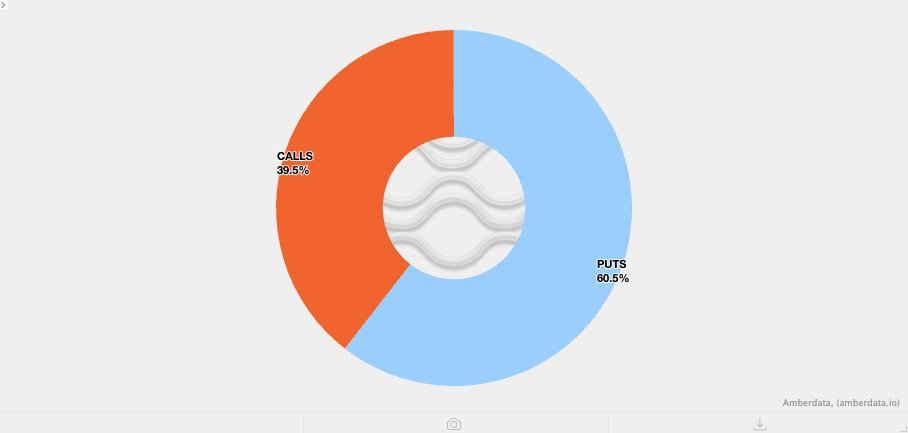
As time passes and more data becomes available, the picture is becoming clearer: this severe sell-off is likely related to the Bitcoin ETF, and the day itself was one of the most turbulent trading days in recent capital market history. We can draw this conclusion because IBIT's trading volume hit a record high that day—exceeding $10 billion, double the previous record (a truly staggering number), while options volume also set a new record (see chart below, showing the highest number of contracts since the ETF's launch). Somewhat unusually compared to the past, the volume structure showed that options trading was clearly dominated by puts, not calls (we will elaborate on this later).
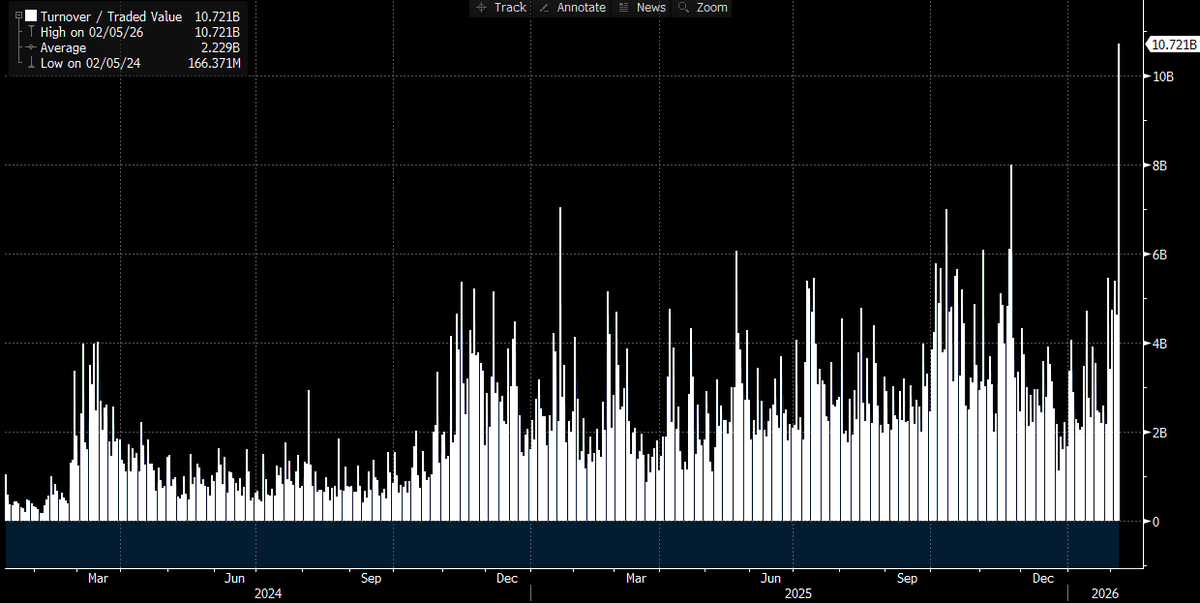
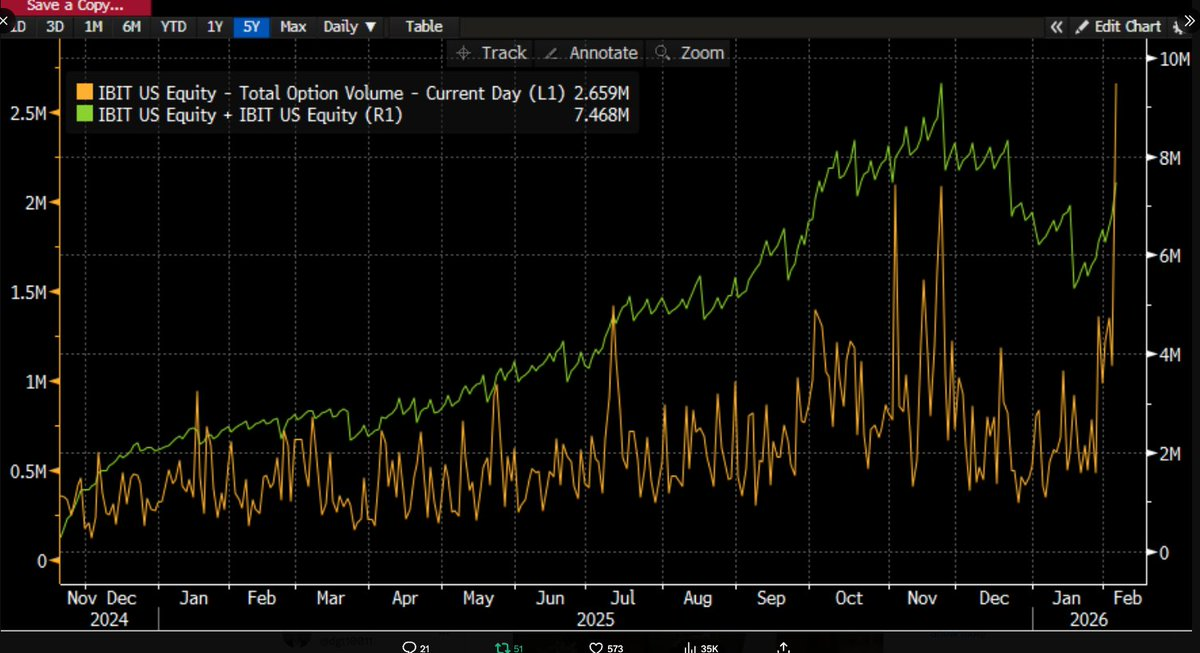
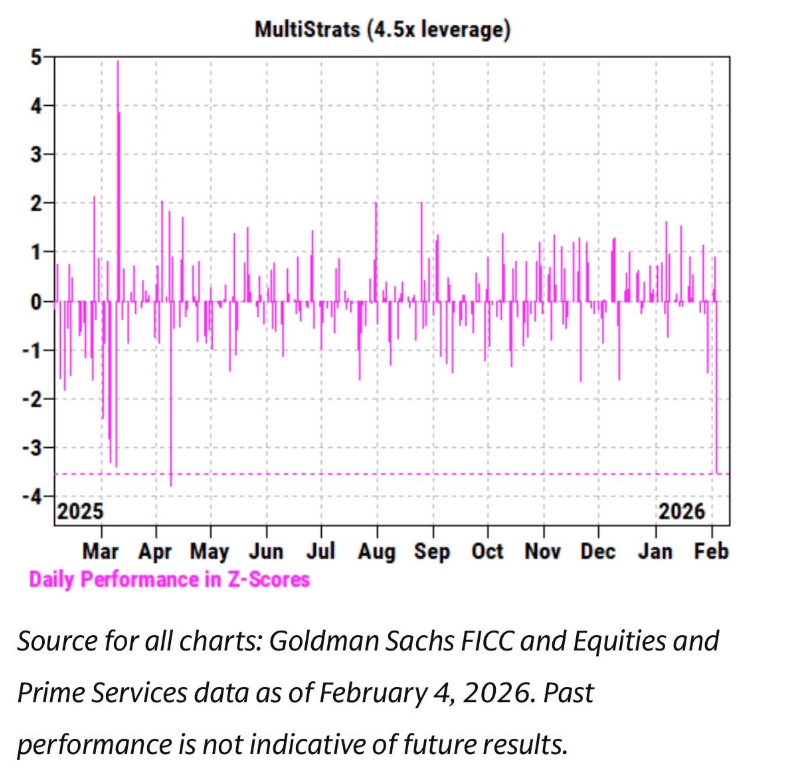
Simultaneously, over the past few weeks, we have observed an extremely tight correlation between IBIT's price movements and software stocks, as well as other risk assets. Goldman Sachs' Prime Brokerage (PB) team also reported that February 4th was one of the worst single days on record for multi-strategy funds, with a Z-score as high as 3.5. This means it was an extreme event with a probability of only 0.05%, ten times rarer than a 3-sigma event (the classic "black swan" threshold, probability ~0.27%). It was, by all accounts, a catastrophic shock. Typically, it is after such events that risk managers at multi-strategy funds (pod shops) quickly intervene, demanding all trading teams immediately, indiscriminately, and urgently deleverage. This explains why February 5th also turned into a bloodbath.
With so many records broken and a clear downward price direction (a 13.2% single-day drop), we originally expected a high likelihood of seeing net outflows from the ETF. This judgment isn't far-fetched based on historical data: for example, on January 30th, IBIT saw a record $530 million outflow after a 5.8% drop the previous day; or on February 4th, IBIT saw about $370 million in outflows amid consecutive declines. Therefore, expecting at least $500 million to $1 billion in outflows in the market environment of February 5th was entirely reasonable.
But the opposite happened—we saw widespread net inflows. IBIT added approximately 6 million shares that day, corresponding to an increase in Assets Under Management (AUM) of over $230 million. Meanwhile, other Bitcoin ETFs also recorded inflows, with the entire ETF system attracting over $300 million in net inflows.
This outcome is somewhat puzzling. Theoretically, one could勉强conceive that the strong price rebound on February 6th somewhat alleviated redemption pressure, but transitioning from "potentially reduced outflows" to "net inflows" is a completely different matter. This suggests that multiple factors were likely at play simultaneously, but these factors don't form a single, linear narrative framework. Based on the information we currently have, several reasonable preliminary assumptions can be made, and on these assumptions, I will present my overall inference.
First, this round of Bitcoin selling likely affected a type of multi-asset portfolio or strategy that is not purely crypto-native. This could be the multi-strategy hedge funds mentioned earlier, or it could be funds like BlackRock's model portfolio business, which allocates between IBIT and IGV (a software ETF) and were forced into automatic rebalancing during the sharp volatility.
Second, the acceleration of the Bitcoin sell-off was likely related to the options market, particularly structures related to the downside.
Third, this selling did not ultimately translate into outflows at the Bitcoin asset level, meaning the main driving force behind the price action came from the "paper money system," i.e., position adjustment behavior dominated by dealers and market makers, overall in a hedged state.
Based on the above facts, my core hypothesis is as follows.
- The direct catalyst for this sell-off was a broad deleveraging triggered by multi-asset funds and portfolios after the downside correlation of risk assets reached a statistically anomalous level.
- This process then triggered an extremely violent deleveraging, which also included Bitcoin exposure, but a significant portion of this risk was actually in "Delta neutral" hedged positions, such as basis trades, relative value trades (e.g., Bitcoin vs. crypto stocks), and other structures where the residual Delta risk is typically "boxed" by the dealer system.
- This deleveraging then triggered a negative Gamma effect, further amplifying the downward pressure, thus forcing dealers to sell IBIT. However, because the selling was so fiercely, market makers had to go net short Bitcoin regardless of their own inventory. This process, in turn, created new ETF inventory, thereby reducing the market's original expectation of large-scale outflows.
Subsequently, on February 6th, we observed positive inflows into IBIT, as some IBIT buyers (the question is, what type of buyers were these chose to allocate on the dip after the decline, further offsetting what might have been a small net outflow.
First, I personally lean towards the view that the initial catalyst for this event came from the sell-off in software stocks, especially considering the high correlation Bitcoin showed with software stocks, even higher than its correlation with gold. Please refer to the two charts below.
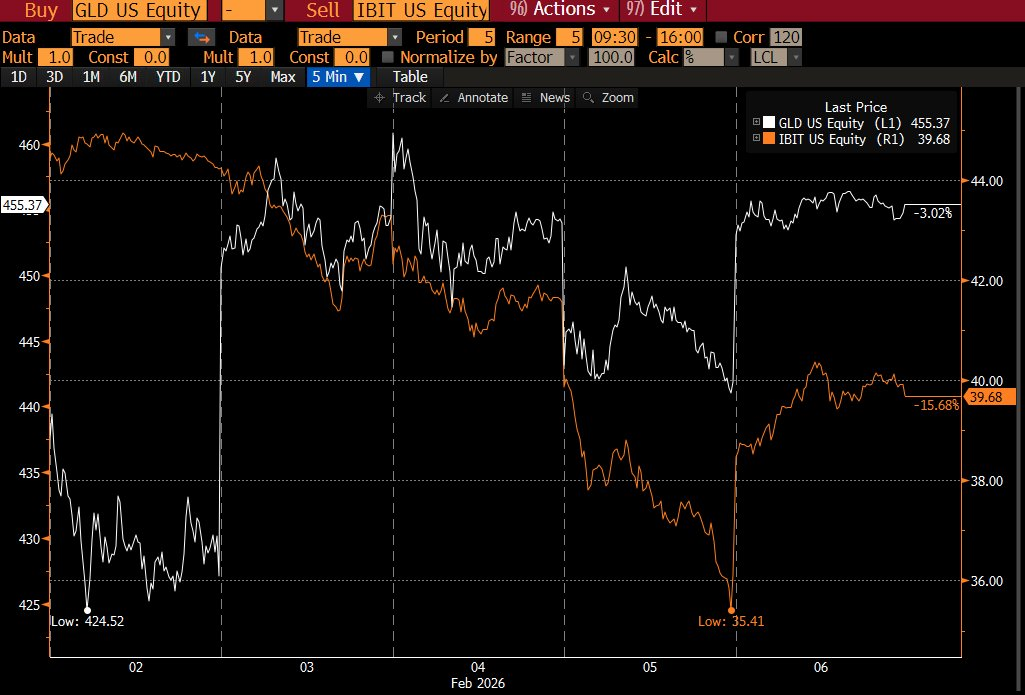
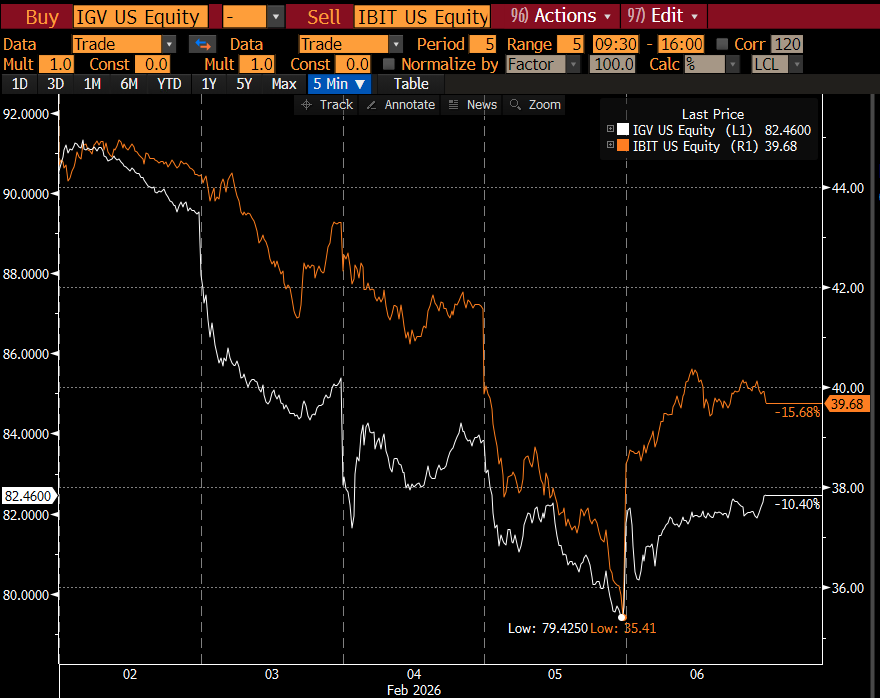
This is logically sound because gold is typically not an asset held in large quantities by multi-strategy funds engaged in financing trades, although it might appear in RIA model portfolios (pre-designed asset allocation schemes). Therefore, in my view, this further supports the judgment that: the epicenter of this turmoil is more likely located within the multi-strategy fund system.
This makes the second judgment seem more reasonable, namely that this violent deleveraging process did indeed include hedged Bitcoin risk. Take the CME Bitcoin basis trade as an example, a strategy long favored by multi-strategy funds.

Looking at the complete data from January 26th to yesterday, covering the CME Bitcoin basis movements for 30, 60, 90, and 120-day tenors (thanks to top-tier industry researcher @dlawant for the data), one can clearly see the near-month basis jumping from 3.3% to as high as 9% on February 5th. This is one of the largest jumps we have personally observed in the market since the ETF launch, which almost unequivocally points to one conclusion: basis trades were forcibly liquidated on a large scale under指令.
Imagine institutions like Millennium, Citadel, being forced to liquidate basis trade positions (selling spot, buying futures). Considering their volume within the Bitcoin ETF system, it's easy to understand why this operation would cause剧烈impact on the overall market structure. I have previously written down my own reasoning on this point.
Odaily Planet Daily adds: Currently, a significant portion of this undifferentiated US-based selling is likely coming from multi-strategy hedge funds. These funds often employ delta hedging strategies, or run some form of relative value (RV) or factor-neutral trades, and these trades are currently widening spreads, possibly accompanied by spillover from growth stock equity correlations.
A rough estimate: About 1/3 of Bitcoin ETF holdings are of the institutional type, and roughly 50% (possibly more) of that is believed to be held by hedge funds. This is a considerable amount of fast money flow, which can easily capitulate and liquidate once financing costs or margin requirements rise in the current high-volatility environment and risk managers intervene, especially when the basis yield no longer justifies the risk premium. It's worth noting that MSTR's USD trading volume today is among the highest in its history.
This is why the biggest factor最容易causing hedge fund failures is the notorious "common holder risk": multiple seemingly independent funds hold highly similar exposures, and when the market turns down, everyone rushes for the same narrow exit, causing all downside correlations to tend towards 1. Selling in such poor liquidity conditions is typical "risk-off" behavior, which we are seeing today. This will eventually be reflected in the ETF flow data. If this hypothesis holds, I suspect prices will reprice quickly once this all clears, though rebuilding confidence will still take some time afterwards.
This leads to the third clue. Now that we understand why IBIT was sold amid broad deleveraging, the question becomes: What was accelerating the decline? A possible "accelerant" is structured products. Although I don't believe the structured products market is large enough to trigger this sell-off on its own, when all factors align异常ly and perfectly simultaneously in a way beyond any VaR (Value at Risk) model's expectations, they can certainly act as an acute event triggering连锁liquidation behavior.
This immediately reminds me of my time at Morgan Stanley. There, structured products with knock-in put barriers (options that only "activate" into effective put options if the underlying asset price touches/crosses a specific barrier level) often had highly destructive consequences. In some cases, the change in option Delta could even exceed 1, a phenomenon not even considered in the standard Black-Scholes model—because in the standard Black-Scholes framework, for plain vanilla options (the most basic European call/put options), the delta can never exceed 1.
Take a note priced by JPMorgan last November as an example; its knock-in barrier was set exactly at 43.6. If these notes continued to be issued in December, and the Bitcoin price fell another 10%, one can imagine a large accumulation of knock-in barriers in the 38–39 range, the so-called "eye of the storm".
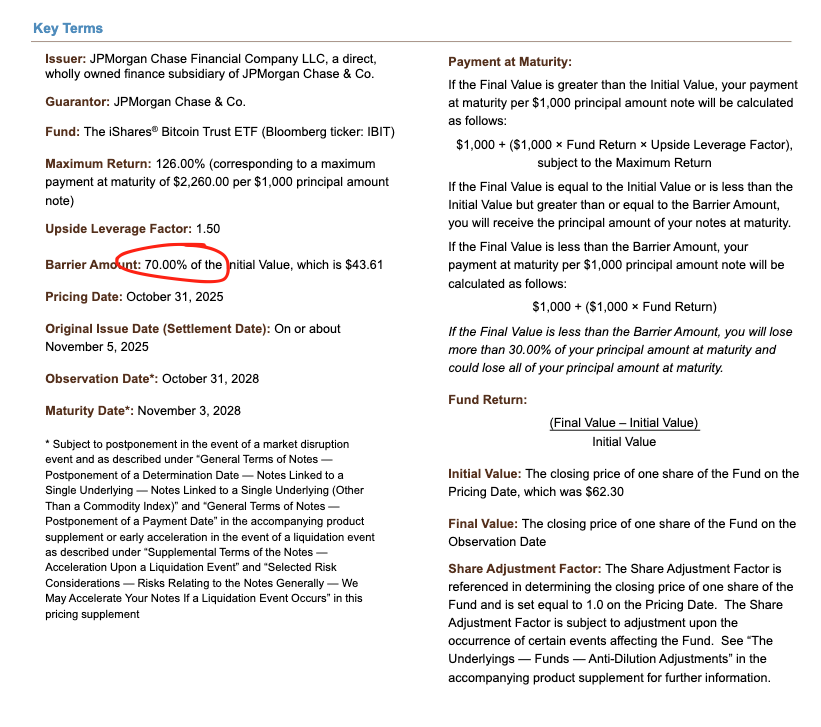
In the event these barriers are breached, if the dealer hedged the knock-in risk by, say, selling puts, then under negative Vanna dynamics, the rate of change of Gamma can be extremely rapid. At this point, as a dealer, the only viable response is to aggressively sell the underlying asset as the market weakens. This is precisely what we observed: implied volatility (IV) collapsed to near 90%, a historical extreme, almost reaching a catastrophic squeeze level. In such a situation, dealers were forced to expand their IBIT short positions to the extent that they ultimately created net new ETF shares. This part确实requires some degree of inference and is difficult to fully confirm without more detailed spread data, but given the record volume that day and the deep involvement of Authorized Participants (APs), this scenario is entirely plausible.
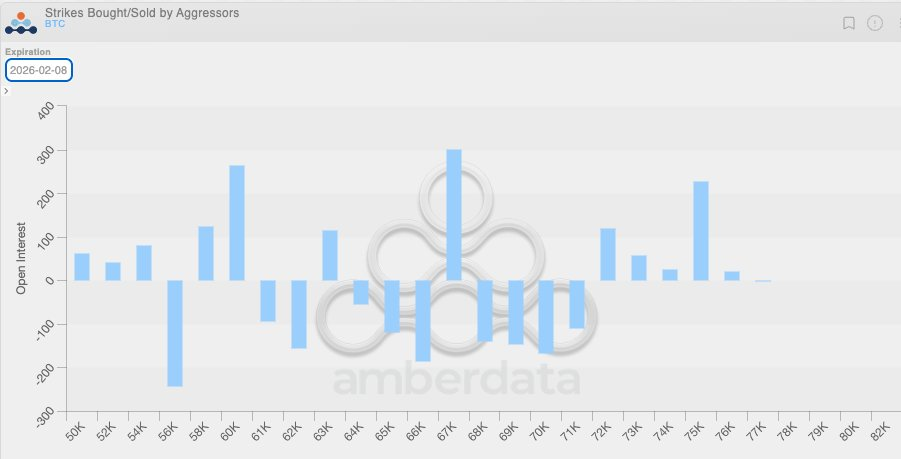
Combining this negative Vanna dynamic with another fact makes the logic even clearer. Due to the overall low volatility in the previous period, crypto-native market clients had generally been inclined to buy puts over the past few weeks. This means crypto dealers were naturally in a short Gamma state and had underpriced the potential for outsized moves. When the big move finally arrived, this structural imbalance further amplified the downward pressure. The position distribution chart below also clearly shows this, with dealers heavily positioned short Gamma on puts in the $64k to $71k range.
This brings us back to February 6th, when Bitcoin staged a strong rebound of over 10%. A notable phenomenon here is that the CME's open interest (OI) expanded明显faster than Binance's (again, thanks to @dlawant for aligning the hourly data to 4 PM ET). From February 4th to 5th, a clear collapse in CME OI can be seen, again confirming the judgment that basis trades were massively unwound on February 5th; on February 6th, these positions were likely re-established to take advantage of the higher basis levels, thereby offsetting the impact of outflows.
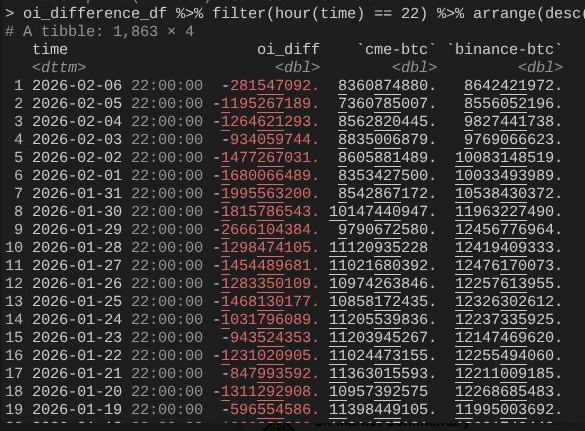
At this point, the entire logical chain closes: IBIT was roughly flat in terms of creations and redemptions because CME basis trades had recovered; but prices remained偏低because Binance's OI showed a clear collapse, meaning a significant portion of the deleveraging pressure came from short Gamma positions and liquidations within the crypto-native market.
The above is my best explanation for the market performance on February 5th and subsequently on February 6th. This reasoning is built on several assumptions and is not entirely satisfying because it lacks a clear "culprit" to blame (like the FTX incident). But the core conclusion is this: The trigger for this sell-off came from de-risking behavior in traditional finance outside crypto, and this process恰好pushed the Bitcoin price into a range where short Gamma hedging behavior would accelerate the decline. This drop was not driven by directional bearishness but triggered by hedging needs, and ultimately reversed quickly on February 6th (unfortunately, this reversal primarily benefited market-neutral capital in traditional finance, not directional strategies in crypto-native markets). While this conclusion may not be exciting, it is at least somewhat reassuring that: the previous day's sell-off likely has nothing to do with a 10/10 event.
Yes, I don't believe what happened last week is a continuation of the 10/10 deleveraging process. I read an article suggesting this turmoil might originate from a non-US, Hong Kong-based fund involved in a failed JPY carry trade. But this theory has two obvious flaws. First, I don't believe a non-crypto prime broker would be willing to service such a complex multi-asset trade while also providing a 90-day margin buffer, without falling into insolvency first when the risk framework tightened. Second, if the carry trade money was "bailed out" by buying IBIT options, then the Bitcoin price drop itself wouldn't accelerate the risk release—these options would just go out-of-the-money, their Greeks rapidly to zero. This means the trade itself must have contained real downside risk. If someone was long USD/JPY carry and simultaneously selling IBIT puts, then that prime broker, frankly, doesn't deserve to exist.
The next few days will be crucial, as we will get more data to judge whether investors are using this dip to build new demand; if so, that would be a very bullish signal. For now, I am quite encouraged by the potential for ETF inflows. I still firmly believe that true RIA-style ETF buyers (not relative value hedge funds) are savvy investors, and at the institutional level, we are seeing substantial, real, and profound progress, evident throughout the industry's advancement and among my friends at Bitwise. For this reason, I am focusing on net inflows that are not accompanied by an expansion in basis trading.
Finally, all this also shows once again that Bitcoin has integrated into the global financial capital markets in an extremely complex and mature way. This also means that when the market finds itself on the other side of a squeeze in the future, the upside move will be steeper than ever before.
The fragility of traditional finance's margin rules is Bitcoin's antifragility. Once the rebound comes—which I see as inevitable, especially after Nasdaq raised the options open interest cap—it will be a spectacular sight to behold.