Analyst Reveals The Best Time To Buy Bitcoin And The Best Time To Sell

bitcoinistPublished on 2026-02-11Last updated on 2026-02-11

Abstract

A crypto analyst named Tony proposes a predictable long-term pattern for Bitcoin's price cycles, based on historical data since 2015. According to his framework, each major bull market lasts approximately 1,066 days, followed by a bear market of about 365 days. The current cycle is said to have started on November 22, 2022, and peaked at $126,080 on October 6, 2025, completing another 1,066-day bull run. The subsequent bear phase is projected to last until October 5, 2026, potentially driving Bitcoin's correction down to a strong support zone between $40,000 and $50,000. A final bottom could form between mid-September and late November 2026. At the time of writing, Bitcoin was trading at $66,950, still significantly above this projected bottom range.

Bitcoin’s long-term price structure may look chaotic on lower timeframes, but one crypto analyst believes it is following a more predictable pattern on larger timeframes.

In a recent post on X, analyst Tony outlined a macro cycle framework that he says has consistently defined the best windows to accumulate Bitcoin and the best periods to exit around cycle highs. His theory is based on historical bull and bear market durations stretching back to 2015, and he claims the current cycle is following that same pattern almost perfectly.

The 1,066-Day Bull And 365-Day Bear Pattern

According to Tony, Bitcoin’s market cycles have followed a remarkably consistent structure over the past decade. Each major bull market has lasted roughly 1,066 days, followed by a bear phase of about 365 days.

The first example he highlights runs from January 8, 2015, to December 17, 2017, a 1,066-day expansion that ended near the cycle peak. That was followed by a one-year decline into December 2018. The same pattern repeated from December 16, 2018, to November 10, 2021, another 1,066-day bull run, followed by a 365-day bear market into November 2022.

According to Tony, the current cycle is no different. The most recent bull market was dated from November 22, 2022, to October 6, 2025, right when Bitcoin reached a peak price of $126,080. Interestingly, this period once again totaled approximately 1,066 days.
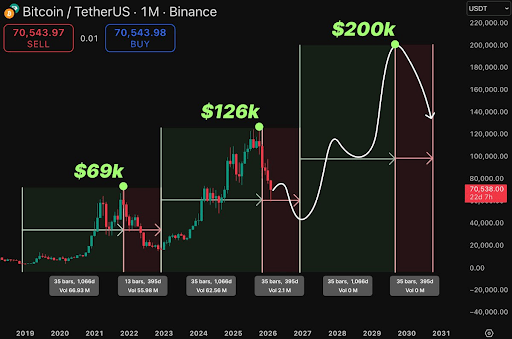
Source: Chart from Tony on X

Keeping this cycle of bull and bear periods in mind, the subsequent bear phase, he suggests, should run from October 7, 2025, to October 5, 2026, completing another 365-day correction. This means Bitcoin could continue to trade in corrections of lower highs and lower lows until early October 2026. However, the timing is not perfect to the exact day, and there can be a 10- to 20-day variance to the predicted date.

The chart attached to his post, shown below, divides these cycles into green expansion zones and red correction phases. Previous peaks around $69,000 in 2021 and $126,000 in 2025 are marked clearly, with the projection being a move to $40,000 and another return to $200,000 before the next red correction zone takes over.

Final Capitulation Could Still Be Ahead

In a separate post, Tony warned that the next major Bitcoin bottom may not yet be in place. The analyst projected further declines until Bitcoin enters into a strong support region between $40,000 and $50,000, with a potential bottom forming between mid-September and late November 2026.

He contrasted two emotional extremes in the analysis: early buyers celebrating perceived bargains during a falling market and later participants paralyzed by fear as the price reaches deep support.

At the time of writing, Bitcoin is trading at $66,950, sitting 47% below its October 2025 all-time high but still significantly above the $40,000-$50,000 identified as a potential final bottom zone. This projection means that Bitcoin could still fall further by 50% to 40% before it establishes a bottom.

BTC trading at $66,900 on the 1D chart | Source: BTCUSDT on Tradingview.com

Related Questions

QAccording to analyst Tony, what is the duration of Bitcoin's typical bull market and bear market cycle based on historical pattern since 2015?

AAccording to Tony, Bitcoin's typical bull market lasts roughly 1,066 days, followed by a bear market phase of about 365 days.

QWhat are the start and end dates for the current bear market phase as predicted by Tony's analysis?

AThe predicted bear market phase runs from October 7, 2025, to October 5, 2026.

QWhat price level does Tony identify as a strong support region where Bitcoin could potentially form its next major bottom?

ATony identifies the strong support region as between $40,000 and $50,000.

QWhen does the analyst project that the potential final bottom for Bitcoin could form?

AHe projects a potential bottom could form between mid-September and late November 2026.

QWhat was the all-time high price of Bitcoin mentioned in the article for October 2025, and what is the current price mentioned?

AThe all-time high price mentioned for October 2025 is $126,080, and the current price mentioned at the time of writing is $66,950.

Related Reads

In the Era of Agent Explosion, How Should We Cope with AI Anxiety?

The article addresses the widespread anxiety around AI and Agent technologies, arguing against the view that AI advancement is merely a race in token consumption. It critiques recent viral claims suggesting that burning more tokens—such as 100 million or even 1 billion per day—equates to greater power or evolutionary advantage, pointing out the impractical cost and lack of inherent value in pure token usage. Instead, the author frames AI as a force for technological democratization, similar to historical innovations like steam engines, electricity, and the internet. These technologies eventually became accessible to all, rather than remaining exclusive to elites. AI, particularly through tools like ChatGPT, offers a form of knowledge and capability equality—it responds based on parameters, not the user's identity. The key differentiator in using Agents effectively is not the volume of tokens consumed, but the clarity of goals, structural design, and quality of questioning. Efficiency—achieving more with fewer tokens—is where true value lies. Human judgment and creativity remain essential. The piece also explores AI anxiety through the lens of Max Weber’s concept of "instrumental rationality," where AI excels at optimizing for efficiency without questioning underlying values. While AI may outperform humans in task execution, the author suggests that humans must focus on "value rationality"—pursuing meaning, beauty, and purpose beyond pure utility. Just as围棋 (Go) persists as an art form despite AI dominance, human activities can retain significance through aesthetic, emotional, and ethical dimensions. The conclusion urges readers not to fear replacement by AI, but to reaffirm what makes us human: the pursuit of joy, meaning, and values—qualities that AI, despite its power, does not inherently possess or prioritize.

marsbit4m ago

In the Era of Agent Explosion, How Should We Cope with AI Anxiety?

marsbit4m ago

Trading

Spot
Futures

Hot Articles

What is $BITCOIN

DIGITAL GOLD ($BITCOIN): A Comprehensive Analysis Introduction to DIGITAL GOLD ($BITCOIN) DIGITAL GOLD ($BITCOIN) is a blockchain-based project operating on the Solana network, which aims to combine the characteristics of traditional precious metals with the innovation of decentralized technologies. While it shares a name with Bitcoin, often referred to as “digital gold” due to its perception as a store of value, DIGITAL GOLD is a separate token designed to create a unique ecosystem within the Web3 landscape. Its goal is to position itself as a viable alternative digital asset, although specifics regarding its applications and functionalities are still developing. What is DIGITAL GOLD ($BITCOIN)? DIGITAL GOLD ($BITCOIN) is a cryptocurrency token explicitly designed for use on the Solana blockchain. In contrast to Bitcoin, which provides a widely recognized value storage role, this token appears to focus on broader applications and characteristics. Notable aspects include: Blockchain Infrastructure: The token is built on the Solana blockchain, known for its capacity to handle high-speed and low-cost transactions. Supply Dynamics: DIGITAL GOLD has a maximum supply capped at 100 quadrillion tokens (100P $BITCOIN), although details regarding its circulating supply are currently undisclosed. Utility: While precise functionalities are not explicitly outlined, there are indications that the token could be utilized for various applications, potentially involving decentralized applications (dApps) or asset tokenization strategies. Who is the Creator of DIGITAL GOLD ($BITCOIN)? At present, the identity of the creators and development team behind DIGITAL GOLD ($BITCOIN) remains unknown. This situation is typical among many innovative projects within the blockchain space, particularly those aligning with decentralized finance and meme coin phenomena. While such anonymity may foster a community-driven culture, it intensifies concerns about governance and accountability. Who are the Investors of DIGITAL GOLD ($BITCOIN)? The available information indicates that DIGITAL GOLD ($BITCOIN) does not have any known institutional backers or prominent venture capital investments. The project seems to operate on a peer-to-peer model focused on community support and adoption rather than traditional funding routes. Its activity and liquidity are primarily situated on decentralized exchanges (DEXs), such as PumpSwap, rather than established centralized trading platforms, further highlighting its grassroots approach. How DIGITAL GOLD ($BITCOIN) Works The operational mechanics of DIGITAL GOLD ($BITCOIN) can be elaborated on based on its blockchain design and network attributes: Consensus Mechanism: By leveraging Solana’s unique proof-of-history (PoH) combined with a proof-of-stake (PoS) model, the project ensures efficient transaction validation contributing to the network's high performance. Tokenomics: While specific deflationary mechanisms have not been extensively detailed, the vast maximum token supply implies that it may cater to microtransactions or niche use cases that are still to be defined. Interoperability: There exists the potential for integration with Solana’s broader ecosystem, including various decentralized finance (DeFi) platforms. However, the details regarding specific integrations remain unspecified. Timeline of Key Events Here is a timeline that highlights significant milestones concerning DIGITAL GOLD ($BITCOIN): 2023: The initial deployment of the token occurs on the Solana blockchain, marked by its contract address. 2024: DIGITAL GOLD gains visibility as it becomes available for trading on decentralized exchanges like PumpSwap, allowing users to trade it against SOL. 2025: The project witnesses sporadic trading activity and potential interest in community-led engagements, although no noteworthy partnerships or technical advancements have been documented as of yet. Critical Analysis Strengths Scalability: The underlying Solana infrastructure supports high transaction volumes, which could enhance the utility of $BITCOIN in various transaction scenarios. Accessibility: The potential low trading price per token could attract retail investors, facilitating wider participation due to fractional ownership opportunities. Risks Lack of Transparency: The absence of publicly known backers, developers, or an audit process may yield skepticism regarding the project's sustainability and trustworthiness. Market Volatility: The trading activity is heavily reliant on speculative behavior, which can result in significant price volatility and uncertainty for investors. Conclusion DIGITAL GOLD ($BITCOIN) emerges as an intriguing yet ambiguous project within the rapidly evolving Solana ecosystem. While it attempts to leverage the “digital gold” narrative, its departure from Bitcoin's established role as a store of value underscores the need for a clearer differentiation of its intended utility and governance structure. Future acceptance and adoption will likely depend on addressing the current opacity and defining its operational and economic strategies more explicitly. Note: This report encompasses synthesised information available as of October 2023, and developments may have transpired beyond the research period.

363 Total ViewsPublished 2025.05.13Updated 2025.05.13

Discussions

Welcome to the HTX Community. Here, you can stay informed about the latest platform developments and gain access to professional market insights. Users' opinions on the price of BTC (BTC) are presented below.

活动图片