The Glamour Belongs to the 'Epsteins', Saylor Just Wants to Hoard Bitcoin

marsbitPublished on 2026-02-02Last updated on 2026-02-02

Abstract

Summary: The recently unsealed Epstein files revealed an unexpected connection to Michael Saylor, CEO of MicroStrategy (now Strategy). In a 2010 email, Epstein's PR coordinator, Peggy Siegal, complained about Saylor's presence at a high-society dinner, describing him as a "zombie on drugs" who was impossible to engage socially and had no personality or understanding of social etiquette. This social awkwardness, however, may have been his saving grace, as it from deeper involvement in the scandal. This perceived personal flaw is presented as a professional strength in his role as a Bitcoin maximalist. Saylor’s company is the largest corporate holder of Bitcoin, with 712,647 BTC purchased at an average cost of $76,037. Despite recent market volatility pushing the price down and his company's stock falling 60%, Saylor remains committed to his strategy of buying Bitcoin weekly, famously tweeting "More Orange" to signal his intent to continue accumulating. The article argues that the traits that made him a social outcast—being闷 (boring), uninteresting, and unresponsive to external noise—are the exact same traits that make him a successful "Bitcoin zombie." His strategy is simple and requires no complex decision-making: buy and never sell. While his approach is not advisable for the average investor without his corporate financial tools, the core lesson is that in investing, "interesting" strategies like frequent trading and chasing hype often lead to losses. The most profitable ...

Author: Curry, Deep Tide TechFlow

There's a reason why someone can hold onto 710,000 Bitcoins.

Last Friday, the U.S. Department of Justice released documents related to the Epstein case, spanning 3 million pages. Politicians, billionaires, celebrities—a string of names are popping out from these materials. And Michael Saylor, the founder of MicroStrategy (formerly known as MicroStrategy), is also in there.

However, Saylor's appearance is a bit special; he was at the table that got rejected.

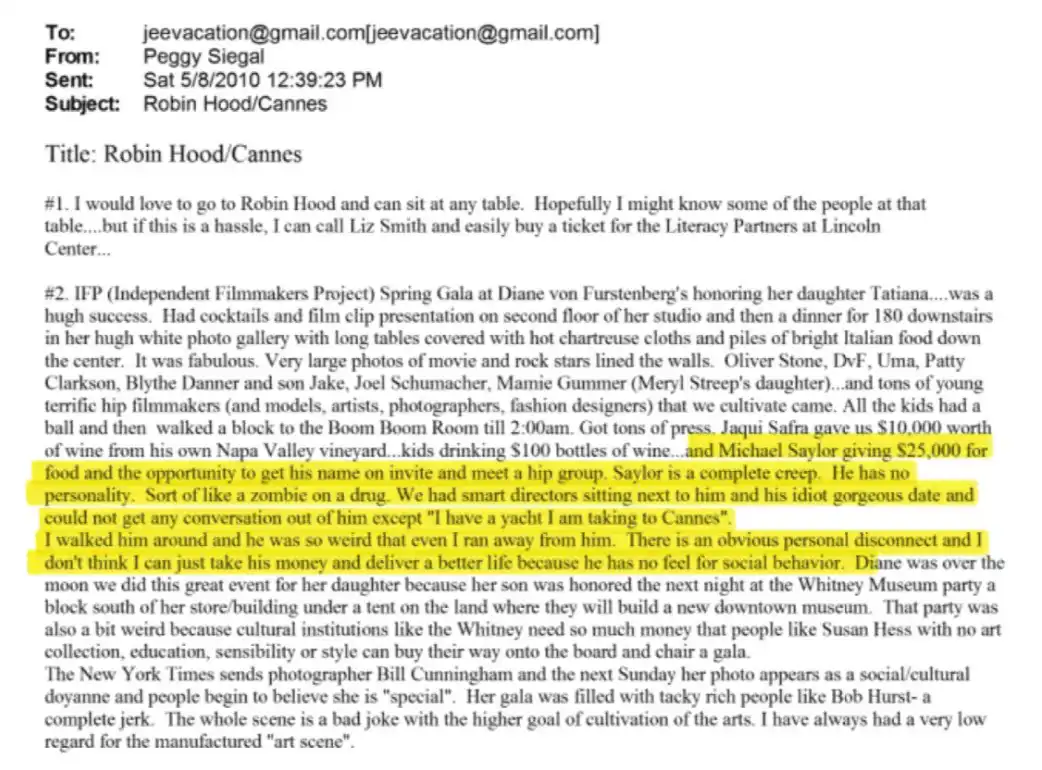
From the currently available information, in 2010, Epstein's publicist Peggy Siegal complained in a private email:

"There's this guy named Saylor who spent twenty-five thousand dollars on a dinner ticket, and I was responsible for socializing with him. But this guy was completely impossible to talk to, like a drugged-up zombie. I couldn't stand it and ran away halfway through."

Peggy's main job was as a Hollywood movie publicist, with a side gig of organizing dinners for Epstein, essentially scouting for wealthy people to pull into the circle.

Socializing with the wealthy, helping them meet the right people at parties and dinners, having a good time, and spending money comfortably. After decades in the business, she's按理说 seen all kinds of billionaires.
But Saylor, she couldn't handle.

The reason wasn't that he had character flaws; it was that he was too dull. He paid to get in, sat there, couldn't engage in conversation, and had no interest in socializing whatsoever.

Peggy's exact words were,"I don't even know if I can take his money, I don't know where to start trying to manipulate him... He has no personality, completely不懂 social etiquette."

Now that the Epstein case has exploded, people on the list are busy distancing themselves. Saylor, on the other hand, never managed to挤进去 in the first place.

Being excessively boring and autistic became a protective shield.

But when this "boredom" is placed in a different context, it's another story.

Saylor's company, MicroStrategy (formerly known as MicroStrategy), is the publicly traded company holding the most Bitcoin globally. This January, when Bitcoin was still oscillating around $90,000, they bought over 37,000 more Bitcoins, spending $3.5 billion.

Buying almost every week, rain or shine.

As of now, MicroStrategy holds 712,647 Bitcoins, with an average cost of $76,037. And today, Bitcoin just fell below $76,000, meaning Saylor's position is right at the break-even line.

The market fear index hit a 20-week high, and the crypto world is filled with cries of despair. MicroStrategy's stock price has also fallen 60% from its peak.
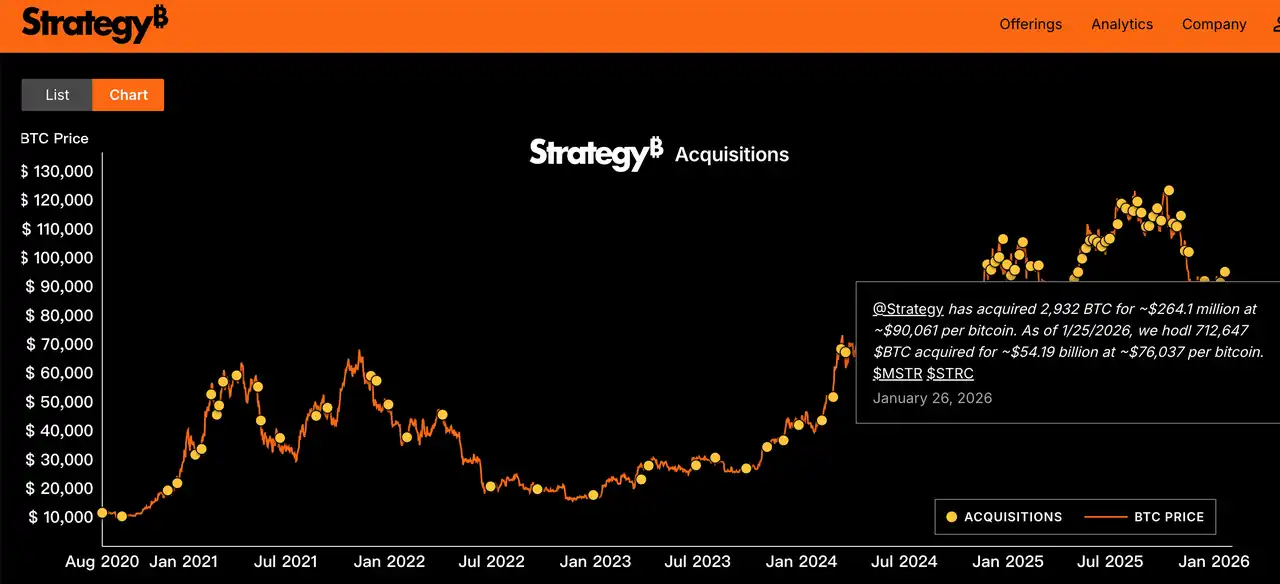
But Saylor tweeted "More Orange," implying he will continue buying next week.

Back then, Peggy said he was like a zombie. Looking at it now, hoarding Bitcoin might be a job that only a zombie can do.

No explanations, no timing the market, no getting off the ride. No feeling for the outside world, and feeling good about oneself.

And while Peggy complained back then about not knowing how to help him spend money, Saylor has clearly found his way to spend it: buying Bitcoin with all of it.

Judging from that email, Saylor was an outsider in the world of fame and fortune. He couldn't sit still, couldn't hold a conversation, spent an evening as if he wasn't even there. But this kind of person can反而 sit still in trading.

No need to socialize, no need to manage relationships, no need to揣摩 others' thoughts. Just focus on one thing, buy every week, and never sell.

Dull, uninteresting, unfeeling towards the outside world... These traits are flaws in social settings, but when it comes to hoarding Bitcoin, they might be a talent.

After this news spread, classic memes have already appeared on Twitter,大意是 Saylor has no interest in underage girls but is extremely obsessed with underage assets.

From a hindsight perspective, this exposure has, to some extent, also树立了 a positive image for Saylor.

After the Epstein case broke out in 2019, Peggy, the publicist, had her contracts with clients like Netflix and FX全部取消, which basically ended her PR career; while Saylor is now one of the world's largest Bitcoin holders.

The rejected person is still buying Bitcoin, the person who rejected him is already out of the game.

But to be fair, Saylor's current situation isn't that轻松 either.

The new Fed Chairman Warsh is偏鹰, and the market expects he won't aggressively cut interest rates after taking office. Once interest rate expectations change, all kinds of assets globally face collective pressure.

Gold fell, silver fell, and Bitcoin fell even harder.

Coupled with tariff friction and tense U.S.-Europe relations, capital is starting to flee to traditional safe-haven assets. Bitcoin's narrative as "digital gold" is gradually fading.

If Bitcoin continues to fall, MicroStrategy's ability to raise capital by issuing new shares will become weaker and weaker, and the flywheel of币股轮转 could turn into a death spiral.

But Saylor really doesn't seem to care about these things; this might be the other side of "boredom."

Ordinary investors can't do what Saylor does, not because they lack money, but because they are too "normal." Normal people read the news, look at K-lines, and listen to what others say. When the fear index spikes, their hands start to itch, and their hearts start to ache.

They make decisions every day, and each decision消耗 willpower.

Whereas in Saylor's strategy, there似乎 isn't a "decision-making"环节. Buying is the only action; not selling is the only principle.

In his own words:"Bitcoin is the best asset ever invented by humankind, why would I sell?"

You can call this faith, or you can call it obsession. But from an execution perspective, the biggest advantage of this system is:

It doesn't require you to be smart, it only requires you to be boring.

Of course, this is not advice for you to imitate him. Saylor's底气 is a publicly traded company; he can issue stock, he can borrow money. Ordinary people don't have these;模仿 his posture will most likely only lead to losses.

But there is one thing that can perhaps be learned.

In investing, "fun" is often the source of losses.

Frequent trading, chasing hot topics, following news, using leverage... these behaviors that make investing "fun" are precisely the enemy of returns.

And the strategies that真正赚钱 are often so boring they make people want to sleep.

Saylor's case is a bit extreme, but the logic holds. In a market full of noise, "boredom" might be the most scarce ability.

Those who were skilled at socializing at parties back then are now either distancing themselves, under investigation, or have completely disappeared.

Perhaps, hoarding Bitcoin and being a person share the same principle:

Don't stay long in lively places; boring things are worth doing long-term.

Related Questions

QWhy was Michael Saylor described as 'like a drugged zombie' in the Epstein case documents?

AHe was described this way by Epstein's publicist, Peggy Siegal, because he was socially awkward, unable to engage in conversation, and showed no interest in socializing at a dinner he paid $25,000 to attend.

QWhat is the name of Michael Saylor's company and what is its primary investment strategy?

AHis company is called MicroStrategy (now Strategy), and its primary investment strategy is to accumulate and hold Bitcoin as a treasury asset, making regular purchases regardless of market conditions.

QHow many Bitcoins does MicroStrategy (Strategy) currently hold, and what is its average cost basis?

AAs of the article's publication, MicroStrategy holds 712,647 Bitcoins with an average cost basis of $76,037 per coin.

QAccording to the article, what is the main reason Saylor's 'boring' personality is an advantage in his Bitcoin strategy?

AHis 'boring' and socially disinterested personality allows him to execute a simple, unwavering strategy of buying and holding Bitcoin without being swayed by market noise, news, or emotional decision-making, which is often a detriment to average investors.

QWhat broader investment lesson does the article suggest can be learned from Michael Saylor's approach?

AThe article suggests that in investing, 'interesting' behaviors like frequent trading, chasing trends, and using leverage are often the enemy of returns. Truly profitable strategies are often simple and 'boring,' requiring discipline and a long-term focus amidst market volatility.

Related Reads

Trading

Spot
Futures

Hot Articles

What is $BITCOIN

DIGITAL GOLD ($BITCOIN): A Comprehensive Analysis Introduction to DIGITAL GOLD ($BITCOIN) DIGITAL GOLD ($BITCOIN) is a blockchain-based project operating on the Solana network, which aims to combine the characteristics of traditional precious metals with the innovation of decentralized technologies. While it shares a name with Bitcoin, often referred to as “digital gold” due to its perception as a store of value, DIGITAL GOLD is a separate token designed to create a unique ecosystem within the Web3 landscape. Its goal is to position itself as a viable alternative digital asset, although specifics regarding its applications and functionalities are still developing. What is DIGITAL GOLD ($BITCOIN)? DIGITAL GOLD ($BITCOIN) is a cryptocurrency token explicitly designed for use on the Solana blockchain. In contrast to Bitcoin, which provides a widely recognized value storage role, this token appears to focus on broader applications and characteristics. Notable aspects include: Blockchain Infrastructure: The token is built on the Solana blockchain, known for its capacity to handle high-speed and low-cost transactions. Supply Dynamics: DIGITAL GOLD has a maximum supply capped at 100 quadrillion tokens (100P $BITCOIN), although details regarding its circulating supply are currently undisclosed. Utility: While precise functionalities are not explicitly outlined, there are indications that the token could be utilized for various applications, potentially involving decentralized applications (dApps) or asset tokenization strategies. Who is the Creator of DIGITAL GOLD ($BITCOIN)? At present, the identity of the creators and development team behind DIGITAL GOLD ($BITCOIN) remains unknown. This situation is typical among many innovative projects within the blockchain space, particularly those aligning with decentralized finance and meme coin phenomena. While such anonymity may foster a community-driven culture, it intensifies concerns about governance and accountability. Who are the Investors of DIGITAL GOLD ($BITCOIN)? The available information indicates that DIGITAL GOLD ($BITCOIN) does not have any known institutional backers or prominent venture capital investments. The project seems to operate on a peer-to-peer model focused on community support and adoption rather than traditional funding routes. Its activity and liquidity are primarily situated on decentralized exchanges (DEXs), such as PumpSwap, rather than established centralized trading platforms, further highlighting its grassroots approach. How DIGITAL GOLD ($BITCOIN) Works The operational mechanics of DIGITAL GOLD ($BITCOIN) can be elaborated on based on its blockchain design and network attributes: Consensus Mechanism: By leveraging Solana’s unique proof-of-history (PoH) combined with a proof-of-stake (PoS) model, the project ensures efficient transaction validation contributing to the network's high performance. Tokenomics: While specific deflationary mechanisms have not been extensively detailed, the vast maximum token supply implies that it may cater to microtransactions or niche use cases that are still to be defined. Interoperability: There exists the potential for integration with Solana’s broader ecosystem, including various decentralized finance (DeFi) platforms. However, the details regarding specific integrations remain unspecified. Timeline of Key Events Here is a timeline that highlights significant milestones concerning DIGITAL GOLD ($BITCOIN): 2023: The initial deployment of the token occurs on the Solana blockchain, marked by its contract address. 2024: DIGITAL GOLD gains visibility as it becomes available for trading on decentralized exchanges like PumpSwap, allowing users to trade it against SOL. 2025: The project witnesses sporadic trading activity and potential interest in community-led engagements, although no noteworthy partnerships or technical advancements have been documented as of yet. Critical Analysis Strengths Scalability: The underlying Solana infrastructure supports high transaction volumes, which could enhance the utility of $BITCOIN in various transaction scenarios. Accessibility: The potential low trading price per token could attract retail investors, facilitating wider participation due to fractional ownership opportunities. Risks Lack of Transparency: The absence of publicly known backers, developers, or an audit process may yield skepticism regarding the project's sustainability and trustworthiness. Market Volatility: The trading activity is heavily reliant on speculative behavior, which can result in significant price volatility and uncertainty for investors. Conclusion DIGITAL GOLD ($BITCOIN) emerges as an intriguing yet ambiguous project within the rapidly evolving Solana ecosystem. While it attempts to leverage the “digital gold” narrative, its departure from Bitcoin's established role as a store of value underscores the need for a clearer differentiation of its intended utility and governance structure. Future acceptance and adoption will likely depend on addressing the current opacity and defining its operational and economic strategies more explicitly. Note: This report encompasses synthesised information available as of October 2023, and developments may have transpired beyond the research period.

363 Total ViewsPublished 2025.05.13Updated 2025.05.13

Discussions

Welcome to the HTX Community. Here, you can stay informed about the latest platform developments and gain access to professional market insights. Users' opinions on the price of BTC (BTC) are presented below.

活动图片