Bitcoin options data shows bulls aiming for $17K BTC price by Friday’s expiry

CointelegraphPublished on 2022-12-08Last updated on 2022-12-08

Abstract

BTC bulls could secure a $130 million profit in the Dec. 9 options expiry, but bears aim to balance the scales by keeping Bitcoin price below $17,000.

Bitcoin price crashed to $15,500 on Nov. 21, driving the price to its lowest level in two years. The 2-day-long correction totaled an 8% downtrend and wiped out $230 million worth of leverage long (buy) futures contracts.

The price move gave the false impression to bears that a sub-$15,500 expiry on the Dec. 9 options expiry was feasible, but those bets are unlikely to pay off as the deadline approaches.

Year-to-date, Bitcoin price is 65% down for 2022, but the leading cryptocurrency remains a top 30 global tradable asset class ahead of tech giants like Meta Platforms (META), Samsung (005930.KS), and Coca-Cola (KO).

Investors' main concern is still the possibility of a recession if the U.S. Federal Reserve raises rates for longer than expected. Proof of this comes from Dec. 2 data which showed that 263,000 jobs were created in November, signaling the Fed’s effort to slow the economy and bring down inflation remains a work in progress.

On Dec. 7, Wells Fargo director Azhar Iqbal wrote in a note to clients that "all told, financial indicators point to a recession on the horizon." Iqbal added, "taken together with the inverted yield curve, markets are clearly braced for a recession in 2023."

Bears were overly pessimistic and will suffer the consequences

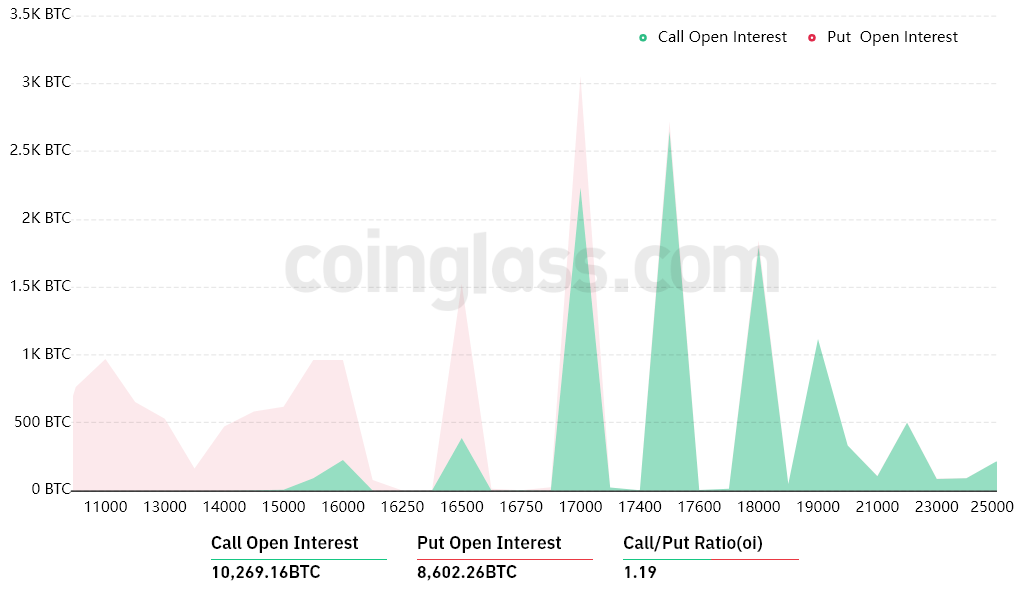
The open interest for the Dec. 9 options expiry is $320 million, but the actual figure will be lower since bears were expecting sub-$15,500 price levels. These traders became overconfident after Bitcoin traded below $16,000 on Nov. 22.

Bitcoin options aggregate open interest for Dec. 9. Source: CoinGlass

The 1.19 call-to-put ratio reflects the imbalance between the $175 million call (buy) open interest and the $145 million put (sell) options. Currently, Bitcoin stands at $16,900, meaning most bearish bets will likely become worthless.

If Bitcoin's price remains near $17,000 at 8:00 am UTC on Dec. 9, only $16 million worth of these put (sell) options will be available. This difference happens because the right to sell Bitcoin at $16,500 or $15,500 is useless if BTC trades above that level on expiry.

Bulls aim for $18k to secure a $130 million profit

Below are the four most likely scenarios based on the current price action. The number of options contracts available on Dec. 9 for call (bull) and put (bear) instruments varies, depending on the expiry price. The imbalance favoring each side constitutes the theoretical profit:

Between $15,500 and $16,500: 200 calls vs. 2,100 puts. The net result favors the put (bear) instruments by $30 million.

Between $16,500 and $17,000: 1,700 calls vs. 1,500 puts. The net result is balanced between bears and bulls.

Between $17,000 and $18,000: 5,500 calls vs. 100 puts. The net result favors the call (bull) instruments by $100 million.

Between $18,000 and $18,500: 7,300 calls vs. 0 puts. Bulls completely dominate the expiry by profiting $130 million.

This crude estimate considers the put options used in bearish bets and the call options exclusively in neutral-to-bullish trades. Even so, this oversimplification disregards more complex investment strategies.

For example, a trader could have sold a put option, effectively gaining positive exposure to Bitcoin above a specific price, but unfortunately, there's no easy way to estimate this effect.

Bulls probably have less margin to support the price

Bitcoin bulls need to push the price above $18,000 on Friday to secure a potential $130 million profit. On the other hand, the bears' best-case scenario requires a slight push below $16,500 to maximize their gains.

Bitcoin bulls just had $230 million leverage long positions liquidated in two days, so they might have less margin required to support the price.

Considering the negative pressure from traditional markets due to recession concerns and raising interest rates, bears will likely avoid a loss by keeping Bitcoin below $17,000 on Dec 9.

Related Reads

DeFi Has Reached Its Most Dangerous Moment: The Real Vulnerabilities Are Not in the Code

DeFi in Peril: The Real Vulnerability Isn't in the Code April 2026 marked a paradigm shift in DeFi security, with over $625 million lost across 30 incidents—the worst month in crypto history by event count. Crucially, none of the major exploits (Drift Protocol: $285M, KelpDAO: $292M, Wasabi Protocol: $4.5M) resulted from smart contract vulnerabilities. Instead, failures occurred in the operational "plumbing": social engineering to compromise multi-signature councils, a single-point-of-failure 1-of-1 bridge validator, and stolen admin private keys. These events expose a fundamental misalignment: the industry's security model has long focused on code audits, while the actual attack surface has shifted to privileged access points and off-chain infrastructure. The article introduces the term "OpenFi" to describe this reality: permissionless, on-chain, yet operationally dependent on trusted third parties (admins, validators, oracles) at key junctures. The KelpDAO exploit vividly demonstrated asymmetric "contagion risk." A configuration error in a smaller protocol triggered a panic, causing approximately $13.2 billion in outflows from larger, unaffected protocols like Aave within 48 hours, as users fled uncertain collateral. The core dilemma is the double-edged sword of centralization. Operational levers like emergency councils (e.g., Arbitrum freezing stolen funds post-KelpDAO) enable crisis response but also create catastrophic attack surfaces if compromised (e.g., Drift). The path forward demands radical honesty: protocols must clearly disclose their trust assumptions, operational levers, and failure modes. The industry must treat operational security (key management, configurations, incident response) with the same rigor as code security. Survival depends on building systems whose risks can be understood, priced, and insured, moving beyond the outdated "code is law" mantra to a mature model of disclosed and managed trust.

链捕手7h ago

DeFi Has Reached Its Most Dangerous Moment: The Real Vulnerabilities Are Not in the Code

链捕手7h ago

Vitalik's Article Emphasizes Ethereum Must Be 'Amazing', But Foundation Is Not the Center

Vitalik Buterin has published a lengthy response to recent community criticism directed at the Ethereum Foundation (EF). Acknowledging a sense of "unease," he addresses concerns about the EF's strategic direction, its perceived disconnect from ETH's price performance, and calls for its reduced central role. Vitalik rejects the notion that the EF should be the central governing body of Ethereum, framing it instead as one "node with a clear mandate" among many within the ecosystem. He highlights the EF's limited ETH holdings (≈0.16% of supply) compared to other blockchain foundations and states it will no longer sell significant amounts of ETH. Its future focus will be on long-term, critical projects that align with Ethereum's core values of censorship-resistance and decentralization, which might not otherwise happen. A core argument is that Ethereum must be "amazing," but not by merely chasing higher transaction speeds at the cost of decentralization. He proposes focusing on the "CROPS" dimensions: creating a Cryptographically provable, Reliable, Open, Private, and Secure network. This includes pursuing goals like a formally verifiable, bug-free Ethereum client and minimizing protocol-level reliance on intermediaries. The article concludes by noting that while Vitalik clarifies the EF's refocused role, he does not directly address community suggestions for creating a new organization explicitly aligned with ETH's economic interests. This "alignment gap" is presented as a key challenge for Ethereum's future.

链捕手7h ago

Vitalik's Article Emphasizes Ethereum Must Be 'Amazing', But Foundation Is Not the Center

链捕手7h ago

Galxe: How a Quest Platform Evolved into Web3's Growth Infrastructure

Galxe, once perceived as a simple Web3 quest platform, has evolved into a core growth infrastructure within the Web3 ecosystem. It addresses a fundamental Web3 growth dilemma: the lack of a mature, systematic user acquisition and retention system akin to Web2's advertising and analytics platforms. While users complete quests (social tasks, on-chain interactions) for rewards, Galxe's true innovation lies in transforming these fragmented, one-off actions into lasting, verifiable identity credentials. This process of *behavioral assetization* creates a persistent record of a user's activities across projects and chains. For users, their wallet accumulates a valuable history that can unlock future access and rewards, fostering a "profile-building" mentality. For projects, Galxe provides a pre-screened user pool with rich behavioral data, enabling targeted outreach to users based on their specific on-chain history and community engagement. Galxe employs a gamefied growth path, guiding users from low-friction social tasks into deeper, valuable on-chain interactions through a structured progression of quests. This solves the incentive-behavior mismatch common in Web3, filtering users by their willingness to engage. Beyond quests, products like Passport (identity verification) and Starboard (community analytics) position Galxe as a comprehensive growth operating system. The platform's defensible advantage is its self-reinforcing data and network flywheel: more projects attract more users, enriching behavioral data; richer data enables better user targeting, attracting more projects. Ultimately, Galxe is shifting Web3's growth logic from short-term "reward-driven" traffic towards a long-term "identity-driven" relationship model, where a user's accumulated on-chain履历 becomes a core asset.

marsbit8h ago

Galxe: How a Quest Platform Evolved into Web3's Growth Infrastructure

marsbit8h ago

Trading

Spot
Futures
活动图片