Analyzing the current state of Ethereum, DeFi, stablecoins, NFTs post-FTX fallout

cryptoslatePublished on 2022-12-05Last updated on 2022-12-05

Abstract

2022 approaches year-end; it has been a historical year for all asset classes due to the rapid tightening of monetary policy worldwide and the strength of the U.S. dollar.

Price drawdown from ATH

2022 approaches year-end; it has been a historical year for all asset classes due to the rapid tightening of monetary policy worldwide and the strength of the U.S. dollar. It had severe implications on the crypto ecosystem, which has seen a wide range of liquidations and margin calls, as well as the collapse of FTX and Luna.

A mixed year for the Ethereum ecosystem saw a successful merge in September, and, as a result, ETH was net deflationary for October. However, the magnitude of losses from an investor point of view has been monumental in the DeFi ecosystem.

Ethereum is currently 73% off its all-time high, floating around $1,200; significant liquidations and deleveraging have occurred in 2022 with the fall out of Luna back in May and FTX collapse in November.
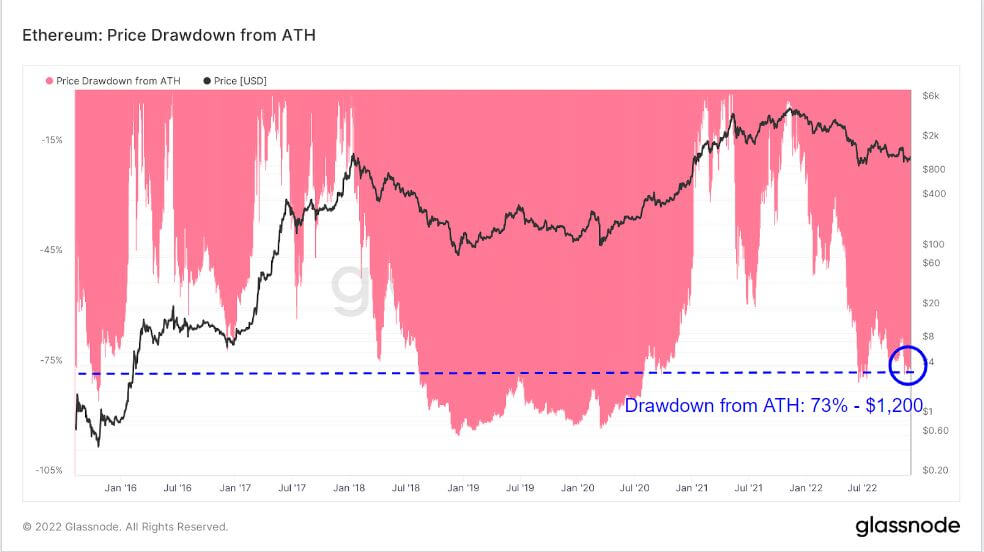
(Source: Glassnode): Price Drawdown from ATH


Ethereum gas usage from 2020 - 2022

Gas fees are the cost of conducting a transaction or executing a contract. For example, this could see exchanging into a stablecoin or minting an NFT.

Since the summer of 2020, Ethereum gas fees have taken off primarily due to the explosion of DeFi use on chain.

Although network activity has tailed off significantly since the summer of 2021, the issue of Ethereum being an expensive chain still prevails.

Ethereum gas fees are priced in gwei, a unit of measure equivalent to one billionth of one ETH. Gas costs fluctuate depending on the network’s congestion, with periods requiring higher gas fees during peak demand to push through a transaction.  
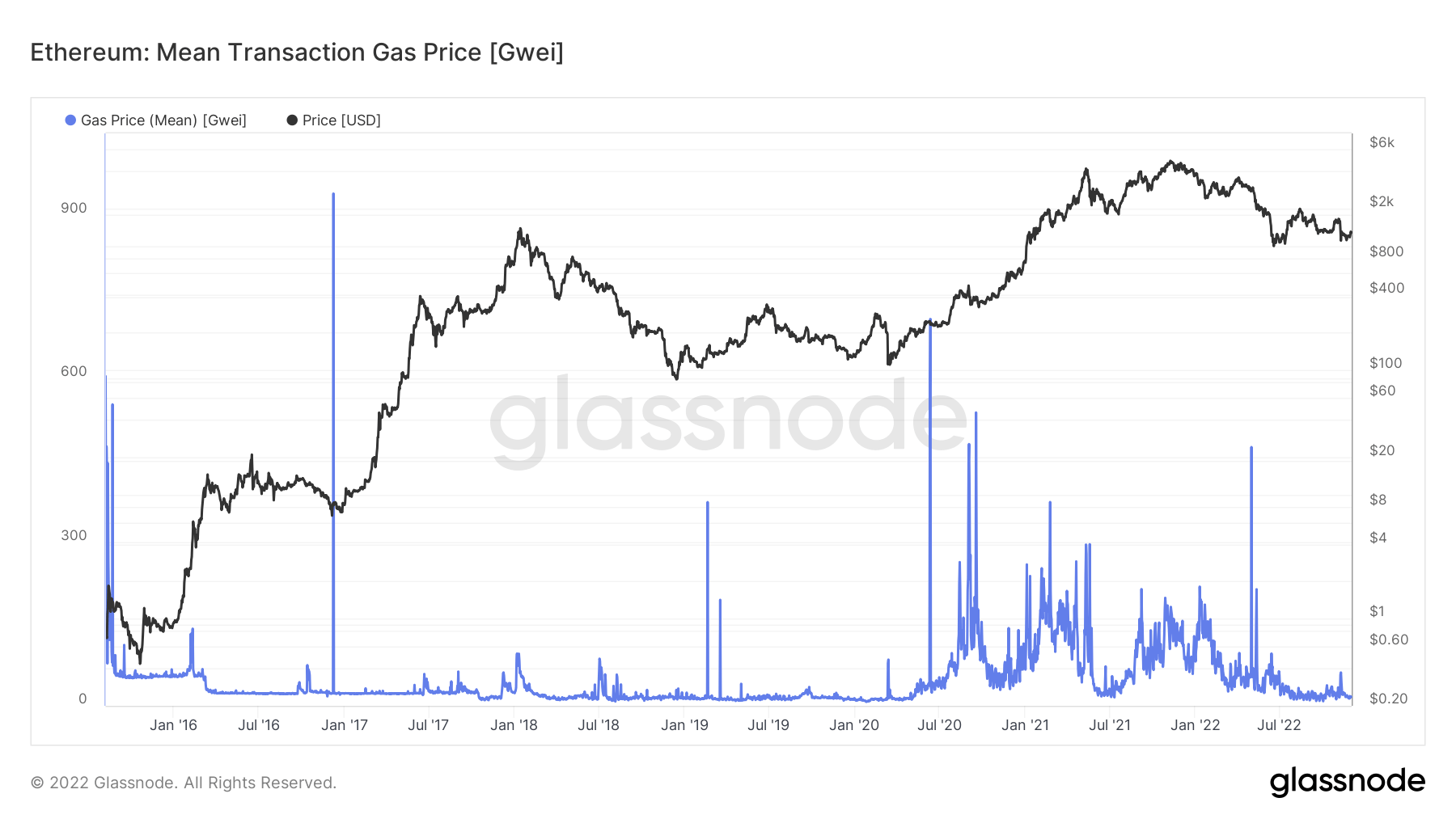
ethereum mean transaction price

(Source: Glassnode): Mean Transaction Gas Price

Stablecoins are cryptocurrencies designed to minimize price volatility by being pegged to a reference asset. The reference asset could be a commodity, cryptocurrency, or fiat money.

The market offers various stablecoins, such as asset-backed, including fiat, crypto, or precious metal assets, and algorithmic, which add to or subtract from circulating token supply to peg the price at the desired level.

The current gas usage for stablecoins is 7% which has been roughly flat for 2022; however, stablecoin mass adoption started at the beginning of 2020, hitting a peak of almost 20% of Ethereum gas usage.
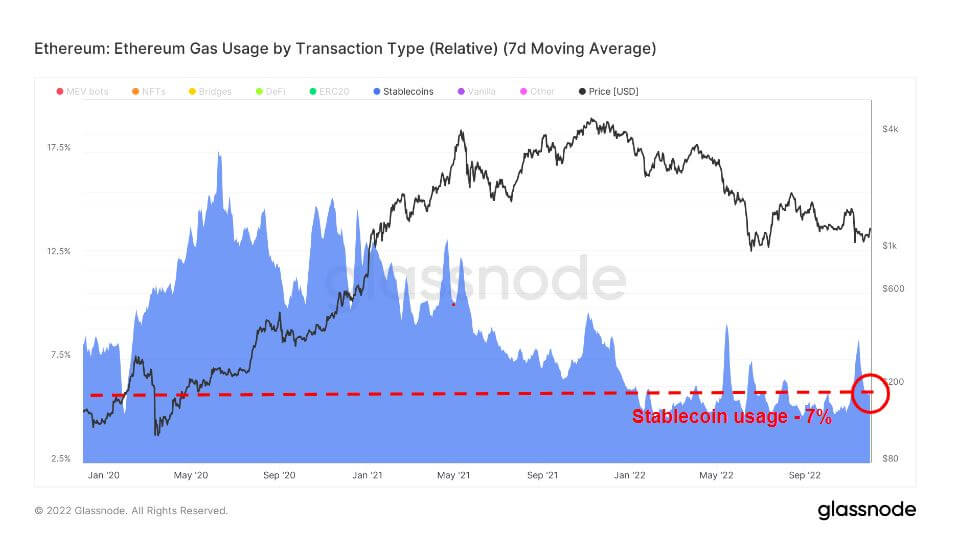
ethereum gas usage

(Source: Glassnode): ETH gas usage

Decentralized finance (DeFi) is an emerging technology that cuts out banks and financial institutions, linking users directly with financial products, typically lending, trading, and borrowing.

DeFi followed shortly after the stablecoin boom; from July 2020, Uniswap emerged as the leading DeFi gas user, peaking around June 2021 before tapering downwards. DeFi usage has maintained a rough 12% average for 2022, above the early 2020 usage.
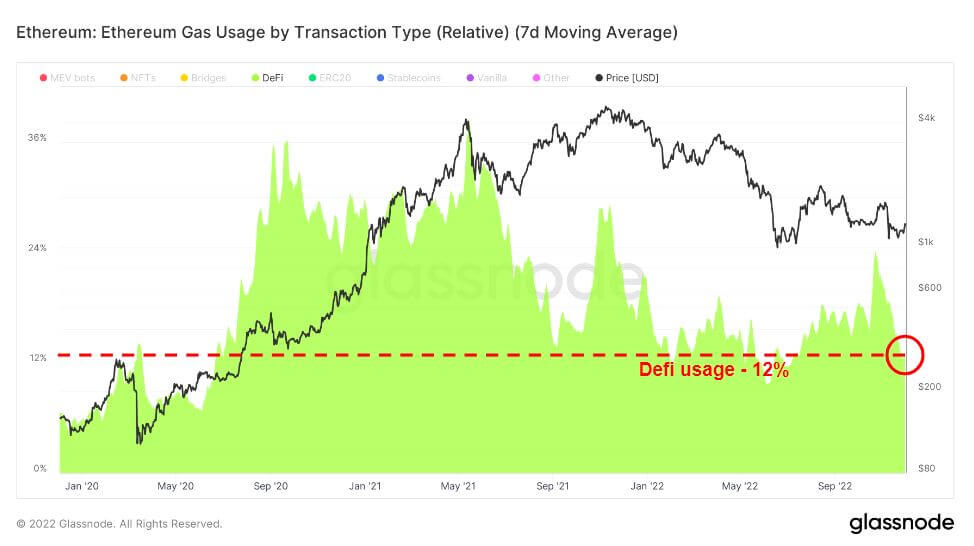
eth gas usage

(Source: Glassnode): ETH gas usage

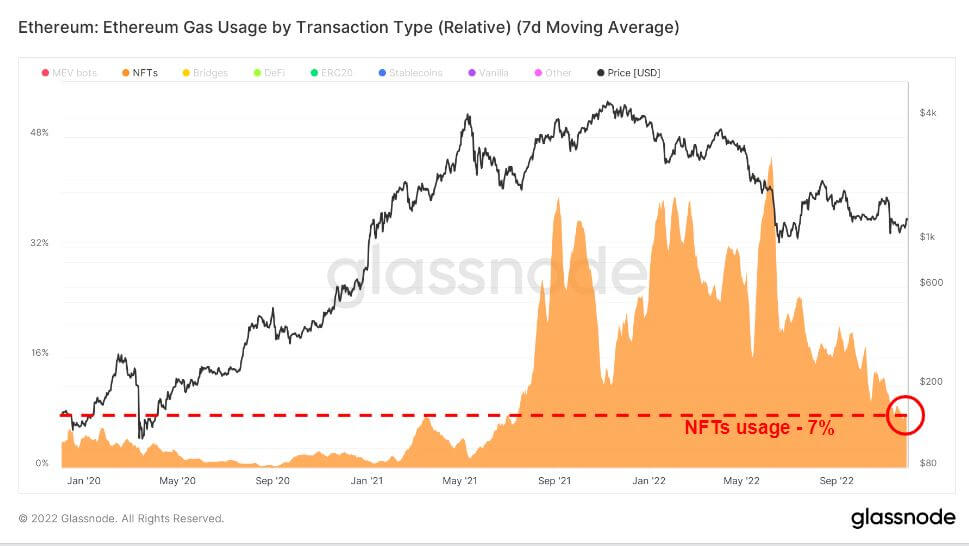
Out of the trifecta, NFTs were the last to boom in this cycle, exploding at the end of 2021. As a result, during the 2021 bull run, OpenSea saw the most significant spikes in gas usage from NFT demand. However, from June 2022, demand has cooled significantly yet remains somewhat elevated compared to previous years.
eth gas usage

(Source: Glassnode): ETH gas usage


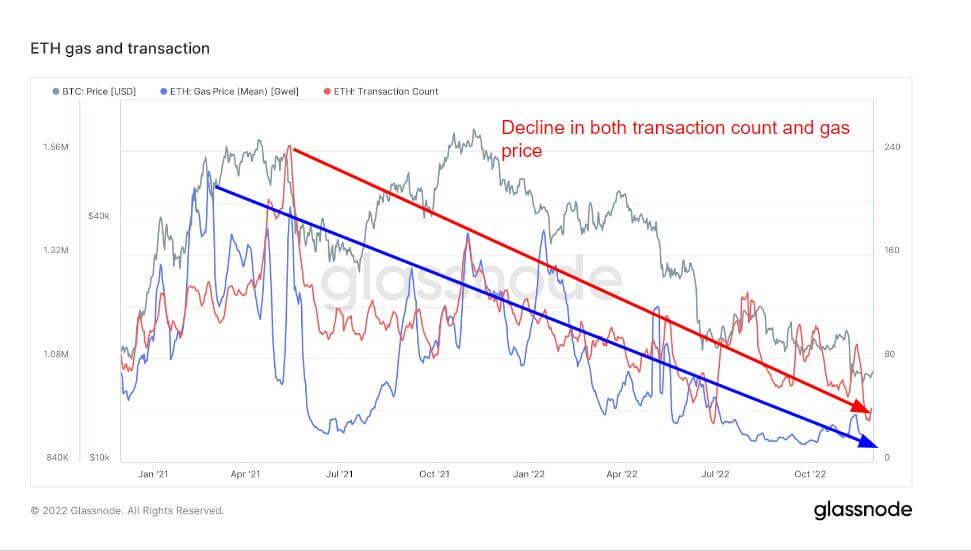
Decline in transaction count and gas price

Ethereum gas usage and transaction counts are at year-to-date lows; the mean gas price has been somewhat muted for the past four months, with slight upticks due to the recent merge and FTX collapse. While transaction count is approaching year-to-date lows, suggesting the bear market has taken its toll on users.
eth gas

(Source: Glassnode): ETH gas and transactions


The rise and fall of TVL in DeFi (USD)

Total Value Locked (TVL) measures the total value of all assets locked into DeFi protocols. TVL is denominated in USD or ETH, while DeFi protocols offer lending, liquidity pools, staking, and more.

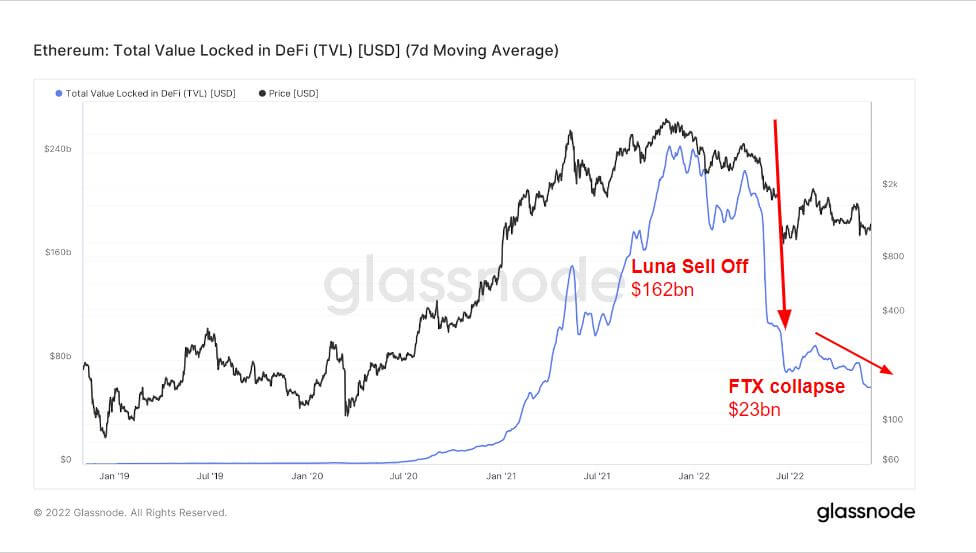
The chart below shows the total value locked in all of DeFi, which surpassed $240bn back in the summer of 2021, due to the nature of DeFi protocols being able to obtain leverage and the use of borrowing and using your crypto as collateral.

The bull of 2021 and the bear of 2022 have been unprecedented by any year due to the massive stimulus provided by the central banks in 2020, which saw the majority of leverage and borrowing get wiped out in 2022.

During the Luna sell-off, TVL went down over $160bn; admittedly, a sell-off occurred just before Luna during the peak of the bull run in Nov 2021, most likely investors withdrawing from the ecosystem. Furthermore, the FTX collapse resulted in a further $23bn sell-off, putting TVL at around $70bn, similar to early 2021.
defi tvl

(Source: Glassnode): Total Value in DeFi


Stablecoin performance as a result of FTX collapse

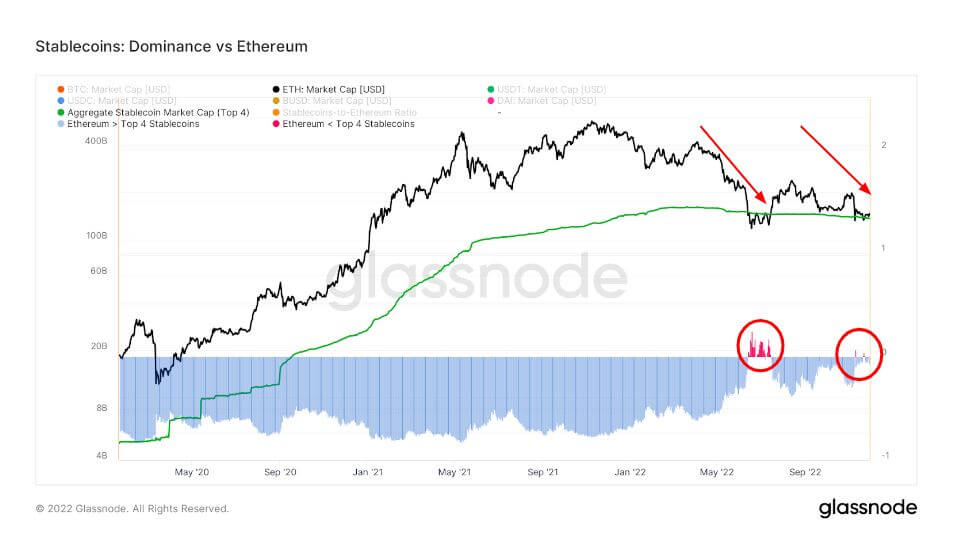
Ethereum’s dominance over the top four stablecoins has been on a downtrend since May, with stablecoins becoming more dominant in June — when ETH hit its lowest price for the year.

This chart compares the Ethereum Market Cap to the aggregate value of the top four stablecoins USDT, USDC, BUSD, and DAI. Note that the supplies of these stablecoins are distributed between multiple host blockchains, including Ethereum.

In June, the ETH market cap was lower than the top 4 stablecoin market caps due to Luna, and the same happened during the FTX collapse; however, a much smaller drop for only a brief period.
stablecoin dominance

(Source: Glassnode): Stablecoins: Dominance vs. Ethereum

The chart below shows the total supply issued on and held within Ethereum smart contracts. This chart shows the aggregate supply held in smart contracts alongside individual traces for the top four stablecoins USDT, USDC, BUSD, and DAI.

Another noticeable trend in the stablecoin ecosystem is the severe decline in the supply of smart contracts. Aggregate supply during its peak was at $44bn; since the Luna and FTX collapse, it is now hanging around $25bn. A significant decline in all top 4 stablecoins as well.
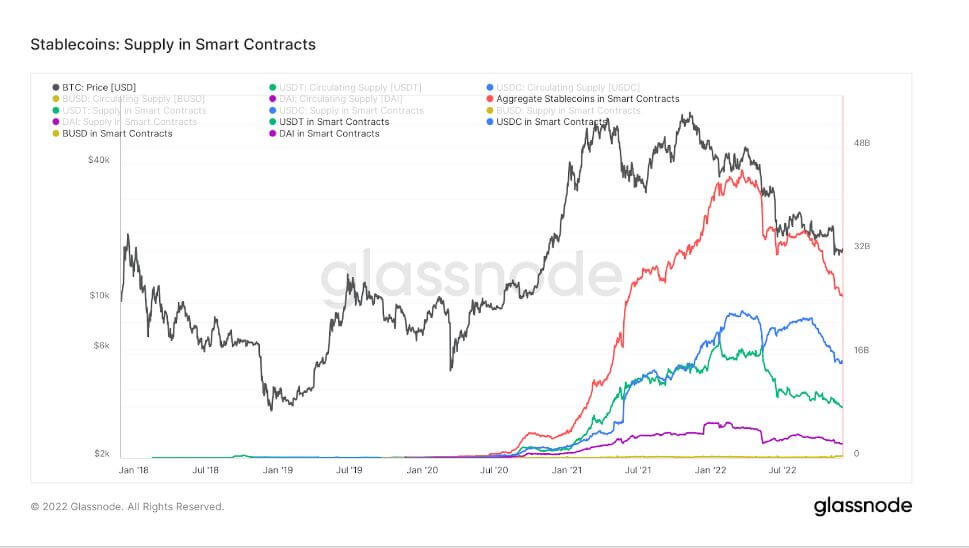
stablecoin smart contracts

(Source: Glassnode): Supply in smart contracts


Substantial losses for Ethereum

Net realized profit/loss is the net profit or loss of all coins spent that day. The price at which each spent coin was last moved and the current price enables the calculation of the USD value the owner realized in profit or loss.

Over the week during the FTX collapse, Ethereum realized losses amounted to over $20bn, with $14bn coming on Nov. 17, multiple times worse than the Luna collapse for investors.
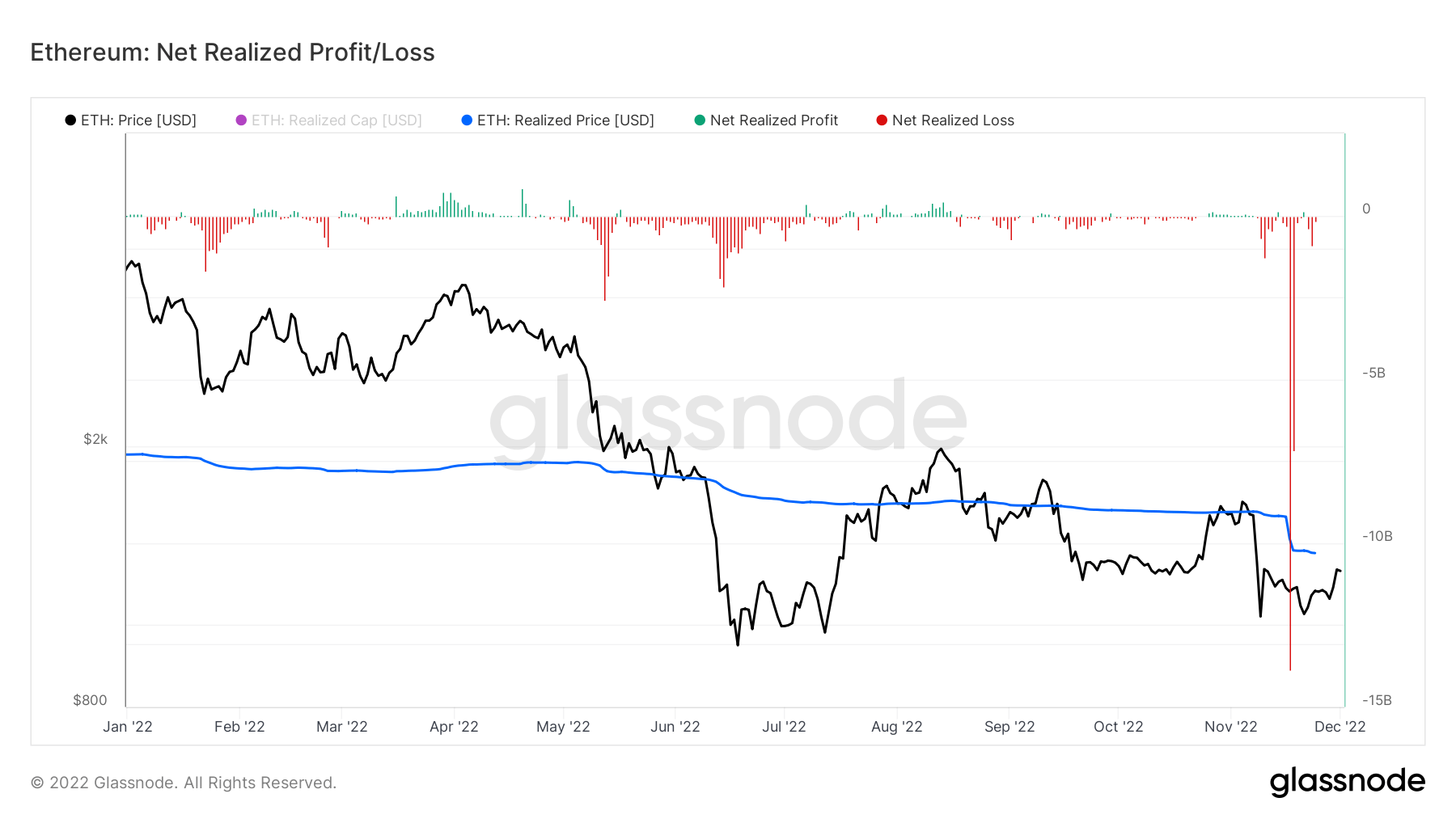
ethereum net profit

(Source: Glassnode): Net realized profit/loss


Trending Cryptos

Related Reads

Foundation Steps Back, Ethlabs Steps Forward: Ethereum Undergoes Its Largest Restructuring in History

On June 23rd, the Ethereum ecosystem witnessed two major shifts, signaling a significant governance realignment. First, former Ethereum Foundation researchers established Ethlabs, a new independent non-profit. Backed by major ETH holders like Bitmine and SharpLink, Ethlabs aims to address practical needs for institutional adoption, including faster settlement, native asset issuance, cross-chain transactions, and mainnet scaling. Secondly, the Ethereum Foundation announced a major restructuring, laying off 54 employees (20% of its staff) to become a leaner entity focused on protocol governance and maintenance rather than being the primary builder. This move represents a pivotal correction. Criticisms had mounted over the Foundation's perceived slowness, lack of clear strategy, and over-reliance on Vitalik Buterin's influence. Ethlabs emerges as a more execution-oriented, "industrialized" layer focused on market adoption—bridging the gap between research and real-world use. Notably, Vitalik Buterin is absent from its list of supporters, interpreted as an intentional step to avoid excessive personal endorsement and allow the organization to build independent credibility. The Ethereum Foundation's downsizing and redefinition mark a retreat from its former central coordinating role. It now aims to share the "privilege of stewarding Ethereum" with other emerging groups like Ethlabs, the Ethereum Applications Guild, and The Ethereum Economic Zone. Analysts frame this dual shift as the Foundation ensuring Ethereum remains "correct" (credibly neutral), while Ethlabs must prove it remains "effective" (competitive and attractive for capital and adoption). This addresses community "shareholder-like anxiety" about ETH's market performance. While risks exist—such as concerns over shifting from Foundation centrality to large-holder influence—the consensus is that the greater risk for Ethereum was inaction, caught between technical idealism and organizational inertia. These steps aim to create a more multi-stakeholder, execution-driven future for the network.

链捕手6h ago

Foundation Steps Back, Ethlabs Steps Forward: Ethereum Undergoes Its Largest Restructuring in History

链捕手6h ago

Second Half of U.S. Crypto Policy: The Clarity Act Aims for 60 Votes, CFTC's "One-Person Commission" Becomes Biggest Variable

In a pivotal year for US crypto policy, the "CLARITY Act" is advancing in the Senate but faces a high hurdle, needing 60 votes to pass. Key challenges include bridging partisan divides on ethics and swaying undecided Republican senators within a tight legislative calendar of only about 40 working days. The policy "second half" involves intense negotiations on a broader framework for Web3 and DeFi, including crypto tax reforms and the Blockchain Regulatory Certainty Act. A significant uncertainty is the understaffed CFTC, operating with four commissioner vacancies, which complicates regulatory clarity. Meanwhile, the departure of key "crypto champions"—SEC Commissioner Hester Peirce and Senator Cynthia Lummis—will impact ongoing policy efforts. Industry experts are cautiously optimistic but realistic. Sara K. Weed notes that while progress is being made, CLARITY is unlikely to pass this Congress, pushing agencies like the SEC and CFTC to provide more guidance. Sulolit Mukherjee suggests meaningful crypto tax legislation is more likely to be attached to larger must-pass bills. Rashan Colbert discusses the jurisdictional debate over prediction markets, emphasizing the need for a regulatory framework that fosters their development as financial tools rather than treating them broadly as gambling. The clock is ticking, but opportunities remain for substantive progress through continued bipartisan dialogue and pragmatic efforts.

marsbit8h ago

Second Half of U.S. Crypto Policy: The Clarity Act Aims for 60 Votes, CFTC's "One-Person Commission" Becomes Biggest Variable

marsbit8h ago

Research Report Analysis: Morgan Stanley Details SanDisk SNDK, The Truth About Cloud Data Center Pricing Power and AI Inference Benefits

Morgan Stanley raised its price target for SanDisk (SNDK) from $1100 to $1750 on June 22, maintaining an Overweight rating. The upgrade is driven by AI inference demand reshaping the NAND market, particularly for KV Cache and context window storage in cloud data centers. These cloud clients exhibit price inelasticity and sign long-term contracts, granting SanDisk significant pricing power. SanDisk's New Business Model (NBM) agreements, covering over one-third of FY27 bit shipments with 3-5 year terms and fixed price/price collar structures, are crucial. They are projected to sustain gross margins around 80% even at floor prices, providing a buffer against cyclical downturns. Morgan Stanley forecasts gross margins to surge from 30.3% in FY25 to 86.7% in FY27e. With NAND supply expected to remain tight into 2026/2027 and cloud/data centers becoming the largest end-market, SanDisk holds supply-side pricing power. The company targets 15-19% bit growth via technology transitions, not capacity expansion. Revenue is projected to grow ~6.6x from FY25 to FY27, with EPS rising from $2.74 to $14.73, driven by high-margin cloud business. Key upside catalysts include faster enterprise SSD adoption and edge AI growth. Downside risks involve slower industry growth, competitor capex increases, market share loss, and competition from Chinese players like YMTC. The investment thesis rests on AI-driven structural demand, NBM's margin protection, and sustained supply tightness. The $1750 target implies ~28x FY27e P/E.

marsbit9h ago

Research Report Analysis: Morgan Stanley Details SanDisk SNDK, The Truth About Cloud Data Center Pricing Power and AI Inference Benefits

marsbit9h ago

Trading

Spot
Futures

Hot Articles

How to Buy GAS

Welcome to HTX.com! We've made purchasing GAS (GAS) simple and convenient. Follow our step-by-step guide to embark on your crypto journey.Step 1: Create Your HTX AccountUse your email or phone number to sign up for a free account on HTX. Experience a hassle-free registration journey and unlock all features.Get My AccountStep 2: Go to Buy Crypto and Choose Your Payment MethodCredit/Debit Card: Use your Visa or Mastercard to buy GAS (GAS) instantly.Balance: Use funds from your HTX account balance to trade seamlessly.Third Parties: We've added popular payment methods such as Google Pay and Apple Pay to enhance convenience.P2P: Trade directly with other users on HTX.Over-the-Counter (OTC): We offer tailor-made services and competitive exchange rates for traders.Step 3: Store Your GAS (GAS)After purchasing your GAS (GAS), store it in your HTX account. Alternatively, you can send it elsewhere via blockchain transfer or use it to trade other cryptocurrencies.Step 4: Trade GAS (GAS)Easily trade GAS (GAS) on HTX's spot market. Simply access your account, select your trading pair, execute your trades, and monitor in real-time. We offer a user-friendly experience for both beginners and seasoned traders.

2.9k Total ViewsPublished 2024.03.29Updated 2026.06.02

How to Buy GAS

Discussions

Welcome to the HTX Community. Here, you can stay informed about the latest platform developments and gain access to professional market insights. Users' opinions on the price of GAS (GAS) are presented below.

活动图片