一文探讨 Crypto 游戏的演变轨迹

DeFi之道Published on 2022-11-24Last updated on 2022-11-24

Abstract

本文试图根据 Crypto 交易的演变历程,来推测 Crypto 游戏的演变轨迹。

关于区块链游戏,Onchain 和 Offchain 的选择问题一度困扰着我,回顾过去几个 Crypto 周期,包括 Axie Infinity、STEPN、The Sandbox 等多款曾获得过成功的游戏,都属于只将 NFT 和 token 记录在链上的 Offchain 链游,而随着熊市的到来,这些 token 以及 NFT 的贬值,使得很多观察者将注意力转移到了 Onchain 链游身上。

本文试图根据 Crypto 交易的演变历程,来推测 Crypto 游戏的演变轨迹。

我们先借用一下 1confirmation 联合创始人 Nick Tomaino 的一张图来引入纯粹主义者(Purists)、游客(Tourists)以及两者之间中间者的概念。
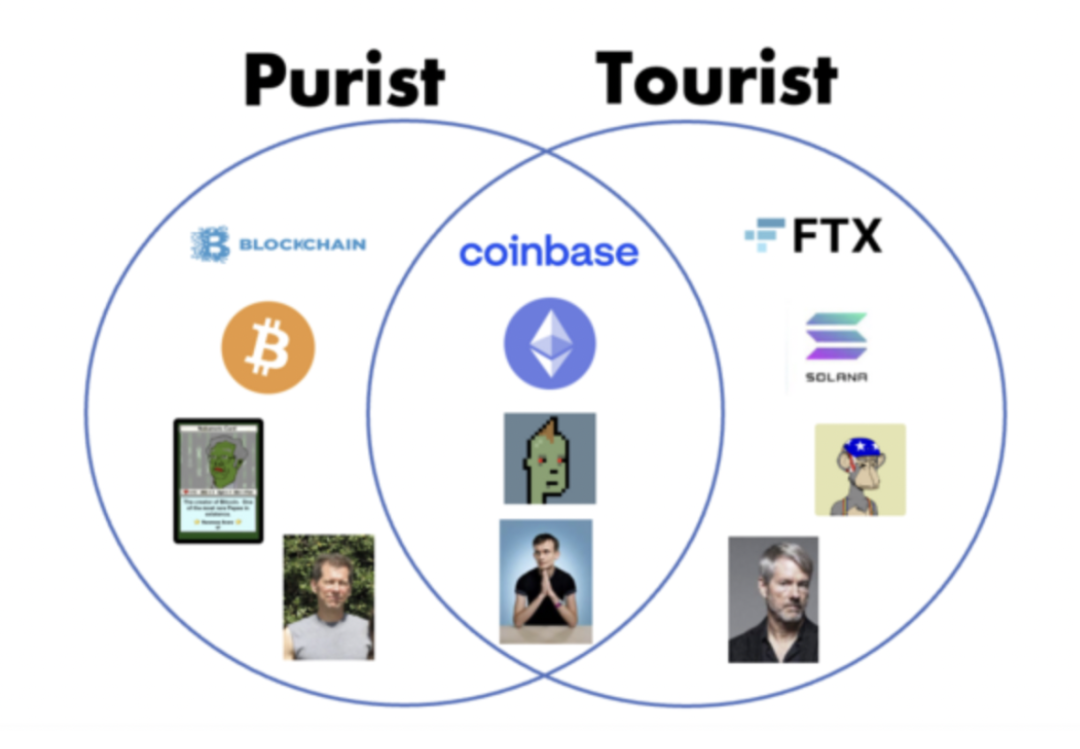
“纯粹主义者是深谙工艺历史和细微差别的人——他们了解细微差别,并在构建之前考虑到所有以前的东西,对真实的事物表示赞赏,并为餐桌带来真正的新事物。纯粹主义者制造的产品对于大众市场来说可能太小众了,但它们是原创的,并且是认真建造的。

游客是不关心历史或细微差别的人,他们只想创造一种能引起人们共鸣的产品。他们正在建造的东西可能会在一段时间内引起共鸣,但游客来得容易,去得也容易。如果一种产品过于旅游化,就没有长期的持久力,而且前一天热门的东西第二天就会消失。” ——《 Crypto 中的纯粹主义者和游客 》

在上图中, FTX 在 Crypto 交易领域被 Nick Tomaino 归类到了游客(Tourists)类型,而事实也证明了他的判断,FTX 确实暴雷了,它成长的快,死亡的也快!

Crypto 交易领域的演变历程

在 Crypto 交易领域,挪用用户资金、不重视私钥安全的中心化交易所便是属于游客(Tourists)类型,例如 2010 年-2014 年时期的 Mt. Gox 以及 2019 年 -2022 年的 FTX 便是其中的代表。

而不作恶、重视私钥安全的中心化交易所便是介于纯粹主义者(Purists)和游客(Tourists)类型之间,例如诞生于 2012 年的 Coinbase 以及在 2017 年创立的币安便是属于这一类别。

而最理想主义的 Crypto 交易项目则是加密原生(Crypto-Native)的,它们是 on-chain 的,我们可以将 Uniswap 归类到最后一个类型。

多数情况下,游客(Tourists)类型项目与 Crypto 精神是无关的,它们只是利用了某些术语或技术,并通过增加安全风险来实现快速扩展,因此这类项目在 Crypto 牛市时的爆发力更强,但在熊市时更容易死亡。

与此同时,以币安为代表的中心化交易所在短期内同样取得了成功,它们介于纯粹主义者(Purists)和游客(Tourists)类型之间,同时考虑了用户体验与安全性。

而加密原生的 Uniswap 等 Crypto 交易项目,因为底层区块链的吞吐量限制以及 MEV 等问题,面临着难以扩展的问题。为了改善用户体验,像订单簿类型的 DEX 便将次要的逻辑放到了链下,此外,很多 defi 项目都默认将 token 授权额度设置成了无限,这种妥协无疑是以牺牲安全性为代价的。

而随着时间的推移,当公链等基础设施变得成熟时,链上 DeFi 才具备了大规模扩展的条件 ,并真正实现 Crypto 去中心化金融的愿景。从长期的角度来看,纯粹主义者(Purists)的项目确实是最值得关注的。

Crypto 游戏领域会如何发展?

那区块链游戏领域呢?

我们可以考虑将上一轮 Gamefi 热潮里爆发过的多数链游项目都归类到游客(Tourists)类型,它们的特点是将 token 和 NFT 发行在游客(Tourists)类公链上,并且不注重游戏本身的可玩性,而是重点关注 Ponzi 代币经济,这样做的目的是在短期内通过炒作获得市场关注。显而易见,这类 Crypto 游戏是经不起时间考验的。

而由纯粹主义者(Purists)构建的区块链游戏项目则是完全不同的,它们具备了以下特点:

极具创新性(代表项目 Dark Forest,其采用了零知识证明技术来拓展游戏的新边界)。

所有有意义的数据都存储在区块链上,无需担心开发商或代理运营商的问题。

游戏是按照开放生态系统原则开发的,游戏合约以及可访问的游戏客户端都是开源的,第三方开发者可以基于这些基础设施建设游戏,甚至进行分叉,这样的游戏具备了更大的想象空间。

几乎看不到欺诈者,参与者多数是有求知欲的人或硬核玩家。

然而,这样的区块链游戏也存在着非常明显的缺点:

游戏用户体验很糟糕。

难以理解,小众,难以扩展。

缺乏 VC 资金的支持。

开发周期很长。

相比 DeFi ,游戏对基础设施的要求会更高,因此,理论上从中短期的角度来看,介于 Purists 和 Tourists 的 Crypto 游戏更有可能获得成功,这也是为什么 VC 会将大量资金投入到 offchain 链游,而尚未在 Onchain 链游上投入太多资金。
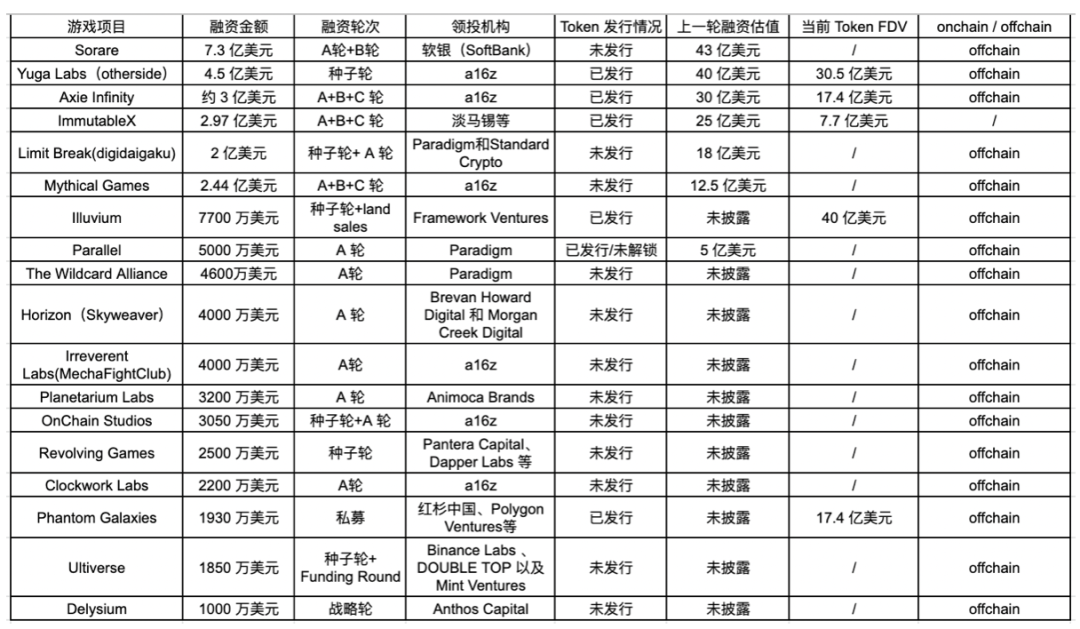
(注:这并不意味着 VC 机构们不关注 Purists 链游项目,例如 Dark Forest 这款纯 onchain 链游便获得了 a16z、Paradigm、Coinbase Ventures 等多家顶级 Crypto VC 机构合伙人的关注)

那介于 Purists 和 Tourists 的 Crypto 游戏,需要具备哪些特点呢?以下提供了一些参考项:

游戏的 token 和 NFT 发行在非游客类型公链(例如以太坊);

尽管游戏的大部分逻辑和数据是 offchain 的,但作为核心资产的 NFT 是 完全 onchain 的;

并未采用简单粗暴的 Play to earn 模型(已被证明是不可持续的),而是进行了改良,例如适合竞技类游戏的W2O(win to earn)模型,或者吸引眼球的 F2O(free to own) 模型;

可以免费参与游戏;

同时注重游戏可玩性和代币经济,而不是一味追求后者;

在同类型游戏当中可以颖脱而出,可以是游戏故事、玩法、艺术质量、创新玩法(例如引入 AI)等;

在 Crypto 熊市背景下可以持续进行建设,并且游戏开发进度和社区氛围是健康的;

对于已经发行的 NFT,不会出现项目方单方面增发或者删除的情况;

整个项目的 treasury 通过多重签名钱包进行管理,并且私钥分布情况要健康,而像 Star Atlas 这样将资金存放在 FTX 这类平台的链游,则容易死亡;

结论

借鉴 Crypto 交易领域的发展历程,我们在 Crypto 游戏领域也可能会看到类似的现象:即 Offchain 链游会更早地迎来爆发式增长,而游客(Tourists)类型项目会不断产生,然后消亡。

另一方面,Onchain 链游会更擅长于创新,它们的生命力也会更为持久。

最后,无论是 Onchain 链游还是 Offchain 链游,两者都会互相学习,正如 CEX 与 DEX 一样。

Trending Cryptos

Related Reads

Beyond the Model Lies the Harness: Deepseek Enters the Arena, Why Has the Main Battlefield of China's AI Competition Shifted?

In mid-to-late May 2026, Deepseek internally established a new Harness team focused on code agent products, internally benchmarked against Anthropic's Claude Code. This move, marked by the formula "Model + Harness = Agent" in their job postings, signals a major shift in China's AI competition: the main battlefield is transitioning from developing large models to building toolchains and achieving workplace integration. Deepseek's direct involvement in Harness development aims to secure control over interface design and training data feedback loops, moving beyond open-sourcing powerful models. Harness, the runtime infrastructure for AI agents, handles everything beyond model reasoning—task orchestration, tool calling, context management, safety checks, and error recovery. It is crucial because agent products are not just outputs of model capability but also training grounds for it. Real-world task failures recorded by Harness can feed back into model training, creating a flywheel effect. Engineering Harness is more critical than optimizing prompts, as poor context management or error handling can drastically reduce agent success rates in multi-step, real-world scenarios. This shift is not isolated. Other major Chinese tech companies are also pursuing differentiated toolchain strategies. Tencent leverages its enterprise ecosystem (WeChat Work, Tencent Cloud) to build connectors for organizational-level AI collaboration and complex task delivery. Alibaba focuses on lowering automation barriers on the web with a front-end, browser-based GUI Agent framework, PageAgent. This diversification shows the industry recognizes that success lies not in a perfect general agent, but in vertically focused solutions built with robust engineering. The trend is validated by overseas success, such as Poland's Viktor, an AI coworker on Slack achieving $20M ARR by autonomously executing complex, multi-step tasks. This proves a shift in enterprise willingness to pay—from "AI-assisted generation" to "AI-autonomous execution." As Harness matures to provide safety guards and reliability, AI transitions from a human-supervised intern to an independent outsourcer. The competition now faces key engineering challenges: preventing "token explosion" through intelligent context compression, and building "thick frameworks" with features like sandbox isolation and checkpoint recovery for enterprise-grade stability. Geopolitical restrictions on tools like Claude Code further create a significant market vacuum for domestic solutions like Deepseek's Harness. For enterprises and developers, the focus must shift from comparing model benchmarks to evaluating a vendor's engineering capabilities, error recovery mechanisms, context management, and ecosystem compatibility when choosing AI products and platforms.

marsbit4m ago

Beyond the Model Lies the Harness: Deepseek Enters the Arena, Why Has the Main Battlefield of China's AI Competition Shifted?

marsbit4m ago

Soaring Export Data for Memory Chips, Market Is Redefining the Valuation Anchor for Memory Stocks

Korean storage export data for the first 20 days of June shows substantial year-on-year increases in both value and price-per-kilogram for categories like DRAM, NAND, and SSDs. This signals a potential shift beyond simple demand recovery, indicating rising prices and a product mix shift towards higher-value items, possibly influenced by AI infrastructure needs. A key point is that the surge in price-per-kilogram is not simply a uniform chip price hike. It reflects a combination of actual price increases and, more importantly, an export structure increasingly dominated by high-value-density products like HBM (High-Bandwidth Memory) and advanced DRAM, which are critical for AI servers. This suggests AI-driven demand may be spilling over from just HBM into broader memory markets. SK Hynix stands to benefit directly due to its leading HBM position. For Samsung and Micron, the implication is potential for greater margin elasticity if the tightness in high-end memory spreads to enterprise SSD and NAND prices. However, the storage sector remains cyclical. Risks include supply expansion, inventory changes, and potential slowdowns in broader AI capital expenditure. Ultimately, while the strong export data supports upward revisions for storage company earnings and fuels discussion of an "AI infrastructure bottleneck premium," a definitive valuation shift from a cyclical to a structural story depends on upcoming quarterly reports. Investors need confirmation from SK Hynix, Samsung, and Micron that improvements in average selling prices, product mix, and, crucially,毛利率 are sustained over multiple quarters.

marsbit1h ago

Soaring Export Data for Memory Chips, Market Is Redefining the Valuation Anchor for Memory Stocks

marsbit1h ago

Why Does SpaceX Have Such a High Valuation Ceiling? The Answer Lies in Musk's Business Blueprint

SpaceX achieved a record-breaking IPO on June 12, 2026, with its market cap surging past $2.1 trillion. This valuation reflects its central role within Elon Musk's expansive, interconnected technological ecosystem. The article details how four core components form a synergistic closed-loop system: 1) **The "Brain" (xAI & Orbital Compute):** xAI provides AI models and massive ground/space-based supercomputing for simulation and decision-making across the system. 2) **The "Neural Logistics Core" (Starlink & Starship):** Starlink's low-latency satellite network enables global data transmission, while Starship's low-cost, reusable launch capacity aims to make large-scale space deployment economically viable. 3) **The "Physical Body" (Tesla & Optimus):** Tesla's manufacturing prowess and energy products support hardware production and power, pivoting toward mass-producing the Optimus humanoid robot for terrestrial and potential space-based labor. 4) **The "Human Interface" (Neuralink & X):** Neuralink seeks direct brain-computer communication, and the X platform provides real-time societal data. Together, these elements create three reinforcing "flywheels": manufacturing/logistics, data-driven iteration, and energy/compute/network synergy. This integrated approach promises lower costs, faster innovation cycles, and potential infrastructure-as-a-service offerings. However, it also concentrates technical, regulatory, and corporate governance risks. Ultimately, SpaceX's high valuation stems from its position as the indispensable infrastructural backbone—handling space transport, global communications, and future orbital computing—tying together Musk's entire vision for a self-reinforcing technological empire.

marsbit1h ago

Why Does SpaceX Have Such a High Valuation Ceiling? The Answer Lies in Musk's Business Blueprint

marsbit1h ago

Trading

Spot
Futures

Hot Articles

What is $BITCOIN

DIGITAL GOLD ($BITCOIN): A Comprehensive Analysis Introduction to DIGITAL GOLD ($BITCOIN) DIGITAL GOLD ($BITCOIN) is a blockchain-based project operating on the Solana network, which aims to combine the characteristics of traditional precious metals with the innovation of decentralized technologies. While it shares a name with Bitcoin, often referred to as “digital gold” due to its perception as a store of value, DIGITAL GOLD is a separate token designed to create a unique ecosystem within the Web3 landscape. Its goal is to position itself as a viable alternative digital asset, although specifics regarding its applications and functionalities are still developing. What is DIGITAL GOLD ($BITCOIN)? DIGITAL GOLD ($BITCOIN) is a cryptocurrency token explicitly designed for use on the Solana blockchain. In contrast to Bitcoin, which provides a widely recognized value storage role, this token appears to focus on broader applications and characteristics. Notable aspects include: Blockchain Infrastructure: The token is built on the Solana blockchain, known for its capacity to handle high-speed and low-cost transactions. Supply Dynamics: DIGITAL GOLD has a maximum supply capped at 100 quadrillion tokens (100P $BITCOIN), although details regarding its circulating supply are currently undisclosed. Utility: While precise functionalities are not explicitly outlined, there are indications that the token could be utilized for various applications, potentially involving decentralized applications (dApps) or asset tokenization strategies. Who is the Creator of DIGITAL GOLD ($BITCOIN)? At present, the identity of the creators and development team behind DIGITAL GOLD ($BITCOIN) remains unknown. This situation is typical among many innovative projects within the blockchain space, particularly those aligning with decentralized finance and meme coin phenomena. While such anonymity may foster a community-driven culture, it intensifies concerns about governance and accountability. Who are the Investors of DIGITAL GOLD ($BITCOIN)? The available information indicates that DIGITAL GOLD ($BITCOIN) does not have any known institutional backers or prominent venture capital investments. The project seems to operate on a peer-to-peer model focused on community support and adoption rather than traditional funding routes. Its activity and liquidity are primarily situated on decentralized exchanges (DEXs), such as PumpSwap, rather than established centralized trading platforms, further highlighting its grassroots approach. How DIGITAL GOLD ($BITCOIN) Works The operational mechanics of DIGITAL GOLD ($BITCOIN) can be elaborated on based on its blockchain design and network attributes: Consensus Mechanism: By leveraging Solana’s unique proof-of-history (PoH) combined with a proof-of-stake (PoS) model, the project ensures efficient transaction validation contributing to the network's high performance. Tokenomics: While specific deflationary mechanisms have not been extensively detailed, the vast maximum token supply implies that it may cater to microtransactions or niche use cases that are still to be defined. Interoperability: There exists the potential for integration with Solana’s broader ecosystem, including various decentralized finance (DeFi) platforms. However, the details regarding specific integrations remain unspecified. Timeline of Key Events Here is a timeline that highlights significant milestones concerning DIGITAL GOLD ($BITCOIN): 2023: The initial deployment of the token occurs on the Solana blockchain, marked by its contract address. 2024: DIGITAL GOLD gains visibility as it becomes available for trading on decentralized exchanges like PumpSwap, allowing users to trade it against SOL. 2025: The project witnesses sporadic trading activity and potential interest in community-led engagements, although no noteworthy partnerships or technical advancements have been documented as of yet. Critical Analysis Strengths Scalability: The underlying Solana infrastructure supports high transaction volumes, which could enhance the utility of $BITCOIN in various transaction scenarios. Accessibility: The potential low trading price per token could attract retail investors, facilitating wider participation due to fractional ownership opportunities. Risks Lack of Transparency: The absence of publicly known backers, developers, or an audit process may yield skepticism regarding the project's sustainability and trustworthiness. Market Volatility: The trading activity is heavily reliant on speculative behavior, which can result in significant price volatility and uncertainty for investors. Conclusion DIGITAL GOLD ($BITCOIN) emerges as an intriguing yet ambiguous project within the rapidly evolving Solana ecosystem. While it attempts to leverage the “digital gold” narrative, its departure from Bitcoin's established role as a store of value underscores the need for a clearer differentiation of its intended utility and governance structure. Future acceptance and adoption will likely depend on addressing the current opacity and defining its operational and economic strategies more explicitly. Note: This report encompasses synthesised information available as of October 2023, and developments may have transpired beyond the research period.

416 Total ViewsPublished 2025.05.13Updated 2025.05.13

What is $BITCOIN

Discussions

Welcome to the HTX Community. Here, you can stay informed about the latest platform developments and gain access to professional market insights. Users' opinions on the price of BTC (BTC) are presented below.

活动图片