Aave Price Recovers Back To $57, But Threat Of New Attack Looms Over Protocol

newsbtcPublished on 2022-11-24Last updated on 2022-11-24

Abstract

The Ethereum-based decentralized finance (DeFi) protocol Aave suffered an attack led by Avraham Eisenberg. The controversial individual was behind a sophisticated run against Mango Markets. The run has been called an attack by some and a clever strategy by others.

The Ethereum-based decentralized finance (DeFi) protocol Aave suffered an attack led by Avraham Eisenberg. The controversial individual was behind a sophisticated run against Mango Markets. The run has been called an attack by some and a clever strategy by others.

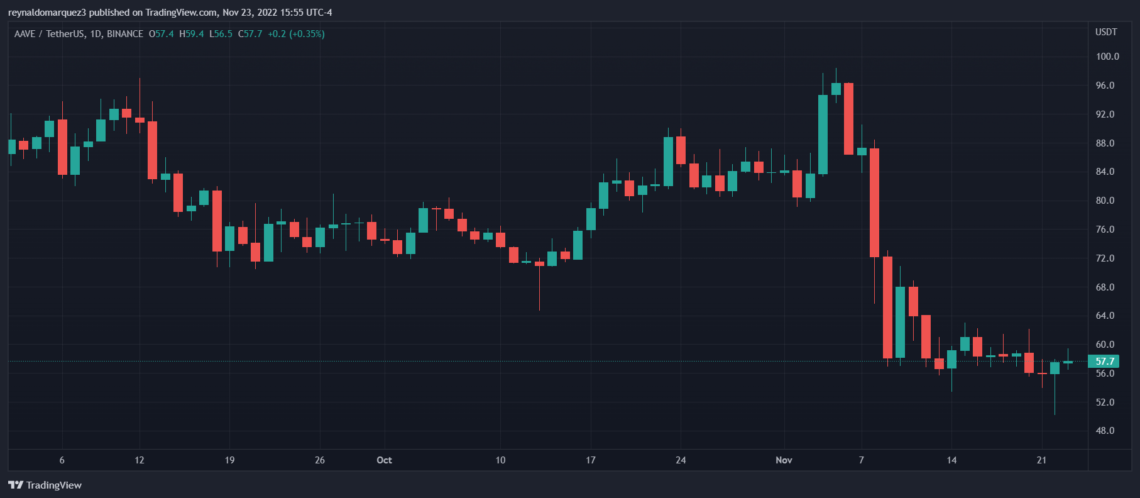
Aave (AAVE) trades at $57 with a 7% and 36% loss in the last 24 hours and the previous week, respectively. Curve Finance’s native token CRV was also part of the attack. This token has seen significant selling pressure in the short term but has been trending to the upside over today’s trading session.
Orchestrating An Attack On Aave, First Attempt?

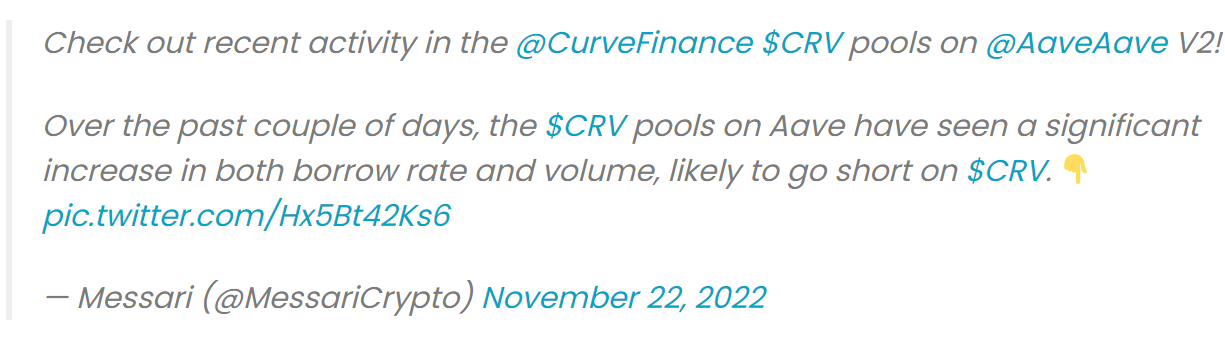
Rudy Kadoch, founder of the portfolio management project Nested, summarized yesterday’s event and the “Bad Debt” attack on Aave. According to this report, Eisenberg borrowed $83 million of CRV and used $50 million of stablecoin USDC as collateral on the decentralized finance platform.

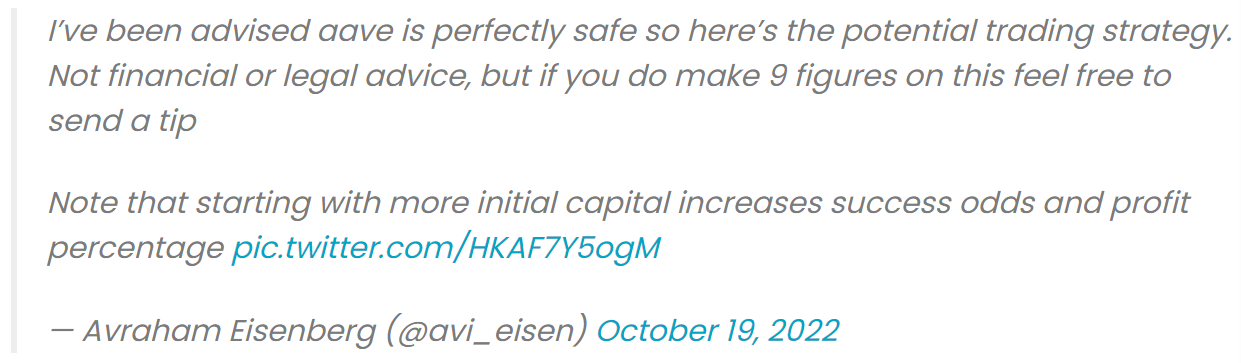
Eisenberg published the thesis that supported this strategy in October 2022 via his Twitter account. It was public, and his objectives were perfectly outlined: to leverage his initial capital to influence the price of an illiquid token, such as CRV or Ravencoin (RVN), in hopes of creating “bad debt,” an excess liability assumed by the protocol.
To pay off this debt, Aave would trigger an auction mechanism that involves selling AAVE on the spot market. By taking a short position on this token, Eisenberg would benefit.
By prompting the price of the underlying collateral, the Aave borrower can double or increase its price by five-fold “at least.” This attack was unsuccessful, as Kadoch noted, due to a lack of capital. The actor was trying to liquidate a CRV whale to create a bad debt.

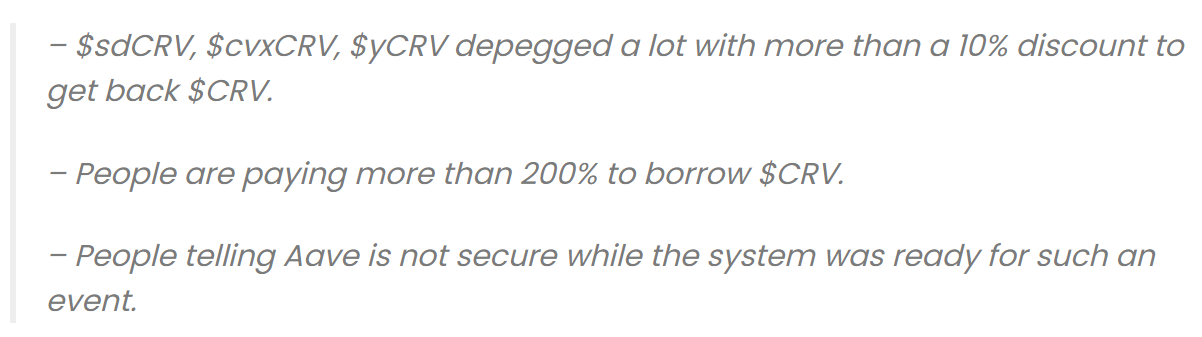
However, as the attack was being carried out, the team behind Curve Finance released the whitepaper for a stablecoin, crvUSD. This announcement supported the price of the token and shifted the trend. Kadoch noted:
The Future Of Aave In Jeopardy?

On the other hand, the protocol operated as intended without centralized intervention. The team behind Aave claims that they will talk with the community and the DAO about the recent incident.

In that sense, the protocol might introduce changes in the coming days to mitigate “long tail asset risk.” Many believe Eisenberg will resume its attack on the protocol once he can pool together more capital.
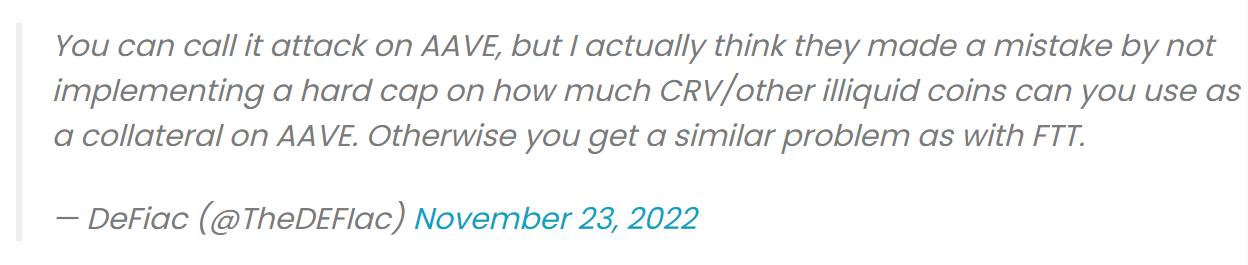
The “Bad Debt” attack on Aave was like the situation that led to the FTX’s collapse. The failed company issued held massive amounts of FTT, its native token. When the price of the asset crashed, Sam Bankman-Fried’s empire followed.

Unlike FTX, as many users pointed out, everyone can access on-chain information about Eisenberg’s transactions, the state of the protocol’s finance, and the amount of bad debt it held on its balance sheet. This transparency is the critical difference between centralized ecosystems and decentralized protocols. The team behind Aave stated:

Related Reads

CLARITY Act Passes Crucial Hurdle, But a Long Road Remains Ahead

The CLARITY Act, a major U.S. digital asset market structure bill, has advanced from the Senate Banking Committee with a 15-9 bipartisan vote, ending a four-month legislative standstill. The bill's core aim is to resolve the long-standing jurisdictional conflict between the SEC and CFTC by clearly defining which digital assets are securities or commodities. It also establishes rules for exchanges and custodians while providing protections for non-custodial software developers and blockchain validators, shielding them from being classified as money transmitters. The committee's approval triggered a positive market reaction, with Bitcoin rising and crypto-related stocks outperforming the broader market. However, the passage was secured only after last-minute negotiations and compromises, including the addition of amendments on investor protection, bank activities, and defining "truly decentralized" DeFi projects. Two key Democratic senators provided the crucial swing votes but cautioned that their future support in a full Senate vote is not guaranteed. Significant hurdles remain. The bill must still pass the full Senate, requiring 60 votes, and a major point of contention is a Democratic demand for an ethics clause restricting financial ties between high-level government officials and crypto firms—a provision opposed by Republicans and the White House. Additionally, the bill must be reconciled with a version from the Senate Agriculture Committee. If not passed before the August congressional recess, the next viable legislative window might not open until 2030. The legislation also faced, and ultimately withstood, last-minute lobbying opposition from traditional banking groups concerned about deposit outflows to crypto. If ultimately enacted, the CLARITY Act would initiate a multi-year rulemaking process, with new regulations likely not taking full effect until 2027 or later. While a critical milestone, the path to becoming law remains a challenging race against time.

链捕手9m ago

CLARITY Act Passes Crucial Hurdle, But a Long Road Remains Ahead

链捕手9m ago

A Century Before Swift and Blockchain, China Built Its Own Cross-Border Financial Network

A century before Swift and blockchain, China's cross-border financial miracle: The Qiaopi Network. Driven by the phrase "a promise is greater than life," the Qiaopi (overseas Chinese remittance letter) system was a remarkable, entirely private financial network. Operating for over a hundred years until 1979, it facilitated billions in remittances, at one point constituting over 50% of China's foreign exchange during WWII—all without central banks, official clearing, or government backing. It began with "Shuike" (water guests), couriers who carried cash and letters personally between Southeast Asia and Chinese villages like Chaozhou. Their operation was peer-to-peer, identity-verified through kinship, and had a near-zero default rate, as trust was their sole collateral. This evolved into "Piju" (remittance houses), creating an institutional network. They ingeniously used currencies like the Hong Kong Dollar for settlement and practiced netting clearance, offsetting remittance flows against trade payments to minimize physical cash movement. Its resilience shone in wartime. When Japanese forces cut off main routes, the network forged an underground "Dongxing Remittance Path" through Vietnam. It used coded messages ("a bag of rice" for a sum of silver) to evade interception, reliably delivering funds critical for survival and even clandestine support for the war effort. Unlike Swift (built on state cooperation) or blockchain (relying on cryptography), Qiaopi was founded on clan,乡土 (native place), and human trust—a cultural consensus where违约 meant social death. Modern finance compensates for this lost trust with complex collateral and regulation. The Qiaopi network, powered only by sailing ships, familiar accents, and profound integrity, achieved a feat of decentralized, cross-border finance that remains unparalleled—a poignant story of信用 (trust/credit) in its purest form.

marsbit58m ago

A Century Before Swift and Blockchain, China Built Its Own Cross-Border Financial Network

marsbit58m ago

A Decade's Bet on Cerebras: How the 'Wafer-Scale AI Chip' Reached NASDAQ

"Cerebras, a pioneering AI chip company, successfully debuted on NASDAQ (CBRS) on May 14, 2026, with its stock price surging approximately 68% on the first day. This marks a significant milestone following a decade-long journey, as recounted by early investor Steve Vassallo. The story begins not in 2016, but with the deep, 19-year relationship between Vassallo and founder Andrew Feldman, which started with Feldman’s previous company, SeaMicro (acquired by AMD in 2012). In 2016, Feldman and a core team of chip and system experts sought to challenge the emerging consensus. At a time when AI’s practical utility was still debated and GPUs were becoming the default hardware, they envisioned a fundamentally new computer architecture purpose-built for AI workloads. They identified memory bandwidth, not raw compute power, as the critical bottleneck for neural networks. Defying industry inertia, Cerebras pursued a radical, wafer-scale chip design—58 times larger than the biggest existing chips. This meant confronting and solving a cascade of unprecedented engineering challenges: power delivery, thermal management, and maintaining electrical continuity across tens of thousands of connections. It required reinventing nearly every aspect of modern computing—semiconductors, systems, data structures, software, and algorithms. The path was fraught with setbacks, including a prototype that caught fire on its first power-up. Progress was marked by intense, iterative problem-solving, with the board meeting every 6-8 weeks to tackle the latest technical frontier. Through disciplined perseverance and deep trust within the team, they achieved a breakthrough in August 2019 when their first wafer-scale computer successfully operated. Feldman’s drive for a 1000x leap, his formative upbringing among intellectual giants who modeled both brilliance and kindness, and his belief in building a loyal, mission-driven team were central to Cerebras’s culture. His competitive strategy was that of David vs. Goliath—finding innovative, human-centric approaches that larger incumbents would overlook. From the symbolic delivery of the first term sheet over a backyard fence in 2016 to the NASDAQ bell ringing in 2026, Cerebras’s journey is a testament to long-term vision, technical audacity, and the power of foundational founder-investor relationships. It stands as a reminder that the computing revolution can come not just from more GPUs, but from a complete reimagining of the architecture itself."

marsbit1h ago

A Decade's Bet on Cerebras: How the 'Wafer-Scale AI Chip' Reached NASDAQ

marsbit1h ago

Trading

Spot
Futures

Hot Articles

How to Buy AAVE

Welcome to HTX.com! We've made purchasing Aave Protocol (AAVE) simple and convenient. Follow our step-by-step guide to embark on your crypto journey.Step 1: Create Your HTX AccountUse your email or phone number to sign up for a free account on HTX. Experience a hassle-free registration journey and unlock all features.Get My AccountStep 2: Go to Buy Crypto and Choose Your Payment MethodCredit/Debit Card: Use your Visa or Mastercard to buy Aave Protocol (AAVE) instantly.Balance: Use funds from your HTX account balance to trade seamlessly.Third Parties: We've added popular payment methods such as Google Pay and Apple Pay to enhance convenience.P2P: Trade directly with other users on HTX.Over-the-Counter (OTC): We offer tailor-made services and competitive exchange rates for traders.Step 3: Store Your Aave Protocol (AAVE)After purchasing your Aave Protocol (AAVE), store it in your HTX account. Alternatively, you can send it elsewhere via blockchain transfer or use it to trade other cryptocurrencies.Step 4: Trade Aave Protocol (AAVE)Easily trade Aave Protocol (AAVE) on HTX's spot market. Simply access your account, select your trading pair, execute your trades, and monitor in real-time. We offer a user-friendly experience for both beginners and seasoned traders.

5.0k Total ViewsPublished 2024.03.29Updated 2025.05.06

How to Buy AAVE

Discussions

Welcome to the HTX Community. Here, you can stay informed about the latest platform developments and gain access to professional market insights. Users' opinions on the price of AAVE (AAVE) are presented below.

活动图片