After the collapse of FTX, the premium of DCG ’s Bitcoin Trust Fund (GBTC) continued to decrease and reached a record low at -46%.
What is Grayscale?
Grayscale owns the world's largest Bitcoin trust, GBTC, which accounts for 3.5% of all available BTC. The birth of Grayscale provided compliant investors a Bitcoin exposure for the first time, marking the asset's entry into the mainstream.
Unlike traditional US equity funds applying company structure, the intrinsic value of GBTC comes from the BTC it directly holder and is publicly traded on OTCQX (the US over-the-counter market).
Grayscale’s token holdings and historical performance
Holding 673,000 BTC, accounting for 3.5% of all available BTC, GBTC is currently a $10.6 billion trust fund, compared to $13.5 billion 2 weeks ago.
Holding 3 million ETH, Grayscale currently holds 3.6 billion ETH, compared with 4.8 billion U.S. dollars two weeks ago.
2018 market collapse: GBTC plummeted 90.5% in 13 months before bottoming out.
2022: market collapse: GBTC has fallen by more than 85% and still falling.
Last Friday, in order to appease the market sentiment , Coinbase certificated the asset of Grayscale's asset with reserves of various assets announcement.
The reason for the negative premium of GBTC
Worried about internal risk control issues
Both Grayscale and Genesis are subsidiaries of DCG, and Genesis is in charge of the issuance of Grayscale 's new shares before. It seems reasonable to worry about internal transfer by them.
Concerns about Grayscale's robustness intensified after Genesis announced on Nov. 16 that it started to suspend redemptions and loans.
In addition, GBTC is facing a problem that it has been replaced by better Bitcoin tools.
Defects of trust products
Once upon a time, GBTC was one of the few investable vehicles for qualified traders. With the expansion of the encryption industry, their management scale and premium were at a high level.
Later, Canada began to launch the first Bitcoin ETF. The new vehicle cut the fee to its half, and it also provided greater liquidity without paying a premium. GBTC‘s crown began to dim.
Actually, GBTC does not have an arbitrage mechanism to make its price approach to fair, and GBTC shares cannot be redeemed for real bitcoins and can only be sold through the OTC. If the managers want to cut the premium by repurchasing, they also needs to obtain the approval letter from US SEC, which is difficult under Gary Gensler's watch.
Gary Gensler , chairman of the US SEC , coerce GBTC’s redeem
Although Grayscale, out of the original intention of protecting investors, hopes to convert GBTC into Bitcoin to reduce the negative premium. The SEC is determined not to allow it, citing concerns about potential fraud and manipulation, refusing to follow regulators elsewhere who approved bitcoin ETFs.
Currently, Grayscale is suing the SEC to get the right to convert GBTC. But the widening negative GBTC premium suggests few market participants think the SEC will let up.
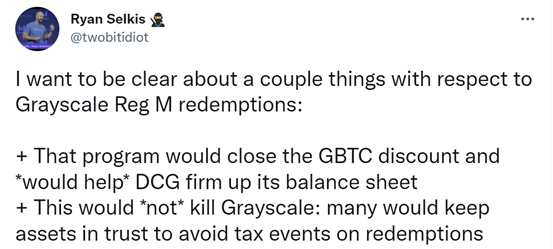
Messari founder Ryan Selkis expressed his dislike of Gary Gensler more than once:
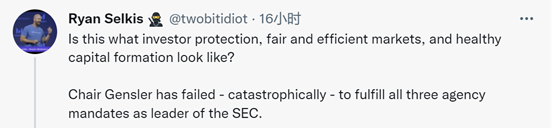
After all, the SEC continues to allow investors to trade GBTC, but does not approve a path that can solve the GBTC discount problem, which is ridiculous. This may just be a maneuver of Gary Gensler.
Negative premiums may not last
As the market has been weak recently, the reputation of Coinbase has been questioned, and the SEC has not changed its tone, the negative premium of GBTC will not last in the near future.
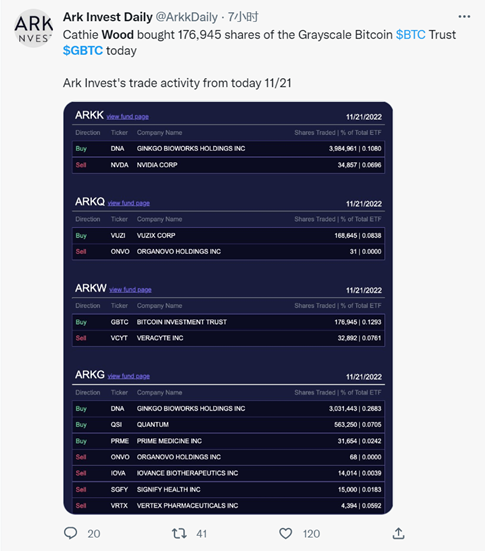
Long-term investors such as ARK are constantly buying discounted GBTC . This may be one of the few acts in the market that use real money to cast a vote of confidence in the Crypto industry.
Grayscale is becoming a canary for predicting bad luck
The reason why Grayscale 's negative premium can reach such a low level is inseparable from its connection with Genesis and DCG which are the parent company and brother company of Grayscale separately. Their ties have raised concerns about insider trading。
Coinbase has dispelled some suspicions. And ARK cast a vote of confidence for Coinbase with practical actions. It seems that the canary in a coal mine is still alive.
DCG and Genesis behind Grayscale be the next dominoes?
Genesis is a New York licensed institution that can carry out token lending. It is allowed to provide institutional investors and high-net-worth investors with brokerage transactions of tokens such as BTC , ETH , ETC , BCH , XRP , Litecoin and Zcash.
The market generally believed that Genesis had been hit hard in the bankruptcy of 3AC. After 3AC went bankrupt, the news that Genesis claimed $1.2 billion from 3AC is a prove. Recently, Genesis confirmed lent 2.36 billion USD to 3AC.
After the FTX thunderstorm in November, Genesis’s loan department could not withdraw 175 million from FTX. Finally, it announced on Nov.16 that it would stop redemption and new loan issuance services. The market began to pay attention to their solvency, well, a new round of storm.
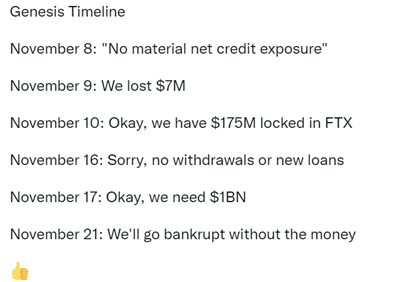
A few days ago, there were rumors that DCG, the parent company of Genesis, borrowed more than 110 million US dollars from Genesis, and the market anxiety began to intensify, which lead Genesis to turn to giants such as Binance and Apollo for help. But Binance walked way after due diligence.

Genesis and DCG have deeply bounded. If Genesis falls, the corresponding related parties may not be able to survive alone, which could also affect the traditional financial world.
Next: Will Genesis play the same as FTX
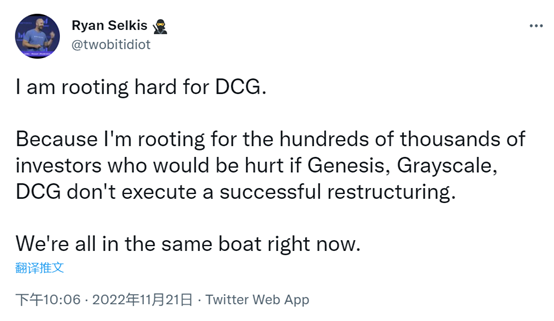
What we're seeing so far is Genesis trying to avoid bankruptcy.Looking forward, we could picture that:
Optimistically, Genesis and DCG negotiated with their debtor to extend their debt. After all , Grayscale still contributes 2% of management expenses to DCG every year, and stakeholders can wait for the storm settle down. In this scenario, Crypto winter may be over soon.
In the neutral to optimistic situation, DCG and Genesis are sold as a package, and the industry still shows some resilience. The crypto winter will last for a short period of time.
In a neutral to pessimistic situation, once Genesis goes bankrupt, DCG will inevitably fall, and related parties such as Gemini and traditional financial institutions may also suffered. The risk spillover and regulation choice will be put on the desk of regulators. Next, Tether’s balance sheet will be examined under the microscope by regulators. This winter of Crypto may be more painful. BTC will Drill down further.
In an extremely pessimistic situation, if Coinbase lied to the collateral of Grayscale, the entire Crypto industry will probably be subject to the most stringent regulation, Bitcoin will likely dip through $10,000 easily, and the industry may return to a prehistoric.
Summarize
Under the continuous amplification of the FUD sentiment of DCG and Genesis, Grayscale's premium rate reached a record low. Although it is difficult for the SEC to allow Grayscale to convert assets into ETFs in the short run, using a long-term perspective, the GBTC is offering a BTC discount at 8,500 USD, which is attractive enough.
Grayscale also provides DCG and Genesis with a stable cash flow, it is becoming a cushion for the market.
Stay SAFU!