[Key interpretation] Funds drive AR up 70%, and ETH bulls prepare for the bull market

HuobiPublished on 2022-11-03Last updated on 2022-11-04

Abstract

The strong return of ETH bulls is brewing to raise prices.

1. BTC discharge shock

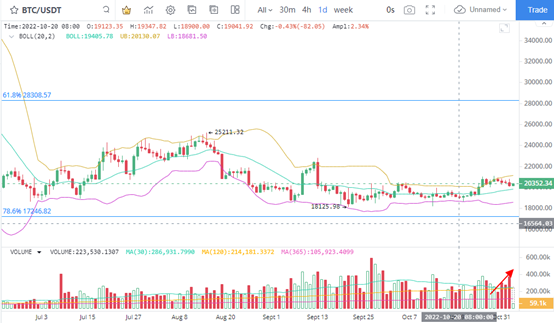
The daily K line chart shows that after BTC retreated for four consecutive trading days, the trading volume has reached its peak in the past month. With the adjustment, the selling pressure also reached its peak on November 2. On the news side, the Federal Reserve raised interest rates again by 0.75 basis points to 3.75% - 4.00%, which is the fourth consecutive meeting of the Federal Reserve to announce a 75 basis point increase in interest rates. Affected by this, the BTC price also experienced a short-term strong earthquake of 3.68%. The performance of volume and price suggests that BTC, an investor, has once again withstood the impact of interest rate hikes. At present, the price is still above the middle track of Bollinger Line.
2. BTC contract position decline

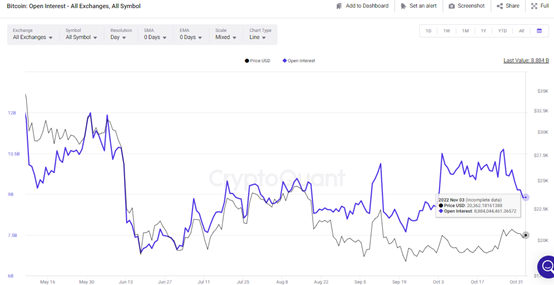
The position of BTC contract showed signs of continuous decline. On November 3, the position of BTC contract fell to 8.89 billion US dollars, a decrease of 1.76 billion US dollars, or 17%, compared with the peak of 10.65 billion US dollars on October 26. The position of BTC contract ushered in the most important decline since October, which means that the price amplitude that contract investors can bear in the near future has increased. At the same time, it means that BTC is easier to choose a breakthrough direction in the near future.
3. ETH ready for lifting

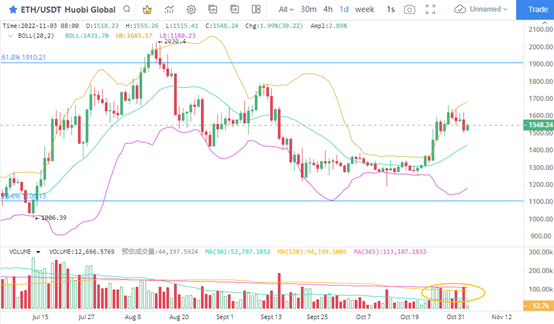
The daily K line chart shows that there is limited room for ETH price to retreat in the short term. As the rebound continues, ETH still maintains a large-scale operation. This shows that the recent ETH price rebound trend is expected to continue. Until the trading heat cools down, investors can absorb the market at a low price. In terms of contracts, the long short ratio of ETH rebounded, further indicating that spot prices will strengthen.
4. ETH long short ratio continues to rise

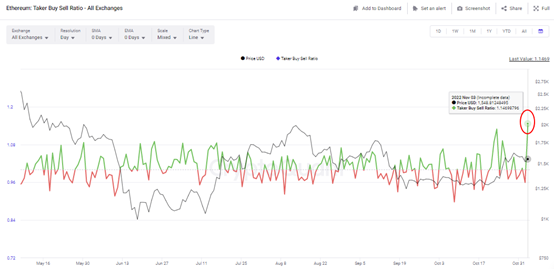
With the rebound of the long short ratio of ETH contracts, the value has reached the peak level of the recent high of 1.146. That is to say, compared with 1.129 on October 23, many parties are more optimistic about the short-term breakthrough performance of ETH price. In terms of trading, attention can be paid to ETH bargain buying opportunities. Considering that the long short ratio has fluctuated less in the past three years and is currently the highest in three years, it has a better effect on the market, further verifying that ETH's market entry trading opportunities are relatively reliable.
5. AR short line volume soars

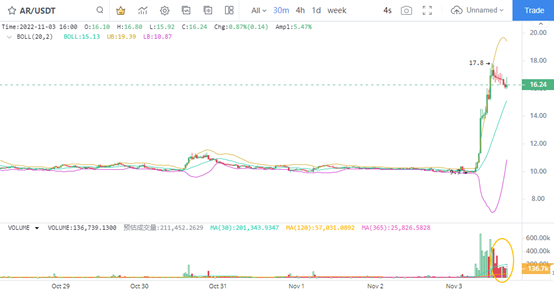
In the short-term surge phase of AR, the trading volume was significantly enlarged, and the volume started on November 3 was the same as that on October 30. The short-term capacity has reached 20 times, and the AR has been continuously pulled up to the K line for 8 times and 30 minutes. In the phase of AR surge and fall, the trading volume shrinks significantly relative to the phase of price rise, indicating that bulls still have the opportunity to raise prices for a second time. The profit taking market did not completely escape, and focused on the rebound opportunity after the withdrawal of AR. From the point of view, pay attention to the low absorption opportunities of AR above $15.

Related Reads

Circle's Second Growth Curve: After the $222 Million ARC Financing, CRCL or ARC?

Circle, the issuer of USDC, announced that its new public blockchain Arc completed a $222 million private sale for its native token ARC, with the network's fully diluted valuation reaching $3 billion. The funding round was led by a16z crypto, with participation from major institutions including BlackRock, Apollo, and ICE. The article explains Circle's rationale for building its own L1 blockchain, Arc. Existing chains like Ethereum and Solana are seen as lacking native support for large-scale institutional needs, such as regulatory compliance, predictable transaction costs, and asset issuance/redemption workflows. Arc is designed to fill this gap as a foundational layer for the on-chain economy, moving beyond Circle's reliance on USDC reserve interest for revenue. It details the dual-token model of Arc: USDC serves as the stable gas token for predictable transactions, while ARC is the network's native asset used for staking in the planned transition to Proof-of-Stake, governance, and aligning long-term incentives among participants. ARC's total supply is 10 billion, with 60% allocated to ecosystem development, 25% to Circle, and 15% to a long-term reserve. All protocol fees are converted to ARC, with portions burned and distributed to stakers. The piece contrasts the value proposition of Circle's public stock (CRCL) and the ARC token. CRCL captures the company's core cash flows from USDC interest and other business lines. ARC captures the growth potential of the Arc network itself. While legally separate, network success benefits both: it drives USDC usage for Circle and increases the value of its 25% ARC holding. Finally, it outlines participation avenues for retail users, primarily through the Arc House community and testnet activities, while noting the competitive landscape with projects like Canton Network and Plasma. The article concludes that Arc's success hinges on attracting real institutional activity post-mainnet launch, scheduled for Summer 2026.

链捕手2h ago

Circle's Second Growth Curve: After the $222 Million ARC Financing, CRCL or ARC?

链捕手2h ago

From Gas Limit to Keyed Nonces: How to Understand the Next Stage of Ethereum's Scalability?

From Gas Limits to Keyed Nonces: Understanding the Next Phase of Ethereum Scalability This article explores how recent Ethereum developments focus on moving complexity away from end-users, wallets, and DApps to the protocol layer. It discusses the consensus around significantly increasing the Gas Limit to 200 million, a change aimed at reducing fees and improving network capacity. However, it emphasizes that this increase is part of a holistic approach that includes mechanisms like enshrined Proposer-Builder Separation (ePBS) and Block-Level Access Lists to manage state growth and maintain node decentralization. The piece also delves into Keyed Nonces (EIP-8250), a proposed upgrade to Ethereum's transaction ordering. It explains how moving from a single, linear nonce queue per account to multiple independent nonce domains ("channels") can enable parallel transaction streams for different use cases. This is particularly crucial for privacy protocols and smart wallets, reducing transaction conflicts and unlocking new design possibilities. Ultimately, the article argues that these technical upgrades—alongside native account abstraction and cross-L2 interoperability—are converging towards a singular goal: enhancing the overall user experience. This means making on-chain interactions smoother, safer, and more cohesive, with wallets serving as the critical interface translating complex protocol improvements into intuitive user actions.

marsbit2h ago

From Gas Limit to Keyed Nonces: How to Understand the Next Stage of Ethereum's Scalability?

marsbit2h ago

Trading

Spot
Futures
活动图片