熊市红海 NFT市场Element能成功吗?

吴说区块链Published on 2022-10-20Last updated on 2022-10-20

Abstract

自 8 月 18 日上线以来,Element 2.0 市场的发展已有两个月时间。

在长达 3 个多月的 1.0 阶段的摸索,顶着王峰下场和红衫投资光环的多链聚合 NFT 交易市场 Element 2.0 在界面/功能设计、空投活动奖励、挖矿机制等方面都吸取了 NFT 交易市场三位老大哥 OpenSea、LooksRare 和 X2Y2 的优劣点。自 8 月 18 日上线以来,Element 2.0 市场的发展已有两个月时间,离 11 月 5 日结束的元素风暴 ELE 奖励活动的日子也在逐渐逼近。当奖励活动结束后,Element Token 很有可能迎来上线,那么对项目的估值以及 ELE 的预期将十分重要。但尽管离奖励活动还有小半个月的时间,从交易人数和交易量日渐低迷的趋势来看,Element 的 Token 奖励活动已经越来越难以吸引交易者。

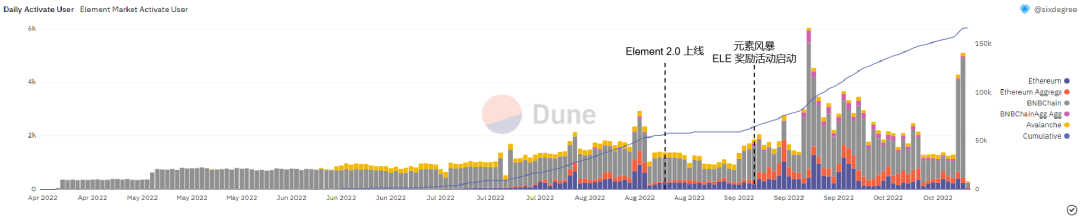
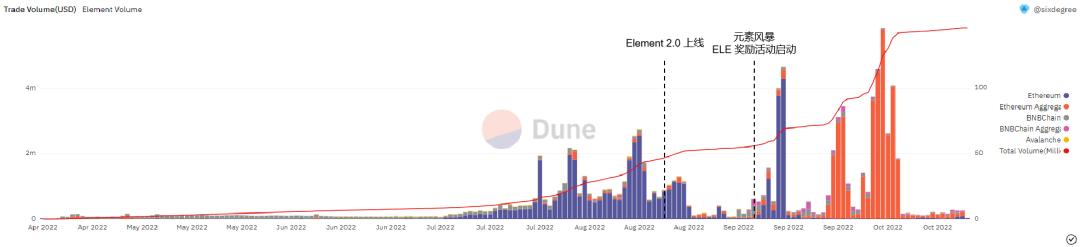
从整体交易量来看,在 Element 2.0 上线和元素风暴活动开启后,Element 经历了如下几个阶段:薅羊毛、羊毛党冷静期、聚合交易期、低迷期。元素风暴活动主要包括挂单奖励、交易奖励和邀请奖励。

在空投活动刚开启时,头几天并未吸引到太多羊毛党和交易员的关注,在经历了部分中文加密 KOL 的宣传后,Element 交易量在 9 月 10 日 - 11 间迎来了大幅上涨。由于交易奖励仅限于 Ethereum 且奖励主要集中在自有市场,在 9 月 11 日当天 Element Ethereum 自有市场交易量被疯狂的羊毛党推动超过了 430 万美金,接近 OpenSea 同天交易量的 1/2。怎么也没想到的是,9 月 11 日的交易量却已经是 Element Ethereum 自有市场交易量峰值。自此之后的时间,Element Ethereum 自有市场的日交易量再也没有达到峰值的 1/10。这背后 430 万美金的疯狂,仅仅是由 1043 名交易员创造出来的,平均交易超过 4 千美金。或许正是羊毛党疯狂的举动着实把 Element 项目方吓了一跳,第二天 Element 交易奖励和挂单奖励的系数便被大削一笔。其实在刚开启活动的头几天,项目方便随时根据奖励情况修改规则,修改之频繁以及奖励的大幅度下降,羊毛党光速退场,9 月 12 日 Ethereum 自有交易量同比下跌 97%,此后的不少日子里更是出现日交易量不足 5000 美金的情况。

在 9 月末到 10 月初前后,Element 交易量实现了从自有市场向聚合市场的转变,并在 10 月 1 日当天通过 Element 聚合市场交易的交易量达到了 580 万美金,刷新了平台的整体日成交量记录。值得在意的是,同天 Element 自有市场的交易量却不足 4000 美金。Element 聚合市场包括 OpenSea、LooksRare、X2Y2 等主流交易所之外,还包括了 OKX NFT 交易市场、基于 Reservoir API 聚合的 NFT 流动性市场等。这段时间来自聚合市场交易量的增长比较疑惑,三大主流平台的交易量并未出现明显波动,或可能与海外营销战略、蓝筹交易和少量给予到聚合交易市场的奖励等有关。好景不长,国庆假期还未结束,来自聚合交易市场的交易量就迅速萎靡。

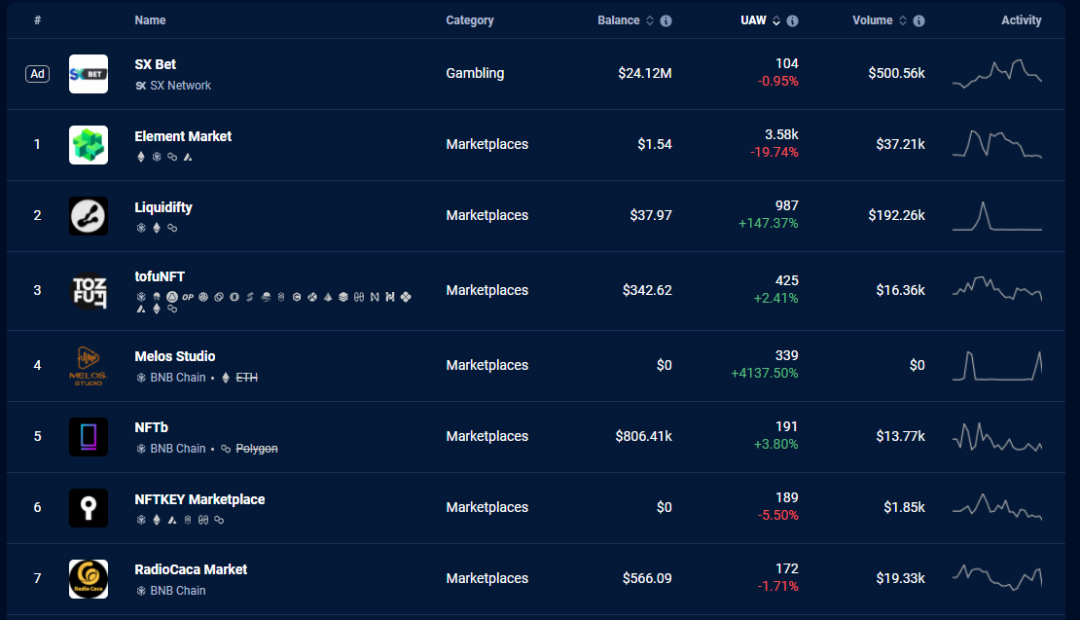
作为跨链聚合市场的 Element,尽管在 Ethereum 市场上并未能瓜分到些许份额,但其在 BSC 上是可称成功的。目前 Element 在 BSC 上日交易量可入前五,仅逊色于侧重于链游的交易市场 Liquidifty;若轮综合交易市场交易量,其已超过昔日龙头 NFTb 和 NFTrade;在日均交易人数和新增用户上更是一骑绝尘,凭借优质的用户体验和交易聚合,日交易超过 4 千人次。不过 BSC NFT 整体仍处于荒漠状态,整个链上 NFT 交易量约莫不过百万美金,对于 Element 整体交易量的贡献仍十分有限。正因为 BSC 链上优质 NFT 的贫瘠,交易市场也是处于勉强能用的状态。得益于同行的衬托,凭借在 OpenSea 等老大哥身上学习到的经验,Element 的用户体验上吊打 BSC 上一众平台。

回归到整体,这个由 Ethereum、BSC 和 Avalanche 组成的跨链聚合交易市场的日交易量大概维持在 25 万美金,日均交易用户约 5 千,其中 Ethereum 交易用户约占不到 10%。对比于三大主流平台而言,Element 差距可谓甚远,而且还在有奖励的情况下。这个由王峰和其旗下媒体 MarsBit 大力宣传,获得红杉资本、TikTok 最大投资者 SIG 等 1150 万美金 A 轮投资的交易市场,笔者认为其远远未达到预期。从上线至今 Element 可能面临的问题包括:

1.Token 奖励预期无法抗衡低迷的市场。作为 OpenSea 的挑战者,LooksRare 和 X2Y2 均在市场上线时几乎同步了 Token 的推出用于挖矿,在后续走势中,LOOKS 和 X2Y2 均呈现高开低走的架势,而彼时的 NFT 市场情况和流动性还未有现在的这般糟糕。Element 把市场上线和 Token 推出时间错开,但同时开启预挖矿,这样做的好处是避免在糟糕的市场状况下上线而面临更加源源不断地挖矿抛压。不过,Element 对于 ELE Tokenomics 的“佛系”,也让投资者陷入对未来 ELE 价值的担忧。目前投资者所领取的奖励仅仅只是页面上的一个数字,从 1.0 到 2.0 到至今为止,投资者所得知的关于 ELE 的消息仅有总量、空投和奖励活动的信息,而关于具体的分配情况、治理系统等更复杂的信息均处于未知,这样空白状态的 Tokenomics 之下的奖励就显得十分廉价。

2.社区建设以华语用户为主,暂时难敌 X2Y2,海外营销力量则更弱。从用户分布上看,OpenSea 凭借先发优势之下的交易深度,占据了最大的用户群体,而 LooksRare 和 X2Y2 则分别从中默默地吸收英文用户和华语用户。Element 背靠的宣传阵地 Marsbit 的受众主要在华语用户,在海外营销上面较弱;从 Discord 构建上来看,也明显侧重在华语用户。但是经历了小半年的发展,占有先发优势的 X2Y2 在华语用户的吸引上比 Element 强的多,且 X2Y2 十分注重对华语用户的需求、建议,以及优质的质押 APY,为其笼络了一大批的忠诚用户。

3.同质化过高,创新力度不足。回归到 Element 本身,作为综合性市场,市场上基本形成了 OpenSea、LooksRare 和 X2Y2 三雄争霸和小平台默默存活的局面,且 LooksRare 和 X2Y2 作为 OpenSea 挑战者,已经发展了半年的时间,得到了市场的认可,用户格局也基本形成,再加之市场环境并不理想,新增用户有限,此时 Element 想在从中分一块肥肉是比较难的。再者,Element 本身在功能和体验上其实和 X2Y2 并没有太大的区别,作为综合市场难以与三大巨头的其中一家较量;作为聚合器,被 OpenSea 收购的 Gem 和被 Uniswap 兼并的 Genie 两家已经满足了市场上的需求,且这两家背后的实体实力在整个 Crypto 的实力远超过一般的机构。Element 最大的卖点——跨链聚合并没有特别的用武之地。彼时,我们吐槽 OpenSea 的用户体验如何糟糕,X2Y2 等其实已经将那部分需求给逐渐弥补了,而 Element 并没有享受到功能完善带来的用户体验转变的这个红利。论创新性,自然也比不过 SudoSwap 等 AMM 型交易市场,综合型平台大多只是在进行功能的点对点完善,与用惯了淘宝、京东等的我们来说,这些功能在基础不过了,完全谈不上新东西,而是必需要具备的。

未达预期的市场交易量、不理想的市场环境可能会影响其 Token ELE 上线后的前景,不过对于薅羊毛的投资者而言,盈利的可能性和空间还是比较大。按照当前薅羊毛的价格,每枚 ELE 的成本主要在 $0.1 - $0.2。早期的流通量,主要包括用于元素活动的 2500 万枚的 1/2(上线解锁一半,剩余一半分十二个月线性解锁),用于空投的约 1800 万枚,以及可能的私募轮机构投资者的部分解锁等,初始流通量或不超过 5 千万枚。对比于 20 亿的总量,流通还是比较的少,按照千万融资,其估值或能达到 1 亿美金,结合 LOOKS 和 X2Y2 的经验很有可能是冲高回落的走势。

Trending Cryptos

Related Reads

Preferred Stock Is Not the Trigger for Corporate Bankruptcy, MicroStrategy's Dollar Reserves Can Cover Dividend and Interest Payments Until February 2027

Preferred Shares Are Not the Catalyst for Corporate Bankruptcy; MicroStrategy's Dollar Reserves Can Cover Dividend and Interest Payments Until February 2027. This article analyzes the nature of preferred shares used by MicroStrategy (MSTR). Legally equity but economically similar to debt, these shares, including its Bitcoin-linked STR convertible preferred notes (STRC), offer fixed or floating dividends. Crucially, MicroStrategy's preferred shares lack rigid redemption clauses, meaning they are not classified as traditional debt. This eliminates principal repayment pressure and means missed dividends do not constitute default or trigger bankruptcy, creating a "self-contradictory virtuous cycle." The article clarifies that if funds are short, MicroStrategy can defer or suspend preferred share dividends (except for non-cumulative types like STRD) without immediate risk. The real potential crisis point lies with its convertible bonds. If a prolonged bear market prevents conversion, MicroStrategy might need to sell Bitcoin to repay these bonds starting from the earliest maturity in September 2027, potentially creating a downward spiral. Preferred dividend suspensions would only exacerbate market panic in such a scenario. Recent financial activity shows MicroStrategy strengthened its position through four weeks of common stock (MSTR) issuances, raising over $851 million without issuing new preferred shares. It increased its dollar reserves to approximately $1.4 billion, which is sufficient to cover all preferred share dividends and interest until around March 2027. While Bitcoin purchases slowed recently, this prioritization of cash reserves enhances the company's near-term financial safety. The analysis concludes that if the Bitcoin bear market ends by early 2025 as anticipated, MicroStrategy can resume issuing MSTR stock in a rising market to replenish reserves and manage future dividend obligations, thereby reducing the long-term pressure from its preferred share structure.

marsbit43m ago

Preferred Stock Is Not the Trigger for Corporate Bankruptcy, MicroStrategy's Dollar Reserves Can Cover Dividend and Interest Payments Until February 2027

marsbit43m ago

Giants Wage the Context War, Reconstructing AI Moats

The article "Giants Launch the Context War, Reconstructing AI's Moat" discusses how leading AI companies—OpenAI, Anthropic, and Google—are shifting their competitive focus from model size to acquiring, managing, and utilizing user context (Context). Initially, Context referred to the length of text a model could process, leading to a "arms race" for longer context windows. However, the competition has evolved through three key phases: expanding text capacity (long context windows), enabling memory across sessions, and finally, integrating AI into real user environments like browsers and desktops to capture dynamic task states. Each company is pursuing a distinct strategy. OpenAI is building Context around the ChatGPT account, turning it into a central hub that accumulates user understanding across various integrated applications and tools. Anthropic, lacking a major user base, focuses on high-value verticals like coding, empowering its Claude model to actively gather Context through GUI interaction (Computer Use) and system connections (MCP protocol). Google, with vast existing user data from products like Search and Gmail, faces the challenge of restructuring this data into actionable, AI-understandable Context for its Gemini model within its ecosystem. The core argument is that the nature of competitive advantage in AI is changing. The internet era prized network effects—connecting more users. The AI era values "individual depth": the ability to build deep, task-specific understanding of a user. This creates a new moat through 1) the compounding value of accumulated Context, 2) deep integration with user tools and permissions, and 3) the establishment of trust for complex tasks. Therefore, the battle for Context is fundamentally about capturing "task entry points" and converting existing digital ecosystems into environments where AI can effectively understand and act, rather than merely scaling user numbers.

marsbit1h ago

Giants Wage the Context War, Reconstructing AI Moats

marsbit1h ago

Foundation Steps Back, Ethlabs Steps Forward: Ethereum Undergoes Its Largest Restructuring in History

On June 23rd, the Ethereum ecosystem witnessed two major shifts, signaling a significant governance realignment. First, former Ethereum Foundation researchers established Ethlabs, a new independent non-profit. Backed by major ETH holders like Bitmine and SharpLink, Ethlabs aims to address practical needs for institutional adoption, including faster settlement, native asset issuance, cross-chain transactions, and mainnet scaling. Secondly, the Ethereum Foundation announced a major restructuring, laying off 54 employees (20% of its staff) to become a leaner entity focused on protocol governance and maintenance rather than being the primary builder. This move represents a pivotal correction. Criticisms had mounted over the Foundation's perceived slowness, lack of clear strategy, and over-reliance on Vitalik Buterin's influence. Ethlabs emerges as a more execution-oriented, "industrialized" layer focused on market adoption—bridging the gap between research and real-world use. Notably, Vitalik Buterin is absent from its list of supporters, interpreted as an intentional step to avoid excessive personal endorsement and allow the organization to build independent credibility. The Ethereum Foundation's downsizing and redefinition mark a retreat from its former central coordinating role. It now aims to share the "privilege of stewarding Ethereum" with other emerging groups like Ethlabs, the Ethereum Applications Guild, and The Ethereum Economic Zone. Analysts frame this dual shift as the Foundation ensuring Ethereum remains "correct" (credibly neutral), while Ethlabs must prove it remains "effective" (competitive and attractive for capital and adoption). This addresses community "shareholder-like anxiety" about ETH's market performance. While risks exist—such as concerns over shifting from Foundation centrality to large-holder influence—the consensus is that the greater risk for Ethereum was inaction, caught between technical idealism and organizational inertia. These steps aim to create a more multi-stakeholder, execution-driven future for the network.

链捕手8h ago

Foundation Steps Back, Ethlabs Steps Forward: Ethereum Undergoes Its Largest Restructuring in History

链捕手8h ago

Second Half of U.S. Crypto Policy: The Clarity Act Aims for 60 Votes, CFTC's "One-Person Commission" Becomes Biggest Variable

In a pivotal year for US crypto policy, the "CLARITY Act" is advancing in the Senate but faces a high hurdle, needing 60 votes to pass. Key challenges include bridging partisan divides on ethics and swaying undecided Republican senators within a tight legislative calendar of only about 40 working days. The policy "second half" involves intense negotiations on a broader framework for Web3 and DeFi, including crypto tax reforms and the Blockchain Regulatory Certainty Act. A significant uncertainty is the understaffed CFTC, operating with four commissioner vacancies, which complicates regulatory clarity. Meanwhile, the departure of key "crypto champions"—SEC Commissioner Hester Peirce and Senator Cynthia Lummis—will impact ongoing policy efforts. Industry experts are cautiously optimistic but realistic. Sara K. Weed notes that while progress is being made, CLARITY is unlikely to pass this Congress, pushing agencies like the SEC and CFTC to provide more guidance. Sulolit Mukherjee suggests meaningful crypto tax legislation is more likely to be attached to larger must-pass bills. Rashan Colbert discusses the jurisdictional debate over prediction markets, emphasizing the need for a regulatory framework that fosters their development as financial tools rather than treating them broadly as gambling. The clock is ticking, but opportunities remain for substantive progress through continued bipartisan dialogue and pragmatic efforts.

marsbit11h ago

Second Half of U.S. Crypto Policy: The Clarity Act Aims for 60 Votes, CFTC's "One-Person Commission" Becomes Biggest Variable

marsbit11h ago

Trading

Spot
Futures

Hot Articles

How to Buy NFT

Welcome to HTX.com! We've made purchasing AINFT (NFT) simple and convenient. Follow our step-by-step guide to embark on your crypto journey.Step 1: Create Your HTX AccountUse your email or phone number to sign up for a free account on HTX. Experience a hassle-free registration journey and unlock all features.Get My AccountStep 2: Go to Buy Crypto and Choose Your Payment MethodCredit/Debit Card: Use your Visa or Mastercard to buy AINFT (NFT) instantly.Balance: Use funds from your HTX account balance to trade seamlessly.Third Parties: We've added popular payment methods such as Google Pay and Apple Pay to enhance convenience.P2P: Trade directly with other users on HTX.Over-the-Counter (OTC): We offer tailor-made services and competitive exchange rates for traders.Step 3: Store Your AINFT (NFT)After purchasing your AINFT (NFT), store it in your HTX account. Alternatively, you can send it elsewhere via blockchain transfer or use it to trade other cryptocurrencies.Step 4: Trade AINFT (NFT)Easily trade AINFT (NFT) on HTX's spot market. Simply access your account, select your trading pair, execute your trades, and monitor in real-time. We offer a user-friendly experience for both beginners and seasoned traders.

7.1k Total ViewsPublished 2024.03.29Updated 2026.06.02

How to Buy NFT

What is Altura NFT?

Altura: Providing One-Stop NFT Solutions for Game Developers

56.0k Total ViewsPublished 2024.06.12Updated 2024.06.12

What is Altura NFT?

What is AINFT

EternaFi Agents and $AINFT: A Comprehensive Analysis of AI-Powered NFT Infrastructure in the Web3 Ecosystem The intersection of artificial intelligence (AI) and blockchain technology is rapidly evolving, establishing innovative platforms that redefine ownership models and economic participation. EternaFi Agents, along with its native token $AINFT, exemplifies a groundbreaking approach to the tokenization of AI infrastructures through the means of non-fungible tokens (NFTs). Launched in July 2025 by the development team at Nova Club, EternaFi merges the advancements of AI with the decentralized financial mechanisms of blockchain, presenting a unique investment opportunity for participants within the web3 ecosystem. This article aims to provide an in-depth assessment of EternaFi Agents, covering its core components, functionality, and significance within the crypto landscape. Introduction and Project Overview EternaFi Agents stands as a salient example of how blockchain technology can democratize access to advanced AI capabilities. The project endeavors to reshape the paradigm of AI ownership by diversifying economic participation, making sophisticated AI systems accessible to a larger pool of stakeholders. At its core, the project tokenizes a proprietary large language model (LLM) developed by Nova Club, allowing NFT holders to gain fractional exposure to the model's economic performance. By utilizing NFTs representing stakes in the LLM, EternaFi Agents fosters a model wherein stakeholders not only participate in AI service consumption but also enjoy sharing in the economic rewards generated by the platform. This transformative approach enables the development of sustainable revenue models for AI services, all the while promoting broad community engagement and facilitating transparent governance. What is EternaFi Agents? EternaFi Agents represents an AI-NFT infrastructure project that aims to blend the capabilities of AI with blockchain technology in a coherent ecosystem. The essential feature of this project is the creation of NFTs that serve as financial instruments, representing fractions of ownership in Nova Club's proprietary AI infrastructure. Each NFT symbolizes direct exposure to the economic performance of the underlying AI system, providing a lucrative opportunity for investors. The project operates on the Base blockchain, known for its scalability and efficiency, thus ensuring manageable transaction costs while facilitating a seamless operational experience. One of the notable features includes a revenue-sharing mechanism, wherein NFT holders can receive portions of subscription income generated by the AI services provided on the platform. This innovative approach establishes a connection between the success of the AI services and the economic dividends distributed among the holders, thus ensuring an alignment of interests across the community. Who is the Creator of EternaFi Agents? The creative force behind EternaFi Agents is Nova Club, a development team based in Singapore proficient in the amalgamation of AI and blockchain technology. Their prior experience in AI development and cryptocurrency analysis gives credence to the project, contributing a breadth of expertise to the creation of EternaFi Agents. Nova Club’s mission centers on democratizing access to cutting-edge AI technologies while building sustainable economic models that benefit users alongside developers. Their commitment to transparency, community governance, and innovation is reflected in the design and implementation of the EternaFi platform, aiming to establish a unique ecosystem that fosters positive engagement and long-term value creation. Who are the Investors of EternaFi Agents? The specific details concerning investors or investment organizations backing EternaFi Agents are not publicly available. However, EternaFi has adopted an inclusive approach to funding its development through the sale of NFTs to the public, allowing a wide array of participants to invest in the ecosystem. The project’s architecture ensures that core infrastructure is funded responsibly while allowing community members to partake in the ownership and economic returns generated from the AI services. This model emphasizes community engagement by aligning the interests of investors and project developers, creating a collaborative environment where long-term participation is incentivized. How Does EternaFi Agents Work? EternaFi Agents operates through a multifaceted ecosystem where NFTs serve as a primary means of ownership representation within the project. Each NFT holder is entitled to a share of the monthly subscription income produced by the underlying AI-powered platform, thereby positioning NFT ownership as a lucrative investment vehicle. Revenue Generation Mechanism The primary source of revenue generation for the EternaFi platform stems from subscription fees related to the AI services provided. Users can access various tiered services, ranging from basic market analysis tools to comprehensive AI-assisted trading solutions. These services are monetized and form the basis for the revenue-sharing framework, which distributes profits to NFT holders through automated smart contracts. An innovative feature of the EternaFi ecosystem is the revenue-sharing mechanism that operates transparently, ensuring that rewards are allocated based on verifiable metrics from the AI platform's operations. This creates a direct link between the performance of AI services and the returns available to community investors, establishing a sustainable economic model. Staking and Vesting Mechanisms Participants within EternaFi can engage in staking their NFTs to unlock additional economic benefits. The vesting schedule is designed to promote long-term commitment among participants, rewarding those who exhibit ongoing support for the project. This ensures a robust alignment of interests and fosters a sense of community engagement essential for achieving the project's long-term goals. Transparent Governance EternaFi Agents embraces decentralized governance, allowing NFT holders to play an active role in decision-making regarding the platform's development and future directions. The governing structure includes community voting mechanisms, providing NFT holders with the opportunity to influence significant decisions and contributing to a collaborative approach to project growth. Timeline of EternaFi Agents The development trajectory of EternaFi Agents showcases a systematic approach toward building a sustainable AI infrastructure while meeting the needs of community participants. Below is a timeline of important milestones in the project’s history: July 2025: Launch of EternaFi Agents, including the public sale of NFTs and deployment of the $AINFT token on the Base blockchain. Q4 2025: Establishment of market infrastructure including liquidity pools and launch of staking dashboards for NFT holders. 2026: Initiation of community engagement programs, expanding AI capabilities, and integration with cross-chain technologies. Q4 2026: Implementation of the dividend distribution system, allowing NFT holders to reap economic benefits from their investments. These milestones signify the focus on establishing a functional and participative ecosystem while ensuring continuous evolution to meet market demands. Technological Infrastructure and Blockchain Integration EternaFi Agents is anchored in an advanced technological framework combining AI systems with blockchain capabilities. Operating on the Base blockchain, the project leverages the advantages of scalability and low transaction costs. The underlying smart contract architecture governs the NFT ownership, revenue sharing, and community management features, ensuring efficiency and transparency. AI System Development The proprietary large language model underpinning EternaFi Agents has been independently developed and designed to cater to revenue-generating applications without reliance on proprietary external frameworks. This endeavor reflects a commitment to creating a versatile and adaptable AI infrastructure capable of delivering meaningful services to users, thus generating economic value for investors. Security Measures The robustness of EternaFi’s security infrastructure is paramount. Regular audits and stringent security measures ensure the integrity of the AI systems and blockchain mechanisms, safeguarding against potential vulnerabilities while fostering confidence among participants. Conclusion EternaFi Agents signifies a landmark innovation within the realm of artificial intelligence and blockchain technology, opening avenues for community ownership and economic participation in advanced AI capabilities. The project’s comprehensive strategy to tokenize AI infrastructure via NFTs establishes a precedent for future decentralized ecosystems. By harmonizing technical sophistication with user-centric economic models, EternaFi not only fosters engagement but also generates a sustainable revenue-sharing framework for community participants. The significance of EternaFi extends well beyond its operational success as it exemplifies how blockchain can democratize cutting-edge AI technologies, paving the way for future ventures in this intersectional space. The evolution of EternaFi Agents may herald a new era of AI development characterized by participant-driven governance, sustainable economic models, and transparent verification, ultimately contributing to the broader democratization of AI and technology accessibility across industries.

4.1k Total ViewsPublished 2025.08.14Updated 2025.08.14
What is AINFT

Discussions

Welcome to the HTX Community. Here, you can stay informed about the latest platform developments and gain access to professional market insights. Users' opinions on the price of NFT (NFT) are presented below.

活动图片