While Its Lost 94% in Value Since the Collapse, Terra's Fractured Ecosystem Is Still Worth $2.5 Billion

newsbtcPublished on 2022-10-17Last updated on 2022-10-17

Abstract

The Terra ecosystem fallout was a dark day for the crypto community when Terra’s stablecoin terrausd (UST).

It’s been five months since the Terra ecosystem collapsed as tens of billions of dollars in value disappeared from the crypto economy in a matter of days after May 7. Terra’s new Phoenix blockchain managed to restart the ecosystem to some degree and since the end of June, Terra’s total value locked (TVL) in decentralized finance (defi) has increased from $350,174 to today’s $41.55 million.

A Look at Terra’s Blockchain Ecosystem Over the Last 5 Months Since the Collapse

The Terra ecosystem fallout was a dark day for the crypto community when Terra’s stablecoin terrausd (UST), now known as UST classic (USTC), depegged from the token’s $1 parity. Before the collapse, Terra’s luna, now known as luna classic (LUNC) was a top ten crypto asset by market capitalization and Terra’s stablecoin also held a top ten position. Prior to the fallout, luna held the seventh position in terms of crypto market caps, and on April 28, Terra’s native crypto asset was trading for $88 per coin.

Precisely one day before Terra’s stablecoin depegged, USTC made it into the top ten crypto asset positions by market capitalization. Furthermore, in terms of TVL in defi, Terra had the second largest TVL under Ethereum (ETH) with approximately $29.29 billion held on April 29, 2022. Today is a totally different story and the Terra ecosystem is a shell of what it used to be five months ago.
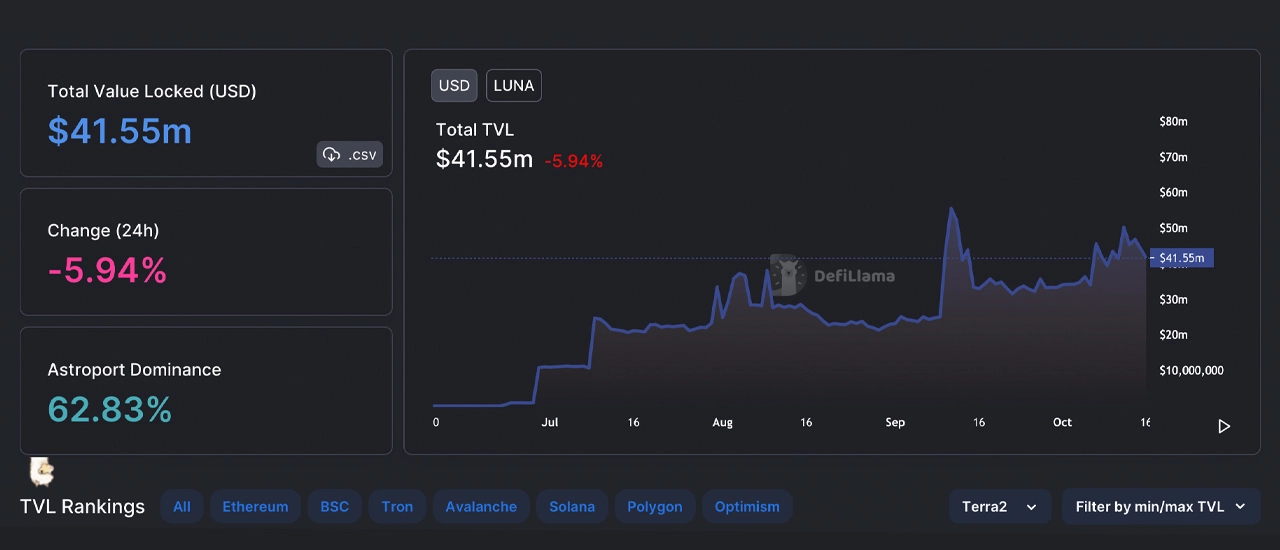
Total value locked on the Terra Phoenix blockchain on October 16, 2022, according to defillama.com metrics.

For instance, LUNC is trading for less than a U.S. penny at $0.00025948 per unit which is a lot lower than the $88 per coin recorded on April 28, and much lower than the coin’s all-time high at $119 per unit recorded two week’s prior. In terms of the new Terra Phoenix blockchain’s native asset which now leverages the name luna (LUNA), it’s down 86.2% lower than the $18.87 all-time high recorded five months ago. The Terra Phoenix chain’s defi TVL, however, has seen growth during the last five months as it has swelled by 12,151% since the end of June.
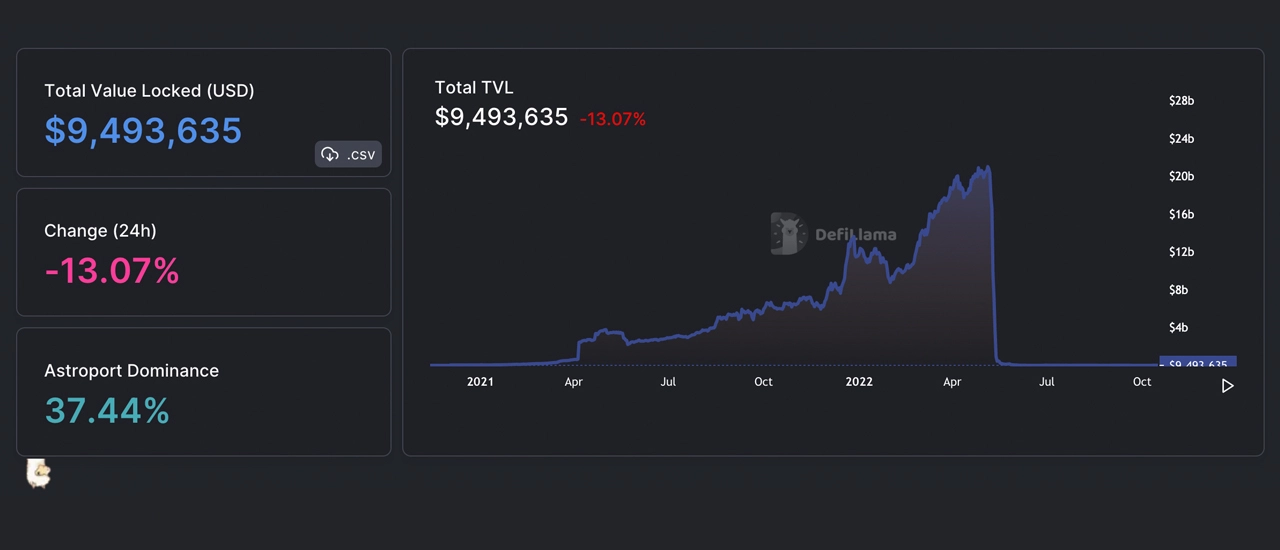
Total value locked on the Terra classic blockchain on October 16, 2022, according to defillama.com metrics.

At that time, the TVL was $350,174 and since then it has grown to $41.55 million. While the Terra classic chain held $29.29 billion last April, it’s now just under $10 million today at approximately $9,493,635. While Astroport and Terraswap have roughly $3.5 million, the defi lending protocol Anchor has around $1.6 million.
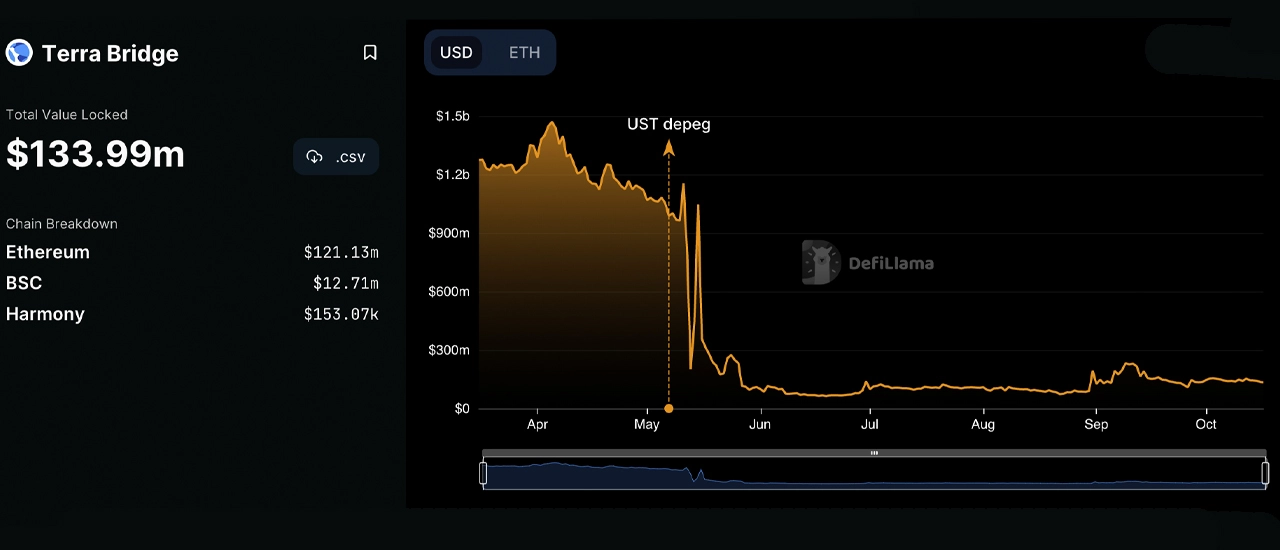
Total value locked on the Terra Bridge on October 16, 2022, according to defillama.com metrics.

On the Phoenix chain, in terms of TVL held in defi, the decentralized exchange (dex) app Astroport holds around $27.55 million, followed by Risk Harbor’s $14.76 million. Stader, Spectrum Protocol, and Eris Protocol follow Astroport and Risk Harbor respectively in terms of TVL statistics. Furthermore, while the Terra Bridge once held $1.4 billion during the first week of April, today the Terra Bridge holds around $132 million in value.

In terms of non-fungible token sales, the new Terra chain’s sales data is not documented as well as the classic chain’s NFT sales before the collapse. Despite the extremely low number of sales, Terra Phoenix chain is supported by more than a half dozen NFT marketplaces. In terms of the total value between the two native coins LUNC and LUNA, Terra’s blockchain assets between the classic and Phoenix chain is roughly $2.18 billion on October 16, 2022, at 3:00 p.m. (ET).

Terraclassicusd (USTC) is trading for more than a U.S. penny today, at $0.03 per unit on October 16, 2022, with a market valuation of around $378.49 million. The statistics show that at least for today, the crypto market values USTC, LUNA, and LUNC at roughly $2.558 billion, and all three of these crypto assets are incorporated into the TVL held on both chains.

While $2.558 billion is a lot for a blockchain ecosystem that collapsed, it’s still a shell of the $49.26 billion in value LUNC and USTC used to be worth prior to the blockchain’s fallout on May 7, 2022. In fact, the USD value of LUNA, LUNC, and USTC today is 94.82% less than LUNC’s and USTC’s U.S. dollar value before Terra’s market crash.

Related Reads

Podcast Notes: Hyperliquid Has Become the Top Interest Point for Traditional Hedge Funds

Empire Podcast hosts Jason Yanowitz and Santiago Santos discuss the surging institutional interest in Hyperliquid, a decentralized perpetual exchange, marking the highest level of engagement from traditional hedge fund managers since Paul Tudor Jones endorsed Bitcoin in 2020. The primary driver is the demand for weekend trading of commodities like oil, especially during geopolitical tensions such as the Iran conflict, as Hyperliquid provides the only active price discovery venue when traditional markets are closed. Trade XYZ, a front-end on Hyperliquid, has seen significant growth, with weekend oil price predictions having a median error of only 50 basis points. Santos predicts commodity trading volume on Hyperliquid will surpass Bitcoin within the year and that its market cap could rise from $25 billion to $100 billion. Other key points include Kraken raising $200 million at a reduced valuation of $13.3 billion, and the SEC clarifying that self-custodied DeFi frontends like MetaMask are not subject to broker-dealer rules, resolving a major regulatory uncertainty. The hosts also note the strong correlation between crypto and macro markets, with the S&P 500 posting one of its best 10-day rallies since 1950. They highlight MicroStrategy's continued Bitcoin acquisitions and the potential of real-world asset (RWA) tokenization as a key trend. The discussion concludes with skepticism towards many L2 projects, predicting a wave of protocols truly going to zero as capital concentrates in proven assets like Bitcoin and Hyperliquid.

marsbit3h ago

Podcast Notes: Hyperliquid Has Become the Top Interest Point for Traditional Hedge Funds

marsbit3h ago

a16z: The Next Frontier of AI, The Triple Flywheel of Robotics, Autonomous Science, and Brain-Computer Interfaces

a16z presents a comprehensive investment thesis for the next frontier of AI: Physical AI, centered on a synergistic flywheel of robotics, autonomous science, and novel human-computer interfaces (HCIs) like brain-computers. While the current AI paradigm scales on language and code, the most disruptive future capabilities will emerge from three adjacent fields leveraging five core technical primitives: 1) learned representations of physical dynamics (via models like VLA, WAM, and native embodied models), 2) embodied action architectures (e.g., dual-system designs, diffusion-based motion generation, and RL fine-tuning like RECAP), 3) simulation and synthetic data as scaling infrastructure, 4) expanded sensory channels (touch, neural signals, silent speech, olfaction), and 5) closed-loop agent systems for long-horizon tasks. These primitives converge to power three key domains: * **Robotics:** The literal embodiment of AI, requiring all primitives for real-world physical interaction and manipulation. * **Autonomous Science:** Self-driving labs that conduct hypothesis-experiment-analysis loops, generating structured, causally-grounded data to improve physical AI models. * **Novel HCIs:** Devices (AR glasses, EMG wearables, BCIs) that expand human-AI bandwidth and act as massive data-collection networks for real-world human experience. These domains form a mutually reinforcing flywheel: Robotics enable autonomous labs, which in turn generate valuable data for robotics and materials science. New interfaces provide rich human-physical interaction data to train better robots and scientists. Together, they represent a new scaling axis for AI, moving beyond the digital realm to interact with and learn from physical reality, promising significant emergent capabilities and value.

marsbit3h ago

a16z: The Next Frontier of AI, The Triple Flywheel of Robotics, Autonomous Science, and Brain-Computer Interfaces

marsbit3h ago

Conversation with Bitwise Advisor: From K-Shaped Economy to AI Taking Jobs, How Can Bitcoin Save the Younger Generation?

Jeff Park, a macro strategist and advisor at Bitwise, argues that the traditional financial system is broken, particularly for young generations. He describes a "K-shaped economy" where asset inflation enriches the wealthy while leaving others behind, with unaffordable housing as a key symptom. Park explains that real estate is often a depreciating asset due to maintenance costs and taxes, yet it remains unattainable for many young people due to distorted demand from global capital flows. He proposes Bitcoin as a superior store of value—scarce, portable, and free from maintenance costs or excessive taxation. By diverting capital away from real estate, Bitcoin could help lower housing prices and increase accessibility. Park also discusses the decline of traditional "smart investing" (e.g., value stocks) and the rise of "ideological investing" in non-correlated assets like crypto, luxury goods, and collectibles. On AI, Park warns it could trigger extreme social inequality by eliminating jobs while boosting corporate profits. He believes this will push younger generations toward Bitcoin, not only as a hedge but also as a symbol of decentralization and data sovereignty—offering an alternative to centralized AI systems that use personal data without fair compensation. He advises a diversified portfolio with Bitcoin as a core holding to hedge against currency devaluation and systemic risk.

marsbit5h ago

Conversation with Bitwise Advisor: From K-Shaped Economy to AI Taking Jobs, How Can Bitcoin Save the Younger Generation?

marsbit5h ago

Trading

Spot
Futures

Hot Articles

How to Buy NFT

Welcome to HTX.com! We've made purchasing AINFT (NFT) simple and convenient. Follow our step-by-step guide to embark on your crypto journey.Step 1: Create Your HTX AccountUse your email or phone number to sign up for a free account on HTX. Experience a hassle-free registration journey and unlock all features.Get My AccountStep 2: Go to Buy Crypto and Choose Your Payment MethodCredit/Debit Card: Use your Visa or Mastercard to buy AINFT (NFT) instantly.Balance: Use funds from your HTX account balance to trade seamlessly.Third Parties: We've added popular payment methods such as Google Pay and Apple Pay to enhance convenience.P2P: Trade directly with other users on HTX.Over-the-Counter (OTC): We offer tailor-made services and competitive exchange rates for traders.Step 3: Store Your AINFT (NFT)After purchasing your AINFT (NFT), store it in your HTX account. Alternatively, you can send it elsewhere via blockchain transfer or use it to trade other cryptocurrencies.Step 4: Trade AINFT (NFT)Easily trade AINFT (NFT) on HTX's spot market. Simply access your account, select your trading pair, execute your trades, and monitor in real-time. We offer a user-friendly experience for both beginners and seasoned traders.

6.0k Total ViewsPublished 2024.03.29Updated 2025.12.26

How to Buy NFT

What is Altura NFT?

Altura: Providing One-Stop NFT Solutions for Game Developers

55.7k Total ViewsPublished 2024.06.12Updated 2024.06.12

What is Altura NFT?

What is AINFT

EternaFi Agents and $AINFT: A Comprehensive Analysis of AI-Powered NFT Infrastructure in the Web3 Ecosystem The intersection of artificial intelligence (AI) and blockchain technology is rapidly evolving, establishing innovative platforms that redefine ownership models and economic participation. EternaFi Agents, along with its native token $AINFT, exemplifies a groundbreaking approach to the tokenization of AI infrastructures through the means of non-fungible tokens (NFTs). Launched in July 2025 by the development team at Nova Club, EternaFi merges the advancements of AI with the decentralized financial mechanisms of blockchain, presenting a unique investment opportunity for participants within the web3 ecosystem. This article aims to provide an in-depth assessment of EternaFi Agents, covering its core components, functionality, and significance within the crypto landscape. Introduction and Project Overview EternaFi Agents stands as a salient example of how blockchain technology can democratize access to advanced AI capabilities. The project endeavors to reshape the paradigm of AI ownership by diversifying economic participation, making sophisticated AI systems accessible to a larger pool of stakeholders. At its core, the project tokenizes a proprietary large language model (LLM) developed by Nova Club, allowing NFT holders to gain fractional exposure to the model's economic performance. By utilizing NFTs representing stakes in the LLM, EternaFi Agents fosters a model wherein stakeholders not only participate in AI service consumption but also enjoy sharing in the economic rewards generated by the platform. This transformative approach enables the development of sustainable revenue models for AI services, all the while promoting broad community engagement and facilitating transparent governance. What is EternaFi Agents? EternaFi Agents represents an AI-NFT infrastructure project that aims to blend the capabilities of AI with blockchain technology in a coherent ecosystem. The essential feature of this project is the creation of NFTs that serve as financial instruments, representing fractions of ownership in Nova Club's proprietary AI infrastructure. Each NFT symbolizes direct exposure to the economic performance of the underlying AI system, providing a lucrative opportunity for investors. The project operates on the Base blockchain, known for its scalability and efficiency, thus ensuring manageable transaction costs while facilitating a seamless operational experience. One of the notable features includes a revenue-sharing mechanism, wherein NFT holders can receive portions of subscription income generated by the AI services provided on the platform. This innovative approach establishes a connection between the success of the AI services and the economic dividends distributed among the holders, thus ensuring an alignment of interests across the community. Who is the Creator of EternaFi Agents? The creative force behind EternaFi Agents is Nova Club, a development team based in Singapore proficient in the amalgamation of AI and blockchain technology. Their prior experience in AI development and cryptocurrency analysis gives credence to the project, contributing a breadth of expertise to the creation of EternaFi Agents. Nova Club’s mission centers on democratizing access to cutting-edge AI technologies while building sustainable economic models that benefit users alongside developers. Their commitment to transparency, community governance, and innovation is reflected in the design and implementation of the EternaFi platform, aiming to establish a unique ecosystem that fosters positive engagement and long-term value creation. Who are the Investors of EternaFi Agents? The specific details concerning investors or investment organizations backing EternaFi Agents are not publicly available. However, EternaFi has adopted an inclusive approach to funding its development through the sale of NFTs to the public, allowing a wide array of participants to invest in the ecosystem. The project’s architecture ensures that core infrastructure is funded responsibly while allowing community members to partake in the ownership and economic returns generated from the AI services. This model emphasizes community engagement by aligning the interests of investors and project developers, creating a collaborative environment where long-term participation is incentivized. How Does EternaFi Agents Work? EternaFi Agents operates through a multifaceted ecosystem where NFTs serve as a primary means of ownership representation within the project. Each NFT holder is entitled to a share of the monthly subscription income produced by the underlying AI-powered platform, thereby positioning NFT ownership as a lucrative investment vehicle. Revenue Generation Mechanism The primary source of revenue generation for the EternaFi platform stems from subscription fees related to the AI services provided. Users can access various tiered services, ranging from basic market analysis tools to comprehensive AI-assisted trading solutions. These services are monetized and form the basis for the revenue-sharing framework, which distributes profits to NFT holders through automated smart contracts. An innovative feature of the EternaFi ecosystem is the revenue-sharing mechanism that operates transparently, ensuring that rewards are allocated based on verifiable metrics from the AI platform's operations. This creates a direct link between the performance of AI services and the returns available to community investors, establishing a sustainable economic model. Staking and Vesting Mechanisms Participants within EternaFi can engage in staking their NFTs to unlock additional economic benefits. The vesting schedule is designed to promote long-term commitment among participants, rewarding those who exhibit ongoing support for the project. This ensures a robust alignment of interests and fosters a sense of community engagement essential for achieving the project's long-term goals. Transparent Governance EternaFi Agents embraces decentralized governance, allowing NFT holders to play an active role in decision-making regarding the platform's development and future directions. The governing structure includes community voting mechanisms, providing NFT holders with the opportunity to influence significant decisions and contributing to a collaborative approach to project growth. Timeline of EternaFi Agents The development trajectory of EternaFi Agents showcases a systematic approach toward building a sustainable AI infrastructure while meeting the needs of community participants. Below is a timeline of important milestones in the project’s history: July 2025: Launch of EternaFi Agents, including the public sale of NFTs and deployment of the $AINFT token on the Base blockchain. Q4 2025: Establishment of market infrastructure including liquidity pools and launch of staking dashboards for NFT holders. 2026: Initiation of community engagement programs, expanding AI capabilities, and integration with cross-chain technologies. Q4 2026: Implementation of the dividend distribution system, allowing NFT holders to reap economic benefits from their investments. These milestones signify the focus on establishing a functional and participative ecosystem while ensuring continuous evolution to meet market demands. Technological Infrastructure and Blockchain Integration EternaFi Agents is anchored in an advanced technological framework combining AI systems with blockchain capabilities. Operating on the Base blockchain, the project leverages the advantages of scalability and low transaction costs. The underlying smart contract architecture governs the NFT ownership, revenue sharing, and community management features, ensuring efficiency and transparency. AI System Development The proprietary large language model underpinning EternaFi Agents has been independently developed and designed to cater to revenue-generating applications without reliance on proprietary external frameworks. This endeavor reflects a commitment to creating a versatile and adaptable AI infrastructure capable of delivering meaningful services to users, thus generating economic value for investors. Security Measures The robustness of EternaFi’s security infrastructure is paramount. Regular audits and stringent security measures ensure the integrity of the AI systems and blockchain mechanisms, safeguarding against potential vulnerabilities while fostering confidence among participants. Conclusion EternaFi Agents signifies a landmark innovation within the realm of artificial intelligence and blockchain technology, opening avenues for community ownership and economic participation in advanced AI capabilities. The project’s comprehensive strategy to tokenize AI infrastructure via NFTs establishes a precedent for future decentralized ecosystems. By harmonizing technical sophistication with user-centric economic models, EternaFi not only fosters engagement but also generates a sustainable revenue-sharing framework for community participants. The significance of EternaFi extends well beyond its operational success as it exemplifies how blockchain can democratize cutting-edge AI technologies, paving the way for future ventures in this intersectional space. The evolution of EternaFi Agents may herald a new era of AI development characterized by participant-driven governance, sustainable economic models, and transparent verification, ultimately contributing to the broader democratization of AI and technology accessibility across industries.

3.6k Total ViewsPublished 2025.08.14Updated 2025.08.14

What is AINFT

Discussions

Welcome to the HTX Community. Here, you can stay informed about the latest platform developments and gain access to professional market insights. Users' opinions on the price of NFT (NFT) are presented below.

活动图片