Dappradar’s Q3 Industry Report Shows Crypto Economy and Participants Are ‘Riding Out the Bear Market’

newsbtcPublished on 2022-10-08Last updated on 2022-10-08

Abstract

According to Dappradar’s latest crypto industry report that covers 2022’s third quarter, the crypto economy and its participants are “riding out the bear market.”

Dappradar’s Q3 Industry Report Shows Crypto Economy and Participants Are ‘Riding Out the Bear Market’

Dappradar’s Q3 Industry Report Shows Crypto Economy and Participants Are ‘Riding out the Bear Market’

According to Dappradar’s latest crypto industry report that covers 2022’s third quarter, the crypto economy and its participants are “riding out the bear market.” However, these days a number of macroeconomic events have influenced the crypto market, and Dappradar researchers say it’s currently “impossible to foresee a worldwide expansion of cryptocurrencies without a general recovery in conventional financial markets.”

Dappradar Report Highlights Crypto Economy’s Slow but Steady Recovery

The crypto industry is still dealing with the crypto winter and the latest report from Dappradar indicates that markets and participants are trucking through the storm. For instance, following the Terra collapse, the decentralized finance (defi) and decentralized app (dapp) industry has consolidated after taking heavy losses.

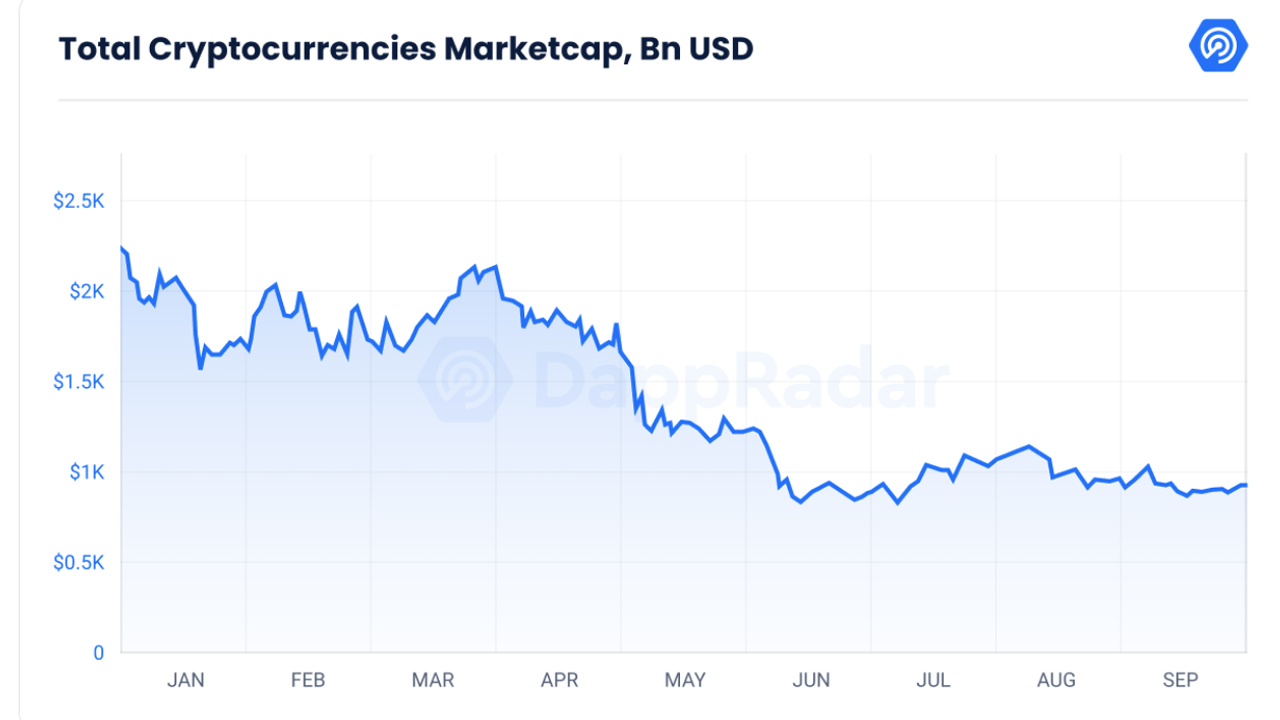
Dappradar’s report shows that bitcoin (BTC) and ethereum (ETH) have remained roughly around the same price since the end of June, but the two leading crypto assets have a high correlation with equity markets.
Dappradar’s Q3 Industry Report Shows Crypto Economy and Participants Are ‘Riding Out the Bear Market’

“In Q3, the correlation between BTC and the S&P 500 increased, showing that investors still consider cryptos in the same category as risky stocks,” Dappradar’s researcher Sara Gherghelas details.

Moreover, while Ethereum’s transition from proof-of-work to proof-of-stake via The Merge pushed prices up, crypto markets “cooled down after the event.” Moreover, while Dappradar’s Gherghelas says The Merge was a technical success, a 36% drop in layer two (L2) transactions was recorded.
Dappradar’s Q3 Industry Report Shows Crypto Economy and Participants Are ‘Riding Out the Bear Market’

Despite the overall crypto market performance, technology adoption saw a significant upswing. “In July, Polygon and Nothing company announced a partnership to build a Web3-native smartphone, while Disney, Ticketmaster, Mastercard, and Starbucks became the latest leading brands to announce the integration of NFTs as part of their Web3 strategy,” Dappradar’s Q3 report further notes.

According to the Dappradar researchers, $428.71 million in losses were recorded during 2022’s third quarter. Most of the losses were stolen from Nomad Bridge, Dappradar explains, as $190 million was siphoned away from the bridge.

“On a positive note, these figures indicate a decline of 62.9% compared to the third quarter of 2021, when hackers and fraudsters stole $1,155,334,775,” Dappradar’s researchers add. During the last quarter, the study notes that in general, the defi ecosystem has shown improvement.

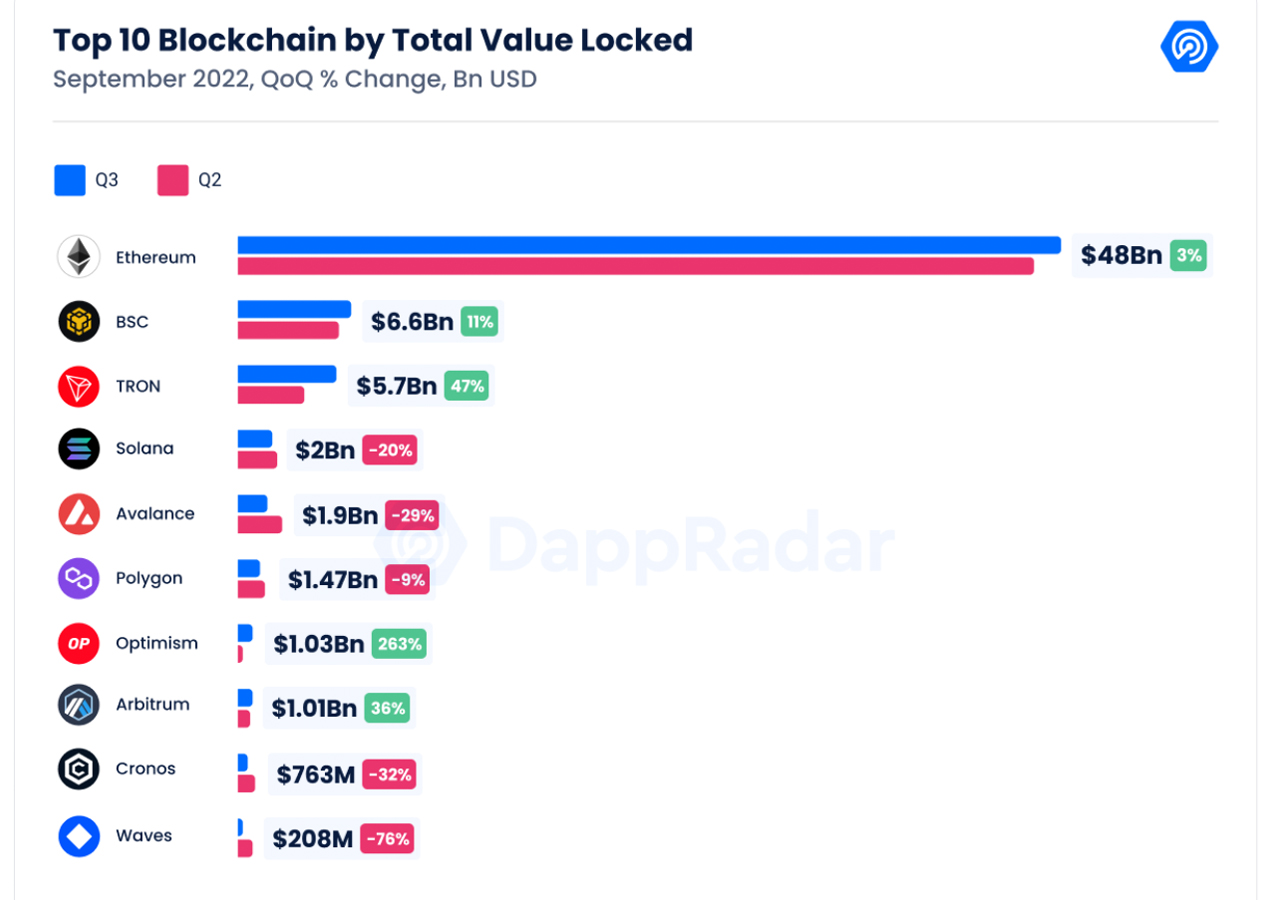
“Defi as a whole showed signs of recovery with a 2.9% growth in TVL [total value locked] from Q2,” Dappradar’s study notes. “Ethereum remains the most dominant chain with its dominance increasing to 69% with $48 billion, a 3.17% growth from Q2.”
Dappradar’s Q3 Industry Report Shows Crypto Economy and Participants Are ‘Riding Out the Bear Market’

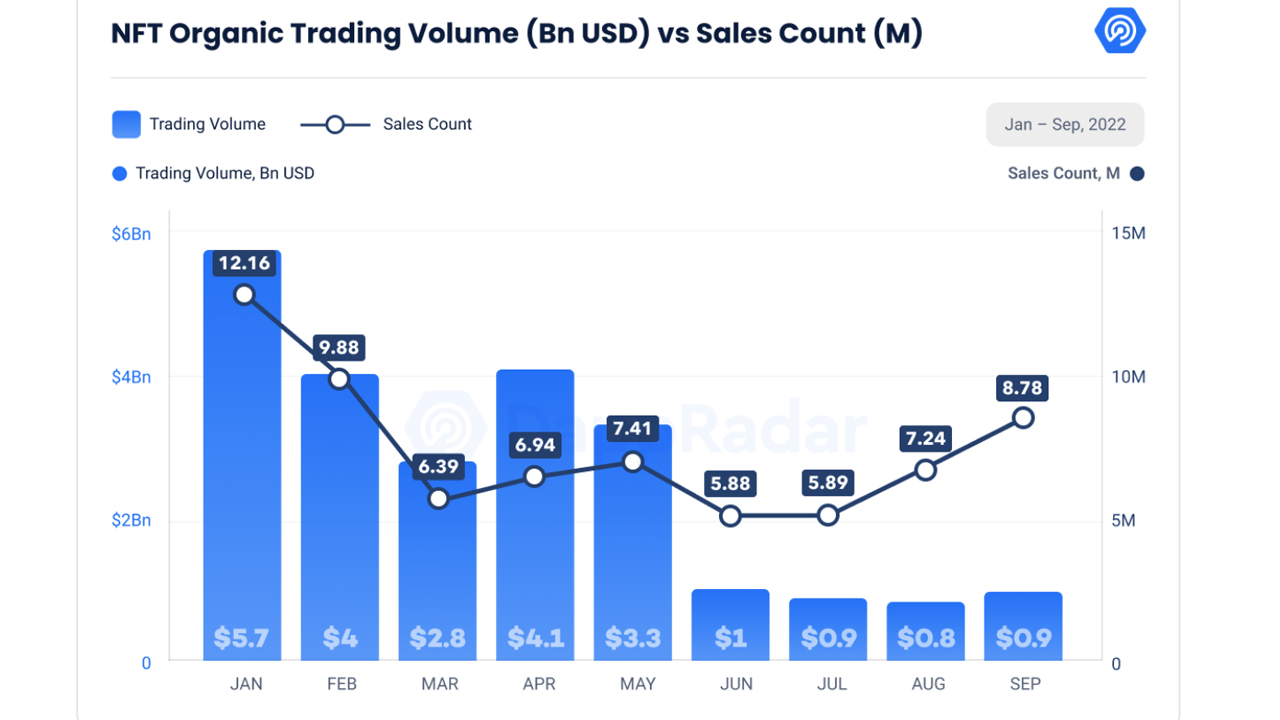
While the defi ecosystem and crypto economy as a whole saw declines in the third quarter, non-fungible token markets also recorded a decline in trading volume activity. Dappradar’s research shows NFT trade volume is down 67% but NFT sales volume increased 8.3% higher from Q2.

“The rise in sales indicates that the NFT business continues to be in great demand, whereas overall the drop in trading volume may be attributable to the decline in cryptocurrency values,” Dappradar’s research report suggests.

Dappradar’s report concludes that the global economy is dealing with “extreme challenges” and in some people’s opinions, the tides may get worse. The researchers note that it’s possible “we may be in the beginning phase of the crisis” but when the tides do turn, a bullish runup will eventually materialize.

“Undoubtedly, a further bull run will occur, and it may be much stronger than the last one,” the Dappradar report’s closing statements detail. “Each time the market has difficulties, it eventually becomes stronger, and the quality of initiatives increases.”

Trending Cryptos

Related Reads

Soaring Export Data for Memory Chips, Market Is Redefining the Valuation Anchor for Memory Stocks

Korean storage export data for the first 20 days of June shows substantial year-on-year increases in both value and price-per-kilogram for categories like DRAM, NAND, and SSDs. This signals a potential shift beyond simple demand recovery, indicating rising prices and a product mix shift towards higher-value items, possibly influenced by AI infrastructure needs. A key point is that the surge in price-per-kilogram is not simply a uniform chip price hike. It reflects a combination of actual price increases and, more importantly, an export structure increasingly dominated by high-value-density products like HBM (High-Bandwidth Memory) and advanced DRAM, which are critical for AI servers. This suggests AI-driven demand may be spilling over from just HBM into broader memory markets. SK Hynix stands to benefit directly due to its leading HBM position. For Samsung and Micron, the implication is potential for greater margin elasticity if the tightness in high-end memory spreads to enterprise SSD and NAND prices. However, the storage sector remains cyclical. Risks include supply expansion, inventory changes, and potential slowdowns in broader AI capital expenditure. Ultimately, while the strong export data supports upward revisions for storage company earnings and fuels discussion of an "AI infrastructure bottleneck premium," a definitive valuation shift from a cyclical to a structural story depends on upcoming quarterly reports. Investors need confirmation from SK Hynix, Samsung, and Micron that improvements in average selling prices, product mix, and, crucially,毛利率 are sustained over multiple quarters.

marsbit1h ago

Soaring Export Data for Memory Chips, Market Is Redefining the Valuation Anchor for Memory Stocks

marsbit1h ago

Why Does SpaceX Have Such a High Valuation Ceiling? The Answer Lies in Musk's Business Blueprint

SpaceX achieved a record-breaking IPO on June 12, 2026, with its market cap surging past $2.1 trillion. This valuation reflects its central role within Elon Musk's expansive, interconnected technological ecosystem. The article details how four core components form a synergistic closed-loop system: 1) **The "Brain" (xAI & Orbital Compute):** xAI provides AI models and massive ground/space-based supercomputing for simulation and decision-making across the system. 2) **The "Neural Logistics Core" (Starlink & Starship):** Starlink's low-latency satellite network enables global data transmission, while Starship's low-cost, reusable launch capacity aims to make large-scale space deployment economically viable. 3) **The "Physical Body" (Tesla & Optimus):** Tesla's manufacturing prowess and energy products support hardware production and power, pivoting toward mass-producing the Optimus humanoid robot for terrestrial and potential space-based labor. 4) **The "Human Interface" (Neuralink & X):** Neuralink seeks direct brain-computer communication, and the X platform provides real-time societal data. Together, these elements create three reinforcing "flywheels": manufacturing/logistics, data-driven iteration, and energy/compute/network synergy. This integrated approach promises lower costs, faster innovation cycles, and potential infrastructure-as-a-service offerings. However, it also concentrates technical, regulatory, and corporate governance risks. Ultimately, SpaceX's high valuation stems from its position as the indispensable infrastructural backbone—handling space transport, global communications, and future orbital computing—tying together Musk's entire vision for a self-reinforcing technological empire.

marsbit1h ago

Why Does SpaceX Have Such a High Valuation Ceiling? The Answer Lies in Musk's Business Blueprint

marsbit1h ago

Snap, Unprofitable for Nine Years, and a Decade-Long AR Obsession Without Return

Snap's AR Obsession: A Decade of Betting Against the Odds On June 16, Snap CEO Evan Spiegel unveiled the new AR glasses, Specs, priced at $2,195, causing the company's stock (SNAP) to plummet nearly 10%. The launch was met with intense criticism online, with investors questioning why a consistently unprofitable company would stake its future on an expensive product its core young user base can't afford. Snapchat, known for pioneering features like ephemeral Stories and popular AR lenses (like the iconic dog filter), has a history of innovation often copied by rivals like Instagram and Meta. Despite this, it has struggled to translate first-mover advantage into commercial success. Since its 2017 IPO, Snap has reported annual net losses, with a Q1 2026 loss of $89 million. Its stock is down 94% from its 2021 peak, hampered by iOS privacy changes, competition, and a young demographic less attractive to major advertisers. In this challenging context, Spiegel is doubling down on AR. He calls 2026 a "crucible moment," having recently laid off 16% of staff while reportedly investing over $3.5 billion cumulatively in its AR glasses line over nearly a decade. The new Specs represent a significant leap from the 2016 camera-focused Spectacles, offering true AR overlays, gesture control, and standalone operation. However, at $2,195, it faces tough comparisons. While more advanced than Meta's $799 Ray-Ban smart glasses, critics point to its heavier weight, short battery life, and features largely replicable by a smartphone. Facing pressure from investors to cut losses on the Specs project, Spiegel has refused, framing it as essential to Snap's long-term vision. The company finds itself in a paradoxical position: cutting costs while heavily funding a decade-long, unproven bet. Some see Specs as an awkward but necessary step in AR's evolution, akin to early mobile phones. Whether Spiegel is a visionary outlier or a gambler destined to fail remains an open question, highlighting the tension between long-term ambition and short-term market demands.

marsbit1h ago

Snap, Unprofitable for Nine Years, and a Decade-Long AR Obsession Without Return

marsbit1h ago

Annualized Revenue Exceeds $20 Billion, Kalshi Aims to Become the First Prediction Platform IPO?

Kalshi, a leading U.S. prediction markets platform, is reportedly in early, informal discussions for an Initial Public Offering (IPO). The company's annualized revenue now exceeds $2 billion, fueled by its dominance of over 90% of the domestic prediction market activity. This growth stems from a surge in trading volume—reaching a total of $52.7 billion—and an increase in fee rates, largely driven by sports event contracts like the NBA playoffs and the 2026 FIFA World Cup. Monthly active users are approximately 2 million. Kalshi recently raised $1 billion in a funding round led by Coatue Management, valuing the company at $22 billion. It has also expanded its offerings to include Bitcoin perpetual contracts and plans to launch a dedicated trading platform, Kalshi Pro. However, Kalshi's path to an IPO faces significant regulatory hurdles. The core risk involves jurisdictional conflicts, as multiple U.S. states are challenging its operations under local gambling laws. For instance, Arizona has filed criminal charges against the platform, while states like Kentucky have filed lawsuits. Kalshi and the Commodity Futures Trading Commission (CFTC) argue that its event contracts fall under exclusive federal jurisdiction as "swaps." The outcomes of these ongoing legal battles could critically impact Kalshi's core revenue and its IPO timeline. Analysts suggest that while an IPO could theoretically occur by late 2026, a more likely timeframe is late 2027 or 2028, contingent on resolving legal issues and favorable market conditions. If successful, its fundraising could significantly exceed $1 billion, given its current valuation and revenue multiple.

Foresight News2h ago

Annualized Revenue Exceeds $20 Billion, Kalshi Aims to Become the First Prediction Platform IPO?

Foresight News2h ago

Trading

Spot
Futures

Hot Articles

How to Buy NFT

Welcome to HTX.com! We've made purchasing AINFT (NFT) simple and convenient. Follow our step-by-step guide to embark on your crypto journey.Step 1: Create Your HTX AccountUse your email or phone number to sign up for a free account on HTX. Experience a hassle-free registration journey and unlock all features.Get My AccountStep 2: Go to Buy Crypto and Choose Your Payment MethodCredit/Debit Card: Use your Visa or Mastercard to buy AINFT (NFT) instantly.Balance: Use funds from your HTX account balance to trade seamlessly.Third Parties: We've added popular payment methods such as Google Pay and Apple Pay to enhance convenience.P2P: Trade directly with other users on HTX.Over-the-Counter (OTC): We offer tailor-made services and competitive exchange rates for traders.Step 3: Store Your AINFT (NFT)After purchasing your AINFT (NFT), store it in your HTX account. Alternatively, you can send it elsewhere via blockchain transfer or use it to trade other cryptocurrencies.Step 4: Trade AINFT (NFT)Easily trade AINFT (NFT) on HTX's spot market. Simply access your account, select your trading pair, execute your trades, and monitor in real-time. We offer a user-friendly experience for both beginners and seasoned traders.

7.1k Total ViewsPublished 2024.03.29Updated 2026.06.02

How to Buy NFT

What is Altura NFT?

Altura: Providing One-Stop NFT Solutions for Game Developers

56.0k Total ViewsPublished 2024.06.12Updated 2024.06.12

What is Altura NFT?

What is AINFT

EternaFi Agents and $AINFT: A Comprehensive Analysis of AI-Powered NFT Infrastructure in the Web3 Ecosystem The intersection of artificial intelligence (AI) and blockchain technology is rapidly evolving, establishing innovative platforms that redefine ownership models and economic participation. EternaFi Agents, along with its native token $AINFT, exemplifies a groundbreaking approach to the tokenization of AI infrastructures through the means of non-fungible tokens (NFTs). Launched in July 2025 by the development team at Nova Club, EternaFi merges the advancements of AI with the decentralized financial mechanisms of blockchain, presenting a unique investment opportunity for participants within the web3 ecosystem. This article aims to provide an in-depth assessment of EternaFi Agents, covering its core components, functionality, and significance within the crypto landscape. Introduction and Project Overview EternaFi Agents stands as a salient example of how blockchain technology can democratize access to advanced AI capabilities. The project endeavors to reshape the paradigm of AI ownership by diversifying economic participation, making sophisticated AI systems accessible to a larger pool of stakeholders. At its core, the project tokenizes a proprietary large language model (LLM) developed by Nova Club, allowing NFT holders to gain fractional exposure to the model's economic performance. By utilizing NFTs representing stakes in the LLM, EternaFi Agents fosters a model wherein stakeholders not only participate in AI service consumption but also enjoy sharing in the economic rewards generated by the platform. This transformative approach enables the development of sustainable revenue models for AI services, all the while promoting broad community engagement and facilitating transparent governance. What is EternaFi Agents? EternaFi Agents represents an AI-NFT infrastructure project that aims to blend the capabilities of AI with blockchain technology in a coherent ecosystem. The essential feature of this project is the creation of NFTs that serve as financial instruments, representing fractions of ownership in Nova Club's proprietary AI infrastructure. Each NFT symbolizes direct exposure to the economic performance of the underlying AI system, providing a lucrative opportunity for investors. The project operates on the Base blockchain, known for its scalability and efficiency, thus ensuring manageable transaction costs while facilitating a seamless operational experience. One of the notable features includes a revenue-sharing mechanism, wherein NFT holders can receive portions of subscription income generated by the AI services provided on the platform. This innovative approach establishes a connection between the success of the AI services and the economic dividends distributed among the holders, thus ensuring an alignment of interests across the community. Who is the Creator of EternaFi Agents? The creative force behind EternaFi Agents is Nova Club, a development team based in Singapore proficient in the amalgamation of AI and blockchain technology. Their prior experience in AI development and cryptocurrency analysis gives credence to the project, contributing a breadth of expertise to the creation of EternaFi Agents. Nova Club’s mission centers on democratizing access to cutting-edge AI technologies while building sustainable economic models that benefit users alongside developers. Their commitment to transparency, community governance, and innovation is reflected in the design and implementation of the EternaFi platform, aiming to establish a unique ecosystem that fosters positive engagement and long-term value creation. Who are the Investors of EternaFi Agents? The specific details concerning investors or investment organizations backing EternaFi Agents are not publicly available. However, EternaFi has adopted an inclusive approach to funding its development through the sale of NFTs to the public, allowing a wide array of participants to invest in the ecosystem. The project’s architecture ensures that core infrastructure is funded responsibly while allowing community members to partake in the ownership and economic returns generated from the AI services. This model emphasizes community engagement by aligning the interests of investors and project developers, creating a collaborative environment where long-term participation is incentivized. How Does EternaFi Agents Work? EternaFi Agents operates through a multifaceted ecosystem where NFTs serve as a primary means of ownership representation within the project. Each NFT holder is entitled to a share of the monthly subscription income produced by the underlying AI-powered platform, thereby positioning NFT ownership as a lucrative investment vehicle. Revenue Generation Mechanism The primary source of revenue generation for the EternaFi platform stems from subscription fees related to the AI services provided. Users can access various tiered services, ranging from basic market analysis tools to comprehensive AI-assisted trading solutions. These services are monetized and form the basis for the revenue-sharing framework, which distributes profits to NFT holders through automated smart contracts. An innovative feature of the EternaFi ecosystem is the revenue-sharing mechanism that operates transparently, ensuring that rewards are allocated based on verifiable metrics from the AI platform's operations. This creates a direct link between the performance of AI services and the returns available to community investors, establishing a sustainable economic model. Staking and Vesting Mechanisms Participants within EternaFi can engage in staking their NFTs to unlock additional economic benefits. The vesting schedule is designed to promote long-term commitment among participants, rewarding those who exhibit ongoing support for the project. This ensures a robust alignment of interests and fosters a sense of community engagement essential for achieving the project's long-term goals. Transparent Governance EternaFi Agents embraces decentralized governance, allowing NFT holders to play an active role in decision-making regarding the platform's development and future directions. The governing structure includes community voting mechanisms, providing NFT holders with the opportunity to influence significant decisions and contributing to a collaborative approach to project growth. Timeline of EternaFi Agents The development trajectory of EternaFi Agents showcases a systematic approach toward building a sustainable AI infrastructure while meeting the needs of community participants. Below is a timeline of important milestones in the project’s history: July 2025: Launch of EternaFi Agents, including the public sale of NFTs and deployment of the $AINFT token on the Base blockchain. Q4 2025: Establishment of market infrastructure including liquidity pools and launch of staking dashboards for NFT holders. 2026: Initiation of community engagement programs, expanding AI capabilities, and integration with cross-chain technologies. Q4 2026: Implementation of the dividend distribution system, allowing NFT holders to reap economic benefits from their investments. These milestones signify the focus on establishing a functional and participative ecosystem while ensuring continuous evolution to meet market demands. Technological Infrastructure and Blockchain Integration EternaFi Agents is anchored in an advanced technological framework combining AI systems with blockchain capabilities. Operating on the Base blockchain, the project leverages the advantages of scalability and low transaction costs. The underlying smart contract architecture governs the NFT ownership, revenue sharing, and community management features, ensuring efficiency and transparency. AI System Development The proprietary large language model underpinning EternaFi Agents has been independently developed and designed to cater to revenue-generating applications without reliance on proprietary external frameworks. This endeavor reflects a commitment to creating a versatile and adaptable AI infrastructure capable of delivering meaningful services to users, thus generating economic value for investors. Security Measures The robustness of EternaFi’s security infrastructure is paramount. Regular audits and stringent security measures ensure the integrity of the AI systems and blockchain mechanisms, safeguarding against potential vulnerabilities while fostering confidence among participants. Conclusion EternaFi Agents signifies a landmark innovation within the realm of artificial intelligence and blockchain technology, opening avenues for community ownership and economic participation in advanced AI capabilities. The project’s comprehensive strategy to tokenize AI infrastructure via NFTs establishes a precedent for future decentralized ecosystems. By harmonizing technical sophistication with user-centric economic models, EternaFi not only fosters engagement but also generates a sustainable revenue-sharing framework for community participants. The significance of EternaFi extends well beyond its operational success as it exemplifies how blockchain can democratize cutting-edge AI technologies, paving the way for future ventures in this intersectional space. The evolution of EternaFi Agents may herald a new era of AI development characterized by participant-driven governance, sustainable economic models, and transparent verification, ultimately contributing to the broader democratization of AI and technology accessibility across industries.

4.1k Total ViewsPublished 2025.08.14Updated 2025.08.14

What is AINFT

Discussions

Welcome to the HTX Community. Here, you can stay informed about the latest platform developments and gain access to professional market insights. Users' opinions on the price of NFT (NFT) are presented below.

活动图片