$60B trading giant BlockFills hits ‘pause’ as ‘extreme fear’ takes over market

ambcryptoPublished on 2026-02-12Last updated on 2026-02-12

Abstract

BlockFills, a major Chicago-based crypto trading firm that handled over $60 billion in trades last year, has paused all client deposits and withdrawals due to extreme market instability. The decision follows Bitcoin’s sharp decline of nearly 25% to around $60,000, though trading on the platform remains active. The move has heightened investor anxiety, evoking memories of the 2022 crypto collapses. Despite Bitcoin’s slight recovery to $67,490, institutional clients face significant risk. Analysts note parallels to past market crashes but suggest Bitcoin may be oversold and poised for a rebound if key support levels hold. The situation underscores ongoing regulatory uncertainty and fragile market sentiment.

In high-risk crypto trading, BlockFills is a major Chicago-based firm that handled over $60 billion in trades last year. After a difficult week in the market, when Bitcoin [BTC] dropped by nearly 25% to around $60,000, the company decided to take urgent action.

The company has paused all client deposits and withdrawals, saying this is needed because of unstable market and financial conditions.

Even though clients can still trade on the platform, they cannot move money in or out right now. This has made many investors nervous, especially since the industry still remembers the major failures of 2022.

In 2025, the company was doing extremely well. It handled $61.1 billion in trades and worked with more than 2,000 institutional clients around the world.

However, things changed after the “October Crash” of 2025, when Bitcoin fell sharply from its record high of $124,500. Even though Bitcoin has now recovered slightly to about $67,490, the damage to big investors and lenders remains serious.

Community reactions

Needless to say, the crypto community reacted strongly to this incident, as noted by Walter Bloomberg.

“The move echoes past crypto downturns, including the 2022 collapse of FTX and other lenders. Bitcoin’s recent drop below $65,000—down ~45% from October highs—has intensified pressures, while stalled U.S. crypto legislation continues to weigh on the market.”

Usually, small retail traders suffer the most when crypto exchanges go down. On the contrary, the BlockFills situation is different.

This time, it is not about regular users panicking. Instead, it may be a serious problem for large institutions with big money at stake, according to Milk Road’s analysis.

How is this incident acting in favor of Bitcoin?

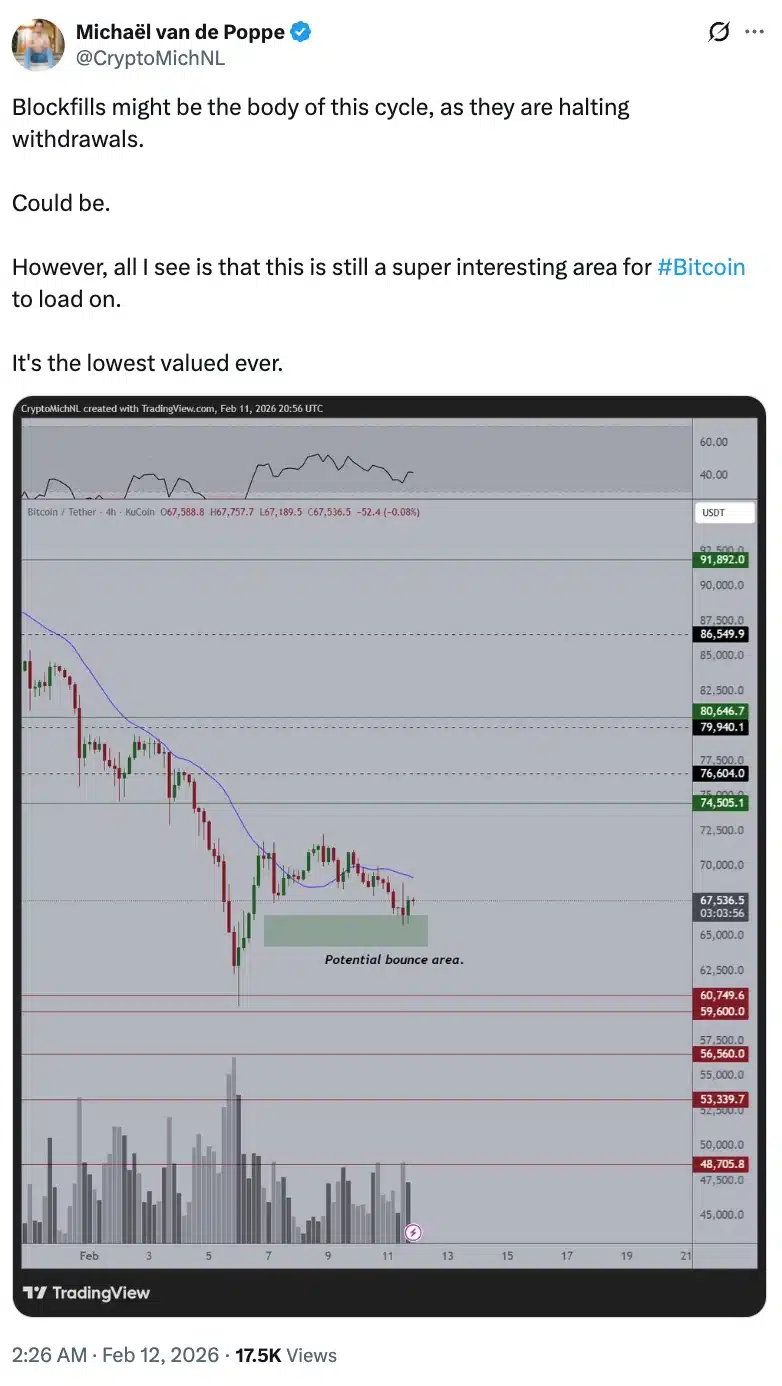
At the same time, there is some positive news due to this incident. Well-known analyst Michaël van de Poppe believes Bitcoin may be close to a strong turning point.

Even though Bitcoin is still around $67,490, he believes that market fear is extremely high right now. Recently, fear levels dropped to just 7 – A sign that many investors are worried.

Van de Poppe compared the current situation to the 2020 COVID crash, when prices fell sharply before recovering. He believes Bitcoin is now oversold and may be ready to bounce back.

If key support levels hold, BTC’s price could still move towards $100,000 in the coming months.

Source: Michaël van de Poppe/X
Former chairman of the National Vocational and Technical Training Commission, Javed Hassan, also weighed in. He noted,

“Thanks to Trump and his bandito family, this latest scam has full institutional respectability. Wall Street has adopted it. Yup, the same bunch of sharks who packaged subprime sh*t under exotic wrappers like: Mortgage-Backed Securities (MBS) , CDO, CDS, etc. Once again there’s the anything goes regulatory shrug.”

Past triggers

The pause in activity at BlockFills brings back memories of Celsius Network and Voyager Digital – Both of which collapsed after freezing user funds.

Binance [BNB] also experienced a similar situation in 2025, when it temporarily restricted withdrawals during market turmoil.

This coincided with recent data from Santiment as retail traders are full of doubt and fear right now. In fact, negative posts on social media are at a four-year high too.

Thus, for now, it is still unclear whether BlockFills is facing a small, temporary cash problem or something more serious. In the coming days, how open the company is with its 2,000+ institutional clients will matter the most.


Final Thoughts

  • Pausing withdrawals may protect the company in the short term, but it has clearly shaken investor confidence.
  • Memories of past failures like Celsius Network and Voyager Digital are making investors extra cautious.

Related Questions

QWhy did BlockFills pause all deposits and withdrawals?

ABlockFills paused all client deposits and withdrawals due to unstable market and financial conditions following a sharp drop in Bitcoin's price.

QHow much trading volume did BlockFills handle in 2025, and how many clients did it serve?

AIn 2025, BlockFills handled $61.1 billion in trades and worked with over 2,000 institutional clients worldwide.

QAccording to analyst Michaël van de Poppe, what does the current market fear level indicate for Bitcoin's price?

AMichaël van de Poppe believes the extreme fear, with levels dropping to just 7, indicates that Bitcoin is oversold and may be close to a strong turning point, potentially bouncing back towards $100,000 if key support levels hold.

QHow does the BlockFills situation differ from typical crypto exchange failures in terms of affected users?

AUnlike typical crypto exchange failures that most severely impact small retail traders, the BlockFills situation is primarily a problem for large institutions with significant money at stake.

QWhich past crypto company failures does the article mention as similar to the current BlockFills incident?

AThe article mentions that the pause in activity at BlockFills brings back memories of the collapses of Celsius Network and Voyager Digital, which also froze user funds before failing.

Related Reads

Lowering Expectations for BTC's Next Bull Market

The author, Alex Xu, explains his decision to significantly reduce his Bitcoin holdings (from full to ~30% of his portfolio) during the current bull cycle, citing a lowered long-term outlook for BTC's price appreciation in the next cycle. He outlines six key reasons for this reduced expectation: 1. **Diminished Growth Drivers:** The narrative of exponential user adoption has largely played out with institutional ETF adoption. The next major growth phase—adoption by sovereign national reserves or central banks—seems unlikely in the near future. 2. **Personal Opportunity Cost:** More attractive investment opportunities have emerged in other assets, such as undervalued companies. 3. **Industry-Wide Contraction:** The broader crypto industry is struggling, with most Web3 business models (SocialFi, GameFi, DePIN) failing. This overall萧条 (depression) reduces the fundamental demand and consensus for Bitcoin. 4. **Strain on Major Buyer:** MicroStrategy, a major corporate buyer of BTC, faces rising financing expenses for its debt, which could slow its purchasing rate and create significant marginal pressure on the market. 5. **Increased Competition from Gold:** The emergence of "tokenized gold" has closed the functional gap (portability, divisibility) between physical gold and Bitcoin, offering a strong competitor in the non-sovereign store-of-value space. 6. **Security Budget Concerns:** The block reward halving continues to exacerbate the long-standing issue of funding Bitcoin's network security, with new fee source explorations like Ordinals and L2s largely failing. The author's decision to hold a significant (though reduced) position reflects a cautious, not bearish, outlook. He remains open to increasing his exposure if the fundamental reasons for his skepticism change or if new positive catalysts emerge.

marsbit38m ago

Lowering Expectations for BTC's Next Bull Market

marsbit38m ago

Can Iran 'Control' the Strait of Hormuz?

Iran has announced a comprehensive plan to assert control over the strategic Strait of Hormuz, a critical global oil shipping chokepoint. The proposed measures include requiring all vessels to obtain Iranian permission for passage, imposing fees for security, environmental protection, and navigation management—preferably paid in Iranian rials—and absolutely banning Israeli ships. Vessels from countries deemed hostile by Iran’s top security bodies may also be barred. Analysts suggest Iran’s motives are multifaceted: increasing pressure on the U.S. and Israel by leveraging control over oil transit to influence global prices and inflation; creating a new revenue stream, potentially exceeding $7.7 billion annually, to counter Western sanctions and support postwar reconstruction; and using transit permissions as bargaining chips in future negotiations, notably with the U.S. However, the plan faces significant practical and diplomatic challenges. Enforcing comprehensive interception and fee collection in the busy waterway, patrolled by international military forces, would be difficult. The U.S. has already countering with a blockade of Iranian ports and threats to intercept any ship paying fees, potentially strangling Iran’s oil exports and fee revenue. Broad international opposition, led by European and Gulf states, and legal controversies further complicate implementation. The proposal may ultimately serve more as a negotiating tactic than a feasible policy, with its execution remaining highly uncertain.

marsbit1h ago

Can Iran 'Control' the Strait of Hormuz?

marsbit1h ago

Trading

Spot
Futures
活动图片