Community-led Terra Classic (LUNC) now worth 12x more than Do Kwon-led Terra LUNA

cryptoslatePublished on 2022-09-08Last updated on 2022-09-08

Abstract

Terra Classic (LUNC) has a current market cap of $3.3 billion, roughly 12x higher than Terra LUNA’s $258 million.

Terra Classic (LUNC) has a current market cap of $3.3 billion, roughly 12x higher than Terra LUNA’s $258 million.

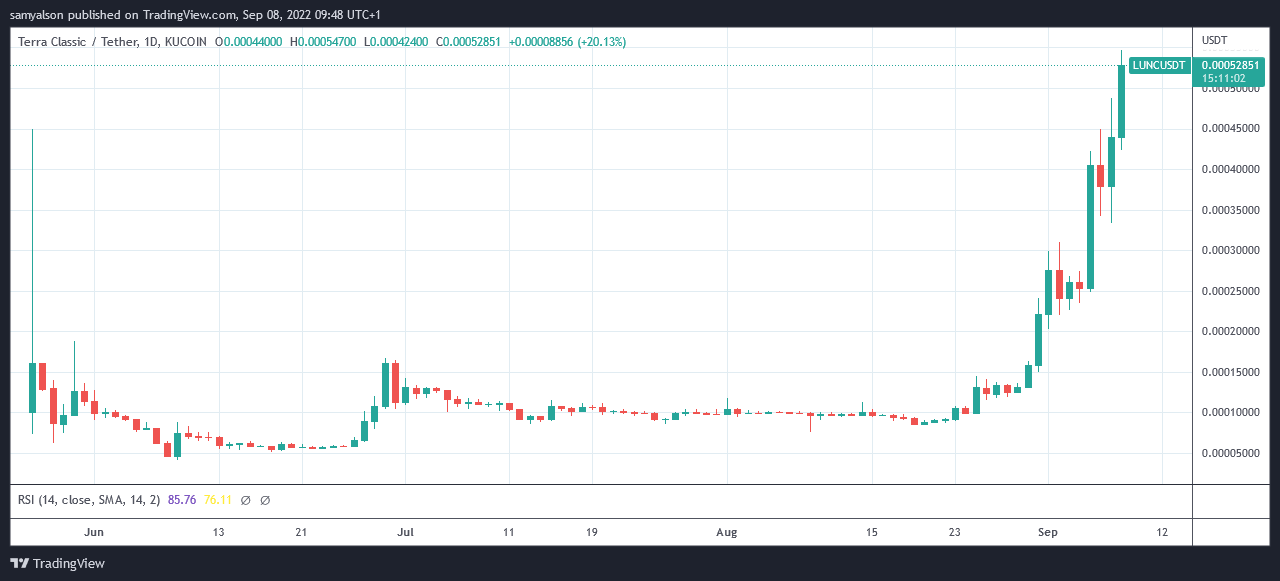
Plans to revive the previously “dead” Terra Classic chain have taken effect, leading to near 1,900% gains since bottoming at $0.00004885 on June 8. The community-led project has implemented several initiatives to boost demand, including token burning and attractive staking opportunities.
Terra LUNA
Terra LUNA

Source: LUNCUSDT on TradingView.com

According to LuncStaking_Bot, 8.8% of the LUNC supply is currently staked. This ratio has steadily increased since staking went live on August 27 — when only 2.6% of LUNC’s supply was staked.

Do Kwon misfires

The Terra ecosystem implosion was triggered when the UST stablecoin lost its dollar peg in May. UST operated under an algorithmic pegging mechanism to moderate supply and demand, hence its price, in conjunction with the LUNA token.

Falling below $1 incentivizes users to mint LUNA and burn UST. By dropping significantly below the peg price, vast quantities of LUNA were minted, increasing supply and tanking the token price.

The upshot was the mass exodus of capital leaving the ecosystem and the subsequent liquidity squeeze impacting the rest of the market. Since then, numerous fraud allegations have been leveled at Terra founder Do Kwon and his senior team. This included money laundering through shell companies and the siphoning of users’ funds. But most damning of all, Terra was a scam from the get-go.

The community accepted Do Kwon’s proposal to fork the chain and create Terra LUNA. The original chain was rebranded Terra Classic (LUNC) and left to the community for development and governance.

Many assumed LUNC would tail off and vanish, yet recent initiatives have seen its token price explode to climb the market cap rankings. LUNC is now ranked the 26th biggest chain, whereas Do Kwon-led LUNA ranks 116th.

FatManTerra slams Terra LUNA project

Terraform Labs associate Maslin Edwin posted a community update on September 7 detailing the latest developments in the Terra LUNA ecosystem.

It mentioned numerous updates, including new staking pools, wallet integrations, exchange listings, and information on recent governance proposals.

However, in response, FatManTerra tweeted that he finds it “amusing and sickening” that it’s business as usual with no acknowledgment of the harm caused by the Terra implosion.

He signed off, saying “we” will never forget what happened.

Related Reads

Wall Street Institutional Holdings Exposed: Jane Street Bitcoin ETF Positions Slashed by 71%, JPMorgan Chase Increases Holdings by 174%

Q1 2026 US institutional 13F filings reveal diverse crypto strategies amid a bearish market. Bitcoin fell ~23.8% for the quarter, with spot ETFs seeing net outflows. Key highlights: Jane Street slashed its iShares Bitcoin Trust (IBIT) holdings by 71%, shifting focus to Ethereum ETFs (e.g., doubling iShares Ethereum Trust holdings) and adding stocks like Galaxy Digital and Riot Platforms. Conversely, JPMorgan aggressively increased Bitcoin ETF exposure, boosting IBIT by 174% and other Bitcoin funds by up to 3000%, while initiating a position in a Solana ETF and clearing its XRP ETF. Wells Fargo built Ethereum ETF positions despite sector outflows. BlackRock increased holdings in crypto-correlated stocks like MicroStrategy (MSTR) and Bitmine (BMNR). Its on-chain Bitcoin holdings grew, though its total crypto portfolio value shrank due to price declines. ARK Invest notably increased its stake in Circle (CRCL), emphasizing the stablecoin infrastructure narrative. Institutions displayed three key trends: 1) Growing interest in Ethereum as infrastructure. 2) Divergent Bitcoin strategies (long-term allocation vs. tactical trading). 3) Broader adoption of crypto-related equities. Market sentiment improved in April, with Bitcoin ETF inflows hitting a six-month high as Bitcoin recovered above $80,000. More major institutional filings are pending.

链捕手4m ago

Wall Street Institutional Holdings Exposed: Jane Street Bitcoin ETF Positions Slashed by 71%, JPMorgan Chase Increases Holdings by 174%

链捕手4m ago

Q1 Wall Street Institutional Holdings Revealed: Jane Street Slashes Bitcoin ETF Position by 71%, JPMorgan Increases Holdings by 174%

Wall Street's Q1 13F filings reveal divergent strategies among major institutions regarding crypto exposure amid a broad market downturn. Bitcoin fell nearly 24% in Q1, with total crypto market cap down 20.4%. Key moves include Jane Street sharply reducing its Bitcoin ETF holdings (cutting IBIT by 71%) while significantly increasing its Ethereum ETF positions and building a new stake in Galaxy Digital. In contrast, JPMorgan Chase aggressively bought the dip, increasing its IBIT holding by 174% and boosting stakes in other Bitcoin ETFs, while initiating a position in a Solana ETF and clearing its XRP ETF. Wells Fargo increased its Ethereum ETF exposure by over 60% despite outflows from the asset class, while nearly exiting its Galaxy Digital position. BlackRock continued buying Bitcoin on-chain (adding ~15,000 BTC) and increased its holdings of crypto-correlated stocks like MicroStrategy and Bitmine, though its overall crypto portfolio value shrank due to price declines. ARK Invest notably increased its bet on Circle, highlighting institutional interest in the stablecoin infrastructure narrative. The filings signal three trends: growing institutional interest in Ethereum for long-term infrastructure plays, strategic differences (not bearishness) driving Bitcoin positioning, and crypto-equities becoming a core, though contested, allocation (e.g., mixed views on Galaxy Digital). The Q1 accumulation by some institutions appears validated in Q2, with Bitcoin rebounding above $80,000 and spot Bitcoin ETFs seeing renewed net inflows.

marsbit4m ago

Q1 Wall Street Institutional Holdings Revealed: Jane Street Slashes Bitcoin ETF Position by 71%, JPMorgan Increases Holdings by 174%

marsbit4m ago

TechFlow Intelligence Brief: South Korean Stock Market Plunges, Trump's Q1 Holdings Revealed

This TechFlow intelligence report covers key developments across AI, crypto, hardware, tech companies, and finance. In AI, Anthropic's valuation surpasses OpenAI, while AWS users face massive bills from runaway Claude API calls, highlighting AI's cost risks. A local AI model executing 'rm -rf' sparks safety debates. Meanwhile, arXiv enforces bans for AI-generated paper errors, and ChatGPT's impact on education grading is questioned. The crypto sector sees a US Senate committee passing a market structure bill, $2B in Bitcoin options expiring, and debates on Bitcoin's seizure resistance and DeFi's value without stablecoin yields. Hardware news includes NVIDIA planning RTX 5090 price hikes and the US approving H200 chip sales to Chinese firms. Tech company updates feature a macOS M5 chip exploit, Apple's iPhone price cuts, a South Korean stock market plunge, and Cisco's record revenue alongside layoffs. In stocks, NVIDIA's market cap hits $5.7T as Trump's Q1 portfolio shifts toward AI infrastructure stocks like NVIDIA and Broadcom. Cerebras' IPO soars, and a Reddit user reports massive gains on a leveraged ETF, fueling discussions on an AI bubble. Macro developments show precious metals falling due to Indian tariff hikes and strong US data. The Iran conflict disrupts Hormuz Strait shipping, affecting oil supplies. New tech includes 'haptic dreaming' to improve robot task success and Meta's Ray-Ban Display glasses with virtual handwriting. The underlying theme is AI's dual reality: creating both massive unexpected costs and immense market valuations. As technology advances rapidly, academia, markets, and regulators are all grappling to find a new equilibrium between innovation, risk, and control.

marsbit12m ago

TechFlow Intelligence Brief: South Korean Stock Market Plunges, Trump's Q1 Holdings Revealed

marsbit12m ago

Anthropic Has Taught Models to Understand Morality and Opened a New Path for Distillation

Anthropic's research "Teaching Claude Why" reveals a new, data-efficient method for AI alignment. Instead of relying on massive reinforcement learning with punishment (RLHF), which only teaches models to mimic safe answers without true ethical understanding, they used a small dataset (3 million tokens) of "difficult advice." This data consisted of detailed moral deliberations, reasoning, and debates, teaching the model the *why* behind decisions. The key was "deliberation-enhanced" Supervised Fine-Tuning (SFT). The model was trained on responses that included a "chain of thought" (CoT) process based on a constitutional framework. This framework included top-level principles, practical heuristics (like the "1000-user test"), and an 8-factor utility calculator (evaluating harm probability, reversibility, consent, etc.) for weighing complex trade-offs. This approach dropped model misalignment rates from 22% to 3% and showed strong generalization to unseen scenarios. The success challenges the old belief that "SFT memorizes, RL generalizes." It shows that SFT can generalize powerfully if the training data has two features: 1) high prompt diversity (many different scenario types) and 2) CoT supervision (showing the reasoning steps, not just the final answer). The model learns the underlying *thinking framework*, not just surface-level behaviors. This method points to a new paradigm for training AI in "non-RLVR" domains—areas like ethics, creative writing, or strategy where there's no single verifiable answer. The formula is: Domain Constitution + Heuristics + Multi-Factor Deliberation Framework + Diverse Deliberative CoT Data = Generalized capability. It represents a new form of "distillation," moving competition from pure compute towards who can best structure expert knowledge into high-quality reasoning datasets.

marsbit16m ago

Anthropic Has Taught Models to Understand Morality and Opened a New Path for Distillation

marsbit16m ago

CLARITY Bill Still Unsettled, Caught Up in U.S. Bipartisan Political Game

The U.S. Senate Banking Committee voted 15-9 to advance the CLARITY Act for a full Senate vote, overcoming a key industry compromise on stablecoin rewards. However, the legislation faces significant political hurdles as it moves forward. The vote fell largely along party lines, with all 13 Republican committee members voting in favor and only two Democrats—Ruben Gallego and Angela Alsobrooks—joining them. Both Democrats indicated their support was conditional to keep debate alive and could be withdrawn later. The path to final passage in the full Senate remains difficult. The bill requires 60 votes to pass. With a current 53-47 Republican majority, this means at least 7 Democratic votes are needed, assuming no Republican defections. The narrow, partisan committee vote suggests securing that level of bipartisan support will be challenging. During the committee process, Democrats pushed for numerous amendments, including a key ethics provision to restrict top government officials' financial ties to the crypto industry. Republicans used their majority to block these amendments, leaving core Democratic concerns unaddressed. These issues, particularly around anti-money laundering and ethics, are expected to resurface as major points of contention during the full Senate debate. Republicans are pushing for a swift Senate vote, ideally before the July 4 recess and the upcoming election season, fearing that a shift in congressional power after the next election could jeopardize the bill's future. However, given the current political stalemate and Democratic demands for concessions, the act's prospects for becoming law in 2026 are uncertain.

Odaily星球日报23m ago

CLARITY Bill Still Unsettled, Caught Up in U.S. Bipartisan Political Game

Odaily星球日报23m ago

Trading

Spot
Futures

Hot Articles

How to Buy LUNC

Welcome to HTX.com! We've made purchasing Terra Classic (LUNC) simple and convenient. Follow our step-by-step guide to embark on your crypto journey.Step 1: Create Your HTX AccountUse your email or phone number to sign up for a free account on HTX. Experience a hassle-free registration journey and unlock all features.Get My AccountStep 2: Go to Buy Crypto and Choose Your Payment MethodCredit/Debit Card: Use your Visa or Mastercard to buy Terra Classic (LUNC) instantly.Balance: Use funds from your HTX account balance to trade seamlessly.Third Parties: We've added popular payment methods such as Google Pay and Apple Pay to enhance convenience.P2P: Trade directly with other users on HTX.Over-the-Counter (OTC): We offer tailor-made services and competitive exchange rates for traders.Step 3: Store Your Terra Classic (LUNC)After purchasing your Terra Classic (LUNC), store it in your HTX account. Alternatively, you can send it elsewhere via blockchain transfer or use it to trade other cryptocurrencies.Step 4: Trade Terra Classic (LUNC)Easily trade Terra Classic (LUNC) on HTX's spot market. Simply access your account, select your trading pair, execute your trades, and monitor in real-time. We offer a user-friendly experience for both beginners and seasoned traders.

2.2k Total ViewsPublished 2024.03.29Updated 2025.03.21

How to Buy LUNC

Discussions

Welcome to the HTX Community. Here, you can stay informed about the latest platform developments and gain access to professional market insights. Users' opinions on the price of LUNC (LUNC) are presented below.

活动图片