全美城镇抵制建数据中心,比特币矿工成了最大受益者

marsbitPublished on 2026-08-25Last updated on 2026-08-25

Abstract

摩根士丹利分析师指出,美国多州正放缓或暂停新建数据中心,这意外地使已接入电网的比特币矿企成为最大受益者。 全美范围内,反对数据中心的声浪已演变为有组织的政治运动。超过500个城镇设限,多个州长推出暂停令或严格限制,导致数百亿美元项目搁置。尽管特朗普公开支持,但地方审批权是关键阻力。 新建数据中心的核心难点在于电力接入与扩容,审批流程漫长。而比特币矿企已拥有现成的电力合同、设施及并网许可,这在当前环境下变得极具稀缺价值。 矿企早已开始转型。过去三个季度,上市矿企削减了21%的算力,将电力转向利润更高的AI计算领域。市场对此反应积极,承接AI业务的矿企估值倍数远超纯挖矿企业。背后原因是比特币价格一度低迷,迫使矿企出售比特币或抵押借贷求生。 然而,前景存在变数:首先,部分州的审查政策同时针对数据中心和加密矿场,矿企的既有许可并非绝对安全。其次,近期比特币价格强劲反弹,若持续上涨可能使挖矿重新变得经济,届时矿企向AI转型的决策可能需要重新评估。

摩根士丹利分析师 Stephen Byrd 8 月 24 日给出了一个反直觉的判断:美国多个州的州长正在放缓甚至停掉数据中心建设,而这件事最大的受益方,是比特币矿企——因为它们的机房已经接在电网上了。

他点名了 Cipher、Hut 8、Galaxy Digital、MARA Holdings 和 Riot Platforms。这个判断听起来绕,其实只有一层:当新的电接不进来的时候,旧的电就变贵了。

全美到底在发生什么?

过去一个月,反对数据中心已经从零星的邻避事件,变成了一场有组织的政治运动。

盖洛普 8 月的调查显示,71% 的美国人反对在自己所在的地方建数据中心。全美已有超过 500 个城镇对数据中心建设设限,一些地方官员因为审批问题收到了死亡威胁,甚至遭遇枪击,有议会直接关闭了公众评论环节。

州一级的动作更硬。纽约州州长 Kathy Hochul 提出对数据中心建设实施为期一年的暂停令。宾夕法尼亚州州长 Josh Shapiro 签署行政令,对新建数据中心设置严格限制。

得克萨斯州州长 Greg Abbott 在三个月里从热烈欢迎转为暂停审批,他给出的理由几乎是在指着这些公司的鼻子说话:数据中心企业没能赢得社区支持,是自掘坟墓,这个反弹是它们应得的。

弗吉尼亚州成了全美第一个按耗电量对数据中心征税的州,预计明年能收上 6 亿美元;该州劳登县境内已有 250 多个数据中心,现在也开始限制新建。

代价是可以计算的。今年前三个月,至少 75 个数据中心项目因当地反对被搁置或延迟,涉及金额约 1300 亿美元。

在这件事上,白宫和州长们的方向是相反的。特朗普 8 月 23 日在采访中说,拒绝数据中心的社区是在犯错,因为数据中心能带来大量就业和财富。但审批权不在他手里。

为什么"已经接上电网"突然值钱了?

要理解摩根士丹利这个判断,得先知道建一个数据中心真正难在哪。

难的不是盖楼,是通电。一个大型 AI 数据中心动辄要几百兆瓦的电力,这需要电网公司专门给你拉线、扩容、排队审批,前后好几年。现在这一环被政治卡住了——得州公用事业委员会甚至排了个时间表,要在 12 月 10 日之前把所有数据中心和加密矿场的并网申请重新审一遍,12 月 17 日交报告。

而比特币矿企手里有什么?它们过去十年干的事,就是满世界找便宜的电,然后把机房接上去。这些电力接入合同、变电设施、并网许可,全部是现成的、已经批完的、没人能再投票否决的。

在数据中心随便建的年代,这没什么了不起。在建不了的年代,这是全美国最稀缺的东西之一。

矿工们早就在转身了

这不是一个新故事,只是被政治加速了。

过去三个季度,上市矿企一共削减了 21% 的算力——不是不干了,是把电腾出来给 AI 用。8 月 11 日,Anthropic 和 Riot Platforms 签下一笔 91 亿美元的算力协议。

市场早就给这种转身打了分。

按 CoinShares 的统计,承接 AI 和高性能计算合约的矿企,企业价值倍数是 12.3 倍;纯挖比特币的,只有 5.9 倍。同样的电、同样的机房、同样的运维团队,接上 AI 合约估值就贵一倍多。
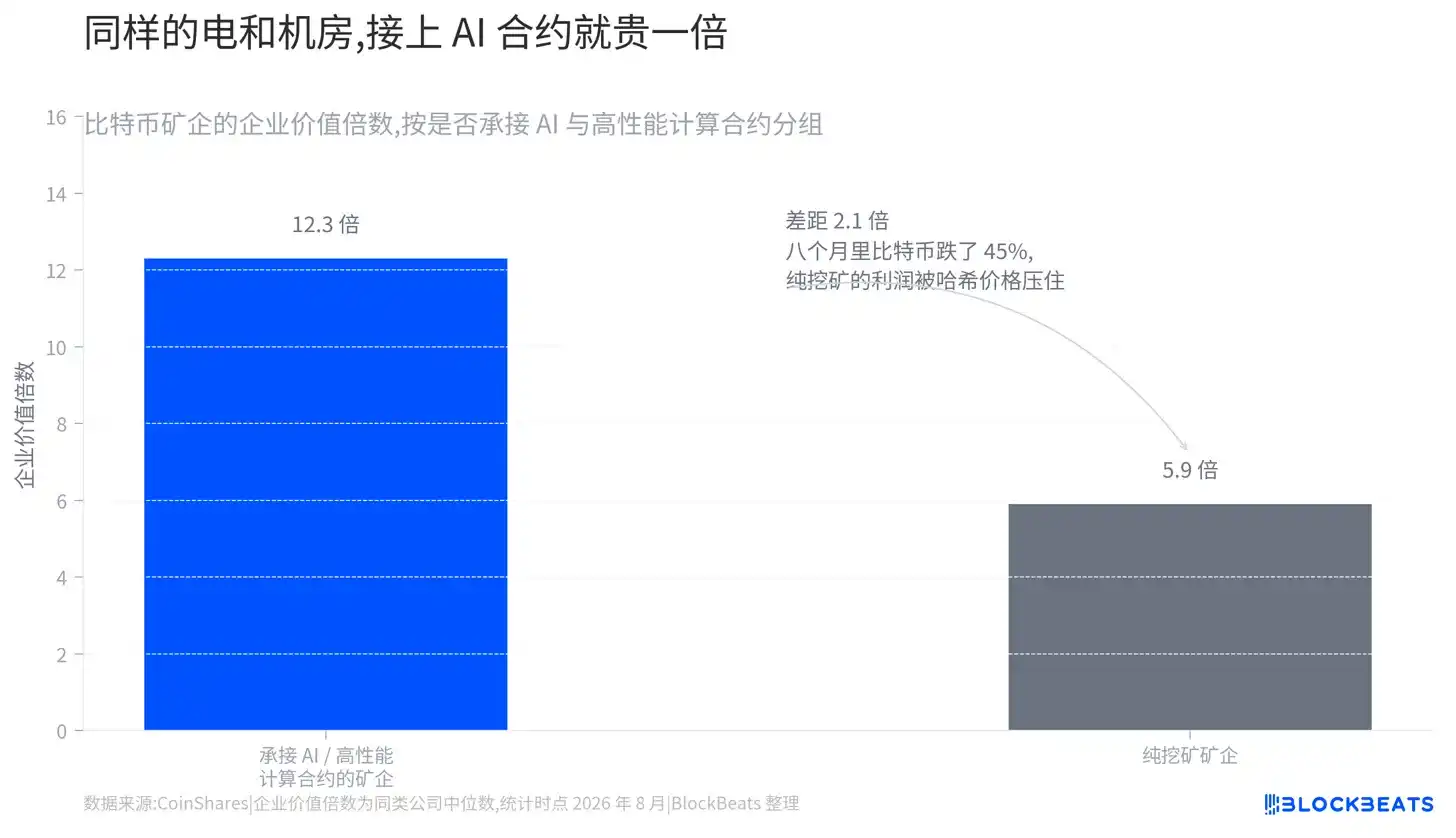
背后是纯挖矿这门生意确实不好过。CoinShares 那份报告发布时,比特币在八个月里跌了 45%,哈希价格(矿工每单位算力能赚到的钱)被压得很低。

为了活下去,上市矿企今年已经卖掉了约 2.8 万枚比特币,折合 17.8 亿美元;MARA Holdings 则把 18,750 枚比特币抵押出去,换来两笔总额 6 亿美元的贷款。

这笔账有两个问题

第一,得州那份要重审的名单上,写的是「数据中心和加密矿场」。矿场没有被单独豁免。矿企引以为傲的那些并网许可,是不是完全动不了,得等 12 月 17 日的报告。

反弹的对象是「耗电的大机房」,而不是「叫数据中心的那个」——这一点在阿拉巴马州已经演过一次:当地居民没能拦住一座大型比特币挖矿数据中心,靠的是州分区法的漏洞,不是因为它不招人烦。

第二,比特币刚刚涨回来了。8 月 24 日它逼近 8 万美元,创下多年新高,一周涨了 21%。CoinShares 算过,如果比特币回到 12.6 万美元的历史高点,哈希价格能回到每 PH/s 约 59 美元,挖矿的经济性会重新成立。

那时候再回头看,把电让给 AI,究竟是转型还是贱卖,答案可能会变。

Trending Cryptos

Related Questions

Q为什么摩根士丹利分析师认为全美抵制新建数据中心的最大受益方是比特币矿企?

A因为建设新数据中心的核心难点在于获得电网接入和扩容审批,这个过程通常需要数年且正面临日益严格的政治阻力。而比特币矿企在过去多年已经完成了在全球各地寻找廉价电力并成功接入电网的工作,它们拥有现成的、已获审批的电力接入合同、变电设施和并网许可。在新数据中心难以获批、电力接入变得稀缺的背景下,这些现成的“已接网”资产价值大幅提升。矿企可以将原本用于挖矿的电力资源转向为高需求的AI计算提供服务,从而获得更高的估值和收入。

Q文章中提到,市场如何区分‘承接AI合约的矿企’和‘纯挖比特币的矿企’?

A根据CoinShares的统计数据,市场对这两类矿企的估值倍数存在显著差异。那些承接AI和高性能计算(HPC)合约的比特币矿企,其企业价值倍数为12.3倍;而纯粹进行比特币挖矿的矿企,企业价值倍数仅为5.9倍。这表明,同样的电力、机房和运维团队,如果将其计算能力服务于AI等高价值领域,市场愿意给出高一倍多的估值。

Q美国地方和州政府对数据中心建设采取了哪些具体的限制措施?

A采取的措施包括:1. 城镇层面:全美已有超过500个城镇对数据中心建设设限,部分地区因此发生激烈冲突,甚至有官员收到死亡威胁。2. 州层面:纽约州州长提出为期一年的数据中心建设暂停令;宾夕法尼亚州州长签署行政令对新建数据中心设置严格限制;得克萨斯州州长暂停了数据中心审批;弗吉尼亚州成为全美首个按耗电量对数据中心征税的州,其劳登县也开始限制新建。这些政治阻力导致今年初至少75个、价值约1300亿美元的数据中心项目被搁置或延迟。

Q比特币矿企从‘挖矿’向‘AI算力服务’转型面临哪两个潜在问题?

A文章指出了两个潜在问题:第一,政策风险并未完全排除。例如,得克萨斯州计划在12月10日前重新审核所有数据中心和加密矿场的并网申请。抵制运动的根本对象是“耗电的大机房”,矿场的并网许可并非绝对安全。第二,比特币价格波动可能影响转型决策。如果比特币价格持续上涨(例如文章提到的若重回12.6万美元历史高点),挖矿本身可能重新变得极具经济性。届时,将宝贵的电力资源“贱卖”给AI,可能成为一个需要重新评估的决策。

QRiot Platforms与Anthropic签订的协议说明了什么行业趋势?

ARiot Platforms与AI公司Anthropic签订的这笔价值91亿美元的算力协议,是比特币矿企向AI和高性能计算领域转型的一个标志性案例。它具体说明了:1. 转型正在进行且规模巨大:矿企正在将原本用于比特币挖矿的算力基础设施(电力、机房)大规模地重新部署,以满足AI爆发式增长的计算需求。2. 市场验证了这种商业模式:顶级AI公司愿意为此支付巨额费用,证明了矿企所拥有的稳定电力、冷却设施和运维能力在AI时代具有极高的商业价值。这加速了整个挖矿行业从单一的加密货币生产向多元化算力服务提供商的转变。

Related Reads

Conversation with Charles Zhang: Amidst the AI Frenzy, Why Pursue 'Anti-Efficiency' Content?

Dialogue with Charles Zhang: In the Era of AI's Sprint, Why Create "Anti-Efficiency" Content Standing out among China's early internet pioneers, Charles Zhang, founder and CEO of Sohu, maintains a distinct personal identity. He keeps a consistent public presence and embodies traits of high-energy individuals: sleeping only 4-5 hours daily, running 5km or marathons, and hosting frequent offline tech forums and dialogues with Nobel laureates. He has shifted focus from external business expansion to internal self-reconstruction, adhering to his own pace. "People aren't afraid of being busy; the busier you are, the better your health. Having nothing to do can lead to emotional issues and poor health." Marking the 10th anniversary of his live-streamed "Charles Zhang's English Class," he recently took it offline for a real-world classroom session. Following this, he discussed the course's decade-long journey, Sohu Video's content ecosystem, and the value of content in the AI era. **Pen and Mouth Diligence: A Class Against Instant Mastery** His English class began in August 2016 on "Qianfan Live." He spends about 40 minutes daily preparing, reviewing dozens of news headlines, reading five in detail, and selecting three for the lesson. Over ten years, he has completed over 2000 live sessions totaling more than 110,000 minutes, with over 52 million views. Initially, the stream was a way to "talk more" and combat emotional struggles. He started by repeating after TV news anchors, then moved to live-streaming with the launch of Qianfan Live. It was 40% for personal emotional regulation ("like a monk chanting sutras"), 30% to deliver authentic news, and 30% to promote the new platform. This daily "ritual" helped him overcome depression, leading to what he calls his "peak life state." From a product perspective, it was counter-intuitive—launched without prior market research or growth strategies, based on the founder's personal need that resonated with users. Yet, his content creation follows a strict routine. The decade of covering geopolitics, economics, tech, health, and society has built a vast "knowledge compound interest" system. In an age of AI summaries and algorithmic content, Zhang insists on "hard work": meticulous reading, handwritten notes, and manually created teaching materials, refusing AI-generated content. The English class is now a fixed daily rhythm; preparing for his weekly physics class requires a full day of solitary deduction on a blackboard. In his live streams, Zhang positions himself as a "content creator," not a CEO or teacher. He sees physics as extreme brain training and English as a "sensor" to understand the world. This explains why a top entrepreneur persists for a decade in seemingly "unprofessional" pursuits—it's the information input and psychological healing method he found during a low point. It's fundamentally an "anti-efficiency" commitment. He believes the meaning of reading lies in finding community and spiritual support, not just fleeting conversation points. For today's media, he states: "Reading news isn't the goal. As humans with many confusions, we need reference points, to find a group, find kindred spirits, or seek support and spiritual nourishment. Large language models can't satisfy these starting points; they only give you information." This offers solace and a value defense for media professionals impacted by AI summaries. **"Don't Think Earth Stops Turning Because AI Arrived"** A content creator expressed anxiety: after feeding their article to AI, it produced a more comprehensive, profound version, making their work feel valueless. Zhang responded with an analogy: "Carrots from the market, with a bit of soil, not glossy, taste delicious and flavorful. Tomatoes forced by chemical fertilizer have no taste at all." He sees AI giving world content a "plastic feel," but acknowledges its significant role in improving information access efficiency, especially in physics and social science research where he often queries AI for quick professional answers. The key, Zhang stresses, is that the outside world still needs to guide our perspective. LLMs provide "information," while the outside world offers "viewpoints." He cares deeply about *what* that external viewpoint is and *how* someone thinks about an issue. "Don't think the Earth stops turning because AI arrived," he analyzes. AI currently replaces rule-based work, noting significant impact on the software industry with many programmers laid off as even less experienced people can now write decent code. However, AI cannot yet replace arts, social sciences, emotions, and creative content. "Hollywood remains thriving, producing great works. Oscars will continue, Nobel Literature Prizes will still be awarded—all by real people, with works conceived by real people." While wary of AI, Zhang isn't anti-technology and is open to its applications. Sohu itself has launched AI assistants. In Sohu's AI practice, Zhang defines his role as a "large language model corpus provider." He believes LLM training is inseparable from human-original content as its data foundation, so original content retains irreplaceable value. "The era of self-media indeed offers everyone new ways to discover their strengths and achieve growth." He suggests every young person should consider self-media. Most importantly, the bottom line of content creation should be "authenticity." If using AI avatars, they must be clearly labeled; not doing so and misleading viewers wastes their time, especially when people still prefer real human content. Behind AI's sprint lie unavoidable realities. As AI quickly provides seemingly perfect answers, people grow accustomed to accepting "summarized" results, omitting processes of questioning, deduction, and trial-and-error, leading to a decline in deep thinking. Zhang's "anti-efficiency" practice with his two live-streamed classes is his answer to AI's狂奔: In an algorithm-driven era chasing ultimate efficiency, don't expect AI to fill inner voids. Read books, speak in front of a camera, sweat on a running track, and build connections with real people.

marsbit10m ago

Conversation with Charles Zhang: Amidst the AI Frenzy, Why Pursue 'Anti-Efficiency' Content?

marsbit10m ago

Zcash's ETF Gilding: How a Privacy Coin Was Packaged by Wall Street into a Compliant Asset

The article traces the decade-long path of Zcash (ZEC), a privacy-focused cryptocurrency, to its potential launch as the first privacy coin spot ETF, with Grayscale's ZCSH filing in August 2026. It argues ZEC's suitability stemmed not from regulatory acceptance of its privacy technology, but from its centralized, institutional structure from inception—a commercial company (ECC) with venture capital backing and a Founder's Reward—making it easier to package than decentralized alternatives. Three key institutions, intertwined in a network, drove the process: Grayscale (owned by DCG, an early ZEC investor), which had held ZEC in a trust since 2017; Coinbase, providing custody, prime brokerage, derivatives, and venture investment; and ZODL, a new for-profit entity formed in 2026 when ECC's core development team split from the non-profit foundation. The major regulatory hurdle was SEC scrutiny (2023-2026) over ZEC's historical structure, which resembled an unregistered investment contract due to automatic block rewards to ECC and the Foundation. This was resolved through governance changes (NU6 upgrade in 2024) that ended direct funding and shifted control to community voting, coinciding with a broader shift in SEC enforcement policy. Notably, the law firm Davis Polk represented both the Zcash Foundation in its SEC defense and Grayscale in the ETF filing. The push is also driven by DCG's dire financial needs amid Genesis bankruptcy lawsuits, seeking high-fee products (the ZEC ETF charges 2.5%). Concurrently, major mining operations by entities like Cypherpunk Technologies (backed by Winklevoss Capital) and DCG's Fortitude Mining expanded, motivated by profitability and aiming to influence the network. The article concludes with irony: to become a compliant ETF asset, ZEC must shed its core privacy feature for the fund's holdings, which will be held in transparent, auditable addresses. Wall Street is not adopting privacy technology but packaging the *concept* of privacy into a tradable, fee-generating financial product. The transformation was not a single master plan but the result of a network of aligned interests capitalizing on regulatory, governance, and market shifts over ten years.

marsbit20m ago

Zcash's ETF Gilding: How a Privacy Coin Was Packaged by Wall Street into a Compliant Asset

marsbit20m ago

Bitcoin Core Developer Warns That Bitcoin Payments Are Disappearing at 'Bitcoin Beach'

A Bitcoin Core developer, John Atack, who has lived in El Salvador since 2022, shared a concerning anecdote about Bitcoin adoption in the country. While dining at El Zonte, a region known as "Bitcoin Beach," he paid with Bitcoin and was told it was the first such payment the establishment had received in a month. Staff explained Bitcoin payments, once common, have now virtually disappeared, with nearly all customers using cards. An employee even declined a Bitcoin tip, stating she had forgotten how to use her wallet and declaring "It's already dead." Atack emphasized this was a single observation but noted the employee had witnessed the payment evolution over three years. His comments sparked mixed reactions. Some disputed his experience, with one user confirming successful Bitcoin payments in the same area. However, Bitcoin reporter Juan Galt acknowledged an underlying "economic problem," arguing that expecting price appreciation makes using Bitcoin for everyday transactions counterintuitive to economic incentives needed for a circular crypto economy. Despite the concerning report, Atack also reflected that El Salvador remains a global leader in cryptocurrency adoption and progressive legislation, sometimes causing locals to take these advancements for granted. The story highlights the ongoing challenges of mainstream Bitcoin adoption for daily commerce, even in pioneering nations.

cryptonews.ru22m ago

Bitcoin Core Developer Warns That Bitcoin Payments Are Disappearing at 'Bitcoin Beach'

cryptonews.ru22m ago

A Huge 'Sleeping' Wave of New Bitcoin Buyers Has Not Even Bought Bitcoin Yet

A recent study by the Federal Reserve Bank of Cleveland, titled "Do You Even Crypto, Bro? Cryptocurrencies in Household Finance," reveals that Bitcoin and other crypto assets are less understood than other financial assets in US households. The primary reasons for not owning crypto are a lack of knowledge and the perception that it is a poor investment. Even among owners, the main motivations are profit-seeking and portfolio diversification rather than an understanding of the underlying technology's benefits, such as independence from banks. The research found that showing respondents Bitcoin's past 12-month performance increased their desired portfolio allocation by about 47%, indicating investment decisions are driven more by recent returns than fundamental comprehension. Crypto gains are often treated like lottery winnings, leading to one-off luxury purchases rather than sustained increases in spending. While non-owners largely view crypto as high-risk, owners are somewhat less likely to do so, though they exhibit greater uncertainty about future returns compared to traditional assets like stocks or gold. This ambiguity about Bitcoin's nature and valuation contributes directly to its price volatility. The study concludes that this volatility will persist, but education efforts combined with price appreciation could convert today's uninformed non-owners into future Bitcoin holders.

cryptonews.ru25m ago

A Huge 'Sleeping' Wave of New Bitcoin Buyers Has Not Even Bought Bitcoin Yet

cryptonews.ru25m ago

Trading

Spot

Hot Articles

How to Buy TOWNS

Welcome to HTX.com! We've made purchasing TOWNS (TOWNS) simple and convenient. Follow our step-by-step guide to embark on your crypto journey.Step 1: Create Your HTX AccountUse your email or phone number to sign up for a free account on HTX. Experience a hassle-free registration journey and unlock all features.Get My AccountStep 2: Go to Buy Crypto and Choose Your Payment MethodCredit/Debit Card: Use your Visa or Mastercard to buy TOWNS (TOWNS) instantly.Balance: Use funds from your HTX account balance to trade seamlessly.Third Parties: We've added popular payment methods such as Google Pay and Apple Pay to enhance convenience.P2P: Trade directly with other users on HTX.Over-the-Counter (OTC): We offer tailor-made services and competitive exchange rates for traders.Step 3: Store Your TOWNS (TOWNS)After purchasing your TOWNS (TOWNS), store it in your HTX account. Alternatively, you can send it elsewhere via blockchain transfer or use it to trade other cryptocurrencies.Step 4: Trade TOWNS (TOWNS)Easily trade TOWNS (TOWNS) on HTX's spot market. Simply access your account, select your trading pair, execute your trades, and monitor in real-time. We offer a user-friendly experience for both beginners and seasoned traders.

4.2k Total ViewsPublished 2025.08.08Updated 2026.06.02

How to Buy TOWNS

Discussions

Welcome to the HTX Community. Here, you can stay informed about the latest platform developments and gain access to professional market insights. Users' opinions on the price of TOWNS (TOWNS) are presented below.

活动图片