¿Por qué están cayendo las acciones de Nvidia hoy?

cryptonews.ruPublished on 2026-08-24Last updated on 2026-08-24

Abstract

Las acciones de Nvidia cayeron aproximadamente un 2% este lunes, tras un inicio al alza, influenciadas por noticias relacionadas con Groq. Nvidia anunció el inicio de la producción masiva de su bastidor Groq 3 LPX, tecnología derivada de su mayor adquisición histórica por 20 mil millones de dólares. Estos bastidores, que albergan 256 chips Groq 3 cada uno y ofrecen alta velocidad de procesamiento (3.400 tokens/segundo), serán utilizados por Nebius Group. Nvidia busca monetizar esta velocidad permitiendo a proveedores de nube ofrecer niveles de servicio premium con menor latencia. A pesar de la caída, el valor de mercado de Nvidia ronda los 5,2 billones de dólares. Analistas de Rosenblatt Securities y Wedbush mantienen recomendaciones positivas y altas expectativas para el próximo informe de resultados del segundo trimestre, que se publicará este miércoles, anticipando que superará las previsiones.

Las acciones de Nvidia (NASDAQ: NVDA) dieron un giro brusco el lunes. Poco después de la apertura del mercado, subieron aproximadamente un 3% para luego caer alrededor de un 2% tras la aparición de noticias de Groq.

Anteriormente hoy, Nvidia anunció el inicio de la producción en masa de su bastidor Groq 3 LPX, convirtiendo la tecnología obtenida de la mayor adquisición en la historia de Nvidia en un equipo listo para usar.

En diciembre del año pasado, Nvidia gastó 20 mil millones de dólares en la adquisición de activos de la startup Groq, dedicada al desarrollo de chips para inteligencia artificial. Estos bastidores serán entregados a la compañía Nebius Group (NASDAQ: NBIS), que opera en el ámbito de la computación neocloud, donde se utilizarán junto con los procesadores Vera y las unidades de procesamiento gráfico Rubin.

Dion Harris, director senior de Nvidia, informó a los periodistas que el lanzamiento debería tener lugar más adelante este año. Nvidia busca acelerar el procesamiento de datos, donde la velocidad es crucial para los agentes de IA, especialmente para sistemas de programación que necesitan responder sin largas demoras. Nvidia afirma que los proveedores de servicios en la nube pueden cobrar tarifas más altas por tokens que cumplan con requisitos más estrictos de velocidad y latencia.

Según FactSet (NYSE: FDS), la capitalización de mercado de Nvidia asciende ahora a aproximadamente 5.2 billones de dólares, lo que la convierte en la compañía más grande del mundo por capitalización bursátil. Al cierre del mercado del viernes, las acciones de la compañía habían subido casi un 7% en agosto, mientras que el índice S&P 500 aumentó alrededor de un 2.5%.

De acuerdo con datos de London Stock Exchange Group (LSE: LSEG), los analistas esperan que los ingresos y ganancias trimestrales alcancen aproximadamente el doble del nivel del mismo período del año anterior.

Nvidia implementa Groq 3 en los sistemas de sus clientes, ya que una mayor velocidad de procesamiento de datos con IA crea otro servicio de pago

Cada bastidor Groq 3 LPX alberga 256 chips Groq 3 individuales. Según Nvidia, una instalación completa puede generar 3400 tokens por segundo, según pruebas de inteligencia artificial. Cada procesador tiene 500 megabytes de memoria de acceso aleatorio (SRAM) directamente en el chip.

Esto permite almacenar datos cerca del procesador y elimina las ralentizaciones causadas por memorias más lentas. La compañía Samsungtron(KRX: 005930) fabrica los chips Groq, y la compañía Taiwan Semiconductor Manufacturing (NYSE: TSM) fabrica las unidades de procesamiento gráfico de Nvidia.

Dion explicó cómo Nvidia y los proveedores de servicios en la nube pueden beneficiarse económicamente de esta velocidad. "Para aquellos que proporcionan tokens, esto abre la posibilidad de ofrecer niveles de servicio premium para aquellos usuarios y clientes que realmente requieren acuerdos de servicio más sensibles a la latencia", dijo.

Luego, las compañías de la nube pueden crear otro nivel de precios para clientes que necesiten respuestas de IA más rápidas en lugar de la velocidad de servicio estándar.

Nvidia también está aumentando los envíos de sus sistemas Vera Rubin, cuya producción comenzó a principios de este año. Cuando se presentaron Vera Rubin y Groq 3 LPX en marzo, el CEO Jensen Huang afirmó que Blackwell y Vera Rubin juntos podrían generar un total de 1 billón de dólares en ventas para 2027.

Jensen también declaró que planea asignar el 25% del espacio del centro de datos utilizado para el procesamiento de software a los procesadores Groq. "El resto de mi centro de datos está ocupado al 100% por procesadores Vera Rubin", dijo Jensen.

Wall Street eleva las expectativas para Nvidia, mientras los analistas mantienen altas expectativas sobre el precio de las acciones

Los analistas de Rosenblatt Securities mantuvieron su recomendación de "Comprar" para las acciones de Nvidia y mantuvieron el precio objetivo en 325.00 dólares. Las acciones de Nvidia cotizaban a 214.72 dólares, e InvestingPro estimó un valor razonable de 259.96 dólares.

Los analistas de Rosenblatt esperan que el informe de Nvidia del segundo trimestre del año fiscal 2027 supere las expectativas de Wall Street tanto en ingresos como en ganancias. También anticipan que la publicación de los resultados financieros impulsará el precio de las acciones de la compañía.

El analista de Wedbush, Matt Bryson, que otorgó a las acciones de Nvidia una calificación de "Superior al mercado", espera que el reciente repunte de las acciones continúe tras la publicación de resultados el miércoles. Matt también cree que Nvidia superará sus propias previsiones y presentará un pronóstico para el trimestre de octubre que será mejor de lo que esperan los analistas de Wall Street.

"Una vez más, esperamos que NVDA supere sus pronósticos y confirme un pronóstico para octubre superior a las expectativas de los analistas, dados 1) el aumento del gasto en hiperescala que se ha fortalecido aún más con los resultados del segundo trimestre, y 2) la situación de suministro que seguimos considerando la mejor de la industria, donde el acceso a componentes y materiales, y no la demanda final, define los volúmenes de suministro", escribió Matt.

Nvidia debe publicar sus resultados financieros del segundo trimestre el miércoles después del cierre del mercado, y, como es habitual, Cryptopolitan realizará una transmisión en vivo.


Trending Cryptos

Related Questions

Q¿Cuál fue la reacción del mercado de valores de Nvidia (NASDAQ: NVDA) el lunes tras las noticias de Groq?

ALas acciones de Nvidia (NASDAQ: NVDA) experimentaron una fuerte reversión el lunes. Tras un aumento inicial de aproximadamente un 3% después de la apertura, cayeron alrededor de un 2% después de que se publicaron noticias relacionadas con Groq.

Q¿Qué anunció Nvidia en relación con el sistema Groq 3 LPX y qué compañía lo utilizará?

ANvidia anunció el inicio de la producción en masa de su bastidor Groq 3 LPX, transformando la tecnología adquirida en equipamiento listo para usar. Estos bastidores serán proporcionados a Nebius Group (NASDAQ: NBIS), una compañía de computación neocloud, donde se utilizarán junto con los procesadores Vera y las GPUs Rubin.

Q¿Según el director sénior de Nvidia, Dion Harris, cómo pueden los proveedores de nube beneficiarse económicamente de la mayor velocidad de procesamiento de Groq 3?

ADion Harris explicó que la mayor velocidad permite a los proveedores de nube ofrecer niveles de servicio premium a usuarios y clientes que requieren acuerdos de nivel de servicio (SLA) con baja latencia. Esto les permite crear otro nivel de precios para clientes que necesitan respuestas de IA más rápidas.

Q¿Qué pronóstico hizo el CEO de Nvidia, Jensen Huang, en marzo sobre las ventas combinadas de los sistemas Blackwell y Vera Rubin para 2027?

AEn marzo, el CEO Jensen Huang declaró que los sistemas Blackwell y Vera Rubin juntos podrían generar un total de 1 billón de dólares en ventas para el año 2027.

Q¿Qué expectativas tienen los analistas de Rosenblatt Securities y Wedbush sobre los resultados del segundo trimestre fiscal de Nvidia que se publicarán el miércoles?

ALos analistas de Rosenblatt Securities esperan que los resultados del segundo trimestre superen las expectativas de Wall Street tanto en ingresos como en ganancias, y que impulsen el precio de las acciones. El analista de Wedbush, Matt Bryson, también anticipa que Nvidia superará sus propias previsiones y ofrecerá una guía para el trimestre de octubre que sea mejor de lo esperado por los analistas.

Related Reads

Conversation with Charles Zhang: Amidst the AI Frenzy, Why Pursue 'Anti-Efficiency' Content?

Dialogue with Charles Zhang: In the Era of AI's Sprint, Why Create "Anti-Efficiency" Content Standing out among China's early internet pioneers, Charles Zhang, founder and CEO of Sohu, maintains a distinct personal identity. He keeps a consistent public presence and embodies traits of high-energy individuals: sleeping only 4-5 hours daily, running 5km or marathons, and hosting frequent offline tech forums and dialogues with Nobel laureates. He has shifted focus from external business expansion to internal self-reconstruction, adhering to his own pace. "People aren't afraid of being busy; the busier you are, the better your health. Having nothing to do can lead to emotional issues and poor health." Marking the 10th anniversary of his live-streamed "Charles Zhang's English Class," he recently took it offline for a real-world classroom session. Following this, he discussed the course's decade-long journey, Sohu Video's content ecosystem, and the value of content in the AI era. **Pen and Mouth Diligence: A Class Against Instant Mastery** His English class began in August 2016 on "Qianfan Live." He spends about 40 minutes daily preparing, reviewing dozens of news headlines, reading five in detail, and selecting three for the lesson. Over ten years, he has completed over 2000 live sessions totaling more than 110,000 minutes, with over 52 million views. Initially, the stream was a way to "talk more" and combat emotional struggles. He started by repeating after TV news anchors, then moved to live-streaming with the launch of Qianfan Live. It was 40% for personal emotional regulation ("like a monk chanting sutras"), 30% to deliver authentic news, and 30% to promote the new platform. This daily "ritual" helped him overcome depression, leading to what he calls his "peak life state." From a product perspective, it was counter-intuitive—launched without prior market research or growth strategies, based on the founder's personal need that resonated with users. Yet, his content creation follows a strict routine. The decade of covering geopolitics, economics, tech, health, and society has built a vast "knowledge compound interest" system. In an age of AI summaries and algorithmic content, Zhang insists on "hard work": meticulous reading, handwritten notes, and manually created teaching materials, refusing AI-generated content. The English class is now a fixed daily rhythm; preparing for his weekly physics class requires a full day of solitary deduction on a blackboard. In his live streams, Zhang positions himself as a "content creator," not a CEO or teacher. He sees physics as extreme brain training and English as a "sensor" to understand the world. This explains why a top entrepreneur persists for a decade in seemingly "unprofessional" pursuits—it's the information input and psychological healing method he found during a low point. It's fundamentally an "anti-efficiency" commitment. He believes the meaning of reading lies in finding community and spiritual support, not just fleeting conversation points. For today's media, he states: "Reading news isn't the goal. As humans with many confusions, we need reference points, to find a group, find kindred spirits, or seek support and spiritual nourishment. Large language models can't satisfy these starting points; they only give you information." This offers solace and a value defense for media professionals impacted by AI summaries. **"Don't Think Earth Stops Turning Because AI Arrived"** A content creator expressed anxiety: after feeding their article to AI, it produced a more comprehensive, profound version, making their work feel valueless. Zhang responded with an analogy: "Carrots from the market, with a bit of soil, not glossy, taste delicious and flavorful. Tomatoes forced by chemical fertilizer have no taste at all." He sees AI giving world content a "plastic feel," but acknowledges its significant role in improving information access efficiency, especially in physics and social science research where he often queries AI for quick professional answers. The key, Zhang stresses, is that the outside world still needs to guide our perspective. LLMs provide "information," while the outside world offers "viewpoints." He cares deeply about *what* that external viewpoint is and *how* someone thinks about an issue. "Don't think the Earth stops turning because AI arrived," he analyzes. AI currently replaces rule-based work, noting significant impact on the software industry with many programmers laid off as even less experienced people can now write decent code. However, AI cannot yet replace arts, social sciences, emotions, and creative content. "Hollywood remains thriving, producing great works. Oscars will continue, Nobel Literature Prizes will still be awarded—all by real people, with works conceived by real people." While wary of AI, Zhang isn't anti-technology and is open to its applications. Sohu itself has launched AI assistants. In Sohu's AI practice, Zhang defines his role as a "large language model corpus provider." He believes LLM training is inseparable from human-original content as its data foundation, so original content retains irreplaceable value. "The era of self-media indeed offers everyone new ways to discover their strengths and achieve growth." He suggests every young person should consider self-media. Most importantly, the bottom line of content creation should be "authenticity." If using AI avatars, they must be clearly labeled; not doing so and misleading viewers wastes their time, especially when people still prefer real human content. Behind AI's sprint lie unavoidable realities. As AI quickly provides seemingly perfect answers, people grow accustomed to accepting "summarized" results, omitting processes of questioning, deduction, and trial-and-error, leading to a decline in deep thinking. Zhang's "anti-efficiency" practice with his two live-streamed classes is his answer to AI's狂奔: In an algorithm-driven era chasing ultimate efficiency, don't expect AI to fill inner voids. Read books, speak in front of a camera, sweat on a running track, and build connections with real people.

marsbit10m ago

Conversation with Charles Zhang: Amidst the AI Frenzy, Why Pursue 'Anti-Efficiency' Content?

marsbit10m ago

Zcash's ETF Gilding: How a Privacy Coin Was Packaged by Wall Street into a Compliant Asset

The article traces the decade-long path of Zcash (ZEC), a privacy-focused cryptocurrency, to its potential launch as the first privacy coin spot ETF, with Grayscale's ZCSH filing in August 2026. It argues ZEC's suitability stemmed not from regulatory acceptance of its privacy technology, but from its centralized, institutional structure from inception—a commercial company (ECC) with venture capital backing and a Founder's Reward—making it easier to package than decentralized alternatives. Three key institutions, intertwined in a network, drove the process: Grayscale (owned by DCG, an early ZEC investor), which had held ZEC in a trust since 2017; Coinbase, providing custody, prime brokerage, derivatives, and venture investment; and ZODL, a new for-profit entity formed in 2026 when ECC's core development team split from the non-profit foundation. The major regulatory hurdle was SEC scrutiny (2023-2026) over ZEC's historical structure, which resembled an unregistered investment contract due to automatic block rewards to ECC and the Foundation. This was resolved through governance changes (NU6 upgrade in 2024) that ended direct funding and shifted control to community voting, coinciding with a broader shift in SEC enforcement policy. Notably, the law firm Davis Polk represented both the Zcash Foundation in its SEC defense and Grayscale in the ETF filing. The push is also driven by DCG's dire financial needs amid Genesis bankruptcy lawsuits, seeking high-fee products (the ZEC ETF charges 2.5%). Concurrently, major mining operations by entities like Cypherpunk Technologies (backed by Winklevoss Capital) and DCG's Fortitude Mining expanded, motivated by profitability and aiming to influence the network. The article concludes with irony: to become a compliant ETF asset, ZEC must shed its core privacy feature for the fund's holdings, which will be held in transparent, auditable addresses. Wall Street is not adopting privacy technology but packaging the *concept* of privacy into a tradable, fee-generating financial product. The transformation was not a single master plan but the result of a network of aligned interests capitalizing on regulatory, governance, and market shifts over ten years.

marsbit20m ago

Zcash's ETF Gilding: How a Privacy Coin Was Packaged by Wall Street into a Compliant Asset

marsbit20m ago

Bitcoin Core Developer Warns That Bitcoin Payments Are Disappearing at 'Bitcoin Beach'

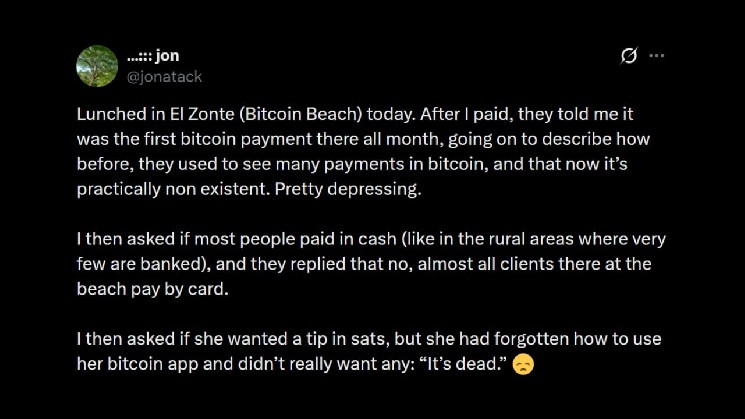
A Bitcoin Core developer, John Atack, who has lived in El Salvador since 2022, shared a concerning anecdote about Bitcoin adoption in the country. While dining at El Zonte, a region known as "Bitcoin Beach," he paid with Bitcoin and was told it was the first such payment the establishment had received in a month. Staff explained Bitcoin payments, once common, have now virtually disappeared, with nearly all customers using cards. An employee even declined a Bitcoin tip, stating she had forgotten how to use her wallet and declaring "It's already dead." Atack emphasized this was a single observation but noted the employee had witnessed the payment evolution over three years. His comments sparked mixed reactions. Some disputed his experience, with one user confirming successful Bitcoin payments in the same area. However, Bitcoin reporter Juan Galt acknowledged an underlying "economic problem," arguing that expecting price appreciation makes using Bitcoin for everyday transactions counterintuitive to economic incentives needed for a circular crypto economy. Despite the concerning report, Atack also reflected that El Salvador remains a global leader in cryptocurrency adoption and progressive legislation, sometimes causing locals to take these advancements for granted. The story highlights the ongoing challenges of mainstream Bitcoin adoption for daily commerce, even in pioneering nations.

cryptonews.ru22m ago

Bitcoin Core Developer Warns That Bitcoin Payments Are Disappearing at 'Bitcoin Beach'

cryptonews.ru22m ago

A Huge 'Sleeping' Wave of New Bitcoin Buyers Has Not Even Bought Bitcoin Yet

A recent study by the Federal Reserve Bank of Cleveland, titled "Do You Even Crypto, Bro? Cryptocurrencies in Household Finance," reveals that Bitcoin and other crypto assets are less understood than other financial assets in US households. The primary reasons for not owning crypto are a lack of knowledge and the perception that it is a poor investment. Even among owners, the main motivations are profit-seeking and portfolio diversification rather than an understanding of the underlying technology's benefits, such as independence from banks. The research found that showing respondents Bitcoin's past 12-month performance increased their desired portfolio allocation by about 47%, indicating investment decisions are driven more by recent returns than fundamental comprehension. Crypto gains are often treated like lottery winnings, leading to one-off luxury purchases rather than sustained increases in spending. While non-owners largely view crypto as high-risk, owners are somewhat less likely to do so, though they exhibit greater uncertainty about future returns compared to traditional assets like stocks or gold. This ambiguity about Bitcoin's nature and valuation contributes directly to its price volatility. The study concludes that this volatility will persist, but education efforts combined with price appreciation could convert today's uninformed non-owners into future Bitcoin holders.

cryptonews.ru25m ago

A Huge 'Sleeping' Wave of New Bitcoin Buyers Has Not Even Bought Bitcoin Yet

cryptonews.ru25m ago

Trading

Spot

Hot Articles

Discussions

Welcome to the HTX Community. Here, you can stay informed about the latest platform developments and gain access to professional market insights. Users' opinions on the price of S (S) are presented below.

活动图片