¡Un altcoin ha sido hackeado, lo que provocó una caída brusca de su precio! ¡También cotiza en grandes exchanges!

cryptonews.ruPublished on 2026-08-24Last updated on 2026-08-24

Abstract

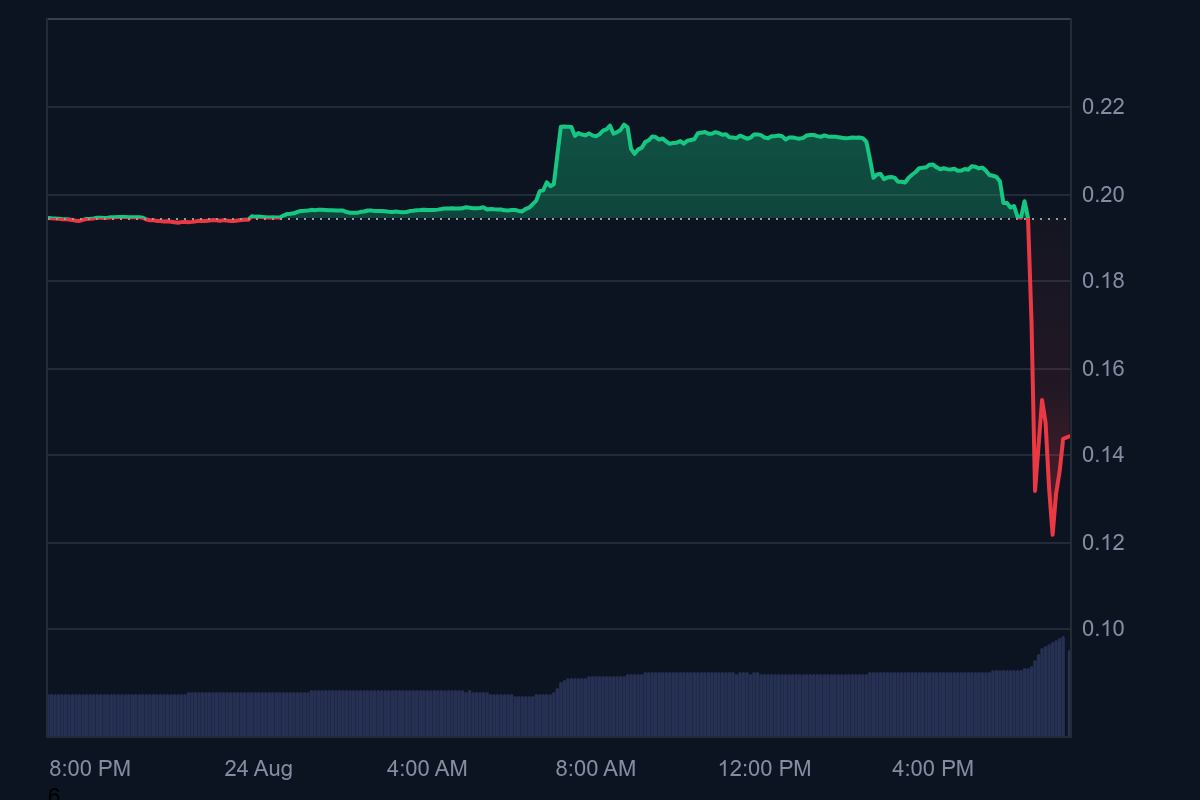
El valor del token NES cayó bruscamente tras detectarse actividad sospechosa y ventas masivas en la red. Observadores de la cadena de bloques sugieren que una billetera generó aproximadamente 55 millones de dólares en tokens NES y comenzó a venderlos en exchanges descentralizados. Esta presión vendedora hizo que el precio de NES cayera hasta un 40%. Según los datos, en la dirección mencionada aún quedan tokens NES por valor de unos 18 millones de dólares, por lo que es probable que la presión vendedora continúe. Antes del incidente, se reportó la transferencia de unos 62,9 millones de tokens NES (equivalente a 12,35 millones de dólares) a la red principal de Ethereum. Más tarde, se afirmó que se retiró liquidez y se vendieron los tokens, aunque estas cifras aún no han sido confirmadas de forma independiente. El equipo de NESA confirmó que detectó un comportamiento malicioso que explotaba una vulnerabilidad en su red de capa 1, originada en Cosmos EVM. Declararon estar trabajando para contener el impacto, responder con rapidez y restaurar los servicios tras implementar un parche de software y medidas de seguridad adicionales. Nesa también notificó a todos los exchanges de criptomonedas y señaló que las operaciones de depósito se reanudarán una vez finalizados los trabajos necesarios. *Esto no es una recomendación de inversión.

El valor del token NES cayó significativamente tras detectarse actividad sospechosa y ventas masivas repentinas en la red. Observadores de la cadena de bloques sugirieron que una billetera había extraído aproximadamente 55 millones de dólares en tokens NES y comenzó a venderlos en exchanges descentralizados. Esta presión vendedora hizo que el precio de NES cayera hasta un 40%.

Según los datos proporcionados, la dirección en cuestión aún contiene tokens NES por valor de aproximadamente 18 millones de dólares. Por lo tanto, es posible que la presión vendedora en el mercado continúe.

Antes del incidente, se informó que en la mañana (hora de Turquía) se transfirieron a la red principal de Ethereum unos 12,35 millones de dólares estadounidenses en forma de 62,9 millones de tokens NES. Por la tarde, se afirmó que se había retirado la liquidez y que los tokens se vendieron en el mercado. Sin embargo, los datos sobre la creación de tokens por valor de 55 millones de dólares y la transferencia de 62,9 millones de tokens NES aún no han sido verificados de forma independiente.

El equipo de NESA confirmó en un comunicado que detectó un comportamiento malicioso que aprovecha una vulnerabilidad en la red de capa 1, proveniente de Cosmos EVM. En la declaración del equipo se decía lo siguiente:

«Hemos identificado actividad maliciosa que utiliza una vulnerabilidad de Cosmos EVM en la red de capa 1 de NESA. Estamos trabajando para contener el impacto. Hemos actuado con prontitud. Restauraremos los servicios tras implementar un parche de software y medidas adicionales para garantizar el funcionamiento seguro de la red».

Nesa también declaró que se ha notificado a todos los exchanges de criptomonedas y que las operaciones de depósito se reanudarán una vez completados los trabajos necesarios.

El gráfico muestra la caída del precio de NES tras completarse el desarrollo.

*Esto no es una recomendación de inversión.

end-content

Trending Cryptos

Related Questions

Q¿Qué provocó la caída del precio del token NES?

ALa caída del precio del token NES fue provocada por actividad sospechosa en la red, donde una billetera extrajo aproximadamente 55 millones de dólares en tokens NES y comenzó a venderlos en exchanges descentralizados, generando presión vendedora.

Q¿Qué vulnerabilidad fue explotada en el incidente, según la declaración del equipo de NESA?

ASegún la declaración del equipo de NESA, la actividad maliciosa explotó una vulnerabilidad en la red de Capa 1 (nivel 1) que provenía de la EVM de Cosmos.

Q¿Qué medidas está tomando el equipo de NESA en respuesta al incidente?

AEl equipo de NESA está trabajando para localizar el impacto, ha respondido rápidamente y planea restablecer los servicios después de implementar un parche de software y medidas adicionales para garantizar el funcionamiento seguro de la red.

Q¿Qué sucedió con los tokens NES que fueron transferidos a la red principal de Ethereum la mañana del incidente?

ALa mañana del incidente, se transfirieron aproximadamente 62,9 millones de tokens NES (valorados en unos 12,35 millones de dólares) a la red principal de Ethereum. Más tarde, se afirmó que se retiró liquidez y se vendieron los tokens en el mercado, pero estos datos aún no han sido confirmados de forma independiente.

Q¿Cuál es el valor aproximado de los tokens NES que aún permanecen en la dirección sospechosa después de las ventas?

ADespués de las ventas, la dirección sospechosa aún contiene tokens NES por un valor aproximado de 18 millones de dólares, lo que sugiere que la presión vendedora en el mercado podría continuar.

Related Reads

Conversation with Charles Zhang: Amidst the AI Frenzy, Why Pursue 'Anti-Efficiency' Content?

Dialogue with Charles Zhang: In the Era of AI's Sprint, Why Create "Anti-Efficiency" Content Standing out among China's early internet pioneers, Charles Zhang, founder and CEO of Sohu, maintains a distinct personal identity. He keeps a consistent public presence and embodies traits of high-energy individuals: sleeping only 4-5 hours daily, running 5km or marathons, and hosting frequent offline tech forums and dialogues with Nobel laureates. He has shifted focus from external business expansion to internal self-reconstruction, adhering to his own pace. "People aren't afraid of being busy; the busier you are, the better your health. Having nothing to do can lead to emotional issues and poor health." Marking the 10th anniversary of his live-streamed "Charles Zhang's English Class," he recently took it offline for a real-world classroom session. Following this, he discussed the course's decade-long journey, Sohu Video's content ecosystem, and the value of content in the AI era. **Pen and Mouth Diligence: A Class Against Instant Mastery** His English class began in August 2016 on "Qianfan Live." He spends about 40 minutes daily preparing, reviewing dozens of news headlines, reading five in detail, and selecting three for the lesson. Over ten years, he has completed over 2000 live sessions totaling more than 110,000 minutes, with over 52 million views. Initially, the stream was a way to "talk more" and combat emotional struggles. He started by repeating after TV news anchors, then moved to live-streaming with the launch of Qianfan Live. It was 40% for personal emotional regulation ("like a monk chanting sutras"), 30% to deliver authentic news, and 30% to promote the new platform. This daily "ritual" helped him overcome depression, leading to what he calls his "peak life state." From a product perspective, it was counter-intuitive—launched without prior market research or growth strategies, based on the founder's personal need that resonated with users. Yet, his content creation follows a strict routine. The decade of covering geopolitics, economics, tech, health, and society has built a vast "knowledge compound interest" system. In an age of AI summaries and algorithmic content, Zhang insists on "hard work": meticulous reading, handwritten notes, and manually created teaching materials, refusing AI-generated content. The English class is now a fixed daily rhythm; preparing for his weekly physics class requires a full day of solitary deduction on a blackboard. In his live streams, Zhang positions himself as a "content creator," not a CEO or teacher. He sees physics as extreme brain training and English as a "sensor" to understand the world. This explains why a top entrepreneur persists for a decade in seemingly "unprofessional" pursuits—it's the information input and psychological healing method he found during a low point. It's fundamentally an "anti-efficiency" commitment. He believes the meaning of reading lies in finding community and spiritual support, not just fleeting conversation points. For today's media, he states: "Reading news isn't the goal. As humans with many confusions, we need reference points, to find a group, find kindred spirits, or seek support and spiritual nourishment. Large language models can't satisfy these starting points; they only give you information." This offers solace and a value defense for media professionals impacted by AI summaries. **"Don't Think Earth Stops Turning Because AI Arrived"** A content creator expressed anxiety: after feeding their article to AI, it produced a more comprehensive, profound version, making their work feel valueless. Zhang responded with an analogy: "Carrots from the market, with a bit of soil, not glossy, taste delicious and flavorful. Tomatoes forced by chemical fertilizer have no taste at all." He sees AI giving world content a "plastic feel," but acknowledges its significant role in improving information access efficiency, especially in physics and social science research where he often queries AI for quick professional answers. The key, Zhang stresses, is that the outside world still needs to guide our perspective. LLMs provide "information," while the outside world offers "viewpoints." He cares deeply about *what* that external viewpoint is and *how* someone thinks about an issue. "Don't think the Earth stops turning because AI arrived," he analyzes. AI currently replaces rule-based work, noting significant impact on the software industry with many programmers laid off as even less experienced people can now write decent code. However, AI cannot yet replace arts, social sciences, emotions, and creative content. "Hollywood remains thriving, producing great works. Oscars will continue, Nobel Literature Prizes will still be awarded—all by real people, with works conceived by real people." While wary of AI, Zhang isn't anti-technology and is open to its applications. Sohu itself has launched AI assistants. In Sohu's AI practice, Zhang defines his role as a "large language model corpus provider." He believes LLM training is inseparable from human-original content as its data foundation, so original content retains irreplaceable value. "The era of self-media indeed offers everyone new ways to discover their strengths and achieve growth." He suggests every young person should consider self-media. Most importantly, the bottom line of content creation should be "authenticity." If using AI avatars, they must be clearly labeled; not doing so and misleading viewers wastes their time, especially when people still prefer real human content. Behind AI's sprint lie unavoidable realities. As AI quickly provides seemingly perfect answers, people grow accustomed to accepting "summarized" results, omitting processes of questioning, deduction, and trial-and-error, leading to a decline in deep thinking. Zhang's "anti-efficiency" practice with his two live-streamed classes is his answer to AI's狂奔: In an algorithm-driven era chasing ultimate efficiency, don't expect AI to fill inner voids. Read books, speak in front of a camera, sweat on a running track, and build connections with real people.

marsbit10m ago
Conversation with Charles Zhang: Amidst the AI Frenzy, Why Pursue 'Anti-Efficiency' Content?

marsbit10m ago

Zcash's ETF Gilding: How a Privacy Coin Was Packaged by Wall Street into a Compliant Asset

The article traces the decade-long path of Zcash (ZEC), a privacy-focused cryptocurrency, to its potential launch as the first privacy coin spot ETF, with Grayscale's ZCSH filing in August 2026. It argues ZEC's suitability stemmed not from regulatory acceptance of its privacy technology, but from its centralized, institutional structure from inception—a commercial company (ECC) with venture capital backing and a Founder's Reward—making it easier to package than decentralized alternatives. Three key institutions, intertwined in a network, drove the process: Grayscale (owned by DCG, an early ZEC investor), which had held ZEC in a trust since 2017; Coinbase, providing custody, prime brokerage, derivatives, and venture investment; and ZODL, a new for-profit entity formed in 2026 when ECC's core development team split from the non-profit foundation. The major regulatory hurdle was SEC scrutiny (2023-2026) over ZEC's historical structure, which resembled an unregistered investment contract due to automatic block rewards to ECC and the Foundation. This was resolved through governance changes (NU6 upgrade in 2024) that ended direct funding and shifted control to community voting, coinciding with a broader shift in SEC enforcement policy. Notably, the law firm Davis Polk represented both the Zcash Foundation in its SEC defense and Grayscale in the ETF filing. The push is also driven by DCG's dire financial needs amid Genesis bankruptcy lawsuits, seeking high-fee products (the ZEC ETF charges 2.5%). Concurrently, major mining operations by entities like Cypherpunk Technologies (backed by Winklevoss Capital) and DCG's Fortitude Mining expanded, motivated by profitability and aiming to influence the network. The article concludes with irony: to become a compliant ETF asset, ZEC must shed its core privacy feature for the fund's holdings, which will be held in transparent, auditable addresses. Wall Street is not adopting privacy technology but packaging the *concept* of privacy into a tradable, fee-generating financial product. The transformation was not a single master plan but the result of a network of aligned interests capitalizing on regulatory, governance, and market shifts over ten years.

marsbit20m ago

Zcash's ETF Gilding: How a Privacy Coin Was Packaged by Wall Street into a Compliant Asset

marsbit20m ago

Bitcoin Core Developer Warns That Bitcoin Payments Are Disappearing at 'Bitcoin Beach'

A Bitcoin Core developer, John Atack, who has lived in El Salvador since 2022, shared a concerning anecdote about Bitcoin adoption in the country. While dining at El Zonte, a region known as "Bitcoin Beach," he paid with Bitcoin and was told it was the first such payment the establishment had received in a month. Staff explained Bitcoin payments, once common, have now virtually disappeared, with nearly all customers using cards. An employee even declined a Bitcoin tip, stating she had forgotten how to use her wallet and declaring "It's already dead." Atack emphasized this was a single observation but noted the employee had witnessed the payment evolution over three years. His comments sparked mixed reactions. Some disputed his experience, with one user confirming successful Bitcoin payments in the same area. However, Bitcoin reporter Juan Galt acknowledged an underlying "economic problem," arguing that expecting price appreciation makes using Bitcoin for everyday transactions counterintuitive to economic incentives needed for a circular crypto economy. Despite the concerning report, Atack also reflected that El Salvador remains a global leader in cryptocurrency adoption and progressive legislation, sometimes causing locals to take these advancements for granted. The story highlights the ongoing challenges of mainstream Bitcoin adoption for daily commerce, even in pioneering nations.

cryptonews.ru22m ago

Bitcoin Core Developer Warns That Bitcoin Payments Are Disappearing at 'Bitcoin Beach'

cryptonews.ru22m ago

A Huge 'Sleeping' Wave of New Bitcoin Buyers Has Not Even Bought Bitcoin Yet

A recent study by the Federal Reserve Bank of Cleveland, titled "Do You Even Crypto, Bro? Cryptocurrencies in Household Finance," reveals that Bitcoin and other crypto assets are less understood than other financial assets in US households. The primary reasons for not owning crypto are a lack of knowledge and the perception that it is a poor investment. Even among owners, the main motivations are profit-seeking and portfolio diversification rather than an understanding of the underlying technology's benefits, such as independence from banks. The research found that showing respondents Bitcoin's past 12-month performance increased their desired portfolio allocation by about 47%, indicating investment decisions are driven more by recent returns than fundamental comprehension. Crypto gains are often treated like lottery winnings, leading to one-off luxury purchases rather than sustained increases in spending. While non-owners largely view crypto as high-risk, owners are somewhat less likely to do so, though they exhibit greater uncertainty about future returns compared to traditional assets like stocks or gold. This ambiguity about Bitcoin's nature and valuation contributes directly to its price volatility. The study concludes that this volatility will persist, but education efforts combined with price appreciation could convert today's uninformed non-owners into future Bitcoin holders.

cryptonews.ru25m ago

A Huge 'Sleeping' Wave of New Bitcoin Buyers Has Not Even Bought Bitcoin Yet

cryptonews.ru25m ago

Trading

Spot

Hot Articles

Discussions

Welcome to the HTX Community. Here, you can stay informed about the latest platform developments and gain access to professional market insights. Users' opinions on the price of S (S) are presented below.

活动图片