Altcoin Hacked, Leading to Sharp Price Drop! Also Listed on Major Exchanges!

cryptonews.ruPublished on 2026-08-24Last updated on 2026-08-24

Abstract

The price of the NES token plummeted significantly following suspicious activity and large sell-offs detected on the network. Blockchain observers suggested that one wallet minted approximately $55 million worth of NES tokens and began selling them on decentralized exchanges. This selling pressure caused the price of NES to drop by up to 40%. According to the data, the address in question still holds around $18 million worth of NES, indicating that market sell-off pressure may continue. Prior to the incident, it was reported that about $12.35 million worth (62.9 million NES tokens) were transferred to the Ethereum mainnet in the morning (Turkish time), with claims that liquidity was withdrawn and tokens were sold on the market later that evening. However, data regarding the $55 million token mint and the transfer of 62.9 million NES tokens has not been independently confirmed. The NESA team confirmed in a statement that they detected malicious activity exploiting a vulnerability in their Layer 1 network originating from Cosmos EVM. They stated they are working to contain the impact, responded promptly, and will restore services after implementing a software patch and additional measures to ensure secure network operation. Nesa also notified all cryptocurrency exchanges and stated deposit operations will resume after necessary work is completed. The article includes a chart showing the NES price decline following the exploit and concludes with a standard disclaimer that this...

The value of NES tokens has plummeted significantly following the detection of suspicious activity and rapid sell-offs within the network. Blockchain observers suspected that one wallet minted approximately $55 million worth of NES tokens and began selling them on decentralized exchanges. This selling pressure caused the price of NES to drop by up to 40%.

According to available data, the specified address still holds approximately $18 million worth of NES. Therefore, it can be assumed that selling pressure on the market may continue.

Prior to the incident, it was reported that in the morning (Turkish time), around $12.35 million worth of 62.9 million NES tokens were transferred to the Ethereum mainnet. In the evening, it was claimed that liquidity was withdrawn and the tokens were sold on the market. However, data regarding the minting of $55 million worth of tokens and the transfer of 62.9 million NES tokens has not yet been independently confirmed.

The NESA team confirmed in a statement that they detected malicious behavior exploiting a vulnerability in the Layer 1 network, originating from Cosmos EVM. The team's statement included the following:

"We have identified malicious activity exploiting a Cosmos EVM vulnerability in the NESA Layer 1 network. We are working to contain the impact. We responded promptly. We will restore services after implementing a software patch and additional measures to ensure the secure operation of the network."

Nesa also stated that all cryptocurrency exchanges have been notified and that deposit operations will resume after the completion of necessary work.
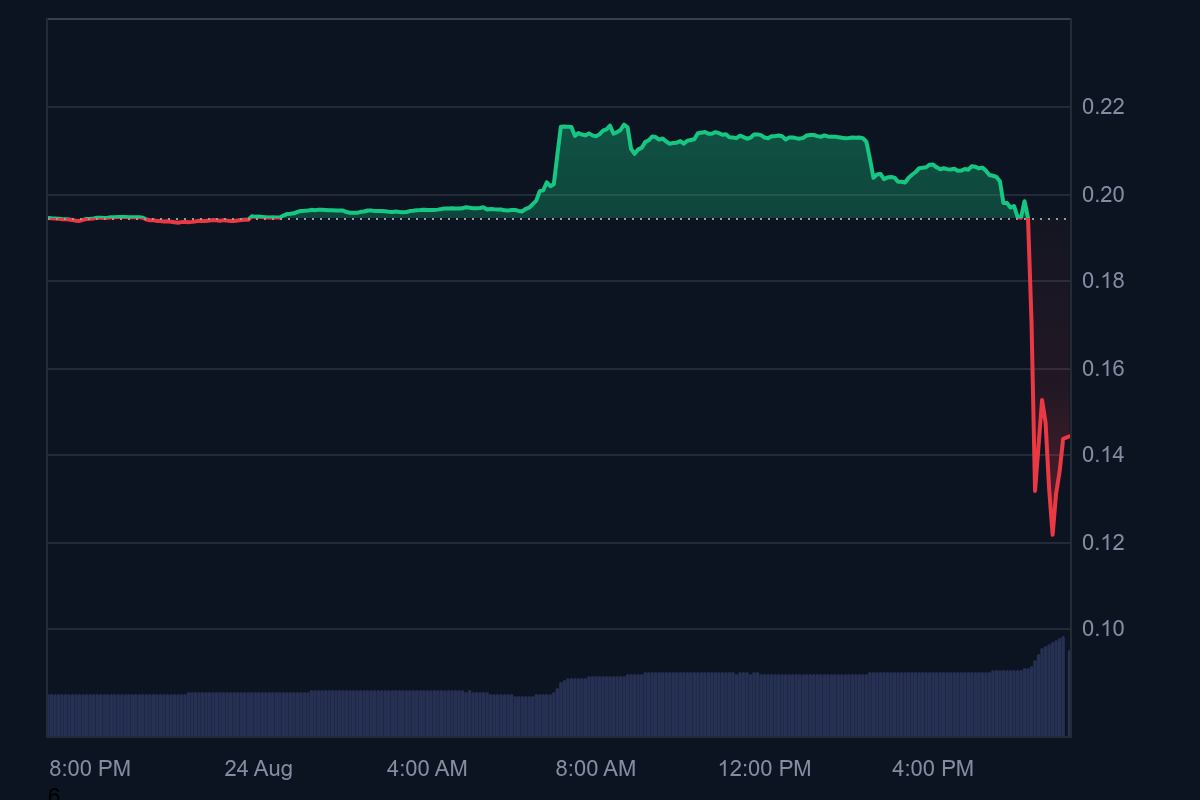
The chart shows the decline in the price of NES after the minting event.

*This is not investment advice.

end-content
Trending Cryptos

Related Questions

QWhat was the suspected cause of the significant price drop in NES tokens?

AThe significant price drop in NES tokens was caused by suspicious activity and sharp sell-offs. Blockchain observers suggested a wallet mined approximately $55 million worth of NES tokens and began selling them on decentralized exchanges, leading to a sell-off pressure.

QAccording to the article, what vulnerability did the malicious actors exploit according to the NESA team's statement?

AAccording to the NESA team's statement, the malicious actors exploited a vulnerability originating from the Cosmos EVM in the NESA Layer 1 network.

QWhat amount of NES tokens, in terms of US dollar value, did the suspected wallet still reportedly hold after the initial sell-off?

AAfter the initial sell-off, the suspected wallet reportedly still held NES tokens worth approximately $18 million.

QWhat did the Nesa team say about their communication with cryptocurrency exchanges regarding the incident?

AThe Nesa team stated that all cryptocurrency exchanges were notified about the incident and that deposit operations would be resumed after the necessary work was completed.

QWhat does the figure caption in the article state about the provided chart?

AThe figure caption states that the chart shows the decline in the NES price after the completion of the development or minting (of the tokens by the malicious actor).

Related Reads

NVIDIA Stuns with First Vera Rubin Test, DeepSeek Throughput Skyrockets 30x

NVIDIA has unveiled the first on-silicon test results for its next-generation flagship cabinet, the Vera Rubin NVL72, using DeepSeek-V4-Pro on real "agent coding" workloads. The results are staggering: compared to the current leading GB300 NVL72, Vera Rubin delivers up to a 30x increase in throughput per megawatt and reduces token generation cost by up to 35x. The benchmark used was the AgentX test from SemiAnalysis, which captures full AI agent workflows with growing context, tool calls, and sub-agent generation, moving beyond traditional LLM benchmarks. This highlights a shift from the LLM era to the Agent era. Key innovations behind Vera Rubin's performance include extreme co-design, separation of services, distributed KV cache, KV-aware routing, MegaMoE architecture, 4-bit NVFP4 quantization, and 6th-gen NVLink for efficient MoE model execution. Simultaneously, NVIDIA announced the full-scale production of two new chips: 1. **Groq 3 LPX:** A low-latency inference accelerator designed for the Vera Rubin platform. When paired with Rubin GPUs for context processing, it achieves record-breaking output speeds—e.g., running Gemma 4 31B at 3,400 tokens/sec—drastically reducing multi-step agent task times. 2. **Vera CPU:** A processor specifically built for agentic AI, featuring 88 custom Olympus cores and 1.2TB/s memory bandwidth to handle the complex orchestration of agent tasks. SpaceXAI is already deploying it, with plans for space-based Vera Rubin systems by 2028. NVIDIA's strategy has evolved from selling GPUs to providing a complete, optimized "AI factory" stack—encompassing GPU, CPU, and specialized accelerators—to power the emerging Agent AI economy.

marsbit1m ago

NVIDIA Stuns with First Vera Rubin Test, DeepSeek Throughput Skyrockets 30x

marsbit1m ago

Bessent Repurchases U.S. Treasury Bonds, So Why Is Bitcoin Rising?

On August 19, U.S. Treasury Secretary Scott Bessent significantly increased the limits for buying back long-term Treasury bonds (10, 20, and 30-year maturities), calling it a "Treasury Twist Operation." The goal was to lower soaring long-term yields, which had recently hit multi-decade highs, by boosting demand for these bonds. However, the effect on yields was brief and limited. The article explains that the Treasury's bond buybacks, funded by issuing more short-term debt or using its cash reserves, do not create new money but merely restructure government debt. Major factors pushing yields higher—such as large budget deficits, corporate borrowing for AI investments, inflation driven by rising oil prices, and Federal Reserve policy uncertainty—remained unaddressed, limiting the operation's impact. Instead of taming bond yields, the intervention was interpreted by markets as a sign of official concern over debt sustainability and potential future currency depreciation. This triggered a rally in assets perceived as hedges against such risks: Bitcoin surged toward $80,000, gold rose, and the U.S. dollar weakened. Further context includes Bessent's unusual suggestion for corporations to issue more medium-term ("belly") debt and the potential long-term role of dollar-pegged stablecoins (backed heavily by Treasuries) in influencing government borrowing costs. The move broke with the Treasury's traditional "regular and predictable" debt management approach. Analysts warn that such unexpected interventions could ultimately increase long-term borrowing costs if they erode investor confidence, creating a potential "Bessent put" similar to the "Greenspan put" for equities. Ultimately, the operation twisted markets for currencies and alternative assets more than the Treasury yield curve itself.

marsbit7m ago

Bessent Repurchases U.S. Treasury Bonds, So Why Is Bitcoin Rising?

marsbit7m ago

DeFi Sector Bounces Back Strongest: Which High-Revenue Projects Offer Entry Opportunities?

DeFi Sector Leads Recovery: Which High-Revenue Projects Are Worth Watching? DeFi has been one of the most active sectors during the recent market rebound. Beyond chasing price action, a key fundamental metric for evaluating DeFi protocols is sustainable revenue, which indicates real user demand. This analysis highlights high-revenue projects across key categories, using protocol fee data (net of supplier payouts). **DEX** * **Uniswap (UNI)**: Leads with $7.18M in 30-day revenue. Protocol fees from v2 and select v3 pools are used for UNI token burns. * **Solana DEXs**: Jupiter (JUP, $4.69M 30-day revenue) uses 50% of revenue for JUP buybacks. Meteora (MET, $1.67M) and Raydium (RAY, $1.13M) also allocate portions of fees to token buybacks. * **PancakeSwap (CAKE)**: Earned $5.16M in 30 days, with part of its fees used for CAKE burns, maintaining a net deflationary supply. * **Aerodrome (AERO)**: On Base, it generated $4.11M in 30 days. Revenue is directly distributed to veAERO holders rather than used for buybacks. **Lending** * **World Liberty Financial (WLFI)**: Top earner with $10.47M in 30-day revenue. A proposal passed to use 100% of fees from its Protocol-Owned Liquidity (POL) for WLFI buybacks, but holder net income remains zero. * **Aave (AAVE)**: Generated $4.12M in 30 days. Its buyback program was paused in April 2026 following the rsETH bridge attack. **ETH Staking** * **ether.fi (ETHFI)**: Earned $3.03M in 30 days. Revenue from eETH withdrawals is used for ETHFI buybacks, which are then distributed to sETHFI stakers. * **Lido (LDO)**: Generated $2.31M. Its new NEST mechanism automatically uses 50% of annual revenue exceeding $40M for LDO buybacks. In summary, several DeFi protocols are generating significant revenue, with many employing token buyback or direct distribution mechanisms. This revenue provides a fundamental basis for evaluation amid market volatility.

marsbit10m ago

DeFi Sector Bounces Back Strongest: Which High-Revenue Projects Offer Entry Opportunities?

marsbit10m ago

Hyperliquid is also getting a Layer2, what is Elysium?

Hyperliquid, a decentralized exchange, is set to launch its own Layer 2 solution called Elysium, developed by its largest liquid staking protocol, Kinetiq. This move aims to address key limitations in Hyperliquid's current ecosystem, particularly the performance and user experience issues on its existing HyperEVM. The article explains that HyperEVM has struggled with network congestion, high gas fees (sometimes exceeding $10-$20 per simple swap), and a fragmented infrastructure for launching and trading new tokens, especially memecoins. While there is significant speculative interest, the current setup lacks the efficient trading infrastructure to sustain it. Elysium is designed as a high-performance L2 that will use HYPE as its gas token. Its goals are to provide drastically faster block times and higher throughput compared to HyperEVM, create a seamless pipeline for token launches (from initial creation on Elysium to eventual listing as spot and perpetual markets on Hyperliquid's main chain, HyperCore), and offer developers richer access to HyperCore's order book data for better hedging and market-making. The L2 is positioned not as a competitor to HyperCore but as a "value-accrual" layer that aims to drive more activity and volume back to the main chain. Potential use cases extend beyond memecoins to include complex applications like PaperTrade (a novel perpetual DEX) and other DeFi protocols requiring fast settlement and real-time data. Elysium's sequencer revenue is planned to be shared with applications, the Kinetiq treasury, and used to buy back and burn the KNTQ token.

marsbit11m ago

Hyperliquid is also getting a Layer2, what is Elysium?

marsbit11m ago

Trading

Spot

Hot Articles

Discussions

Welcome to the HTX Community. Here, you can stay informed about the latest platform developments and gain access to professional market insights. Users' opinions on the price of S (S) are presented below.

活动图片