Huang Renxun is really not content with just selling shovels anymore!
Today, multiple foreign media outlets broke the news that NVIDIA plans to invest $60 billion (approximately 43 billion RMB) to build the world's strongest open-source weight AI model!
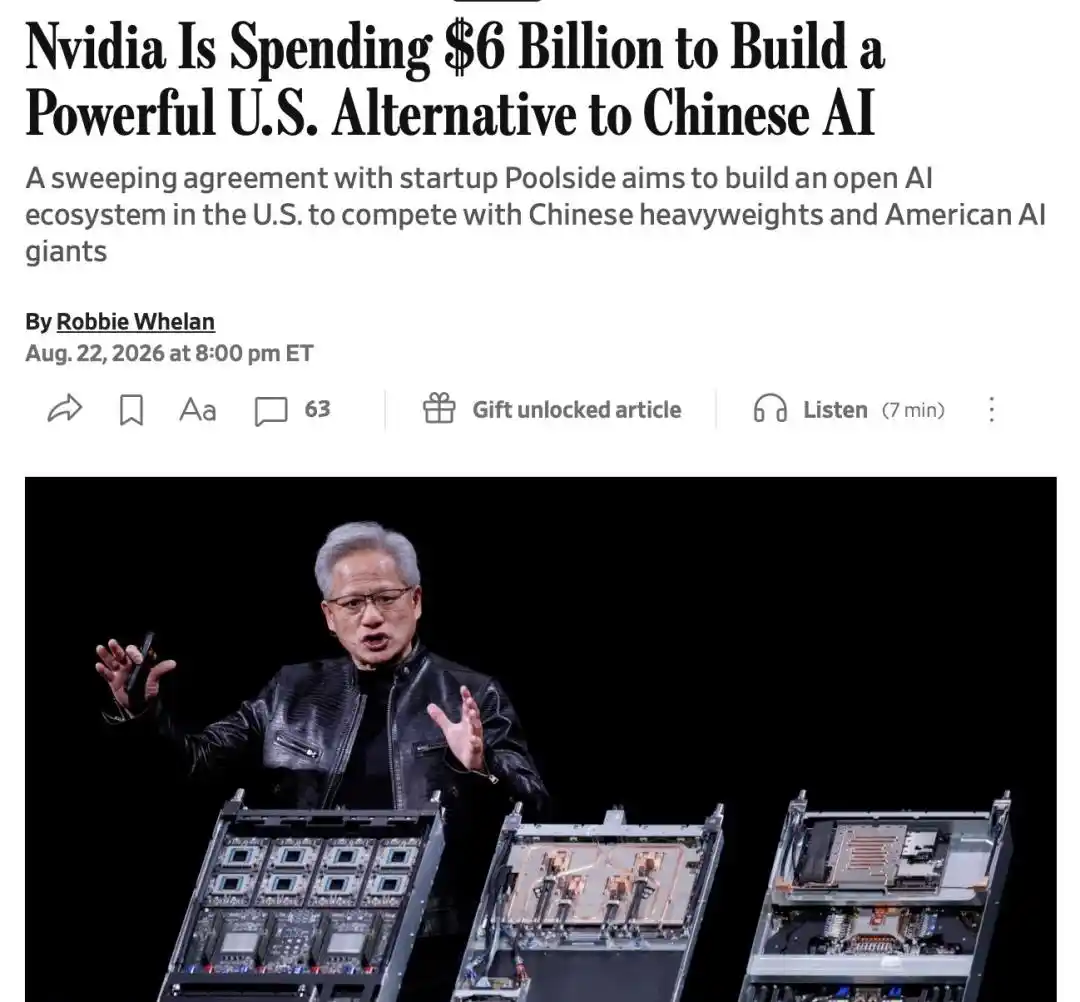
NVIDIA, indeed, is no longer pretending. Now, they are stepping onto the field to take over the gold mines themselves.
To achieve this ambition, Huang Renxun has unleashed a series of swift moves.
First, he spent $6 billion to buy the "model factory" technology from AI startup Poolside.
Next, he poached the core team, directly inviting 109 of Poolside's key engineers to join, with all of them integrated into NVIDIA's Nemotron project.
Finally, he splurged another $1 billion, investing with a pre-money valuation as high as $12 billion!
With this seamless combination of moves, he essentially completed a "soft acquisition" in one fell swoop.
The industry was shocked: the competitive landscape of AI large models is likely to change dramatically soon.
Huang Renxun is no longer the computing power overlord hiding behind the scenes. Now, clad in his leather jacket, he has stepped directly into the spotlight.
Masterful Maneuver: Absorbing a $12 Billion Unicorn
So, why was Poolside chosen?
This company has an extremely impressive background.
It was founded in 2023. Its founder, Eiso Kant, is a seasoned software developer, and the other co-founder, Jason Warner, is the former CTO of GitHub. The Laguna coding model they built is very famous in the Western open-source community.
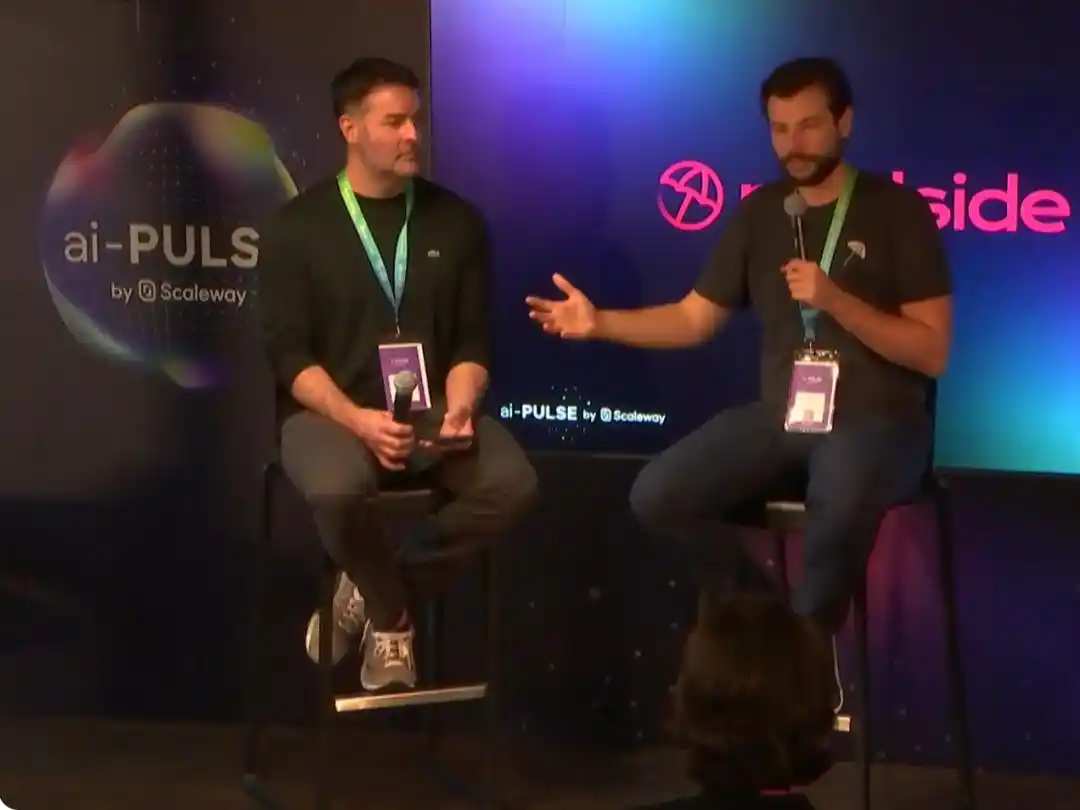
However, even the most brilliant technical geniuses have to bow to financial reality.
In a letter sent to shareholders by Poolside on Thursday, a heartbreaking "survival story" was revealed.
The letter mentioned that late last year, they originally had a 6-week window to urgently raise $2 billion to pay for a supercomputing cluster of 40,000 GB300s scheduled to go online in January of this year.
The result? They failed to secure the financing in time and lost access to that cluster.
The founding team finally realized this harsh reality: without massive capital and top-tier data center support, the company's computing power would be completely exhausted by next year at the latest.
No computing power equals death.
At that very moment, NVIDIA descended from the heavens.
NVIDIA not only has money but also possesses the world's largest and most advanced computing infrastructure. Poolside stated frankly in the letter that NVIDIA is the "perfect partner" because they face almost no limitations in computing infrastructure or cash.
Even more interesting is NVIDIA's maneuvering technique.
They did not choose to fully acquire Poolside outright. Instead, they adopted a model of "$6 billion licensing fee + poaching 109 employees + $1 billion investment."
This way, Poolside founders Kant and Warner, along with operational executive Margarida Garcia, could remain in their positions, and the company continues to operate independently.
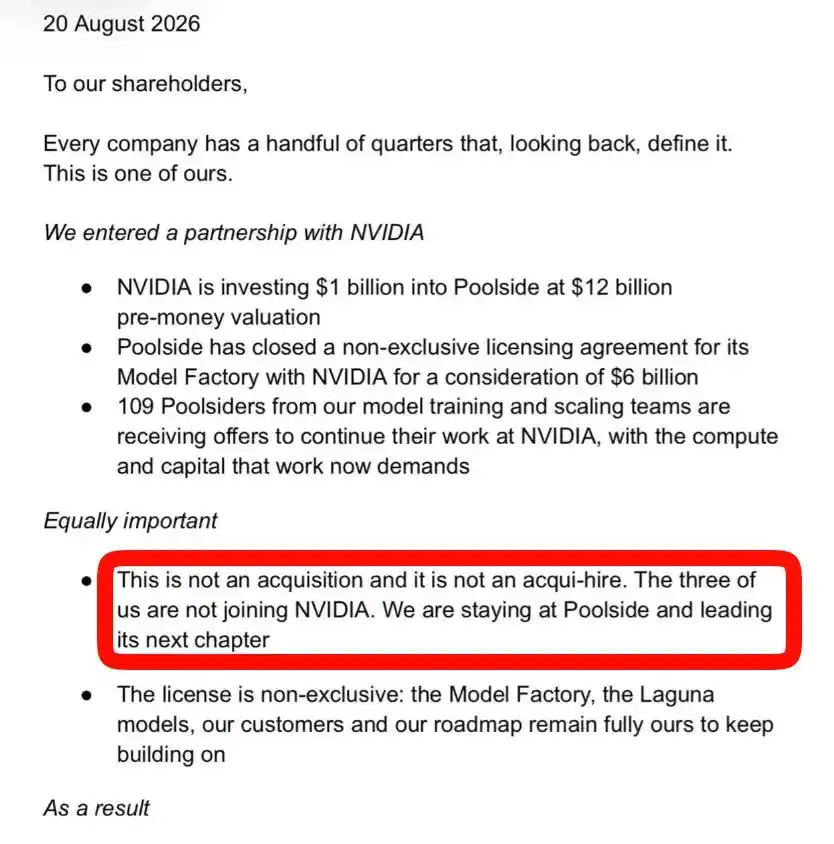
It's worth noting that this is already the third time NVIDIA has used this transaction model! Its previous operations with Groq and Enfabrica were exactly the same.
This "soft acquisition" masterstroke allows them to quickly obtain cutting-edge technology and a hundred-person team while cleverly avoiding the stringent scrutiny that antitrust regulators apply to "full acquisitions."
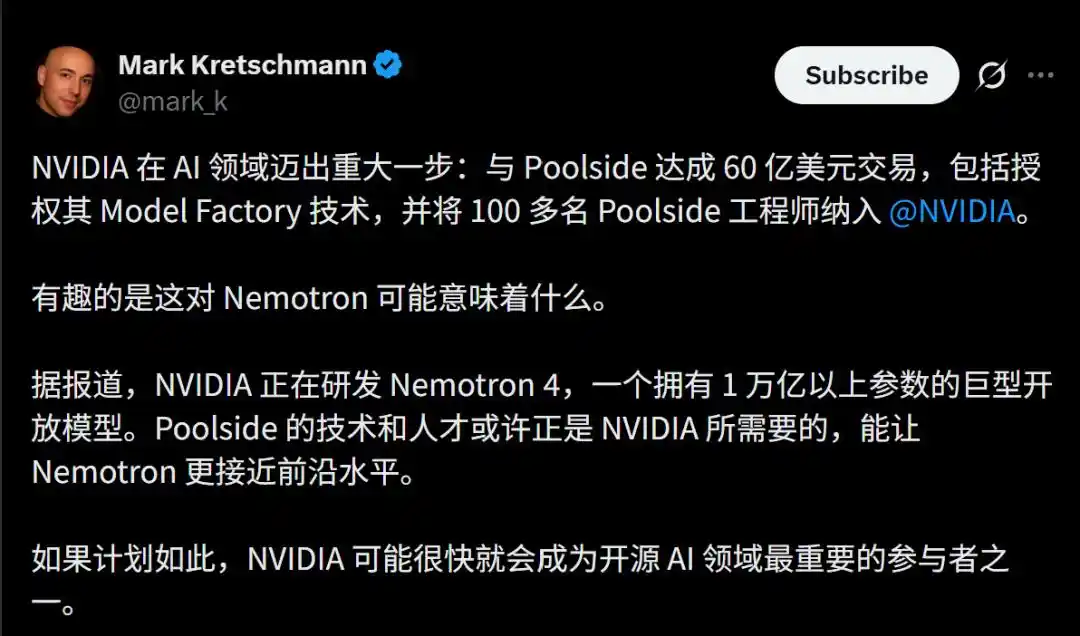
Aiming for Trillion Parameters! Nemotron 4 is About to Take Off
What exactly will these 109 top engineers, poached at great expense, be doing?
There's only one answer: going all out to sprint towards Nemotron 4!
Actually, NVIDIA had already launched its own open-source weight model project—Nemotron. But in the past, this project seemed more like something NVIDIA maintained to showcase the superiority of its GPU computing power.
But now it's different. Nemotron has now been elevated by Huang Renxun to a strategic-level priority.
Just earlier this month, NVIDIA released the lightweight Nemotron 3.5 Lightning model.
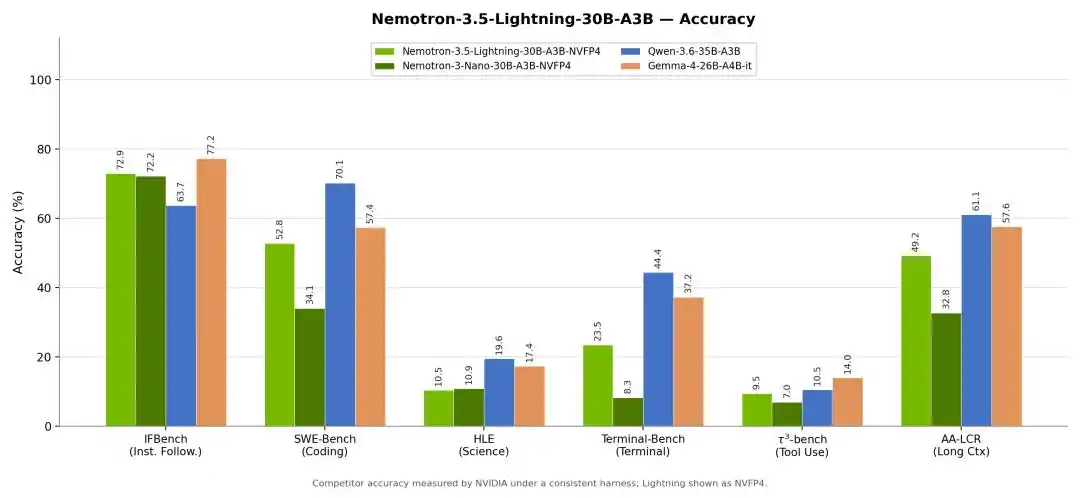
But that was just an appetizer. The real main course is the massive Nemotron 4, currently under secret development.
According to insiders, with the addition of Poolside's hundred-person core team, Nemotron 4 is reaching a terrifying scale of "trillions of training parameters"!
From now on, it is very likely to directly join the global top tier of large models.
NVIDIA's ambition is to reach the pinnacle in one step, creating the "strongest American open-source alternative" capable of competing with the most powerful models.
The Poolside founders explained in the letter that the purpose of this deal is to ensure that the future of AGI "does not become a closed technology controlled by a few, but a technology built together by many in an open environment."
Open source is the right path! This time, NVIDIA is betting on open-source large models.
The "Sputnik Moment" Brought by Open-Source Large Models, Huang Renxun is Getting Anxious
Why is NVIDIA, which has been quietly making a fortune, suddenly investing heavily in building open-source models?
Because the most advanced open-source large models are making American tech giants feel unprecedented pressure.
Although Huang Renxun has always publicly supported open-source weight models, the majority of resources in the US AI industry have been poured into the "closed-source" large models of giants like OpenAI, Anthropic, and Google.
This has given open-source AI a perfect opportunity.
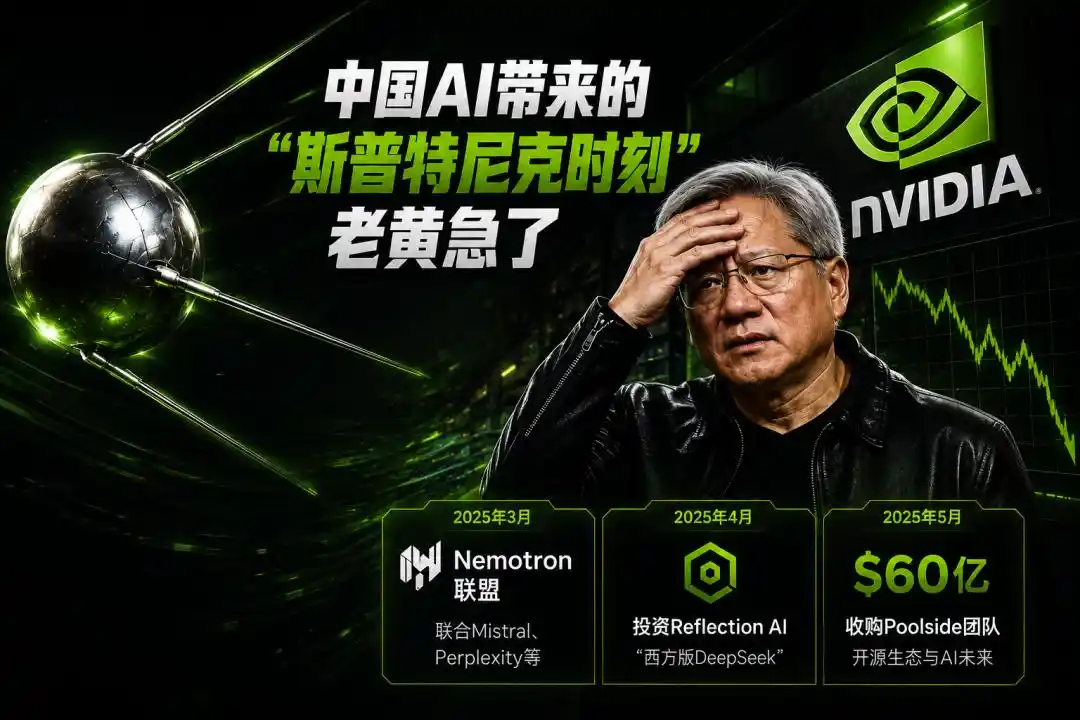
January 2025 was destined to be a month recorded in AI history. When DeepSeek released its first low-cost, high-performance open-source weight model, the entire US tech stock market was in mourning.
Investors suddenly discovered that top open-source models were not only approaching the capabilities of the US's cutting-edge technology but were surpassing them in cost control and open-source ecosystems.
Silicon Valley's famous venture capitalist Marc Andreessen even called that moment the "Sputnik Moment" for the US AI community.
Subsequently, more open-source models caught up.
Huang Renxun finally couldn't sit still.
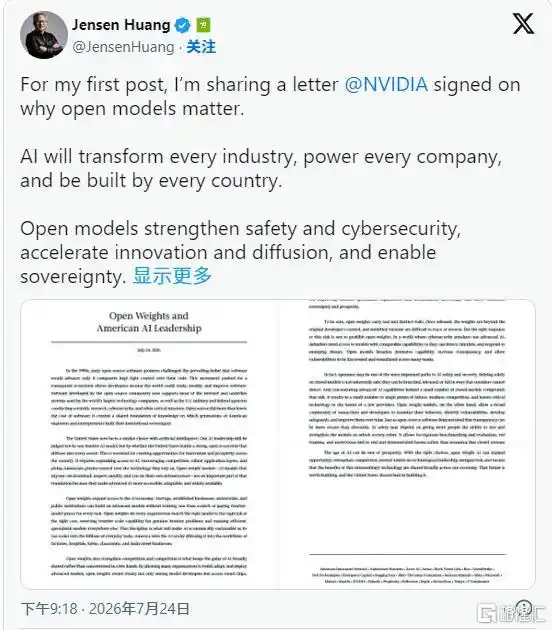
Last month, Jensen Huang published his first long post on X—"Open Weights and US AI Leadership."
In the post, he urgently called out: "Whether America wins cannot be judged by a single frontier closed model, but by whether America can build a strong, pervasive open ecosystem across industries."
To this end, NVIDIA must step onto the field itself.
As early as March this year, NVIDIA took the lead in establishing the "Nemotron Alliance," bringing together Mistral, Perplexity, and others to share data and computing power. Simultaneously, NVIDIA also made significant investments in Reflection AI, which is hailed as the "American version of DeepSeek."
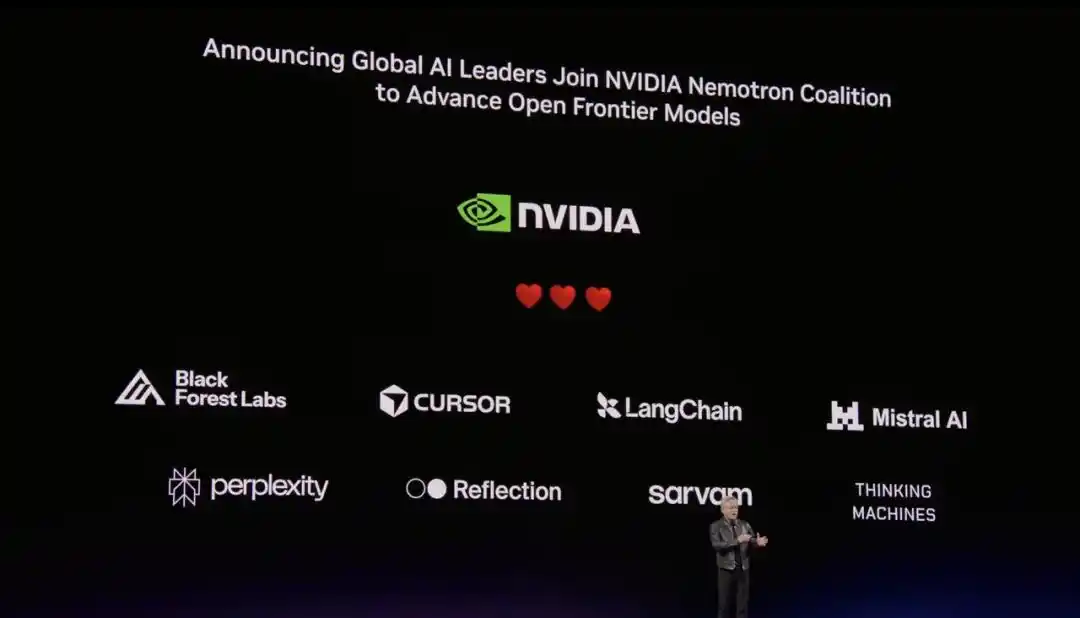
Today's massive $6 billion investment to acquire the Poolside team is NVIDIA's logical next step.
Going Head-to-Head with OpenAI, Is Huang Renxun Not Afraid of Offending Major Clients?
NVIDIA's forceful entry inevitably creates a delicate situation—
NVIDIA is becoming a direct competitor to its biggest clients.
Major companies like OpenAI and Anthropic are NVIDIA's largest GPU buyers. Now that NVIDIA itself is spending money to build the world's strongest model, isn't it afraid of offending bigwigs like Sam Altman?
Netizens commented wittily: "The shovel seller now wants to own the gold mine himself."

Others offered sharp analysis: "I don't think they'll try to completely destroy their main customer base. They'll try to find a balance—keeping their model's level at a slightly lower threshold, but still providing enough challenge and pressure that the big clients have no choice but to obediently buy more chips."

This is an extremely sophisticated form of the "catfish effect."
The deeper reason is: the major companies have long started "backstabbing" NVIDIA.
OpenAI, Google, Microsoft, and even Amazon are all frantically developing customized AI chips, trying to break free from their heavy reliance on NVIDIA GPUs.
If that's the case, what's wrong with NVIDIA doing some model business?
As someone said: "NVIDIA is definitely not doing this for charity. On one hand, it's to increase market demand for its GPUs; on the other hand, they might be targeting enterprise clients eager to have an AI technology stack completely built on an 'American-native foundation.'"
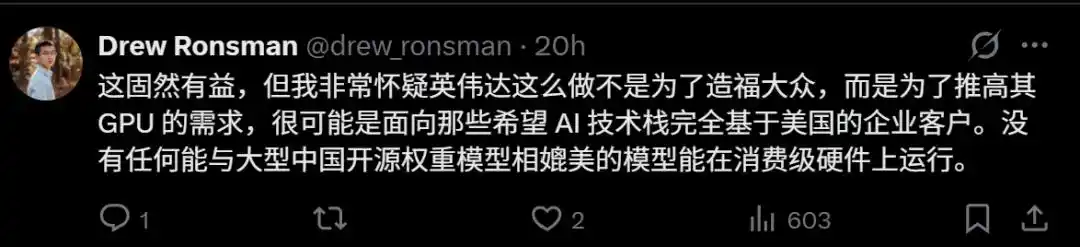
After all, no behemoth like that can run on ordinary consumer-grade hardware.
The larger the model, the higher the computing power demand, and NVIDIA's empire remains as stable as ever.
In this era where computing power equals dominance, NVIDIA is reshaping the open-source large model landscape in a simple and brutal way.
References:
https://x.com/mark_k/status/2091605721611723115
https://www.bloomberg.com/news/articles/2026-08-20/nvidia-to-pay-ai-startup-poolside-a-6-billion-license-newcomer-says
This article is from the WeChat public account "Xin Zhi Yuan" (New Wisdom Source), author: ASI Revelation; Editor: Aeneas