A Critical Moment for Capital? The AI Narrative Shifts from Technology to Financing, Giants' Cash Flow Dries Up, Debt Markets Sound Alarm

marsbitPublished on 2026-08-17Last updated on 2026-08-17

Abstract

The narrative of AI investment is shifting from a technology story to a capital expenditure story, and now to a financing story. This marks a "critical moment for capital," as noted by Bridgewater's Greg Jensen. Morgan Stanley forecasts that the total cost of AI infrastructure through 2028 will reach $3.2 trillion, with approximately $1.75 trillion expected to be raised from credit markets. However, free cash flow projections for major hyperscale cloud providers are declining sharply, with Oracle's 2027 forecast nearing -$40 billion. The bond market is already pricing in the rising risks. Apollo data shows AI-related bonds constitute 40% of long-duration supply. Credit spreads for hyperscalers have widened significantly this year—around 25 basis points for high-quality names—while the overall investment-grade market remained flat. Oracle's credit default swaps (CDS) have surged dramatically, indicating particular market concern. Renowned bond investor Jeff Gundlach sharply criticized financing plans using AI assets like GPUs as collateral, comparing them to "issuing 30-year ABS backed by bananas" due to the assets' rapid obsolescence. Although current balance sheets for hyperscalers appear strong, the future funding gap is widening. Morgan Stanley has nearly doubled its 2027 cloud capital expenditure growth forecast to 29%, amplifying the financing challenge. Purchasing commitments have exploded to $982 billion, with significant capital expenditures now existing off-balance...

The narrative around AI investment is shifting. It began as a technology story, evolved into a capital expenditure story, and is now becoming a financing story.

Recently, Bridgewater's Greg Jensen summarized the current situation in one sentence: "We are entering a critical moment for capital."

Morgan Stanley predicts that total spending on AI infrastructure construction will reach $3.2 trillion by 2028, with approximately $1.75 trillion needing to be raised through the credit markets. Funding sources have expanded from traditional investment-grade bonds to leveraged loans, private credit, and securitized products. Money is available, but it won't be cheap.

The bond market has already started to react. Apollo data shows that AI-related bond issuance now accounts for 40% of long-duration supply. Credit spreads for hyperscale cloud providers (Hyperscalers) have widened significantly this year, while the overall investment-grade market has remained virtually unchanged.

The "new bond king" Gundlach was even more direct, stating that issuing long-term bonds backed by GPUs is akin to "making a 30-year ABS out of bananas."
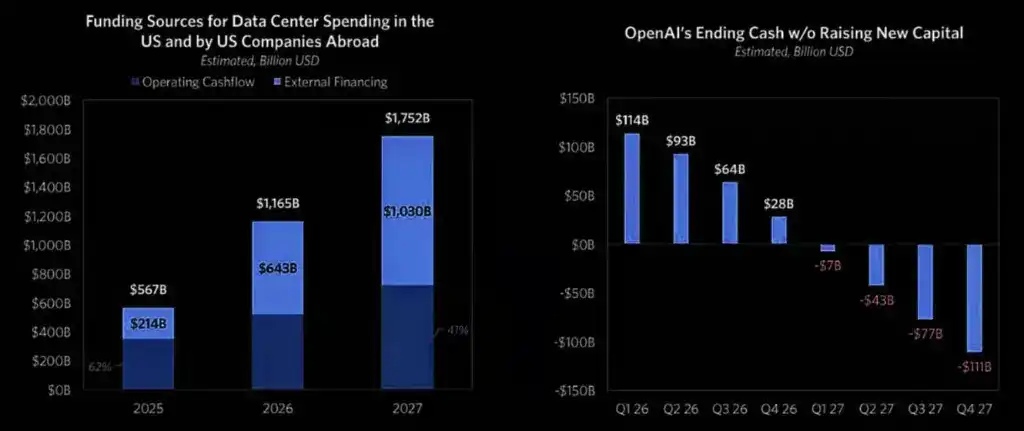
Cash Flow is Moving in the Wrong Direction

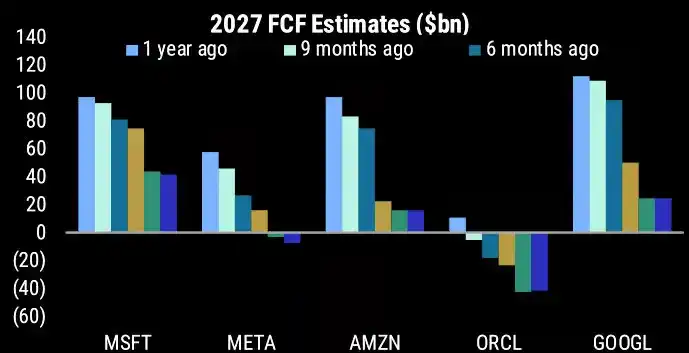
Capital expenditure forecasts are repeatedly revised upwards, while free cash flow forecasts continue to slide.

Morgan Stanley has significantly lowered its free cash flow forecasts for major hyperscale cloud providers for 2027. Oracle's situation is the most prominent, with its 2027 free cash flow forecast now approaching -$40 billion.
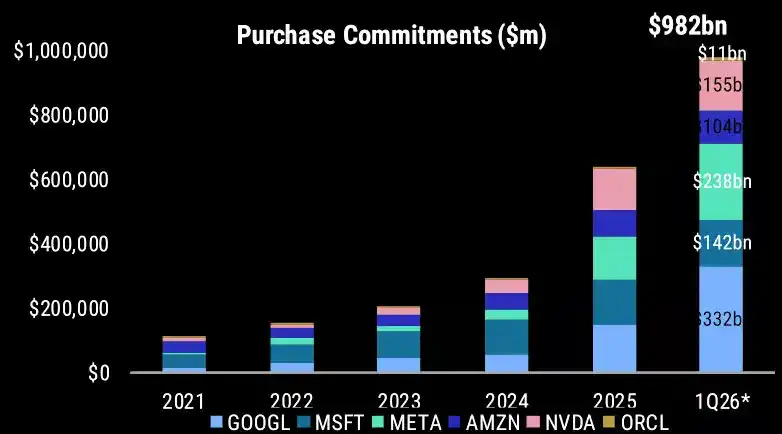
The scale of spending commitments is equally staggering. Purchase commitments from hyperscalers have exploded to $982 billion. Morgan Stanley points out that a significant portion of the real capital expenditure now exists off-balance-sheet. This means that looking only at the balance sheet severely underestimates the actual funding pressure.
Credit Markets Have Begun Pricing Risk

Investors are demanding higher compensation for risk.

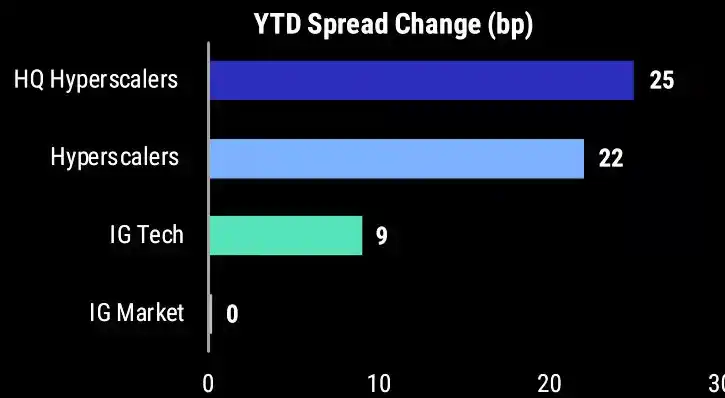
Morgan Stanley data shows that credit spreads for hyperscale cloud providers have "widened significantly this year, far exceeding the overall investment-grade market"—spreads for high-quality hyperscalers (HQ Hyperscalers) widened by about 25 basis points, regular hyperscalers widened by about 22 basis points, while the overall investment-grade market spread changed by 0.
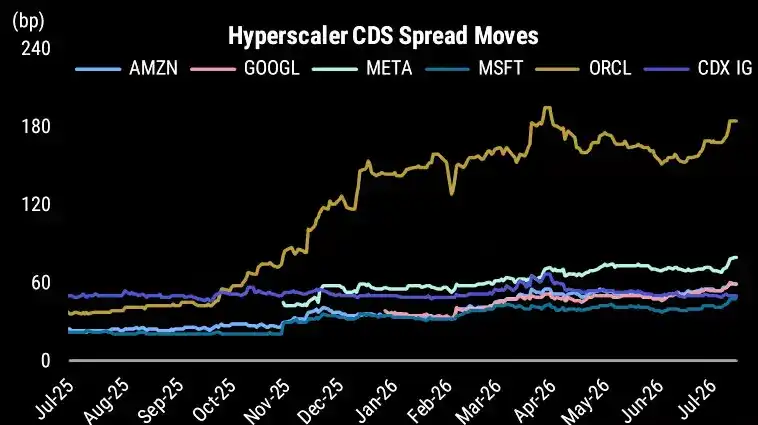
Oracle is the most watched case among them. While other hyperscalers' credit default swaps (CDS) generally trade in the 30 to 80 basis points range, Oracle's CDS surged from around 40 basis points in mid-2025 to a peak near 190 basis points in April 2026, and currently hovers around 180 basis points. Meta's CDS has risen more modestly to about 75 basis points. The credit market has clearly singled out the company it is most concerned about.
Balance Sheets are Strong, But the Problem Lies Ahead

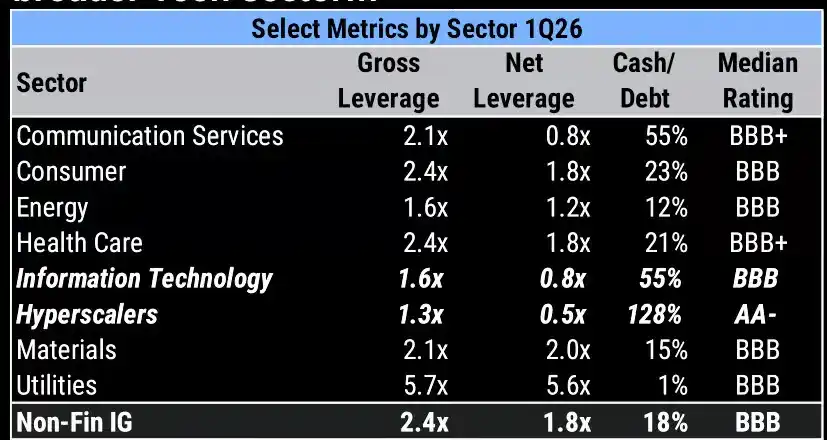
Morgan Stanley's Q1 2026 data shows that hyperscalers' total leverage ratio is only 1.3x, net leverage is 0.5x, the cash-to-debt ratio is as high as 128%, and the median credit rating is AA-. In contrast, the overall non-financial investment-grade universe has a total leverage ratio of 2.4x and a rating of BBB.

But the problem lies ahead. Morgan Stanley has sharply raised its forecast for cloud computing capital expenditure growth in 2027 from 14% to 29%, while hyperscalers are "reaffirming confidence in investment returns." As spending forecasts double, the financing gap widens accordingly.
"New Bond King" Gundlach: Using GPUs as Collateral is Like Using Bananas for ABS

Regarding financing schemes emerging in the market that use AI assets as collateral, renowned bond market investor Jeff Gundlach offered sharp criticism.

He warned about a planned $50 billion fund consortium, stating the plan is "likely not to stand the test of time." He asked on social media: "Using assets with unknown life spans as collateral for long-term debt? Why not do a 30-year ABS trade backed by bananas in a warehouse?" He added, these are "brand new engineered bananas with unknown life spans."

Gundlach's analogy gets to the core issue: GPUs depreciate extremely quickly, with technology refresh cycles far shorter than the tenure of the debt. When using such assets as collateral for long-term financing, the actual value of the collateral is highly uncertain.


Trending Cryptos

Related Questions

QWhat is the main shift in the narrative of AI investment according to the article?

AThe narrative is shifting from being a technology story to a capital expenditure story, and is now becoming a financing story.

QWhat is the significant warning that Jeff Gundlach gives about using AI assets as collateral?

AJeff Gundlach warns that using assets like GPUs as collateral for long-term debt is akin to using bananas for a 30-year ABS, highlighting the risk due to their fast depreciation and short technological lifecycle compared to the debt tenure.

QWhat do the widening credit spreads for Hyperscalers indicate, according to the article?

AThe widening credit spreads for Hyperscalers indicate that investors are demanding higher risk compensation, signaling growing market concern about their future financial health amidst heavy AI infrastructure spending.

QWhich company's financial situation is highlighted as particularly concerning in the credit markets?

AOracle's financial situation is highlighted as particularly concerning. Its Credit Default Swap (CDS) spreads surged dramatically to around 190 basis points, far exceeding those of other Hyperscalers, and its 2027 free cash flow forecast is deep in negative territory.

QAccording to Morgan Stanley, what is the estimated total spending on AI infrastructure by 2028 and the financing need?

AMorgan Stanley predicts total AI infrastructure spending will reach $3.2 trillion by 2028, with approximately $1.75 trillion of that needing to be raised through credit markets.

Related Reads

The Impact of Treasury Buybacks Lasts Only 24 Hours? Beston: We Have Many Tools, Just Wait and See

U.S. Treasury Secretary Besant, addressing market concerns on August 20, signaled that the Treasury's toolkit for intervening in the bond market is far from exhausted. This follows the previous day's announcement to double the size of long-term Treasury buyback operations to at least $40 billion per session, a move that only briefly lowered yields before they climbed again. Besant dismissed the short-lived market reaction as "noise," asserting that yields do not reflect underlying economic fundamentals, especially for illiquid 30-year bonds. He revealed that President Trump has tasked him with leading a new fiscal consolidation plan, expected to be announced soon, aimed at addressing high long-term borrowing costs. Concurrently, Besant announced a press conference for the following Monday to detail aggressive U.S. economic actions against Iran, suggesting that maximum economic pressure could reduce the likelihood of large-scale military conflict. On other topics, Besant reiterated a strong dollar policy, expressed confusion over a recent oil price surge (which he expects U.S. actions will curb), and noted that AI investment prospects are making corporations largely insensitive to yield levels when issuing debt, as they anticipate future productivity gains. Market analysts remain skeptical that Treasury operations alone can durably alter the trajectory of long-term yields, which are driven by broader concerns over fiscal deficits, debt supply, and inflation.

marsbit35m ago

The Impact of Treasury Buybacks Lasts Only 24 Hours? Beston: We Have Many Tools, Just Wait and See

marsbit35m ago

Trading

Spot

Hot Articles

How to Buy FLOW

Welcome to HTX.com! We've made purchasing Flow (FLOW) simple and convenient. Follow our step-by-step guide to embark on your crypto journey.Step 1: Create Your HTX AccountUse your email or phone number to sign up for a free account on HTX. Experience a hassle-free registration journey and unlock all features.Get My AccountStep 2: Go to Buy Crypto and Choose Your Payment MethodCredit/Debit Card: Use your Visa or Mastercard to buy Flow (FLOW) instantly.Balance: Use funds from your HTX account balance to trade seamlessly.Third Parties: We've added popular payment methods such as Google Pay and Apple Pay to enhance convenience.P2P: Trade directly with other users on HTX.Over-the-Counter (OTC): We offer tailor-made services and competitive exchange rates for traders.Step 3: Store Your Flow (FLOW)After purchasing your Flow (FLOW), store it in your HTX account. Alternatively, you can send it elsewhere via blockchain transfer or use it to trade other cryptocurrencies.Step 4: Trade Flow (FLOW)Easily trade Flow (FLOW) on HTX's spot market. Simply access your account, select your trading pair, execute your trades, and monitor in real-time. We offer a user-friendly experience for both beginners and seasoned traders.

4.5k Total ViewsPublished 2024.03.29Updated 2026.06.02

How to Buy FLOW

Discussions

Welcome to the HTX Community. Here, you can stay informed about the latest platform developments and gain access to professional market insights. Users' opinions on the price of FLOW (FLOW) are presented below.

活动图片