Now the Greatest Regret Is to My Family: Crypto Experts Took a Stumble in the Stock Market

marsbitPublished on 2026-07-30Last updated on 2026-07-30

Abstract

Summary: This article examines the significant losses recently suffered by cryptocurrency traders and influencers who ventured into the stock market, specifically by heavily investing in AI-related and semiconductor storage stocks. The narrative centers on the dramatic reversal in the Korean and US equity markets in late July, with stocks like SK Hynix and related leveraged ETFs experiencing historic plunges, erasing massive gains. The analysis highlights several key factors behind the "flip." Traders, accustomed to crypto's high volatility and frustrated by a stagnant market, chased the apparent momentum in AI-themed equities. Many made fatal mistakes: applying high-leverage strategies common in crypto (e.g., 2x ETFs, on-chain perpetual contracts) to stocks, and failing to understand the distinct rules of different stock markets (like Korean pre-market trading). This led to widespread liquidations, especially when a thin Korean pre-market trade triggered a cascading flash crash on a decentralized exchange. Post-crash reflections from prominent figures reveal deep regret and self-criticism. They acknowledge misjudging their expertise, overestimating their edge against sophisticated institutional players, and the dangers of leverage. The article concludes that while such setbacks are part of trading, surviving long-term requires recognizing one's limitations and the inherent risks of cross-market strategies.

"Now, the greatest regret is to my family."

Lately, the frequency of hearing this phrase is no less than that of "Do you believe in the light?" and "You should stand in the light, not let the light stand there" from two months ago.

These two short sentences encapsulate a 180-degree reversal in the market and a landscape of shattered hearts.

According to public data, South Korean stock SK Hynix has halved from its June high, erasing over 1,000 trillion won (approximately $800 billion) in market capitalization. The KOSPI index has retreated about 30% from its peak and has experienced 9 trading halts this year.

On July 28th, SK Hynix fell over 10%. U.S. memory stocks also plunged collectively, with SanDisk, Western Digital, Seagate, and Micron dropping 8% to 13% in a single day.

On July 29th, SK Hynix fell sharply again, dropping nearly 20% intraday, while a 2x long Hynix ETF plummeted over 30%, both setting their largest single-day declines in history.
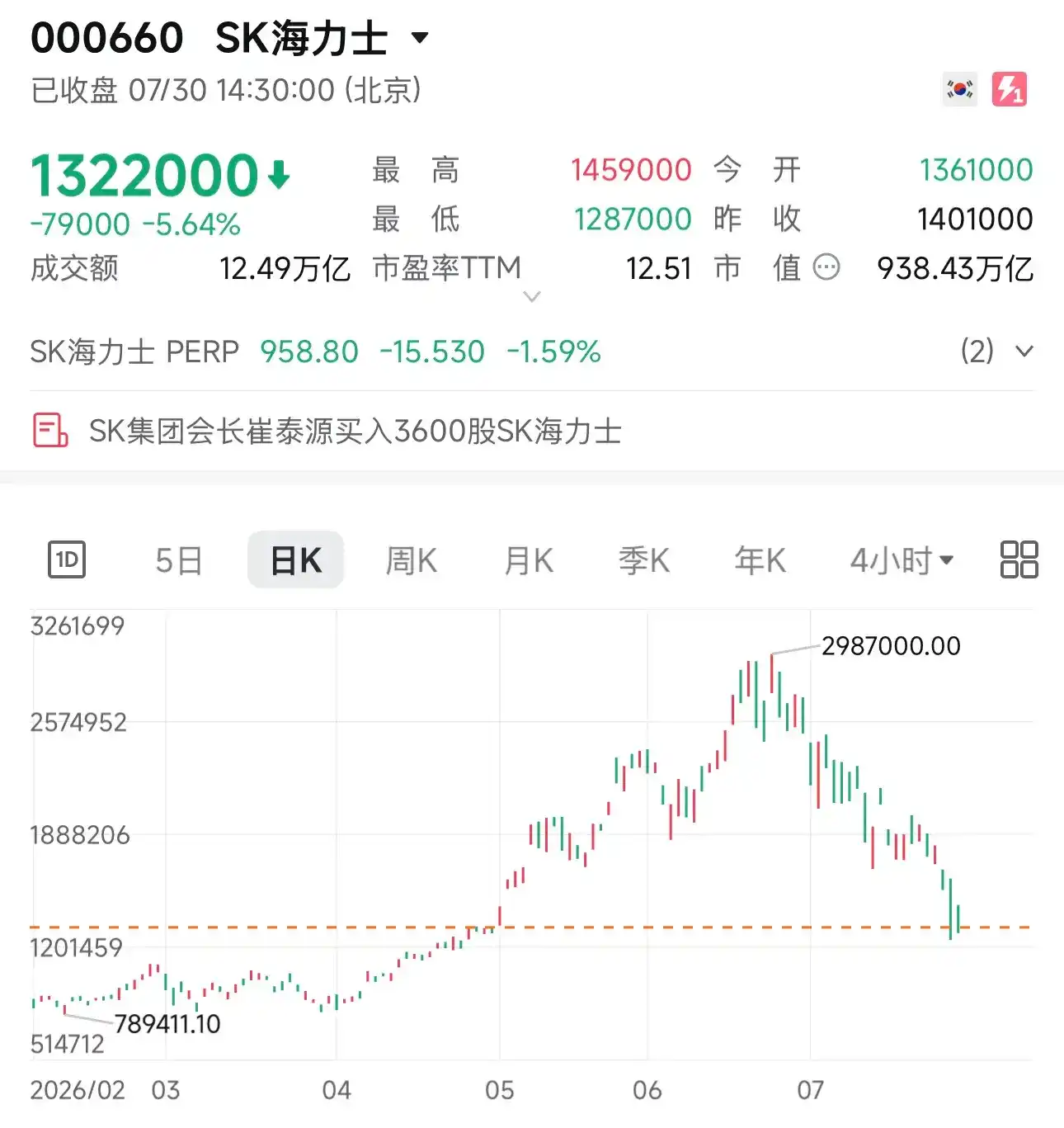
A cross-market bloodbath thus unfolded. The extreme volatility flushed out numerous big V's and traders from the crypto circle. Among them were those who had earned their first pot of gold in the crypto market and those who had already achieved financial freedom. Now, all that's left are reflections and declarations of leaving the scene.
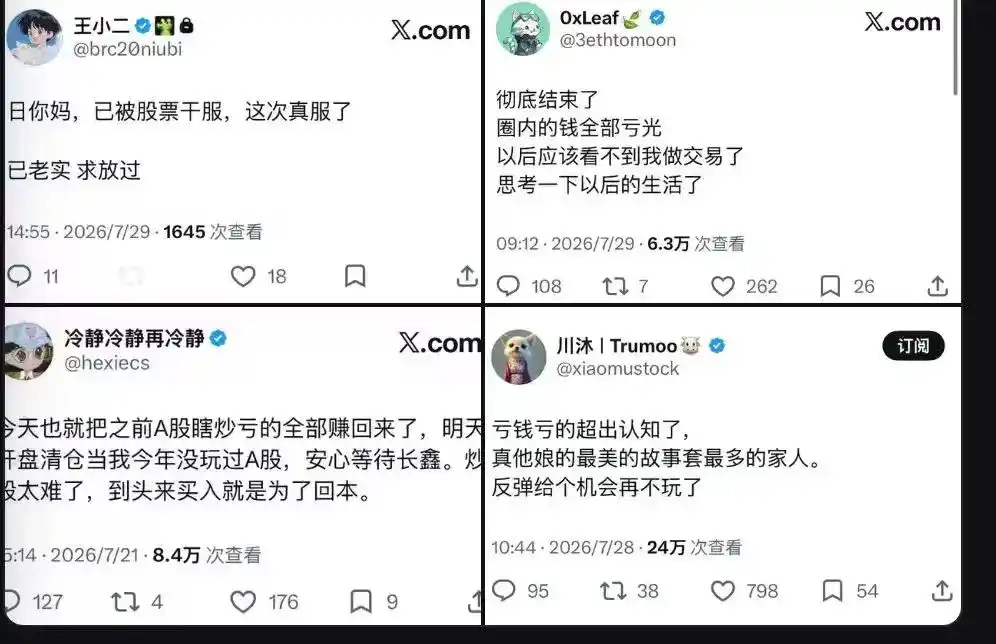
Half Market Conditions, Half Human Nature

Perhaps because the crypto market had been too quiet for too long, memory stocks became the best destination for active capital.

Dp Dapeng (@Dp520888) posted that from the end of last year to the first half of this year, the crypto market was in a constant downtrend. Bitcoin barely caught its breath around $60,000, while South Korean and U.S. stock markets soared on the AI narrative during the same period. Major exchanges, in their efforts to expand markets, had also opened up stock trading access.

He noted that he saw many crypto peers painfully cut losses on their crypto assets and go all-in on Micron and SanDisk at highs, only to lose over 30% subsequently. Had this money stayed in crypto, they could have at least held on until Bitcoin fell to $40,000.

People accustomed to high volatility and tormented by the lack of profit-making opportunities for over half a year found it hard to resist chasing the market that seemed more lucrative. As @hexiecs posted, "Is there any god who has always resisted buying memory stocks? I need to worship them."
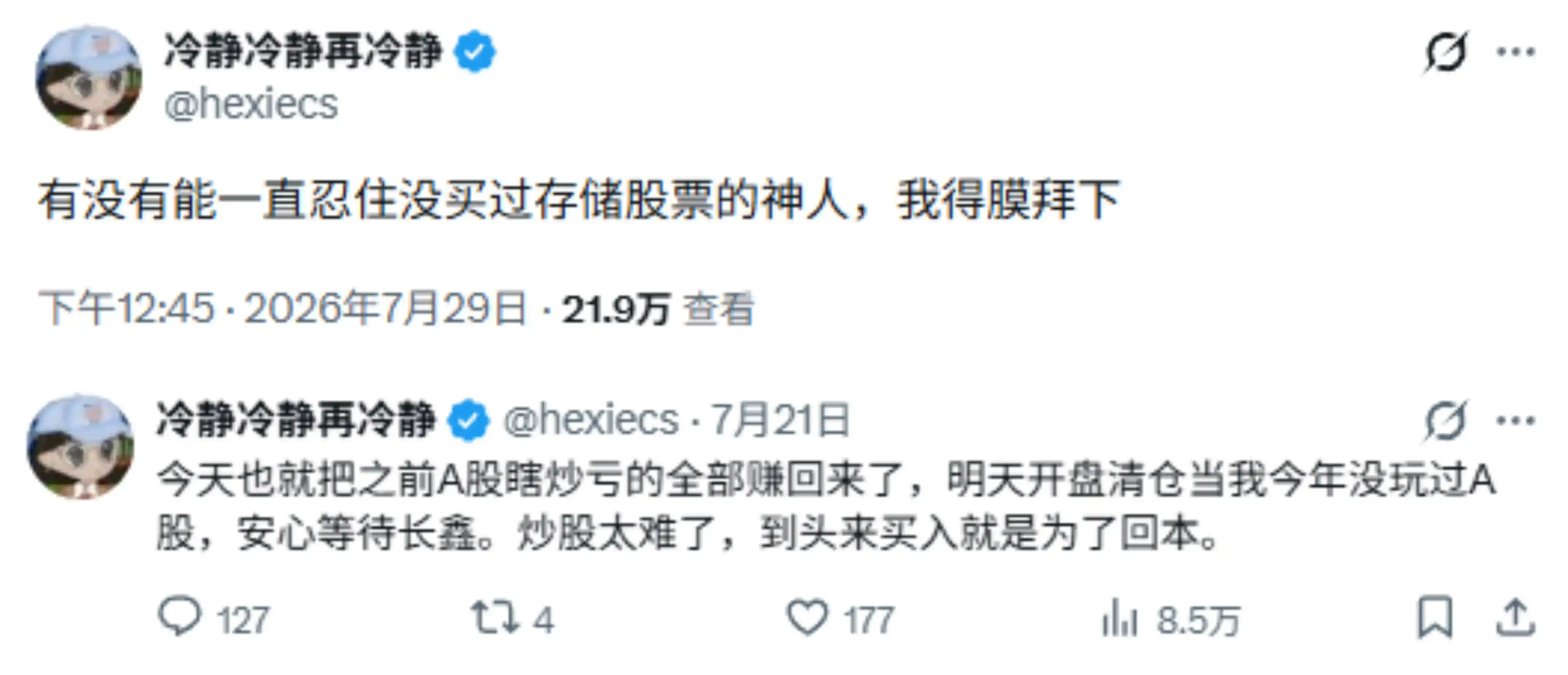
However, narratives like AI, GPU, and storage come and go quickly in capital markets. Nvidia's stock price peaked in May and has already wiped out this year's gains, with its total market cap recently overtaken again by Apple. Now it's just storage's turn.

So, the starting point of this crash is half market conditions, half human nature.

Why the Crash This Time?

People transitioning from the crypto circle to the stock market are prone to culture shock.

On one hand, it's the leverage habit. Many start with 2x long positions or add even higher leverage via on-chain perpetual contracts. The same bearish candle that represents a mere pullback in a spot account becomes a liquidation event in a leveraged account.

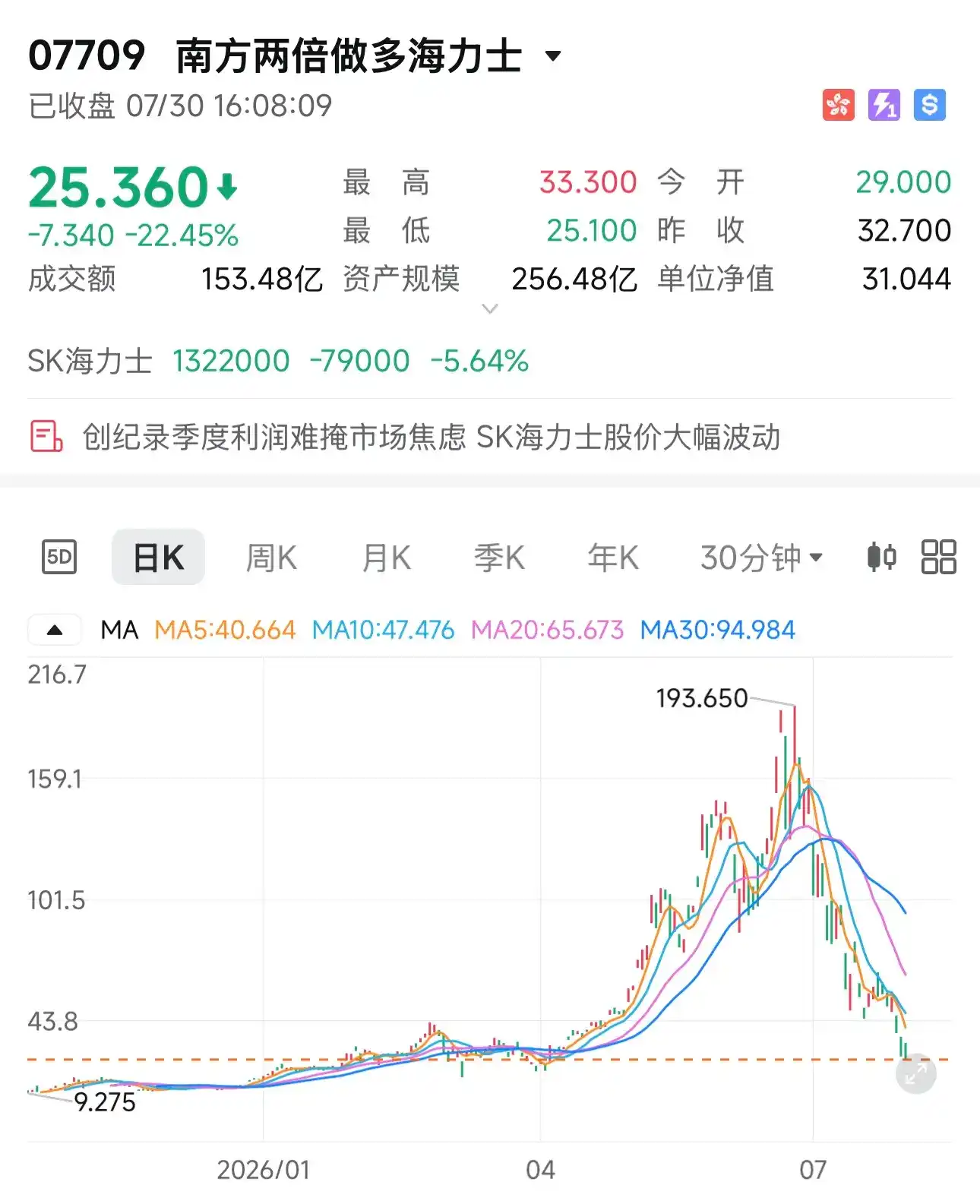
How severe the damage to leveraged products was this round can be seen by looking at the South Korean 2x Long Hynix ETF. This fund was once the world's largest single-stock leveraged product, with peak assets around 130 billion HKD. Its cumulative decline since July has exceeded 80%, with assets now down to 25.6 billion HKD. Another 2x Long Samsung Electronics ETF also fell about 70% this month.
According to Hyperliquid data, on July 29th, the combined 24-hour trading volume for Hynix-related contracts SKHX and SKHY on the platform reached $1.765 billion, becoming the most actively traded asset on the platform, with heat and volume even surpassing BTC.

On the other hand, it's the rule differences. The stock market itself has several sets of rules: U.S. stocks have after-hours trading, South Korean stocks have NXT pre-market, A-shares have price limits, Hong Kong stocks have another set, each with its own trading hours, price bands, and settlement rhythms.

When these underlying assets are packaged into on-chain perpetual contracts, the extreme rules of other markets are bundled in as well. The wick on Hyperliquid on July 28th is a living example.

It is reported that on that day, only one lot of SK Hynix traded in the South Korean pre-market at around $868, about 30% lower than the previous close, right near the lower limit of the price band. This less than $900 real transaction was fed into the chain via the oracle, causing the SKHX perpetual contract to flash crash about 18% in one minute.

According to on-chain data, approximately $80 million was liquidated in the subsequent four hours, with open interest evaporating about $150 million.
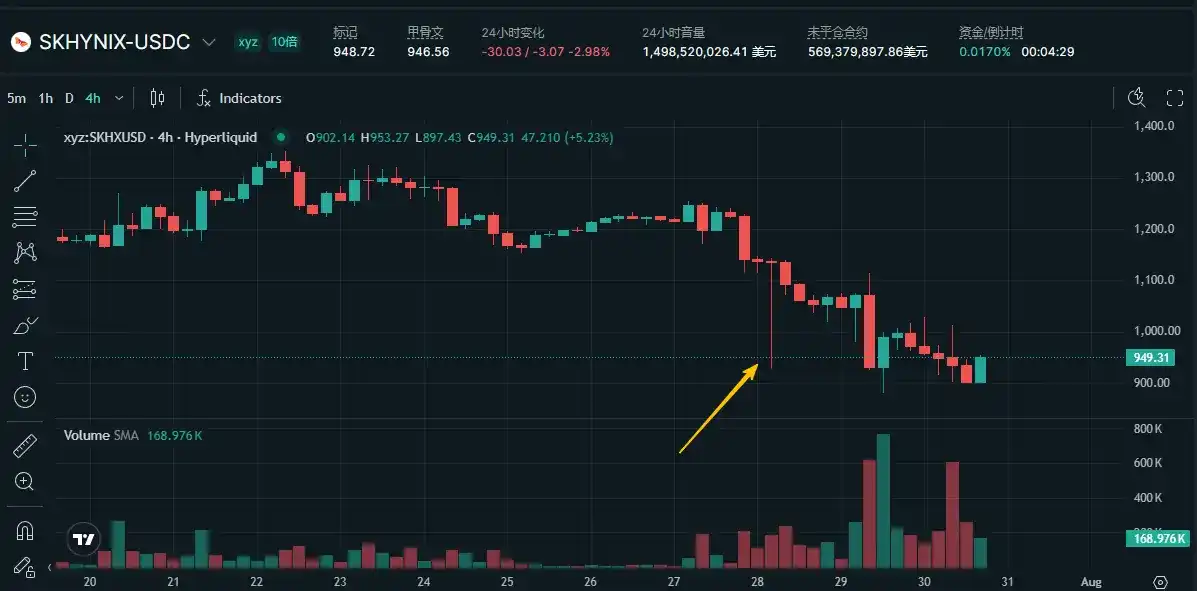
Trade.xyz announced that this price was synchronized from that real transaction in the South Korean pre-market, with the oracle operating according to specifications and no technical error. Although Trade.xyz decided to fully compensate for the liquidation losses this time, it specifically stated this does not constitute a guarantee for similar situations in the future.

Reflections After the Bloodbath

After this bloodbath, many big V's on X began to reflect. Their review focus largely fell on whether the methods they had relied on to make money over the years were still effective after switching markets.

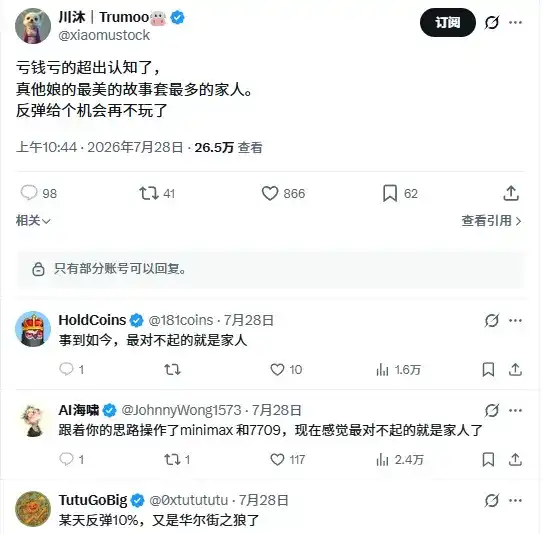
Chuanmu (@xiaomustock) stated that he made and lost money on storage stocks this year. The reason Buffett has survived in the capital market for so long is inseparable from his style of avoiding leverage, not going all-in, and always holding significant idle cash. Ordinary people either lose sleep from anxiety over using leverage to get rich quickly, or continue using leverage after making money, anxious in both profit and loss.
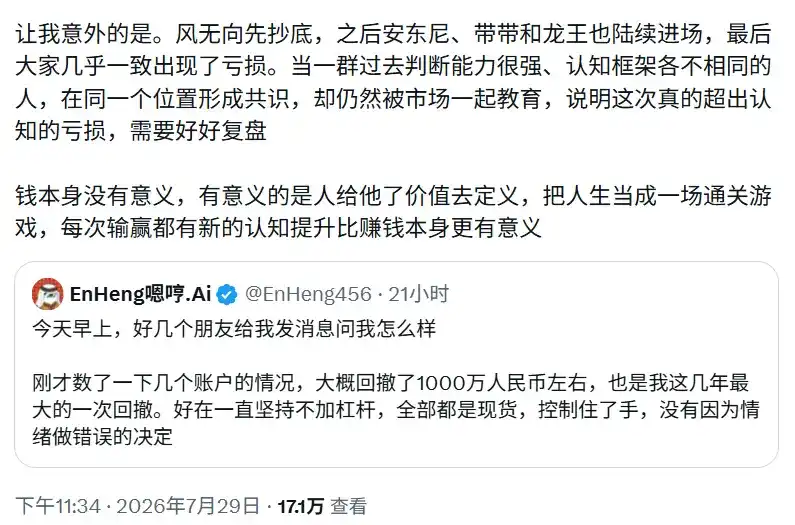
KOL En Heng (@EnHeng456) recounted his three major losses since entering the industry, with this storage wave being the heaviest, resulting in a combined drawdown of over ten million across several accounts, but fortunately, it was all spot trading with no leverage.

He also pointed out that multiple traders with consistently strong judgment and different cognitive frameworks successively entered the market, yet almost all ended up losing. When such a group forms a consensus at the same position but is collectively taught a lesson by the market, it indicates that this loss indeed exceeded their original understanding.
Zishi (@silverfang888), who claimed to have been liquidated for $20 million in semiconductors, also said his biggest regret was moving from crypto to trading stocks. In his view, he is merely a crypto player with limited insight, sitting across from people in the U.S. stock market arena whose cognition and capital far surpass his own.

After being liquidated, many fell into intense self-negation, attributing the losses of these months to their own shallow insight and low cognition. The concentrated outbreak of such emotions also serves as a reminder to everyone using leverage as an amplifier: what the market takes is never just the principal.

Some offered comfort, saying whose trading career hasn't experienced a few such drawdowns? Money lost can be treated as tuition paid. As long as one is still here with spirit intact, there will always be another journey ahead.

In truth, there are very few who can consistently win in the market. Those who can journey a bit further are often those who can still see their own boundaries at different stages.


Trending Cryptos

Related Questions

QAccording to the article, what is the main reason behind the significant losses of crypto traders in the stock market?

AThe main reasons are a combination of market conditions and human nature. Crypto traders, accustomed to high volatility, moved to the AI-driven stock market for better returns. However, they faced issues like improper use of leverage and unfamiliarity with the different trading rules of stock markets (like pre-market sessions and price bands), which led to severe losses when the storage sector crashed.

QHow did the specific event on Hyperliquid on July 28th cause major liquidations?

AOn July 28th, a single SK Hynix share traded for around $868 in the Korean pre-market, about 30% lower than the previous close. This price, fed into the chain via an oracle, caused the SKHX perpetual contract on Hyperliquid to flash-crash by about 18% in one minute. This led to approximately $80 million in liquidations and a $150 million drop in open interest over the next four hours.

QWhat is one key trading habit from the crypto world that proved detrimental in the stock market?

AOne key detrimental habit was the immediate use of high leverage. Many traders started with 2x leveraged ETFs or even higher leverage on perpetual contracts. This meant that a price decline that would be a simple drawdown in a spot account resulted in margin calls and liquidations in leveraged positions.

QWhat major reflection did trader '川沐' (@xiaomustock) share after the losses?

ATrader '川沐' reflected that his gains and losses this year both came from the storage sector. He noted that Warren Buffett's longevity in the market is tied to his style of avoiding leverage, not going all-in, and always keeping a large amount of cash on hand. In contrast, ordinary people either lose sleep over leverage-driven anxiety to get rich or continue using leverage after profits, leading to anxiety in both winning and losing.

QWhat was the final attitude or lesson some traders expressed after the market crash?

AAfter the crash, some traders expressed a lesson in humility and recognizing one's boundaries. They acknowledged that moving from the crypto circle to the stock market meant competing against players with far superior knowledge and capital. While some fell into self-doubt, others offered comfort, stating that such drawdowns are part of a trading career, and as long as one's spirit remains, there will always be another opportunity.

Related Reads

UNI Doubles in Two Months Against the Trend: A 5-Year-Overdue Value Realization

Amidst a generally stagnant crypto market in June and July, UNI, the governance token of Uniswap, saw a significant surge, nearly doubling in price from around $2.3 to $4.6. This rally represents a delayed but significant value reassessment, triggered by the practical implementation of its long-debated "fee switch" mechanism. The key turning point was the on-chain execution of the UNIfication proposal in December 2025. It activated a protocol fee on select pools, directed Unichain sequencer revenue (net of costs) to a communal treasury, executed a one-time burn of 100 million UNI, and established a system where all protocol revenue flows into a "TokenJar" contract. This treasury has a single exit: purchasing and permanently burning UNI via a "Firepit" contract. Initially, the market reacted tepidly as the generated revenue and corresponding burn rate were modest. The narrative shifted dramatically in July 2025 with two major developments. First, the launch of Robinhood Chain, tailored for tokenized stocks, rapidly became a primary source of volume and fees for Uniswap, at one point contributing nearly half of its weekly fees. Second, governance votes successfully expanded the fee mechanism to v4 pools and initiated a temperature check for fees on Robinhood Chain. The activation of v4 fees caused the protocol's daily revenue earmarked for UNI burns to nearly triple. The core of UNI's recent price action is the transition from a pure governance token to a cash-flow asset with a permanent, protocol-funded buyer. Its effectiveness is amplified by UNI's mature and widely distributed supply, with no major impending unlocks to dilute the impact of the buybacks. The sustainability of this rally now hinges on whether the transaction volume, particularly on Robinhood Chain, persists after its initial gas subsidies expire, determining if this is a genuine value realization or a subsidy-fueled spike.

marsbit1h ago

UNI Doubles in Two Months Against the Trend: A 5-Year-Overdue Value Realization

marsbit1h ago

Breaking: Google Earth Urgently Pulls Back Nano Banana 2 Image Generation Feature!

Google Earth's newly launched "Create image" feature, powered by the Nano Banana 2 AI image generation model, was abruptly withdrawn shortly after its release due to being "played" by users. The feature allowed users to generate and overlay AI-created visuals directly onto real-world satellite and 3D maps in Google Earth. The tool enabled creative applications like historical recreations (e.g., visualizing ancient Pompeii), generating informational graphics for landmarks, and envisioning architectural projects or futuristic cityscapes on real terrain. It operated under "geospatial grounding," meaning the AI respected the underlying geography, topography, and perspective of the chosen map view. The model also integrated with Gemini to retrieve relevant factual information. However, upon release, users quickly tested its limits. A prominent example involved reimagining Philadelphia's historic Independence Hall as a post-apocalyptic ruin overrun by "happy" zombies, evil clowns, and giant alien mechs. This highlighted both the feature's playful potential and its risks regarding the generation of inappropriate or misleading content on realistic maps, leading to its swift temporary removal. Google stated it would re-release the feature after implementing "enhanced guardrails." Analysts note this move strategically leverages Google's vast proprietary geospatial data, positioning its AI not just for artistic generation but for spatially accurate world visualization—a unique advantage in the competitive AI image generation landscape.

marsbit2h ago

Breaking: Google Earth Urgently Pulls Back Nano Banana 2 Image Generation Feature!

marsbit2h ago

Altman Admits: Overestimated AI Snatching Jobs! Huang Renxun: The Unemployment Narrative Is Completely Backwards

Sam Altman has revised his earlier predictions about AI rapidly replacing jobs, admitting he overestimated the speed at which AI would eliminate entry-level white-collar roles. Speaking on the "Invest Like the Best" podcast, he stated that people do not truly want an AI CEO, as accountability and human connection remain critical. He found that individuals prefer interacting with people who can be held responsible for decisions. Similarly, NVIDIA's Jensen Huang argued that the narrative of AI destroying jobs is misguided. He distinguishes between tasks and jobs, noting that while AI can automate specific tasks, entire jobs—encompassing communication, judgment, coordination, and accountability—are not eliminated. He cited examples like radiologists and software engineers, where demand for these roles has increased as AI handles repetitive tasks, allowing for business expansion and the creation of more positions. Data from a University of Maryland and LinkUp study supports this, showing that U.S. job postings for new graduates have actually risen, countering the fear of vanishing entry-level roles. However, a significant shift is occurring: the traditional entry-level tasks that help newcomers gain experience are being automated, making initial career access more challenging. The key insight is that as AI takes over standardized tasks, the enduring value of human work shifts toward areas of responsibility, trust-building, and final decision-making—aspects that AI cannot replicate. The real "moat" for professionals lies in these irreplaceable human elements.

marsbit3h ago

Altman Admits: Overestimated AI Snatching Jobs! Huang Renxun: The Unemployment Narrative Is Completely Backwards

marsbit3h ago

Trading

Spot

Hot Articles

How to Buy T

Welcome to HTX.com! We've made purchasing Threshold Network Token (T) simple and convenient. Follow our step-by-step guide to embark on your crypto journey.Step 1: Create Your HTX AccountUse your email or phone number to sign up for a free account on HTX. Experience a hassle-free registration journey and unlock all features.Get My AccountStep 2: Go to Buy Crypto and Choose Your Payment MethodCredit/Debit Card: Use your Visa or Mastercard to buy Threshold Network Token (T) instantly.Balance: Use funds from your HTX account balance to trade seamlessly.Third Parties: We've added popular payment methods such as Google Pay and Apple Pay to enhance convenience.P2P: Trade directly with other users on HTX.Over-the-Counter (OTC): We offer tailor-made services and competitive exchange rates for traders.Step 3: Store Your Threshold Network Token (T)After purchasing your Threshold Network Token (T), store it in your HTX account. Alternatively, you can send it elsewhere via blockchain transfer or use it to trade other cryptocurrencies.Step 4: Trade Threshold Network Token (T)Easily trade Threshold Network Token (T) on HTX's spot market. Simply access your account, select your trading pair, execute your trades, and monitor in real-time. We offer a user-friendly experience for both beginners and seasoned traders.

12.7k Total ViewsPublished 2024.03.29Updated 2026.06.02

How to Buy T

Discussions

Welcome to the HTX Community. Here, you can stay informed about the latest platform developments and gain access to professional market insights. Users' opinions on the price of T (T) are presented below.

活动图片












