Trump’s Teleprompter Operator Investigated for Insider Trading, "Whistleblower" Turns Out to Be Prediction Platform Kalshi

Foresight NewsPublished on 2026-07-17Last updated on 2026-07-17

Abstract

According to reports from CNBC and ABC, a longtime teleprompter operator for President Trump, Gabriel Perez, is under federal investigation for allegedly using insider information to place bets on the prediction market platform Kalshi. Perez, who had handled Trump's speeches since 2016, is suspected of trading on over a dozen upcoming presidential addresses, including the State of the Union, based on his advance knowledge of speech content. Kalshi's monitoring systems flagged the atypical trading patterns in March, leading to his account being frozen and the case being referred to the Commodity Futures Trading Commission (CFTC). Perez reportedly profited over $90,000, though most funds are held by the platform. He is now in settlement talks with the CFTC and has been placed on unpaid leave by the White House. This incident is part of a broader pattern of insider trading on prediction markets. Similar cases involve a congressional candidate betting against his own attendance, military personnel using classified information, and a Google engineer trading on internal data. The growing liquidity of these markets, with some contracts seeing over $150,000 in volume, creates incentives for abuse. In response, platforms like Kalshi are enhancing monitoring, requiring occupational disclosures, and cooperating with regulators. The CFTC and the Justice Department are pursuing civil and criminal actions, while the White House has issued memos explicitly barring staff from such trading.


By: Nicky, Foresight News


On July 16, according to reports from CNBC and ABC, a long-serving teleprompter operator for President Donald Trump has been suspended by the White House and is under investigation by federal regulators for allegedly using insider information to place bets on a prediction market platform.
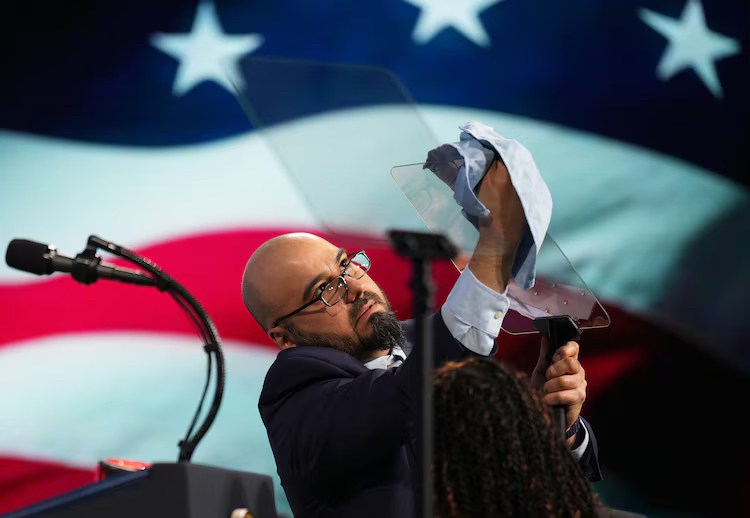

March 27, 2026, Miami Beach, Florida. Perez cleaning the teleprompter before Trump's speech at the Future Investment Initiative Institute summit.


The person involved, Gabriel Perez, has been operating teleprompters for Trump since 2016. He was typically the last among aides to handle and adjust the president's speeches, even receiving last-minute changes from Trump himself. Citing sources familiar with the matter, ABC and CNBC reported that investigators from the Commodity Futures Trading Commission (CFTC) discovered Perez had traded on over a dozen of Trump's public speeches in about three months, covering events such as the State of the Union address, speeches at the World Economic Forum in Davos, prime-time addresses, and Medal of Honor ceremonies.


He used his advance knowledge of speech content to bet on whether specific words, phrases, or topics would be mentioned in the "Mentions" markets on the Kalshi platform. He even withdrew bets mid-speech on occasion when Trump skipped certain sections.


Perez's trading was detected by Kalshi's monitoring system in March of this year, as the patterns did not match typical buy/sell behavior and were additionally flagged by a market maker through a tip line. The platform subsequently froze the account, withheld nearly all profits, and referred the case to the CFTC. Robert DeNault, Kalshi's Head of Enforcement, stated via CNBC that the monitoring team promptly flagged these trades, the platform is assisting regulators, and has submitted gathered evidence.


CNBC reported that Perez accumulated profits exceeding $90,000, but most of the gains have been frozen by Kalshi. Perez is currently in settlement negotiations with the CFTC and could face consequences including disgorgement of all profits and a ban from engaging in similar trading. The Manhattan U.S. Attorney's Office has been informed but decided not to open a criminal investigation.


White House Press Secretary Karoline Leavitt confirmed at a press briefing that Perez has been placed on unpaid administrative leave, is no longer responsible for teleprompter operations, and will not continue working at the White House. According to CNBC, Leavitt revealed that Trump is aware and considers the matter "very unfortunate, truly a disgrace," and personally made the relevant decisions. Leavitt emphasized the White House has extremely strict ethical guidelines, and an internal memo was specifically issued in March warning staff not to trade on prediction markets using non-public information.


The Perez case is not an isolated incident. As early as May 2025, California gubernatorial candidate Kyle Langford traded about $200 in markets related to his own candidacy, made minimal profits, but was ultimately fined $2,246 and banned from the platform for five years. From August to September 2025, a video editor named Artem Kaptur, who used his job to learn show schedules in advance, was flagged for an abnormally high win rate, profiting about $5,400. He faced disgorgement of profits plus a $15,000 penalty and a two-year ban.


In February 2026, former Congressman George Santos, while publicly pledging to attend Trump's State of the Union address, bet that he would not attend and profited tens of thousands of dollars. His account was frozen and referred to regulators and law enforcement. In April of the same year, three congressional candidates were investigated for making small bets in markets related to their own elections, receiving fines ranging from hundreds to thousands of dollars and five-year bans. Even small profits or unwithdrawn gains can lead to platform penalties and regulatory action for trading on insider information.


Image Source: Internet


Another major prediction market platform, Polymarket, has also experienced similar severe violations. According to a previous CNBC report, U.S. Army Special Forces Staff Sergeant Gannon Ken Van Dyke, during his participation in a military operation to capture former Venezuelan President Nicolás Maduro from December 2025 to January 2026, used classified information to purchase large volumes of contracts in related Polymarket markets, profiting over $400,000. He was arrested in April of this year and faces criminal and civil insider trading charges. In May of the same year, Google software engineer Michele Spagnuolo was charged for allegedly using internal company "annual search trends" data to trade on Polymarket from October to December 2025, profiting approximately $1.2 million.
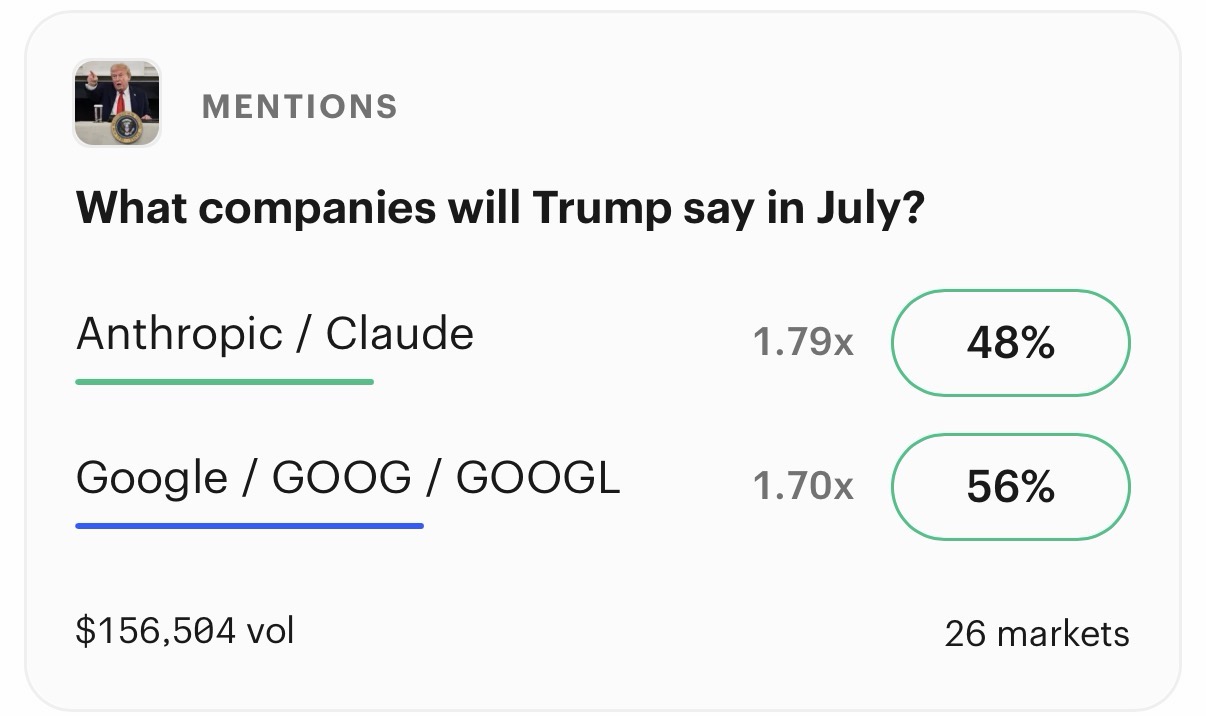


The reason insider trading repeatedly occurs in prediction markets is that informational advantages can be quickly converted into excess returns, and some topic markets have already achieved significant trading volumes that cannot be ignored. For example, on Kalshi, the topic "Which companies will Trump mention in July?" has seen trading volume exceeding $150,000. High-liquidity markets provide ample profit space for insiders, while ordinary users are at a disadvantage due to information asymmetry, damaging market price fairness and platform credibility.


In response to these issues, platforms and regulators are attempting multiple measures to curb them. Kalshi recently updated its policies, requiring traders in certain markets to disclose professional information, and relies on KYC procedures, 24/7 abnormal trading detection, and tip lines to strengthen preventive measures. The platform conducted over 150 investigations in the first quarter of this year, froze more than 100 potentially suspicious trades, and referred over 20 cases to law enforcement agencies.


On the regulatory front, the CFTC has repeatedly cited regulations prohibiting the misuse of non-public information and market manipulation in recent enforcement actions and is collaborating with the Department of Justice to pursue criminal accountability. This means trading using government insider information or corporate data could lead to felony charges such as fraud and money laundering, along with years of imprisonment. The White House has also explicitly prohibited government employees from participating in such betting through internal memos.


Trending Cryptos

Related Questions

QWho is suspected of insider trading related to former President Trump's speeches, and what was their role?

AGabriel Perez, a long-time teleprompter operator for former President Trump, is suspected of insider trading. He was responsible for operating and adjusting the teleprompter for Trump's speeches.

QWhich prediction market platform detected and reported the suspicious trading activity?

AThe prediction market platform Kalshi detected and reported the suspicious trading activity through its monitoring systems and subsequently froze the account and transferred the case to regulators.

QWhat action was taken against Gabriel Perez by the White House following the investigation?

AThe White House placed Gabriel Perez on unpaid administrative leave, relieved him of his teleprompter duties, and he will no longer work at the White House.

QWhat are some other examples of insider trading cases mentioned in the article related to prediction markets?

AOther examples include: former Congressman George Santos betting against his own attendance at a Trump speech; a Google software engineer using internal search trend data on Polymarket; and a U.S. Special Forces sergeant using classified information about a military operation on Polymarket.

QWhat measures are prediction platforms and regulators implementing to prevent insider trading?

AMeasures include: platforms requiring traders in specific markets to disclose their profession, enhancing KYC procedures and real-time monitoring, and cooperating with regulators. Regulators like the CFTC are enforcing rules against misuse of non-public information and market manipulation, and the White House has issued internal memos banning government employees from such betting.

Related Reads

New Fire Group Chief Economist Fu Peng's Latest Speech: Crypto Assets Deeply Bound to Liquidity, Global Assets 'Shrink Circle' with Widening Divergence

The chief economist of Sinovation Group delivered a speech at Wiki Finance EXPO Hong Kong 2026, analyzing the global market through the lens of liquidity. He argues that all major assets, including cryptocurrencies, are fundamentally tied to global liquidity, which is now shifting from an era of extreme post-2008 ease to sustained tightening under new Fed leadership. This marks the end of widespread "asset flooding" and ushers in a "shrinking circle" dynamic: capital is abandoning speculative, low-quality assets and concentrating in a few high-conviction, value-driven core holdings. The only dominant global investment theme is AI, viewed as a 20-25 year productivity cycle. However, a critical inflection point has been reached in Q2, where major tech firms' free cash flow has turned negative. The market narrative has pivoted from rewarding pure capital expenditure growth to demanding proof of future revenue generation and returns. While the AI super-cycle's long-term thesis remains intact, the initial hardware-driven phase (e.g., Nvidia, memory chips) is maturing. The speaker warns of significant volatility risk not from industry fundamentals, but from excessive financial leverage built up in these "certain" assets. He emphasizes that investment strategy must evolve from broad diversification to focused, cyclical allocation within the AI value chain (upstream hardware, midstream, downstream applications), avoiding blind long-term holds on single names. For crypto, this liquidity paradigm shift means the era of speculative "air coin" mania is over; the market is maturing, with institutional participation increasing and volatility stabilizing for core assets like Bitcoin and Ethereum. The core takeaway is that understanding the top-down liquidity framework is essential for navigating the current era of market分化 and focused capital allocation.

链捕手3m ago

New Fire Group Chief Economist Fu Peng's Latest Speech: Crypto Assets Deeply Bound to Liquidity, Global Assets 'Shrink Circle' with Widening Divergence

链捕手3m ago

4 Hours, 118 Responses: Liang Wenfeng’s Internal Q&A Addresses Everything

**DeepSeek Founder Liang Wenfeng's Candid Reflections on the Company's Path to AGI** DeepSeek has recently completed its first external funding round, raising over 500 billion RMB (approx. $74B) at a pre-money valuation of 3.675 trillion RMB ($543B). Founder Liang Wenfeng personally invested 200 billion RMB. This marks a strategic shift from its initial "no financing, no IPO, no commercialization" principle. In a recent investor Q&A, Liang articulated DeepSeek's core philosophy and roadmap. The company is driven by a powerful, unwritten vision for beneficial AGI rather than pure commercial maximization. He emphasizes "strategic restraint"—avoiding unnecessary conflicts, prioritizing long-term AGI success over short-term gains, and maintaining an open, cooperative stance even with competitors. Liang outlined the AGI technical roadmap: current focus on Agent capabilities, followed by solving "continual learning," which he sees as the key to unlocking models that can learn and adapt like humans. This could lead to a gradual "singularity" where AI accelerates its own research, and eventually to embodied intelligence. DeepSeek will strictly focus on this "AGI mainline," avoiding distractions like video generation which, while commercially viable, don't directly advance core intelligence. He identifies team stability as the single most critical factor for success, now bolstered by the recent funding. While talent is not a bottleneck, the primary constraint compared to the US is compute resources. Liang is optimistic about domestic AI chips, stating that Nvidia's CUDA moat is eroding and that within a year, the viability of the Chinese chip ecosystem will be proven, with Huawei's offerings being key. The main issue is production capacity. On competition, Liang believes the final differentiators will be cost, time-to-market, and user experience. He foresees Chinese companies playing a major role by offering systematically lower-cost AI services globally. DeepSeek's commercialization strategy involves offering API services at a "reasonable profit" and focusing on coding Agents. He remains committed to open-sourcing even their strongest models, seeing no downside as the barriers to effective deployment remain high. The company operates with a unique dual management structure combining top-down direction with significant bottom-up, unstructured research time for employees. Data quality and post-training are identified as major current challenges, with half of core researchers involved in data labeling efforts. Liang concludes that DeepSeek aims to be one of several trillion-dollar companies in the AI era, achieved through extreme focus on its chosen path.

链捕手10m ago

4 Hours, 118 Responses: Liang Wenfeng’s Internal Q&A Addresses Everything

链捕手10m ago

After Three Consecutive Quarters of Decline, Can the Crypto Market Find a Window for Stabilization in Q3?

The cryptocurrency market has just concluded its worst-performing quarter since 2022, with total capitalization dropping 12.6% to $2.1 trillion. All core metrics indicate capital is leaving the sector, not just rotating within it. Bitcoin fell 14.2% and Ethereum dropped 25.4% in Q2, breaking their previous correlation with US tech stocks. A key driver is the reversal in US spot Bitcoin ETF flows, which saw a net outflow of approximately $4.67 billion in Q2, including a record monthly outflow near $4.5 billion in June. While recent data suggests long-term holders are accumulating again, sustained ETF outflows mean continued selling pressure. Market focus is now singularly on the Federal Reserve. The upcoming July FOMC meeting is seen as the most critical event for Q3. A dovish signal could support Bitcoin reclaiming a $68,000-$84,000 range, while a hawkish stance might establish a new trading band around $50,000-$56,000. Additionally, regulatory uncertainty persists, with the progress of the crucial *CLARITY Act* stalling in the Senate, reducing its perceived 2026 passage probability to 40-45%. Despite the broad downturn, a few sectors showed growth. Prediction markets saw nominal volume surge 48.7% year-over-year to $113.8 billion, and tokenized collectibles transaction volume rose 143% quarterly to $1.4 billion. The Real-World Asset (RWA) tokenization sector also continued steady growth, now representing ~$28.1 billion in on-chain value. The market's foundation for an extreme crash appears limited, with Bitcoin price hovering near its 200-week moving average. However, the trading paradigm has shifted from narrative-driven speculation to decisions based on price action, policy developments, and interest rate expectations, making a broad sentiment-driven rally unlikely in the near term.

marsbitYesterday 08:36

After Three Consecutive Quarters of Decline, Can the Crypto Market Find a Window for Stabilization in Q3?

marsbitYesterday 08:36

Trading

Spot

Hot Articles

Discussions

Welcome to the HTX Community. Here, you can stay informed about the latest platform developments and gain access to professional market insights. Users' opinions on the price of S (S) are presented below.

活动图片