80 亿美元估值,8 个月涨 2 倍!加密友好银行 Erebor Bank 凭什么?

链捕手Published on 2026-07-04Last updated on 2026-07-04

Abstract

加密友好银行Erebor Bank正寻求新一轮融资,目标估值达80亿美元,较去年12月的43.5亿美元估值上涨近一倍。其估值飙升主要得益于存款规模的快速增长——从3月底的11亿美元激增至约40.5亿美元,一个季度内增长近四倍,并新增近400家客户。 Erebor由Palmer Luckey(Oculus VR和国防科技公司Anduril创始人)发起,并获得Peter Thiel等知名投资人支持。银行核心团队拥有深厚的金融与加密合规背景。与许多金融科技公司不同,Erebor选择自主获取全国性银行牌照(OCC),以独立开展业务并计划深度融合加密服务,如稳定币的存取、铸造与赎回,并已支持Sui网络。 银行定位是填补硅谷银行倒闭后留下的市场空白,专注于服务持有非传统资产(如国防合约、AI硬件、数字代币)的新创科技公司、先进制造业企业等,提供设备融资、信贷及24/7的结算服务。 尽管增长迅速,Erebor目前仍处于投入期,首季录得净亏损。同时,其业务模式也面临诸多挑战,包括客户群集中度高风险、加密市场关联风险、监管政策未来可能转向的风险,以及其商业模式尚未被完全验证的执行风险。市场正密切关注这家融合了传统银行、加密资产与产业政策的“高调实验”能否成功。

作者:Chloe,ChainCatcher

据彭博社报道,由 Anduril 创始人 Palmer Luckey 发起、亿万富翁投资人 Peter Thiel 支持的数字银行 Erebor,正与投资人洽谈新一轮融资,目标估值至少 80 亿美元,约为去年 12 月那轮(3.5 亿美元募资、估值 43.5 亿美元)的两倍。融资仍在早期阶段,估值尚未拍板,Erebor 发言人对协商内容不予置评。

一家成立才几个月的银行,估值两倍跳,是近年新获牌照的美国银行中,估值涨幅最高的案例之一,而真正让投资人愿意重新开价的,或许是它财报的扩张速度。

投资人从财报看到了什么潜力?

据知情人士透露,Erebor 的存款规模从 3 月底向监管机构披露的 11 亿美元,三个月内冲到约40.5 亿美元,单季内翻了近四倍。同时新增近 400 家客户,银行预计在 2026 年底前盈利。
这个成长速度也引发外界质疑,是否 Erebor 与硅谷科技圈、政府国防圈的关系太近?怀疑是“自己人”左手倒右手游戏。

Luckey 对此正面回应,强调季增长中没有任何比例来自他自己的公司,新客户都是独立选择了 Erebor。他也补充,近期扩张有很大一部分聚焦重建美国制造业产能的企业,银行也相应扩大了设备融资、创投信贷,以及支持工业与国防企业的信贷业务。

把镜头拉回首季的财报,会看到 Erebor 总资产 17.03 亿美元、存款 10.98 亿美元、银行权益 6.006 亿美元,账上没有任何贷款或租赁业务,也没有存款以外的其他借款(联邦资金拆入、附买回协议、其他借入款、次级债等项目均为零)。资产结构极度偏向流动性:约 14.11 亿美元是现金与同业存放款项,另约 2.75 亿美元为可供出售之债券与权益证券(其中债券 1.16亿美元、权益证券 1.59 亿美元)。

此外,季净利息收入仅 336 万美元,非利息支出 1,056 万美元,录得 601万美元净亏损,不过这对一家刚上线、仍在摊提科技、合规与运营成本的新银行来说,这样的亏损会是必要支出。

换句话说,投资人愿意用 80 亿美元估值买单,看的不是 Erebor 现在变现潜力,而是它存款从 11 亿冲到 40.5 亿美元的成长速度,以及大家对它未来能把这些存款拿去放款、发展稳定币业务的期待。

创始人不熟悉华尔街,却来头不小

要理解 Erebor,得先理解它背后那套反复出现的产品建构模式。

创始人 Palmer Luckey 的轨迹横跨 Oculus VR 与 Anduril,一贯聚焦于硬件、法规壁垒与政府相邻生态交会的高资本密集产业。2012 年他切入尚未成形的 VR 市场,解决困扰业界多年的延迟与空间追踪问题,2014 年以 20 亿美元把 Oculus 卖给 Facebook。他的第二段创业 Anduril,则把同一套打法搬到国防工业:用私人创投的钱先把国防系统做出来,再以“产品”而非传统“成本加成”的方式卖给政府,由此建立起与国防部及情报体系的深厚关系。Luckey 明说,Erebor 会“从第一天起就与情报体系合作”防范诈欺,采取的是先发制人的合规姿态。

但 Luckey 本人是银行业的外来者。Erebor 的品牌一部分靠的是他与 Thiel 的名声,但声望终究无法替代监理与运营的实绩,只要踏入华尔街,这家银行最终就要以一家受监管机构的标准被检视。

因此,真正操盘的是有深厚金融底子的团队:总裁 Michael Hagedorn 来自富国银行的区域银行业务;执行长 Owen Rapaport 的背景是透过 Aer Compliance 累积的加密合规经验;策略长 Jacob Hirshman 曾参与 Circle 的稳定币业务、并在 Sullivan & Cromwell 执业;成长副总 Noah Pompan 则有 MoonPay 的资历。投资阵容包含 Joe Lonsdale 的 8VC、Thiel 的 Founders Fund、Lux Capital,以及 a16z 的关联基金。
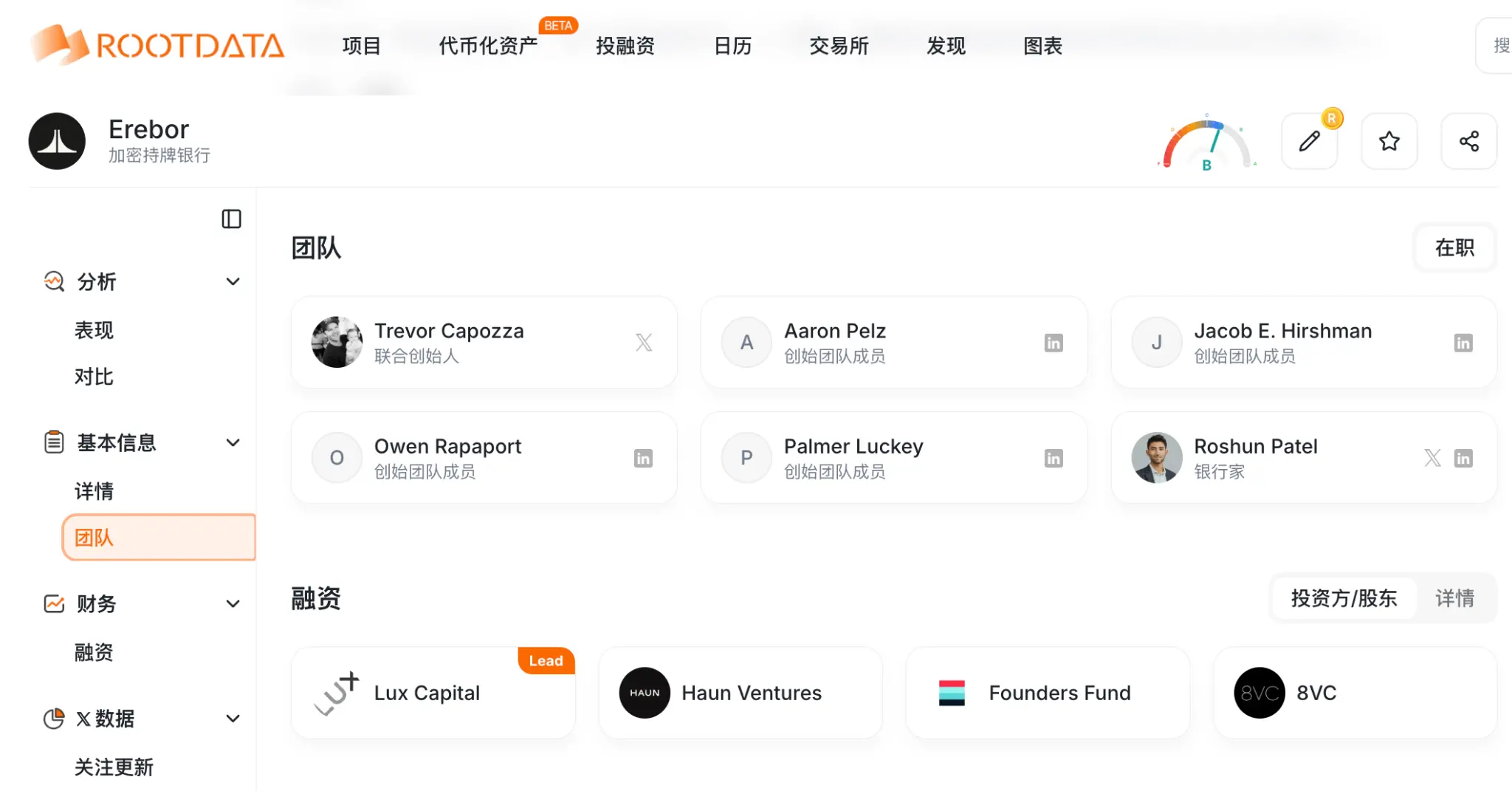
图片来源:RootData

另外,Erebor 有个关键战略选择是:坚持自己拿牌照、为财报负责,不像 Mercury、Brex 那样依附于合作银行。Luckey 的论点是,依赖第三方基础设施,等于把自己暴露在被“去平台化”、政策施压与产品受限的风险下;唯有握有牌照与账本,它才可能实现承诺中的链上结算、稳定币铸造与赎回。

回头看 Erebor 的起点,几乎完全系于 2023 年硅谷银行(SVB)的崩溃。那场倒闭让大批新创与创投一夕之间失去银行伙伴、存款也失去保障。Luckey 与投资人认为,这留下了一个“结构性真空”,也就是专门服务新创的银行消失了,而传统银行对那些持有非标准资产(国防合约、AI 硬件、数字代币)的新创,又太过保守或缓慢。

Erebor 宣称要解决的痛点大致有四个:一是为实体资产提供信贷,传统银行擅长以房地产或应收账款放款,却不擅长为“GPU ”或“航天研究”估值;二是打通链上与链下的割裂,让法币银行与稳定币结算收进同一张受监管的资产负债表;三是满足 24/7 的结算需求,取代仍运行在数十年前时程上的 SWIFT 与 ACH;四是为高成长的国际企业提供美元通道,对抗它们常遭遇的“去银行化”摩擦。

当然,这些运营潜力有几分真实、有几分营销,仍有讨论空间。创投支持的公司如今其实有非银行债权、DeFi 借贷等替代选项,部分既有银行在 SVB 倒闭前也已开始争取科技利基。Erebor 的创始人显然相信既有机构不够用,而它能拿到一张完整的银行牌照,说明监理机构或许也认为这个判断有几分道理?

此外,数字资产是 Erebor 长期战略的核心。它计划承作美元稳定币的存款与支付,提供即时的法币与稳定币互转、全天候的结算轨道,并在受监管框架内逐步支持稳定币的铸造与赎回。它的 OCC 牌照甚至明确允许它在自己账上持有少量加密资产,用以支付链上的手续费,监理信函将这类持有定义为银行业务的“附带”行为,这在合规上是个值得注意的先例。

4 月 2 日,Sui 基金会宣布 Erebor 已支持 Sui 网络,让客户能进行稳定币的存取,这是它把受监管银行基础设施接上链上支付的首批公开迹证之一。

不过,现实同样存在落差。据知情人士透露,加密抵押贷款的需求低于银行最初的预期。这与前述财报互相印证:近期真正带动成长的,反而是重建美国制造业产能的公司,以及对它们的设备融资与创投债。换句话说,Erebor 目前更像一家“国防 + 先进制造 + 加密”的混合体,而非一家纯粹的原生加密银行。

天时地利,Erebor 连申请牌照的时机都很刚好?

拆解牌照部分,Erebor 在 2025 年 10 月 15 日取得 OCC 的初步有条件核准,12 月 16 日获 FDIC 存款保险核准,2026 年 2 月初拿到最终牌照,并于 2 月 8 日以约 6.25 亿美元初始资本正式上线(相较初步核准阶段的约 2.75 亿美元大幅增资)。它是现任美国政府之下第一张全新核发(de novo)的全国性银行牌照。
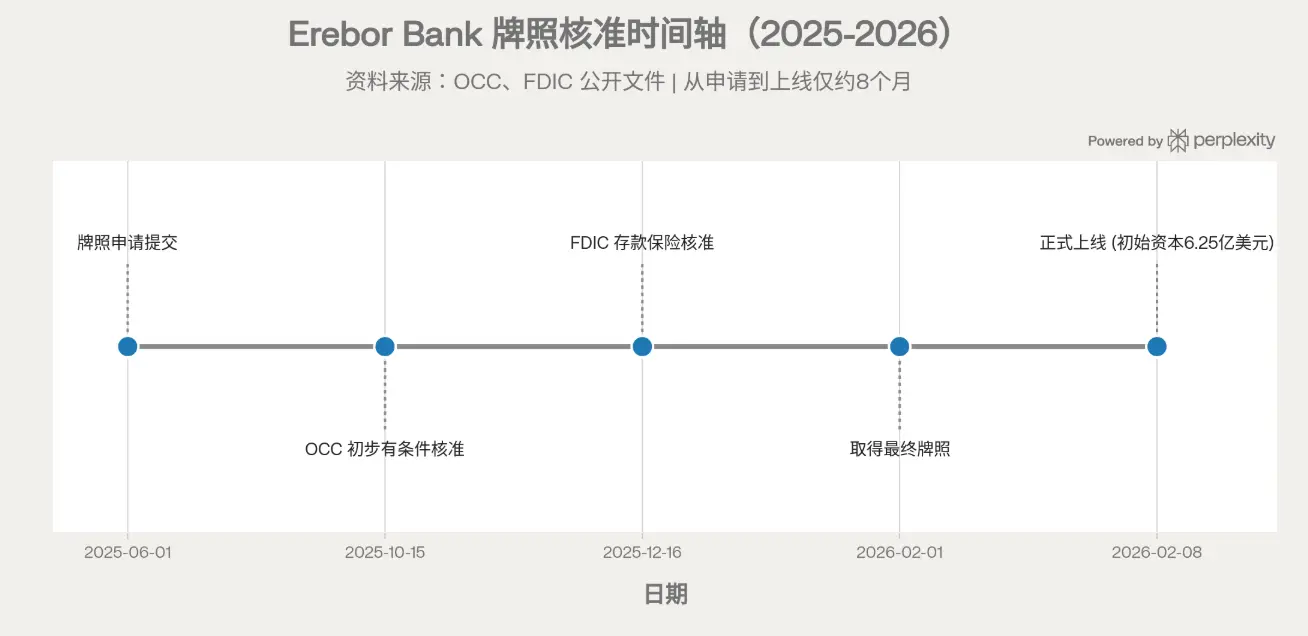
这一切发生在美国银行政策明显转向的背景下:在署长 Jonathan Gould 主政的 OCC,监理姿态对数字资产银行明确表达开放,Gould 本人也把这张牌照誉为“动态且多元的金融体系”的例子;叠加上联邦层级稳定币框架(GENIUS Act)的推进,一度模糊的法律地带被廓清了不少。

值得注意的是,监理机构也并非全然放行。为换取核准,OCC 与 FDIC 加上了严格条件:前三年须维持至少 12% 的第一类杠杆率(约为“资本充足”门槛的两倍),并附带资本补足承诺。可以说,Erebor 的可行性有一部分是绑在当前的政治周期上,若未来监理立场转向、或稳定币与反洗钱规则趋严,它整套建立在“代币友善规则”之上的论述,都可能面临逆风。

最后,综合外媒评断,Erebor 的模式,几乎每一项风险都正复制 SVB 当年的教训。

它承作的是早期、技术型公司,抵押品是非传统资产、它服务的是少数大额账户(新创、创始人、投资基金),而非成千上万的散户,任何单一客户的失败或提领(加密市场震荡、创投大幅收手)都可能显著冲击流动性;监理机构早已指出,SVB 那种“单一作物”式的客群结构,正是挤兑的推手之一。

加密相关性让问题更棘手,若它支持的某个稳定币脱锚、或加密价格崩盘,存款基础与贷款抵押品可能同时缩水,再往下,还有政策反转的风险(它整套论述都押在宽松的代币规则上)、从零打造核心系统与链上结算的执行风险、以及“稳定币是否真被客户广泛采用”这个尚未被验证的前提。最后是声誉与政治风险,Luckey 具高度争议的政治关联,加上“加密银行”本身的新奇,都可能在银行一旦出事时,放大市场的信心流失。

可以说 Erebor 是一场发生在银行、加密与产业政策交会处的高调实验。

它向市场倡导的需求就是 SVB 倒台之后的融资缺口,以及加密支付的摩擦,如今,监理机构已在纸面上背书,团队也兼具科技声望与华尔街背景,这套新模式的执行、监理立场的延续性,以及市场对其整合式服务的真实需求正是市场严谨审视的要点。


Trending Cryptos

Related Questions

QErebor Bank 的最新估值是多少?相比上一轮融资上涨了多少?

AErebor Bank 正在洽谈新一轮融资,目标估值至少为80亿美元。相比去年12月上一轮融资时的43.5亿美元估值,增长了约84%,接近一倍(文章标题提到“8个月涨2倍”,而正文具体指出是从43.5亿美元到至少80亿美元,约1.84倍)。

QErebor Bank 的存款规模在近期展现了怎样的增长势头?

AErebor Bank的存款规模增长极为迅猛。根据文章,其存款从2025年3月底向监管机构披露的11亿美元,在三个月内飙升至约40.5亿美元,单季度增长了近四倍。

Q创始人Palmer Luckey和Erebor Bank的核心战略是什么?

A创始人Palmer Luckey的战略模式是进入硬件、法规壁垒高且与政府生态结合紧密的高资本密集产业。Erebor Bank的核心战略包括:1)持有自己的银行牌照,实现独立运营和链上结算、稳定币业务等承诺;2)专注于服务持有非标准资产(如国防合约、AI硬件、数字代币)的新创企业,解决传统银行对此类客户过于保守的问题;3)长期将数字资产(如美元稳定币)作为战略核心,提供法币与稳定币的即时互转和全天候结算。

Q文章提到了Erebor Bank面临的哪些主要风险和挑战?

A文章指出Erebor Bank主要面临以下风险和挑战:1)业务模式与SVB类似,客户群高度集中于早期技术型公司和大额账户,易受单一客户变动或行业波动影响流动性;2)加密资产的相关性风险,如稳定币脱锚或加密价格暴跌,可能同时冲击存款和抵押品价值;3)政策风险,其业务模式依赖于当前宽松的加密监管政策,未来政策若收紧将带来逆风;4)声誉与政治风险,创始人的政治关联和“加密银行”的新颖性可能在危机时放大市场恐慌;5)执行风险,包括从零建立核心系统和验证市场对稳定币服务的真实需求。

QErebor Bank为何能获得银行牌照,其牌照有何特别之处?

AErebor Bank能获得牌照主要有几个原因:1)抓住了硅谷银行倒闭后市场留下的“结构性真空”,满足了新创企业和加密领域对新型银行服务的需求;2)其业务模式获得了当前美国监理机构(特别是OCC)对数字资产的开放态度支持。其牌照的特别之处在于:它是现任美国政府下第一张全新核发的全国性银行牌照,并且明确允许银行在其账上持有少量加密资产以支付链上手续费,这在合规上是一个值得注意的先例。同时,监管机构也附加了严格条件,如前三年须维持至少12%的高杠杆率。

Related Reads

Reviewing 8 'Cash Cow' Projects in the Bear Market: The Leader Repurchased $283 Million Worth This Year

This article highlights eight cryptocurrency projects that have demonstrated strong cash-generating capabilities and implemented significant token buyback programs during the bear market of 2026. These projects, dubbed "cash cows," are repurchasing their own tokens, often reducing supply. According to data from Tokenomist, the projects with notable buyback activity from January 1st to June 30th are: Meteora (MET), Pump.fun (PUMP), GMX, Rollbit (RLB), Metaplex (MPLX), Hyperliquid (HYPE), Lighter (LIT), and Aave. Notably, MET's buybacks equaled 71% of its January token supply, while HYPE executed the largest buyback by value at $283 million. Key project summaries include: - **Hyperliquid (HYPE):** The leader by dollar value, its perpetual DEX protocol has repurchased and burned 44 million HYPE tokens (approx. 4.4% of supply) using a significant portion of trading fees, with total buybacks exceeding $1.1 billion since March 2025. - **Meteora (MET):** Its buyback of 336.2 million MET tokens had the greatest proportional impact on its circulating supply, equivalent to 71% of its supply at the start of the year. - **Pump.fun (PUMP):** The popular memecoin launchpad has cumulatively bought back over $400 million worth of PUMP since July 2025, using 50% of net revenue for buybacks and burns since April. - **Aave (AAVE):** Despite facing a major security incident earlier in the year, the lending protocol has continued its buyback program, repurchasing over 200,000 AAVE tokens. Its team is designing a new automated buyback mechanism. - **GMX, Lighter (LIT), Rollbit (RLB), and Metaplex (MPLX)** also have active buyback mechanisms funded by protocol fees or revenues. The article concludes that while token buybacks and burns do not guarantee price appreciation—as market conditions, news, and other factors play a role—these projects stand out for their ability to generate consistent cash flow in a challenging market environment.

marsbit52m ago

Reviewing 8 'Cash Cow' Projects in the Bear Market: The Leader Repurchased $283 Million Worth This Year

marsbit52m ago

Ethereum Sheds Its Load? What Ethereum Supporters Think About the Lean Ethereum Upgrade and the Future Market

Ethereum is back in focus with the announcement of the "Lean Ethereum" upgrade roadmap, described by Vitalik Buterin as Ethereum's third major update. This proposal aims to fundamentally redesign the consensus, data, and execution layers from first principles, striving to make Ethereum **simpler, more secure (quantum-resistant), more verifiable, and more scalable.** The announcement comes amidst a broader restructuring within the ecosystem, including a 20% staff reduction at the Ethereum Foundation and the emergence of new organizations like EthLabs. This has sparked a debate among Ethereum supporters ("E-bizens"). **Optimists** view Lean Ethereum as a critical refocusing on core protocol fundamentals: * **sassal.eth** calls it the ultimate bullish catalyst, envisioning a future where running a node is so lightweight it could be done on a smartwatch, greatly enhancing decentralization. * **Ryan Sean Adams** sees it as Ethereum moving from "narrative expansion" to "protocol hardening," addressing long-term foundational issues like security and scalability. * Analysts like **BITWU** and **蓝狐 (Blue Fox)** frame it as a third-phase evolution towards a "minimal, durable, and credible base layer" designed for the next decade. * **gigi发财猪** interprets the organizational changes as Ethereum "shedding old baggage and forming new teams" for a lighter, more agile approach. * **Xiyu** notes that the roadmap itself provides a much-needed new narrative for market sentiment recovery. **Cautious voices** acknowledge the vision but emphasize execution and market timing: * **Ignas** warns that while the roadmap addresses key community requests, it overlooks tokenomics, and competitors are gaining ground in areas like RWA. Timely delivery is crucial; delays could be bearish. * **Dankrad Feist**, a former Ethereum Foundation researcher, agrees on direction but criticizes the proposed 3-4 year timeline as too slow for the current market pace, especially with AI-aided development available. **In summary,** optimists believe Lean Ethereum reaffirms Ethereum's long-term value proposition as a decentralized world computer, while the cautious argue that its success hinges on faster delivery and tangible results to maintain market relevance. Despite ongoing criticism, the move signals Ethereum's effort to regroup and reclaim initiative at the protocol level.

marsbit1h ago

Ethereum Sheds Its Load? What Ethereum Supporters Think About the Lean Ethereum Upgrade and the Future Market

marsbit1h ago

Trading

Spot

Hot Articles

What is $BANK

Bank AI: A Revolutionary Step in the Future of Banking Introduction In an era marked by rapid advancements in technology, Bank AI stands at the intersection of artificial intelligence (AI) and banking services. This innovative project seeks to redefine the financial landscape, enhancing operational efficiency, security measures, and customer experiences through the power of AI. As we embark on this exploration of Bank AI, we will delve into what the project entails, its operational dynamics, its historical context, and significant milestones. What is Bank AI? At its core, Bank AI represents a transformative initiative aimed at integrating artificial intelligence into various banking operations. This project harnesses the capabilities of AI to automate processes, improve risk management protocols, and enhance customer interaction through personalized services. The primary objectives of Bank AI include: Automation of Banking Functions: By leveraging AI technologies, Bank AI aims to automate routine tasks, reducing the burden on human resources and enhancing efficiency. Enhanced Risk Management: The project utilises AI algorithms to predict and identify risks, thereby fortifying security measures against fraud and other threats. Personalization of Banking Services: Bank AI focuses on offering tailored financial products and services by analysing customer data and behaviours. Improving Customer Experience: The implementation of AI-driven solutions, such as chatbots and virtual assistants, aims to provide users with more human-like interactions, revolutionising the way customers engage with banks. With these goals, Bank AI positions itself as a crucial player in rendering banking more efficient, secure, and user-centric. Who is the Creator of Bank AI? Details regarding the creator of Bank AI remain unknown. As such, no specific individual or organisation has been identified in the available information. The anonymity surrounding the project's inception raises questions but does not detract from its ambitious vision and objectives. Who are the Investors of Bank AI? Similar to the project's creator, specific information regarding the investors or supporting organisations of Bank AI has not been disclosed. Without this information, it is challenging to outline the financial backing and institutional support that might be propelling the project forward. Nevertheless, the importance of having a robust investment foundation is pivotal for sustaining development in such an innovative field. How Does Bank AI Work? Bank AI operates on several innovative fronts, focusing on unique factors that differentiate it from traditional banking frameworks. Below are key operational features: Automation: By applying machine learning algorithms, Bank AI automates various manual processes within banks. This results in reduced operational costs and allows human workers to redirect their efforts towards more strategic activities. Advanced Risk Management: The integration of AI into risk management practices equips banks with tools to accurately predict potential threats such as fraud, ensuring that customer information and assets remain secure. Tailored Financial Recommendations: Through continuous learning from customer interactions, the AI systems develop a nuanced understanding of user needs, enabling them to offer tailored advice on financial decisions. Enhanced Customer Interactions: Utilizing chatbots and virtual assistants powered by AI, Bank AI enables a more engaging customer experience, allowing users to have their queries resolved quickly, thus reducing wait times and improving satisfaction levels. Together, these operational features position Bank AI as a pioneer in the banking sector, establishing new benchmarks for service delivery and operational excellence. Timeline of Bank AI Understanding the trajectory of Bank AI requires a look at its historical context. Below is a timeline highlighting important milestones and developments: Early 2010s: The conceptualization of AI integration into banking services began to gain attention as banking institutions recognised the potential benefits. 2018: A marked increase in the implementation of AI technologies occurred when banks started using AI tools like chatbots for basic customer service and risk management systems for improved security handling. 2023: The sophistication of AI continued to advance, with generative AI being introduced for more complex tasks such as document processing and real-time investment analysis. This year marked a significant leap in the capabilities afforded to banks by AI technology. 2024-Current Status: As of this year, Bank AI is on an upward trajectory, with ongoing research and developments poised to further enhance capabilities in banking operations. Continued exploration of AI applications hints at exciting developments yet to come. Key Points About Bank AI Integration of AI in Banking: Bank AI focuses on adopting artificial intelligence to streamline banking processes and improve user experiences. Automation and Risk Management Focus: The project strongly emphasizes these areas, aiming to shift the burden of routine tasks while enhancing security frameworks through predictive analytics. Personalized Banking Solutions: By harnessing customer data, Bank AI enables tailored banking services that cater to individual user needs. Commitment to Development: Bank AI remains committed to ongoing research and development efforts, ensuring its adaptability and ongoing relevance as technology continues to evolve. Conclusion In summary, Bank AI exemplifies a crucial step forward in the banking industry, leveraging artificial intelligence to reshape operational paradigms, enhance security, and promote customer satisfaction. Despite gaps in information surrounding the creator and investors, the clear objectives and functional mechanisms of Bank AI provide a strong foundation for its ongoing evolution. As AI technology continues to advance and merge with the banking sector, Bank AI is well-positioned to significantly impact the future of financial services, enhancing the way we understand and interact with banking.

1.1k Total ViewsPublished 2024.04.05Updated 2024.12.03

What is $BANK

How to Buy BANK

Welcome to HTX.com! We've made purchasing Lorenzo Protocol (BANK) simple and convenient. Follow our step-by-step guide to embark on your crypto journey.Step 1: Create Your HTX AccountUse your email or phone number to sign up for a free account on HTX. Experience a hassle-free registration journey and unlock all features.Get My AccountStep 2: Go to Buy Crypto and Choose Your Payment MethodCredit/Debit Card: Use your Visa or Mastercard to buy Lorenzo Protocol (BANK) instantly.Balance: Use funds from your HTX account balance to trade seamlessly.Third Parties: We've added popular payment methods such as Google Pay and Apple Pay to enhance convenience.P2P: Trade directly with other users on HTX.Over-the-Counter (OTC): We offer tailor-made services and competitive exchange rates for traders.Step 3: Store Your Lorenzo Protocol (BANK)After purchasing your Lorenzo Protocol (BANK), store it in your HTX account. Alternatively, you can send it elsewhere via blockchain transfer or use it to trade other cryptocurrencies.Step 4: Trade Lorenzo Protocol (BANK)Easily trade Lorenzo Protocol (BANK) on HTX's spot market. Simply access your account, select your trading pair, execute your trades, and monitor in real-time. We offer a user-friendly experience for both beginners and seasoned traders.

5.1k Total ViewsPublished 2025.05.09Updated 2026.06.02

How to Buy BANK

Discussions

Welcome to the HTX Community. Here, you can stay informed about the latest platform developments and gain access to professional market insights. Users' opinions on the price of BANK (BANK) are presented below.

活动图片