Anh Quốc Bước Vào Giai Đoạn Cuối Cùng Của Việc Quản Lý Tiền Mã Hóa: Các Quy Định Mới Của FCA Có Những Thay Đổi Gì?

Foresight NewsPublished on 2026-07-02Last updated on 2026-07-02

Abstract

Tại Vương quốc Anh, Cơ quan Quản lý Tài chính (FCA) đã chính thức công bố loạt quy định mới toàn diện về tài sản mã hóa, đánh dấu sự chuyển đổi từ giai đoạn tham vấn sang áp dụng luật định. Khuôn khổ mới, có hiệu lực đầy đủ từ ngày 25/10/2027, sẽ mở rộng phạm vi hoạt động được quản lý, bao gồm phát hành stablecoin, lưu ký, vận hành sàn giao dịch, môi giới, đặt cọc (staking) và cho vay tiền mã hóa. Các công ty hiện tại cần lưu ý quan trọng về "điều khoản chuyển tiếp" (savings provisions). Họ phải nộp đơn xin ủy quyền trong khoảng thời gian từ 30/9/2026 đến 28/2/2027 để được tiếp tục hoạt động trong khi chờ FCA xem xét. Việc đăng ký hiện tại theo quy định chống rửa tiền sẽ không được tự động chuyển đổi. Quy định mới đặt ra các yêu cầu cụ thể về vốn và quản lý rủi ro. FCA thiết lập mức vốn tối thiểu cố định cho từng loại hình kinh doanh, cùng yêu cầu về tài sản thanh khoản cơ bản để đảm bảo hoạt động trong điều kiện khó khăn. Các sàn giao dịch và công ty môi giới phải tuân thủ quy tắc về tính toàn vẹn thị trường và thực hiện lệnh tối ưu cho khách hàng. Dịch vụ lưu ký phải bảo vệ tài sản khách hàng theo quy định nghiêm ngặt (CASS 17), trong khi dịch vụ cho vay và staking hướng tới tăng cường bảo vệ người tiêu dùng. Stablecoin là trọng tâm đặc biệt. FCA yêu cầu stablecoin do Anh phát hành phải được hỗ trợ đầy đủ bằng tài sản dự trữ và cho phép người nắm giữ quyền được mua lại theo mệnh giá trong khung thời gian T+1. Các quy tắc chi tiết về cấu trúc tài sản dự trữ (tài sản hỗ tr...


Tác giả: KarenZ, Foresight News


Một biểu đồ đếm ngược đang viết lại thị trường tiền mã hóa tại Vương quốc Anh.


Nếu một nền tảng tại Anh giúp người dùng mua tiền mã hóa, kết nối giao dịch, lưu ký tài sản, hoặc phát hành stablecoin, vấn đề cốt lõi mà họ sẽ phải đối mặt trong thời gian tới rất trực diện: liệu hoạt động kinh doanh có rơi vào phạm vi quy định mới của Cơ quan Quản lý Tài chính (FCA)? Có cần xin cấp phép hay không? Có được tiếp tục hoạt động trong thời gian chờ xét duyệt đơn xin cấp phép?


Cuối tháng 6 năm 2026, Cơ quan Quản lý Hành vi Tài chính Vương quốc Anh (FCA) đã công bố một loạt các tuyên bố chính sách quản lý tài sản mã hóa, bao gồm phát hành stablecoin, lưu ký, sàn giao dịch, môi giới, staking, cho vay, lạm dụng thị trường, công bố thông tin, vốn thận trọng và khả năng áp dụng Sổ tay FCA.


Theo Lộ trình Crypto của FCA, điều này có nghĩa là việc quản lý tiền mã hóa tại Anh đang chuyển từ giai đoạn tham vấn kéo dài nhiều năm sang giai đoạn quy tắc cuối cùng.


Từ Đăng Ký Đến Cấp Phép


Anh Quốc trước đây đã quản lý ngành công nghiệp tiền mã hóa, nhưng phạm vi còn tương đối hạn chế. Kể từ tháng 1 năm 2020, các nhà cung cấp dịch vụ giao dịch tài sản mã hóa và nhà cung cấp ví lưu ký hoạt động tại Anh cần đăng ký với FCA theo quy định chống rửa tiền; năm 2023, quy tắc khuyến mại tài chính bắt đầu áp dụng cho tiếp thị tài sản mã hóa.


Lần thay đổi này đi xa hơn một bước. FCA tuyên bố, Vương quốc Anh đã thông qua Nghị viện vào ngày 4 tháng 2 năm 2026 về Quy định về Đạo luật Dịch vụ và Thị trường Tài chính 2000 (Tài sản Mã hóa) năm 2026 (Financial Services and Markets Act 2000 (Cryptoassets) Regulations 2026), đưa phạm vi hoạt động tài sản mã hóa rộng hơn lần đầu tiên vào ranh giới quản lý của FCA. Trong chế độ mới, phạm vi hoạt động được quản lý đầy đủ sẽ được mở rộng từ ngày 25 tháng 10 năm 2027.


Chế độ này liên quan đến không ít các thực thể. FCA liệt kê các hoạt động liên quan bao gồm: phát hành stablecoin đủ điều kiện, lưu ký tài sản mã hóa, vận hành sàn giao dịch tài sản mã hóa đủ điều kiện, giao dịch tài sản mã hóa đủ điều kiện theo hình thức tự doanh hoặc đại lý, sắp xếp dịch vụ giao dịch tài sản mã hóa đủ điều kiện (bao gồm cho vay tiền mã hóa), sắp xếp dịch vụ staking tài sản mã hóa đủ điều kiện, v.v.


Nói cách khác, về mặt quản lý đối với Crypto, mục tiêu quản lý của Anh không nhắm vào một khâu nào đó. Phát hành, giao dịch, kết nối, môi giới, lưu ký, staking, cho vay, miễn là hoạt động rơi vào định nghĩa của chế độ mới, đều có thể cần phải đi vào hệ thống cấp phép của FCA.


Thời Điểm Quan Trọng Nhất, Liên Quan Đến Việc Có Thể Vừa Làm Vừa Chờ Thẩm Định


Đối với các công ty tiền mã hóa đang hoạt động trên thị trường Anh, điều cần phải theo dõi sát sao nhất là khoảng thời gian từ ngày 30 tháng 9 năm 2026 đến ngày 28 tháng 2 năm 2027.


FCA tuyên bố, nếu công ty muốn dựa vào các điều khoản bảo lưu chuyển tiếp (savings provisions), cửa sổ nộp đơn dự kiến sẽ mở vào ngày 30 tháng 9 năm 2026 và đóng vào ngày 28 tháng 2 năm 2027. Các công ty đủ điều kiện và nộp đơn trong cửa sổ này có thể tiếp tục tiến hành các hoạt động được chỉ định trong khi chờ FCA đưa ra quyết định.


Đây không phải là một lời nhắc ngày thông thường. Nó quyết định liệu các công ty hiện hữu có thể tiếp tục hoạt động trong khi chờ thẩm định cấp phép hay không. Lỡ mất cửa sổ này, công ty có thể mất đi sự bảo vệ cho phép tiếp tục hoạt động liên quan trong thời gian chuyển tiếp.


FCA cũng nêu rõ, các đăng ký hiện có sẽ không được tự động chuyển đổi. Hiện đang đăng ký theo Đạo luật Dịch vụ và Thị trường Tài chính 2000 (FSMA), Quy định chống rửa tiền, hoặc được cấp phép theo quy tắc dịch vụ thanh toán, tiền điện tử, cũng như các đơn vị phê duyệt khuyến mại tài chính dựa vào Điều 21 FSMA, nếu hoạt động rơi vào phạm vi hoạt động tài sản mã hóa được quản lý mới, vẫn cần phải xin cấp phép tương ứng.


Điều này sẽ buộc nhiều công ty phải rà soát lại ranh giới hoạt động của mình. Mô hình vận hành trước đây dưới đăng ký chống rửa tiền hoặc quy tắc khuyến mại tài chính, sau khi bước vào chế độ mới, chưa chắc đã đủ. Công ty trước tiên cần đánh giá xem mình có rơi vào phạm vi quản lý không, sau đó chuẩn bị hồ sơ xin cấp phép, sắp xếp vốn, hệ thống quản lý rủi ro và cơ chế bảo vệ tài sản khách hàng.


Ngoài Giấy Phép, Còn Có Ngưỡng Vốn Và Quản Lý Rủi Ro


Việc nhận được giấy phép không phải là vấn đề duy nhất. Lần này FCA đã biến nhiều yêu cầu tuân thủ vốn dễ chỉ dừng lại ở khẩu hiệu trước đây thành các quy tắc cụ thể hơn.


Về vốn thận trọng, PS26/12 đưa ra yêu cầu vốn tối thiểu thường trực cho các hoạt động kinh doanh khác nhau. Công ty giao dịch tự doanh tài sản mã hóa đủ điều kiện là 750.000 bảng Anh; phát hành stablecoin đủ điều kiện là 350.000 bảng Anh; lưu ký tài sản mã hóa, cung cấp dịch vụ staking tài sản mã hóa đủ điều kiện, vận hành sàn giao dịch tài sản mã hóa đủ điều kiện là 150.000 bảng Anh; giao dịch đại lý và sắp xếp giao dịch là 75.000 bảng Anh.
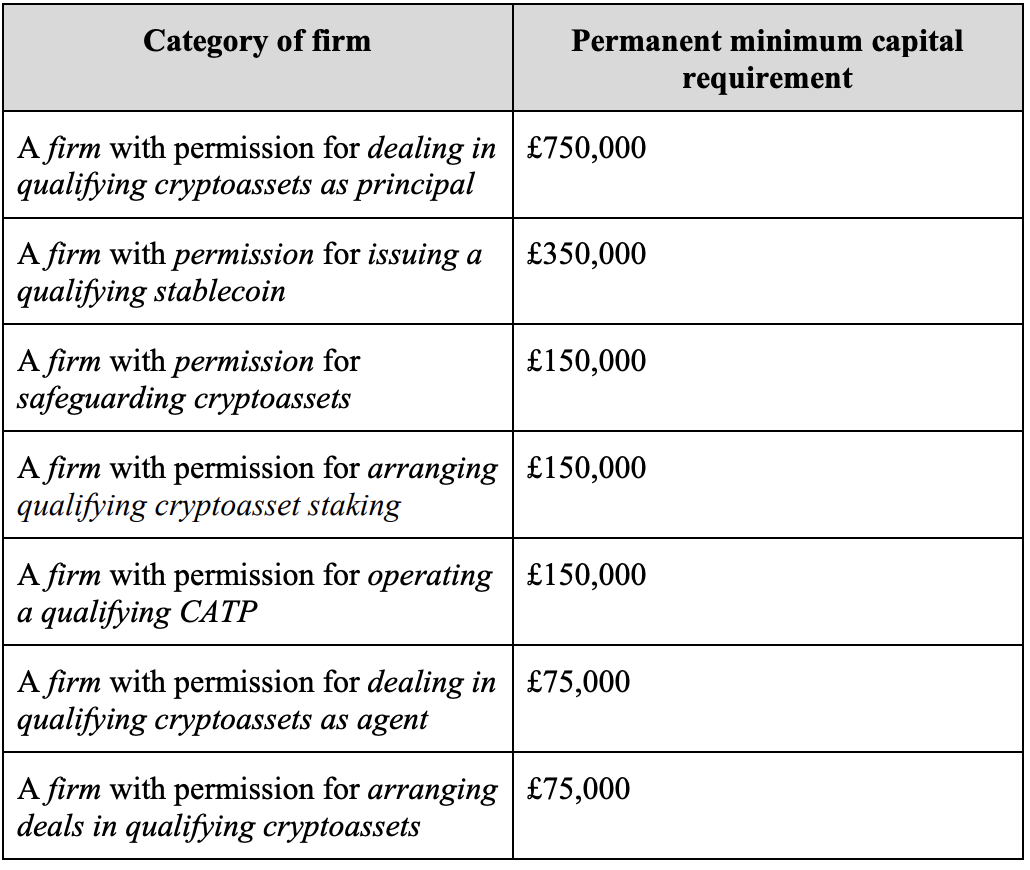


Những con số này trông có vẻ không cao, nhưng đó chỉ là ngưỡng cơ bản. FCA giải thích, yêu cầu vốn tự có tối thiểu của doanh nghiệp được lấy giá trị cao nhất trong ba yếu tố: yêu cầu vốn tối thiểu thường trực, yêu cầu chi phí cố định và yêu cầu K-factor. Vốn tối thiểu thường trực là đường cơ sở, K-factor sẽ được tính toán thêm dựa trên quy mô hoạt động kinh doanh và mức độ phơi nhiễm rủi ro. FCA cũng nhấn mạnh, vốn tối thiểu thường trực là ngưỡng cấp phép, doanh nghiệp không thể xin cấp phép trước, rồi sau đó bổ sung dần dần sau khi được cấp phép.


FCA cũng đưa ra yêu cầu về tài sản thanh khoản cơ bản. Các công ty liên quan cần nắm giữ tài sản thanh khoản cốt lõi, với số tiền bằng một phần ba yêu cầu chi phí cố định, cộng thêm 1,6% tổng số tiền đảm bảo cung cấp cho khách hàng. Mục đích của dự trữ thanh khoản này rất thực tế: công ty không chỉ đáp ứng yêu cầu vốn trên sổ sách, mà còn phải có đủ tài sản thanh khoản để hỗ trợ hoạt động, thoái lui hoặc xử lý nghĩa vụ liên quan đến khách hàng trong tình huống áp lực.


Sàn giao dịch và trung gian cũng phải đối mặt với các quy tắc ứng xử thị trường chi tiết hơn. FCA tuyên bố trong thông cáo báo chí, khuôn khổ mới sẽ đưa ra các quy tắc về tính toàn vẹn thị trường, bao phủ các lĩnh vực như giao dịch nội gián, thao túng thị trường; trong bản tổng quan về chế độ, FCA cũng đưa sàn giao dịch và trung gian vào phạm vi quy tắc hoạt động PS26/11, và đặc biệt đề cập đến các yêu cầu như thực hiện tối ưu, kiểm tra giá tại nhiều địa điểm thực hiện. PS26/11 quy định thêm, các công ty liên quan cần thiết lập quy trình xử lý lệnh của khách hàng, đảm bảo lệnh của khách hàng được thực hiện kịp thời, công bằng, nhanh chóng, và khi có thể, tham khảo giá của ít nhất 3 địa điểm thực hiện được ủy quyền tại Anh có độ tin cậy để kiểm tra.


Nếu số địa điểm được ủy quyền tại Anh có thể thực hiện lệnh đó ít hơn 3, thì kiểm tra các địa điểm hiện có sẵn. FCA đồng thời nhấn mạnh, đây không phải là so sánh giá máy móc cho từng giao dịch, cũng không yêu cầu lệnh chỉ có thể được khớp tại 3 địa điểm được kiểm tra. Nó yêu cầu công ty sử dụng nguồn giá đáng tin cậy để kiểm tra chính sách thực hiện của mình, và có thể chứng minh kết quả thực hiện mang lại cho khách hàng ít nhất là không kém hơn kết quả của các địa điểm được ủy quyền tại Anh trong tình huống có thể so sánh được.


Trọng tâm của hoạt động lưu ký là bảo vệ tài sản khách hàng. FCA xác nhận trong PS26/11, sẽ áp dụng yêu cầu bảo vệ CASS 17 đối với tài sản mã hóa của khách hàng, các quy tắc trọng tâm bao gồm quyền sở hữu, lưu trữ hồ sơ, đối chiếu tài sản và quản lý khóa riêng. Nói một cách đơn giản, nền tảng không thể chỉ nói "tài sản trên chuỗi rất minh bạch", mà còn phải chứng minh mình biết tài sản nào thuộc về khách hàng nào? Sổ cái và tài sản trên chuỗi có thể đối chiếu được không? Việc kiểm soát khóa riêng sẽ không mất kiểm soát do quy trình nội bộ hoặc tấn công bên ngoài.


Phân tích chi phí - lợi ích của FCA đưa ra một con số trực quan hơn: ước tính của họ cho thấy, quy tắc bảo vệ lưu ký có thể giúp người tiêu dùng tránh được khoản lỗ khoảng 60 triệu bảng Anh mỗi năm.


Cho vay và staking cũng được đưa vào khuôn khổ bảo vệ người tiêu dùng chi tiết hơn. Đối với cho vay tiền mã hóa, FCA giữ lại các yêu cầu bảo vệ cốt lõi đối với khách hàng bán lẻ, bao gồm công bố thông tin được tăng cường, sự đồng ý của khách hàng, kiểm tra tính phù hợp, lưu trữ hồ sơ, thế chấp vượt quá và bảo vệ số dư âm. Cái gọi là bảo vệ số dư âm, nghĩa là khoản lỗ mà khách hàng bán lẻ phải chịu trong khoản vay tiền mã hóa, không được vượt quá giá trị thị trường của tài sản thế chấp chuyên biệt mà họ cung cấp cho khoản vay đó.


Đối với dịch vụ staking, FCA giữ lại các yêu cầu về công bố thông tin, điều khoản hợp đồng, sự đồng ý của khách hàng và lưu trữ hồ sơ, nhưng điều chỉnh các sắp xếp staking tự động, cho phép khách hàng đồng ý staking liên tục bao phủ các vị thế hiện tại và tương lai, với điều kiện đáp ứng các điều kiện liên quan và thông báo hàng năm.


Stablecoin Được Đặt Cạnh Khả Năng Tưởng Tượng Về Thanh Toán


Stablecoin là một loại hình kinh doanh được xử lý riêng biệt trong khuôn khổ quản lý này.


FCA tuyên bố, stablecoin đủ điều kiện được phát hành tại Anh sẽ được yêu cầu có tài sản hỗ trợ đầy đủ và có thể được mua lại theo mệnh giá, để hỗ trợ việc sử dụng nó như một "công cụ giống tiền tệ".


Trọng tâm của PS26/10 là yêu cầu nhà phát hành stablecoin thiết lập một cơ chế có thể xem xét được xoay quanh tài sản hỗ trợ, mua lại, công bố thông tin và bảo vệ tài sản. Quy tắc cuối cùng của FCA yêu cầu, nhà phát hành stablecoin tại Anh phải cung cấp tài sản hỗ trợ đầy đủ cho stablecoin ngay từ khi nó được đúc, bao gồm cả token do chính nhà phát hành nắm giữ; các token đã bị hủy vĩnh viễn thì không cần tài sản hỗ trợ bao phủ nữa. Lý do FCA đưa ra rất trực tiếp: stablecoin có tính thanh khoản, nếu các token không được hỗ trợ xâm nhập thị trường, có thể làm suy yếu niềm tin của thị trường vào khả năng neo 1:1 của nó.


Về việc mua lại, FCA yêu cầu nhà phát hành stablecoin tại Anh cung cấp quyền được mua lại theo mệnh giá, và hoàn tất việc mua lại trong khung thời gian T+1. Tuy nhiên, quy tắc cuối cùng đã điều chỉnh điểm bắt đầu thời gian: T+1 không còn được tính từ khi bắt đầu yêu cầu mua lại hoàn chỉnh, mà được tính từ khi nhà phát hành nhận được stablecoin cần mua lại vào ví của mình. Bằng cách này, việc kiểm tra AML/KYC có thể hoàn thành trước T+1, tránh việc lồng ghép thẩm định chống rửa tiền vào thời hạn mua lại.


Về tài sản hỗ trợ, FCA chia dự trữ stablecoin thành hai lớp: tài sản hỗ trợ cốt lõi (core backing assets) và tài sản hỗ trợ mở rộng (expanded backing assets).


Tài sản hỗ trợ cốt lõi bao gồm tiền gửi không kỳ hạn và công cụ nợ chính phủ ngắn hạn; tài sản hỗ trợ mở rộng bao gồm công cụ nợ chính phủ dài hạn, cổ phần quỹ thị trường tiền tệ CNAV công cộng, và các thỏa thuận mua lại hoặc mua lại ngược (repo/reverse repo) có kỳ hạn không quá 7 ngày với công cụ nợ chính phủ làm tài sản cơ sở.


FCA đặt ra hai yêu cầu về thanh khoản: Thứ nhất, nhà phát hành phải đáp ứng Yêu cầu Tiền gửi Theo yêu cầu (ODDR - On-demand Deposit Requirement), tức là nắm giữ ít nhất 5% tổng số tài sản hỗ trợ dưới dạng tiền gửi không kỳ hạn; Thứ hai, nhà phát hành cũng phải đáp ứng Yêu cầu Tài sản Hỗ trợ Cốt lõi (CBAR - Core Backing Asset Requirement), tức là nắm giữ thêm một tỷ lệ nhất định tài sản hỗ trợ cốt lõi, tỷ lệ này lấy giá trị cao hơn giữa 5% và tỷ lệ mua lại cao nhất trong một ngày trong 180 ngày mua lại trước đó. Số tiền gửi không kỳ hạn dùng để đáp ứng ODDR không thể đồng thời dùng để đáp ứng CBAR.


Điểm mấu chốt của thiết kế này là để tránh việc nhà phát hành phân bổ nhiều tài sản dài hạn hoặc phức tạp hơn vì lợi nhuận, nhưng lại không thể đưa ra đủ tài sản thanh khoản cao khi người dùng tập trung mua lại.


Ngoài ra, phía sau đó còn có một sự phân công quản lý lớn hơn. FCA và Ngân hàng Anh cùng ngày đã công bố một bản giải thích chung, làm rõ lộ trình quản lý đối với nhà phát hành stablecoin có tính hệ thống. "Nhà phát hành stablecoin Anh Quốc thông thường" do FCA quản lý; nếu một nhà phát hành stablecoin Anh Quốc nào đó được Bộ Tài chính Anh xác định là có "tầm quan trọng hệ thống", có thể chuyển từ việc chỉ do FCA quản lý sang quản lý chung giữa FCA và Ngân hàng Anh.


PS26/10 cũng đề cập, trong bản dự thảo quy tắc của Ngân hàng Anh, cơ cấu tài sản hỗ trợ của stablecoin hệ thống có thể chuyển sang tối đa 70% nợ chủ quyền Anh với thời hạn còn lại dưới 6 tháng, và ít nhất 30% tiền gửi tại ngân hàng trung ương; một stablecoin đơn lẻ cũng có thể áp dụng giới hạn phát hành tạm thời là 40 tỷ bảng Anh, và yêu cầu mua lại T+0.


Điều này cho thấy Anh Quốc không chỉ coi stablecoin như một công cụ định giá trên sàn giao dịch. Miễn là nó tiếp tục tiến gần hơn đến bối cảnh thanh toán và quyết toán, điểm quan tâm của cơ quan quản lý sẽ mở rộng từ rủi ro đầu tư sang an toàn dự trữ, ổn định mua lại và độ tin cậy của cơ sở hạ tầng tài chính.


Tóm tắt


FCA vẫn nhắc nhở, phần lớn tài sản mã hóa có tính đầu cơ cao, người tiêu dùng có thể mất toàn bộ vốn gốc. Các quy tắc mới sẽ không loại bỏ được loại rủi ro này, cũng không xác nhận bất kỳ điều gì cho tài sản mã hóa. Nó thay đổi một điều khác: Anh Quốc bắt đầu sử dụng ngôn ngữ quản lý tài chính đầy đủ hơn để xử lý hoạt động kinh doanh tiền mã hóa.


Trong khuôn khổ mới, các công ty liên quan đến Crypto còn phải chứng minh vốn có đủ không, tài sản khách hàng được bảo vệ như thế nào, giao dịch được thực hiện có công bằng không, stablecoin có thể được mua lại theo quy định không, và khi rủi ro mất kiểm soát thì ai là người chịu trách nhiệm.


Đến ngày 25 tháng 10 năm 2027, khi bộ đếm ngược kết thúc, những công ty thực sự có thể tồn tại, là những công ty có thể làm rõ ranh giới hoạt động, tài sản khách hàng, dự trữ vốn và trách nhiệm rủi ro của mình.

Trending Cryptos

Related Questions

QCác lĩnh vực kinh doanh tiền điện tử nào sẽ được đưa vào phạm vi quy định mới của FCA?

ATheo bài viết, các lĩnh vực kinh doanh mới sẽ được đưa vào quy định bao gồm: phát hành stablecoin đủ điều kiện, lưu ký tài sản tiền điện tử, vận hành sàn giao dịch tài sản tiền điện tử đủ điều kiện, giao dịch tự doanh hoặc môi giới các tài sản tiền điện tử đủ điều kiện, sắp xếp các dịch vụ giao dịch (bao gồm cho vay tiền điện tử) và sắp xếp các dịch vụ staking tài sản tiền điện tử đủ điều kiện.

QCửa sổ nộp đơn đăng ký 'điều khoản chuyển tiếp' (savings provisions) diễn ra trong thời gian nào, và tầm quan trọng của nó là gì?

ACửa sổ nộp đơn dựa trên 'điều khoản chuyển tiếp' dự kiến mở vào ngày 30/9/2026 và đóng vào ngày 28/2/2027. Đây là khoảng thời gian quan trọng để các công ty đang hoạt động tại thị trường Anh nộp đơn. Nếu nộp đơn trong thời gian này và đủ điều kiện, họ có thể tiếp tục kinh doanh các hoạt động được chỉ định trong khi chờ FCA xem xét và đưa ra quyết định cấp phép cuối cùng. Bỏ lỡ cửa sổ này có thể khiến công ty mất đi sự bảo vệ được tiếp tục hoạt động trong thời gian chuyển tiếp.

QYêu cầu về vốn tối thiểu vĩnh viễn (Permanent Minimum Capital Requirements) đối với các hoạt động khác nhau là gì?

ATheo quy định PS26/12 của FCA, yêu cầu vốn tối thiểu vĩnh viễn cho từng loại hình kinh doanh như sau: Công ty giao dịch tự doanh tài sản tiền điện tử đủ điều kiện: 750.000 bảng Anh; Nhà phát hành stablecoin đủ điều kiện: 350.000 bảng Anh; Dịch vụ lưu ký tiền điện tử, cung cấp dịch vụ staking, vận hành sàn giao dịch: 150.000 bảng Anh; Giao dịch môi giới và sắp xếp giao dịch: 75.000 bảng Anh.

QFCA đưa ra những yêu cầu cụ thể nào để bảo vệ tài sản tiền điện tử của khách hàng (client asset protection) đối với các dịch vụ lưu ký?

AFCA quy định các dịch vụ lưu ký phải tuân theo yêu cầu bảo vệ CASS 17. Các quy tắc trọng tâm bao gồm: Xác định quyền sở hữu rõ ràng, lưu trữ hồ sơ, đối chiếu tài sản và quản lý khóa riêng tư. Điều này yêu cầu nền tảng phải chứng minh được họ biết tài sản nào thuộc về khách hàng nào, sổ sách kế toán khớp với tài sản trên chuỗi, và khóa riêng tư được kiểm soát an toàn, không bị ảnh hưởng bởi lỗi quy trình nội bộ hoặc tấn công bên ngoài.

QFCA và Ngân hàng Trung ương Anh (BoE) sẽ phân chia trách nhiệm quản lý như thế nào đối với các nhà phát hành stablecoin?

ATheo bài viết, các nhà phát hành stablecoin 'thông thường' của Anh sẽ do FCA quản lý. Tuy nhiên, nếu một nhà phát hành stablecoin cụ thể của Anh được Bộ Tài chính Anh xác định là có 'tầm quan trọng hệ thống' (systemically important), họ có thể chuyển từ việc chỉ do FCA quản lý sang chịu sự giám sát chung của cả FCA và Ngân hàng Trung ương Anh (BoE). Điều này cho thấy mức độ giám sát sẽ nghiêm ngặt hơn đối với các stablecoin có khả năng ảnh hưởng lớn đến hệ thống tài chính.

Related Reads

MSTR Discloses Sale of 3,588 Bitcoins, Stock Price Drops Over 5% at One Point During Trading

MicroStrategy, the world's largest corporate holder of Bitcoin, has significantly shifted its business model. Between June 29 and July 5, the company sold 3,588 bitcoins for approximately $216 million to fund quarterly dividends for its preferred stock. This marks its largest-ever Bitcoin sale and signals a strategic pivot: Bitcoin is transitioning from a "buy-and-hold" reserve asset to a liquidity management tool for the company. This move follows a recent authorization allowing Bitcoin sales when equity fundraising is less attractive. The announcement contributed to a more than 5% intraday drop in MicroStrategy's stock price, while Bitcoin fell to around $61,800—below the company's average holding cost of roughly $75,700. The sale represents a major departure from MicroStrategy's long-standing "never sell" commitment, which saw its first minor breach in May with a $2.5 million sale. The latest, hundred-times-larger transaction underscores growing financial pressures. Analysts note the company faces about $1.5 billion in annual preferred dividend obligations, far exceeding cash flow from its software business. As of July 5, MicroStrategy holds 843,775 bitcoins. Its current operational logic involves buying Bitcoin during favorable financing conditions and selling portions to cover dividends when needed, creating a flexible capital management cycle amidst a challenging market environment.

华尔街日报6h ago

MSTR Discloses Sale of 3,588 Bitcoins, Stock Price Drops Over 5% at One Point During Trading

华尔街日报6h ago

Q-Day Countdown: Will Quantum Computing End Cryptocurrencies?

Quantum Computing's Threat to Cryptocurrency: A Countdown to Q-Day Quantum computing, specifically Shor's algorithm, poses a fundamental threat to the public-key cryptography (e.g., ECDSA, RSA) that secures blockchain networks like Bitcoin and Ethereum. This critical juncture, known as Q-Day, is estimated to occur potentially within the next 5-15 years. The core vulnerability stems from the public and immutable nature of blockchains. Assets in addresses where the public key is already exposed on-chain (e.g., spent outputs) are at direct risk, as a sufficiently powerful quantum computer could derive the private key. This threatens the very trust model of cryptocurrencies. The response lies in Post-Quantum Cryptography (PQC)—algorithms like lattice-based ML-DSA and hash-based SLH-DSA, which are resistant to quantum attacks. NIST has standardized key PQC algorithms (FIPS 203, 204, 205), providing a migration path. However, the primary challenge is not technical but socio-economic and involves complex governance: * **Bitcoin's** path is constrained by its conservative ethos. Migrating requires a soft-fork to new address types, facing hurdles like significantly larger signature sizes and, most critically, the divisive governance question of how to handle at-risk legacy UTXOs without violating core principles. * **Ethereum** is pursuing a "cryptographic agility" strategy, with a multi-layered roadmap. It leverages account abstraction for user accounts and is developing compressed hash-based signatures (e.g., leanXMSS) for its consensus layer, aiming for a full-stack upgrade over time. In conclusion, quantum computing does not spell an instant end for cryptocurrency but initiates a critical countdown. The industry has a limited "engineering comfort window" to orchestrate a coordinated, ecosystem-wide migration to PQC. The ultimate bottlenecks are the immense coordination efforts and governance decisions required for this foundational transition.

marsbit7h ago

Q-Day Countdown: Will Quantum Computing End Cryptocurrencies?

marsbit7h ago

Trump, the President Who Knows Best How to 'Trade Stocks'

Former US President Donald Trump reported a record-breaking $2.2 billion in personal income for 2025, the highest annual income ever disclosed by a sitting president. This figure, from a 927-page government ethics filing, represented a 3.5-fold increase from his $600 million income in 2024 and boosted his net worth to $6.5 billion. The primary drivers were cryptocurrency (64% of income, approximately $1.4 billion) and real estate (26%, approximately $575 million). His crypto earnings stemmed largely from the launch of his personal meme coin, $TRUMP, generating over $600 million in licensing fees, and substantial profits from the WLFI token and its parent company. Despite a sluggish property market, his Mar-a-Lago resort and associated golf clubs saw revenue surges of 50% and 27%, respectively, attributed to their use as venues for presidential events. Trump's financial disclosure also revealed an unprecedented level of stock market activity, with over 22,000 trades executed in 2025, averaging 87 trades per market day. Media analyses noted several instances where significant trading coincided with major policy announcements, such as proposed tariffs, raising questions about potential conflicts of interest. While the White House stated these trades were handled by a family-managed trust fund and not Trump directly, critics highlighted this as a departure from the blind trusts traditionally used by presidents post-Watergate. The report has intensified debate over the commercialization of the presidency. Supporters view it as a success story of a businessman-president, while critics argue it demonstrates an unprecedented conversion of public influence into private wealth, with policy decisions potentially linked to personal financial gains. The controversy centers on whether Trump's earnings represent innovative entrepreneurship or a fundamental conflict of interest, sparking renewed calls for stricter ethics reforms in US governance.

marsbit7h ago

Trump, the President Who Knows Best How to 'Trade Stocks'

marsbit7h ago

Trading

Spot

Hot Articles

What is DOGE M

Doge Matrix ($doge m): The New Breed of Community-Driven Cryptocurrency Introduction In the ever-evolving landscape of cryptocurrency, new projects constantly emerge, each aiming to capture the interest of investors and enthusiasts alike. One of the latest entrants to this domain is Doge Matrix, represented by the ticker symbol $doge m. This project has attracted attention thanks to its roots in the popular meme culture surrounding Dogecoin, establishing its place within the web3 space. This article aims to provide a comprehensive analysis of Doge Matrix, covering its overview, creator, investors, functionality, timeline, and notable aspects. What is Doge Matrix ($doge m)? Doge Matrix is a community-driven cryptocurrency project that seemingly builds upon the widespread appeal of Dogecoin, a digital currency known for its Shiba Inu mascot and its meme origins. While the overarching objectives of Doge Matrix are not extensively defined, it is characterized by a commitment to harnessing community involvement and support. Unlike traditional cryptocurrencies that often emphasize utility or intrinsic value through underlying technologies, Doge Matrix positions itself within a space that embraces the cultural phenomenon of cryptocurrencies, particularly appealing to those who resonate with the ethos of meme-based assets. Drawing on the strengths of the Dogecoin community, Doge Matrix operates as part of a broader ecosystem, inviting participation and engagement from users who share an interest in cryptocurrency and the digital landscape. Who is the Creator of Doge Matrix ($doge m)? The identity of the creator of Doge Matrix remains unknown. This lack of transparency is not an uncommon occurrence in the cryptocurrency space, where some projects are launched without revealing the identities of their founders. The absence of information regarding the founding team can raise questions among potential investors about the project’s accountability and direction. Who are the Investors of Doge Matrix ($doge m)? As it stands, there is no publicly available information detailing the investors or investment foundations that back Doge Matrix. The project appears to rely primarily on community support rather than institutional investment. This model aligns with the community-driven nature of the initiative, fostering an environment where the direction of the project is shaped by its participants rather than being dictated by a select few financial backers. How Does Doge Matrix ($doge m) Work? The specifics regarding the operational mechanisms of Doge Matrix are somewhat vague, reflecting a broader trend of projects in the meme coin space where innovative functionalities are not always clearly articulated. Nonetheless, Doge Matrix seems designed to tap into the existing cryptocurrency ecosystem by encouraging user participation while tapping into the familiar cultural references associated with Dogecoin. Its potentially unique characteristics derive from community interactions rather than technological advancements, emphasizing shared experiences and collaboration among token holders. While the exact innovations have not been explicitly outlined, the project appears to create a space where community members can engage, share ideas, and propel the project's potential forward. Timeline of Doge Matrix ($doge m) Reflecting on the project’s timeline reveals notable events that have defined its journey thus far: November 25, 2024: Doge Matrix reached its all-time high value, marking a significant milestone in its early history. January 1, 2025: Conversely, Doge Matrix hit its all-time low value, illustrating the volatility often associated with cryptocurrencies, especially in the early stages of a project's lifecycle. Ongoing: The project continues to be actively traded and supported by its community, although specific future milestones or objectives have yet to be disclosed. Key Points About Doge Matrix ($doge m) Community Focus At the heart of Doge Matrix is a commitment to community engagement. The project thrives on the premise of collaboration and shared objectives among its members, emphasizing the importance of collective effort. Unlike centralized projects that often have a defined leadership structure, Doge Matrix at present showcases a more fluid approach to governance, where every community member's voice matters. Volatility The cryptocurrency market is notorious for its volatility, and Doge Matrix is no exception. Its price history reflects significant fluctuations between high and low values, which is typical of many new cryptocurrencies but underscores the risks associated with investment in emerging tokens. Lack of Detailed Information One of the most striking features about Doge Matrix is the scarcity of detailed information regarding its technological underpinnings and operational mechanisms. This ambiguity necessitates that potential investors conduct thorough due diligence before engaging with the project. Conclusion In summary, Doge Matrix ($doge m) illustrates a new wave of cryptocurrency projects that lean heavily on community engagement and cultural relevance. While lacking in certain specifics—such as clear leadership, defined objectives, and detailed functionality—the project has managed to generate interest within the crypto community, leveraging the established appeal of meme culture. As with any investment in the cryptocurrency space, understanding the inherent risks and conducting comprehensive research is essential for potential participants. Doge Matrix stands as a reminder of the dynamic, sometimes unpredictable nature of the crypto industry, marked by constant evolution and enthusiasm for community-driven initiatives.

3.9k Total ViewsPublished 2025.02.03Updated 2025.02.03

What is DOGE M

What is $M

Understanding Mantis ($M): A New Era in Cross-Chain Interoperability In the continually evolving landscape of Web3 and cryptocurrency, new projects strive to offer innovative solutions aimed at enhancing the user experience and expanding functional possibilities within the decentralized financial ecosystem. One such project garnering attention is Mantis ($M), a pioneering protocol founded on the principles of cross-chain interoperability and intent-based settlements. This article delves into the essential aspects of Mantis, including its core functionality, creators, investment backing, innovative features, and critical milestones. What is Mantis ($M)? Mantis is described as a multi-domain intent settlement protocol that simplifies cross-chain interactions, enabling users to execute complex financial transactions across various blockchain platforms seamlessly. The protocol operates through three primary layers: Intent Expression: Users can articulate their transaction goals using natural language facilitated by the DISE LLM, an advanced AI language model. For instance, a user might express a desire to swap Ethereum (ETH) for Solana (SOL) with a specific slippage tolerance of 1%. Execution: This layer employs a network of solvers that compete to fulfill user intents. Transactions are executed using mechanisms such as Coincidence of Wants (CoWs) and Order Flow Auctions (OFAs), which ensure that user demands are met optimally. Settlement: Leveraging the Inter-Blockchain Communication (IBC) protocol, Mantis enables atomic cross-chain transactions, allowing users to operate across various supported chains, including Ethereum, Solana, and Cosmos. Mantis is engineered to introduce native yield generation for idle assets, employing cryptographic proofs to maintain the integrity of transactions throughout the entire process. Creators & Development Team Mantis was conceived by the Composable Foundation, a research-driven organization notable for its emphasis on blockchain interoperability solutions. This foundation collaborates with esteemed academic institutions, including Harvard University and the University of Lisbon, contributing to extensive research and development efforts that inform Mantis's architecture and functionality. The Composable Foundation’s commitment to fostering innovation in the blockchain space positions Mantis as a robust solution for the growing demand for interoperability among multiple blockchain networks. Investors & Backing While specific details about individual investors have not been publicly disclosed, Mantis enjoys substantial backing from various entities, including: Ecosystem grants from IBC-enabled chains, which support the protocol's growth and integration within decentralized finance ecosystems. Strategic partnerships with infrastructure providers that enhance Mantis's network capabilities and deployment strategies. Funding through the Composable Foundation's treasury, ensuring sustained financial support for ongoing development and operational costs. These collaborative efforts reflect a consensus among stakeholders about the importance of enhancing cross-chain functionality and the potential utility of Mantis's infrastructural innovations. Key Innovations Mantis sets itself apart through several pioneering innovations that enhance its functionality and utility: Chain-Agnostic Intents: Users can initiate transactions from any supported chain while settling on another. This flexibility empowers users, driving increased interaction among different platforms. AI-Powered Interface: The integration of DISE LLM allows users to conduct complex DeFi operations using natural language, thereby simplifying interactions and making blockchain technology accessible to a broader audience. Cross-Domain MEV Capture: Mantis creates an internal market for maximal extractable value (MEV) through competitions among solvers. This innovative approach allows for greater efficiency and value extraction in complex transactions. Modular Settlement Layer: The protocol supports various verification methods, including zero-knowledge proofs and optimistic rollups, providing a versatile framework that can adapt to emerging blockchain technologies. Historical Timeline Mantis's development is marked by several critical milestones that chart its trajectory and growth: | Year | Milestone | |————|————————————————————————-| | 2022 | Initial concept development within the Composable Foundation's research division. | | Q3 2024 | Launch of the testnet with bridging capabilities between Solana and Ethereum. | | Q1 2025 | Anticipated Token Generation Event (TGE) alongside the mainnet launch. | | Q2 2025 | Expected integration of DISE LLM and expansion of cross-chain capabilities. | | 2025 H2 | Planned support for over 15 chains through further IBC upgrades. | This timeline outlines Mantis's evolution, from conceptual discussions to active implementation and future growth phases. Ecosystem Growth Strategy Mantis's strategy for ecosystem growth includes several initiatives designed to encourage user participation and developer engagement: Credits System: Users can earn protocol credits by providing liquidity and engaging in referral programs. These credits are redeemable for incentives in the future, fostering a robust user community. Modular Software Development Kit (SDK): This toolkit empowers developers to create applications based on intent-driven models utilizing Mantis's infrastructure, thus promoting innovation within its ecosystem. Governance Model: As the protocol matures, $M token holders will have a voice in protocol governance, allowing them to vote on proposed upgrades and changes, thereby enhancing community engagement and decentralization. Mantis represents a significant advancement in the realm of cross-chain architecture. By seamlessly integrating advanced AI algorithms with a robust settlement framework, Mantis seeks to tackle the problems of fragmentation within multi-chain ecosystems. Its innovative approach prioritizes improved user experiences while adhering to the foundational principles of decentralization and security, setting a new standard for the future interoperability of blockchain technologies. As Mantis continues its journey of growth and implementation, it promises to be a project to watch closely in the competitive landscape of Web3 and decentralized finance. With its focus on crossing boundaries and elevating user engagement, Mantis is poised to be an integral part of the future developments in the cryptocurrency space.

384 Total ViewsPublished 2025.03.18Updated 2025.03.18

What is $M

How to Buy M

Welcome to HTX.com! We've made purchasing MemeCore (M) simple and convenient. Follow our step-by-step guide to embark on your crypto journey.Step 1: Create Your HTX AccountUse your email or phone number to sign up for a free account on HTX. Experience a hassle-free registration journey and unlock all features.Get My AccountStep 2: Go to Buy Crypto and Choose Your Payment MethodCredit/Debit Card: Use your Visa or Mastercard to buy MemeCore (M) instantly.Balance: Use funds from your HTX account balance to trade seamlessly.Third Parties: We've added popular payment methods such as Google Pay and Apple Pay to enhance convenience.P2P: Trade directly with other users on HTX.Over-the-Counter (OTC): We offer tailor-made services and competitive exchange rates for traders.Step 3: Store Your MemeCore (M)After purchasing your MemeCore (M), store it in your HTX account. Alternatively, you can send it elsewhere via blockchain transfer or use it to trade other cryptocurrencies.Step 4: Trade MemeCore (M)Easily trade MemeCore (M) on HTX's spot market. Simply access your account, select your trading pair, execute your trades, and monitor in real-time. We offer a user-friendly experience for both beginners and seasoned traders.

7.7k Total ViewsPublished 2025.07.02Updated 2026.06.02

How to Buy M

Discussions

Welcome to the HTX Community. Here, you can stay informed about the latest platform developments and gain access to professional market insights. Users' opinions on the price of M (M) are presented below.

活动图片