Cardano Builder IO Says It Delivered 16 Of 18 Treasury Commitments

bitcoinistPublished on 2026-04-30Last updated on 2026-04-30

Input Output said it progressed 16 of 18 treasury-funded Cardano commitments across Q4 2025 and Q1 2026, framing the period as a test of whether ecosystem funding can translate into publicly verifiable delivery. Two commitments, Acropolis and tiered pricing, were canceled, with funding returned to the treasury, according to IO’s delivery report.

The report positions Cardano’s treasury model in unusually direct terms: funding either produces trackable output, or it goes back. “In Q4 2025 and Q1 2026, IO delivered measurable progress across 18 treasury-funded commitments. Sixteen were progressed successfully. Two – Acropolis and tiered pricing – were canceled, and their funding returned. Every outcome in this report is publicly verifiable.”

Cardano Adoption Moves From Roadmap To Usage

The most immediate adoption milestone was the launch of USDCx on Cardano in Q1 2026. IO said the asset went live 84 days after announcement, with more than 15 million USDCx minted in its first week. During that period, Cardano DeFi total value locked rose from $127 million to $142 million, while Minswap, Liqwid and SundaeSwap supported live liquidity pools.

Interoperability was the second major adoption theme. LayerZero’s announced integration with Cardano and Midnight connects the ecosystem to more than 160 blockchains and over $80 billion in omnichain assets, according to the report. IO called it “the single largest interoperability unlock in the ecosystem’s history,” with particular relevance for Midnight’s selective disclosure and zero-knowledge proof architecture.

The report also cited several external milestones around the Cardano ecosystem, including CME Group’s launch of Cardano futures in February, Coinbase adding ada as collateral for on-chain loans, Midnight’s mainnet launch, and ada acceptance at 137 SPAR stores in Switzerland.

IO’s engineering update centered on node reliability, security and upgrade readiness. The company shipped Cardano node versions 10.5.4 and 10.6.2, with improvements to network connectivity, system monitoring, and support for future protocol versions, including v11 and v12.

The KES agent also reached version 1.0. The tool separates cryptographic key management from the main node process, reducing key-related attack surface for stake pool operators. IO linked that work directly to the needs of Cardano’s more than 3,000 stake pools.

UTXO HD was another major infrastructure item. By moving the UTXO set from memory to disk, IO said Cardano node memory utilization was reduced by up to 80%. That matters for operators because lower memory requirements can reduce infrastructure costs and make running nodes less resource-intensive.

Mithril, Hydra And Leios All Reach Working Code

Scaling was presented as a three-track strategy rather than a single upgrade. Mithril reached its first stable release, with distribution 2603.1 adding support for the decentralized message queue protocol. IO said this moves Mithril closer to operating without a central coordinator.

Hydra moved further into production-oriented work, with releases from 1.0.0 through 1.3.0. The report highlighted faster node restarts, chain-sync drift reporting, deposit and decommit fixes, and active work with real users. It also cited Pondora’s Echo as the first non-custodial Hydra implementation and noted the VTech Hydra SDK.

Leios, Cardano’s base-layer throughput upgrade, produced its first working prototype. IO said the prototype now produces and distributes endorser blocks in a local multi-node network, including large blocks with hundreds of transactions and optional simulated network delays.

Beyond scaling, IO emphasized developer tooling and formal methods. Plutus received Van Rossem hard fork features, faster Flat decoding, optimized bytestring-integer primitives, and improved Plinth tooling. Cardano High Assurance opened early access to five companies testing automated formal verification at the UPLC level.

Research also remained part of the delivery narrative. IO said Work Package 25 closed with all funding milestones complete after a public consultation reaching more than 24,000 people. Two papers were published at Financial Cryptography 2026, and IO chief scientist Professor Aggelos Kiayias was named an ACM Fellow.

Looking ahead, IO listed several Q2 targets: the protocol version 11 intra-era hard fork coordinated by Intersect, node v10.7, Mithril 2608, a Leios public testnet, Work Package 26, and the Cryptographic Tools for the Blockchain workshop at Eurocrypt 2026.

At press time, Cardano traded at $0.2491.
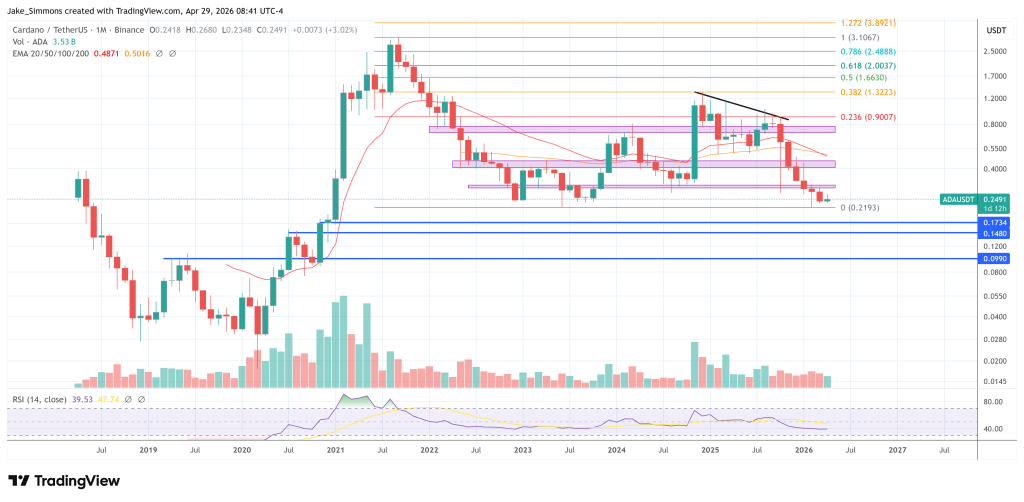
ADA remains below key resistance, 1-monthly chart | Source: ADAUSDT on TradingView.com

Related Reads

M&A Deals in the Crypto Market Are Unusually Active

Title: M&A Activity in Crypto Market Becomes Unusually Active A rare signal is emerging in the crypto primary market: mergers and acquisitions (M&A) are nearing half of all financing deals. According to RootData, this month, M&A cases in the crypto industry reached 10, while financing rounds numbered only 14, meaning M&A accounts for approximately 42% of primary market transactions—the highest level in history. This does not signal a sudden industry boom. Instead, the rapid rise in M&A share primarily reflects the continued downturn in the financing market. Since November 2024, monthly crypto M&A deals have remained between 10-20, while financing deals have plummeted from around 100 to about 50, possibly hitting a new low this month. For project teams, this means the traditional path of relying on narratives, token expectations, and ecosystem subsidies to maintain valuations is narrowing. For leading companies, it presents a rare window to acquire teams, licenses, technology, liquidity, and market access at lower prices, with less competition and stronger bargaining power. Key active buyers include Coinbase, Kraken, Ripple, MoonPay, Polymarket, Kaiko, Sol Strategies, GSR, Keyrock, Jupiter, Paxos, and Ondo Finance. Their M&A logic is consistent: acquiring key capabilities at lower costs during the industry downturn. This is driven by more attractive valuations, reduced time and trial-and-error costs, the acquisition of licenses and compliance resources, and the integration of industry upstream and downstream segments. Current M&A focuses are concentrated in four areas: trading infrastructure (e.g., Coinbase acquiring Deribit, Kraken acquiring NinjaTrader), payments and stablecoins (e.g., MoonPay, Ripple expanding payment networks), compliance licenses, and asset issuance/distribution (e.g., acquisitions related to RWA and token issuance platforms like Coinbase's purchases of Liquifi and Echo). The rise in M&A is altering the primary market's exit logic. It provides an alternative path to the token-dependent model, encouraging teams to build tangible products, revenue, and strategic value that can be integrated. This could inject confidence into the market, showing that asset buyers and exit possibilities still exist, albeit with a stricter focus on real utility. However, this trend also indicates the crypto industry is becoming more centralized. As asset issuance, trading, market-making, custody, payments, and data gradually consolidate in the hands of a few major players, the industry's initial emphasis on openness and anti-monopoly is being reshaped by commercial realities. Coupled with rising compliance barriers, this signals the end of the low-barrier era for crypto entrepreneurship.

链捕手5m ago

M&A Deals in the Crypto Market Are Unusually Active

链捕手5m ago

M&A Deals Are Exceptionally Active in the Crypto Market

Mergers and acquisitions (M&A) activity in the cryptocurrency primary market has reached a historic high, accounting for approximately 42% of total deals in the current month, nearly matching the number of financing rounds. This shift does not signal a new boom cycle but rather reflects a severe contraction in the venture capital funding environment. As financing dwindles, established industry giants—including major exchanges, payment firms, and infrastructure providers—are seizing the opportunity to acquire strategic assets at lower valuations. Key drivers behind the surge in M&A include depressed project valuations, the need to quickly acquire talent and technology to capture short market windows, the pursuit of crucial regulatory licenses, and the strategic expansion into adjacent business verticals such as derivatives, payments, stablecoins, and real-world asset (RWA) issuance. Major acquisitions, like Coinbase's purchase of Deribit and Kraken's acquisition of NinjaTrader, exemplify the push to expand into high-margin areas like derivatives and multi-asset trading. This trend is reshaping the industry's exit landscape, offering an alternative to token-based exits and incentivizing startups to build tangible products and revenue streams with inherent strategic value for acquisition. However, it also points toward increasing centralization, as critical functions—trading, custody, payments, compliance—become concentrated within a few large, well-capitalized platforms, potentially raising barriers to entry for new ventures.

marsbit6m ago

M&A Deals Are Exceptionally Active in the Crypto Market

marsbit6m ago

Solana Privacy Ecosystem Panorama: A Complete Privacy Stack from Compute to AI

**Title: The Solana Privacy Ecosystem: A Full-Stack View from Compute to AI** **Summary:** This article provides a comprehensive overview of the emerging privacy landscape on the Solana blockchain, characterizing it as still in early development. It identifies two primary verticals—Neobanks and Private DeFi—as key drivers, while noting gaps in tooling and user experience. The discussion centers on two main approaches to private computation: Arcium, which utilizes Multi-Party Computation (MPC) networks (Multi-Party eXecution Environments) to process encrypted data with final settlement on Solana; and Magic Block, which leverages Trusted Execution Environments (TEEs) via its Private Ephemeral Rollup (PER). Both enable confidential applications like dark pools and private DeFi with minimal code changes. Building on this infrastructure, projects are creating privacy-focused applications. Umbra, built on Arcium, offers Encrypted Token Accounts (ETAs) for private balances, transfers, and selective disclosure for compliance. Other wallets like Privacy Cash and Hush provide mixer-like functionality for SOL. For private trading, encifherio uses TEEs to encrypt swap details routed through Jupiter, while VanishTrade and Darklake focus on shielding transaction intent and liquidity routing, with Darklake introducing a "blind slippage pool" to prevent front-running. Further applications include private prediction markets (e.g., Melee Markets using Arcium's encrypted order books) and private AI. Loyal exemplifies the latter, using both Magic Block and Arcium to enable decentralized AI agents that store user data, conversations, and transactions confidentially on-chain. The article concludes by framing privacy not as a single technology but as an evolving "ultimate privacy stack," with experts like Helius's Mert envisioning a future combination of Fully Homomorphic Encryption (FHE) and Zero-Knowledge proofs (ZK). Helius Privacy itself is developing a ZK-based UTXO privacy layer for Solana.

Foresight News12m ago

Solana Privacy Ecosystem Panorama: A Complete Privacy Stack from Compute to AI

Foresight News12m ago

7 Key Questions Regarding 'DeepSeek Completes Over 50 Billion Yuan in Financing'

DeepSeek, the prominent Chinese AI company, has reportedly completed its first external funding round, raising over 50 billion RMB (approximately $6.9 billion USD), according to foreign media reports. This financing values the company at over $50 billion USD, a significant increase from a $10 billion valuation when the round began in April 2026. Founder Liang Wenfeng personally contributed 20 billion RMB, with other investors including Tencent, CATL (Contemporary Amperex Technology), JD.com, NetEase, and IDG Capital. Notably, the National Artificial Intelligence Industry Investment Fund also participated with a direct investment of 1 billion RMB. The funding round is distinctive for its structure. Most investors' capital is channeled into a limited partnership controlled by CEO Liang Wenfeng, rather than directly into DeepSeek. These investors face a five-year lock-up period, have no voting rights, but receive priority financial information and future investment rights. This arrangement is seen as a measure to ensure Liang's absolute control over the company's direction, aligning with its stated principles of prioritizing groundbreaking AGI (Artificial General Intelligence) research over short-term profitability. The report highlights strategic reasons for key investors. Tencent's involvement is viewed as a strategic alignment, building on existing collaborations. CATL's investment is linked to the critical energy and power infrastructure needed for AI data centers, a key growth area for the battery giant. The participation of a state-backed fund underscores the national strategic importance of AI development. Post-funding, DeepSeek is expected to accelerate infrastructure development, including building its own data centers, hire more talent, and release new model versions with enhanced capabilities like image and audio support. While this marks a major step, the company's long-term journey towards AGI remains a challenging path that will require balancing its foundational ideals with the expectations of its new investors.

marsbit57m ago

7 Key Questions Regarding 'DeepSeek Completes Over 50 Billion Yuan in Financing'

marsbit57m ago

Trading

Spot
Futures

Hot Articles

Discussions

Welcome to the HTX Community. Here, you can stay informed about the latest platform developments and gain access to professional market insights. Users' opinions on the price of ADA (ADA) are presented below.

活动图片













