Low Investment Isn't Apple's Immunity Pass

marsbitPubblicato 2026-08-01Pubblicato ultima volta 2026-08-01

Introduzione

While Meta and Google face investor scrutiny over ballooning AI capital expenditures, Apple's minimal AI investment has paradoxically become a strength. Its market cap recently reclaimed the global top spot, surpassing $5 trillion. The irony is deep: Apple's own AI efforts have lagged, with "Apple Intelligence" delayed and core talent lost, forcing reliance on partners like Google Gemini and Alibaba's Qianwen. Its Q3 FY2026 (Q2 CY) earnings initially seemed stellar. Revenue hit $109.4B (up 16% YoY), with iPhone and Mac sales, growing 22% and 29% respectively, driving most of the growth. However, the stock fell over 8% post-earnings. The primary concern was a weaker Q4 revenue growth forecast of 9-11%, below expectations, due to looming supply chain constraints. Apple is feeling the indirect cost of the AI boom. Soaring memory and chip prices, fueled by massive data center investments from Microsoft, Amazon, and others, are forcing Apple to raise Mac and iPad prices significantly. The upcoming iPhone launch is also expected to see substantial price hikes. Despite avoiding heavy AI infrastructure spending—its capital expenditures are actually down 28%—Apple cannot escape the industry-wide supply and cost pressures. While Apple's operating cash flow remains robust, its substantial R&D spending (up 32% YoY) has yet to yield major AI breakthroughs. As Tim Cook prepares to step down as CEO, Apple faces a challenging transition: balancing its premium hardware success against the ...

By Shan Shang, Author: I Xue Xingxing, Editor: I Jiang Jiao

While tech giants like Meta and Google face skepticism due to their ever-ballooning AI capital expenditures, Apple's unproductive AI efforts have ironically become a bright spot.

This week, Apple's market cap surpassed Nvidia's, reclaiming the top global spot, with its intraday market value briefly breaking through $3 trillion. Prior to the earnings release, Apple's stock price had accumulated a gain of over 24% this year, making it the only one among the "Magnificent Seven" to achieve double-digit growth.

This is somewhat ironic. Over the past two years, Apple has suffered repeated failures in the AI field. Apple Intelligence has been repeatedly delayed, core AI talent has been continuously lost, ultimately forcing the company to rely on Google's Gemini and Alibaba's Qianwen for implementation. As domestic automakers would say, this is handing over one's soul.

However, as peers' AI spending wars become increasingly extravagant and blind, investors are beginning to panic about whether these investments will ever see returns. Although Apple is behind in AI, it also hasn't burdened itself with heavy capital expenditures. People used to criticize Apple for its slow AI progress, but now they're praising its virtue of restraint.

——This is probably the so-called 'benefit from peer comparison'; standing still can also be a form of leading.

However, the market's enthusiasm didn't last long. In the early morning of July 31, Beijing time, Apple released its Q3 2026 fiscal year (calendar year Q2) earnings report. Revenues from iPhone, Mac, and other businesses significantly exceeded market expectations, driving quarterly revenue up 16% year-over-year, setting a new historical record for the period.

But after the report's release, Apple's stock price fell over 8% in after-hours trading. Meanwhile, Microsoft, Nvidia, and Amazon's stock prices saw noticeable recoveries. Microsoft surged 15.51% in a single day, and Amazon, which also reported earnings alongside Apple, rose over 10% in after-hours trading.

iPhone Saves Apple Once Again

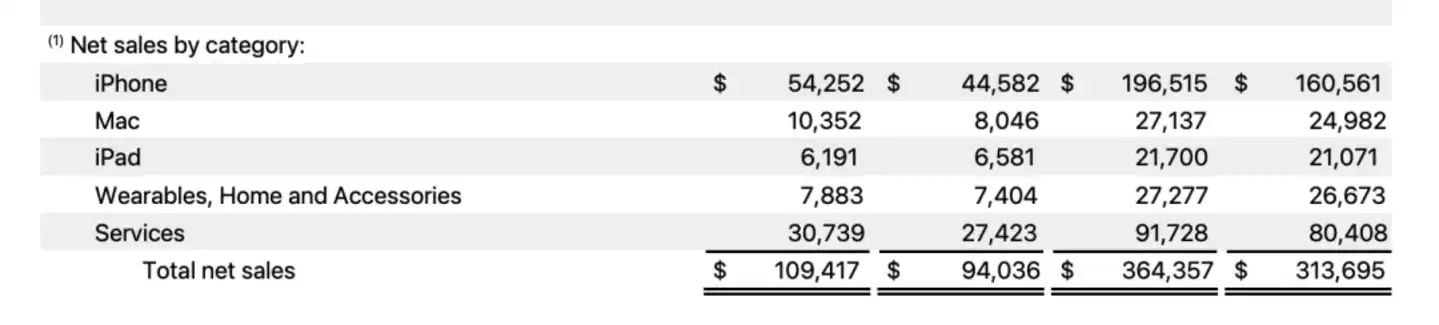
Looking solely at the quarter's performance, Apple delivered a quite outstanding earnings report, with multiple metrics hitting historical highs for the period. The report shows Apple's quarterly revenue was $109.417 billion, up 16.4% year-over-year; net profit was $29.789 billion, up 27.1% year-over-year.

Cook proudly announced in a press release, "We delivered our strongest June quarter ever, with double-digit revenue growth in iPhone, Mac, Services, and across all geographic segments."

iPhone and Mac once again saved Apple, together contributing to about 78% of Apple's quarterly revenue increment, the biggest drivers of its revenue growth. iPhone revenue for the quarter grew 21.7% year-over-year to $54.252 billion, accounting for about 63% of Apple's revenue increment. iPhone's share of total company revenue also rose from 47.4% in the same period last year to 49.6%.
Apple Earnings Report

Omdia's previously released Q2 2026 global smartphone shipment data shows that while global smartphone shipments declined 6% year-over-year for the quarter, Apple achieved 23% year-over-year growth, ranking second globally, with shipment volume hitting a historical high for the period. In contrast, Samsung's market share only grew 5% for the quarter, while Xiaomi, OPPO, and Vivo all saw significant declines, with Xiaomi down 26% year-over-year.

The facts prove that although the marketing narrative of AI phones has been building wave after wave, at least from the current market perspective, what consumers are more willing to pay for is hardware performance and product design. The unintelligent Siri hasn't affected iPhone's popularity at all.

Although Mac's contribution to absolute revenue increment is not as high as iPhone's, its growth rate far exceeded market expectations. Quarterly Mac revenue grew 28.7% year-over-year to $10.352 billion, $1.84 billion higher than market expectations. This was achieved despite supply constraints for high-end chips and some Mac products being in short supply. Apple management previously stated that demand for the MacBook Neo far exceeded expectations, and products like the Mac mini and Mac Studio have also been selling well driven by AI development demand.

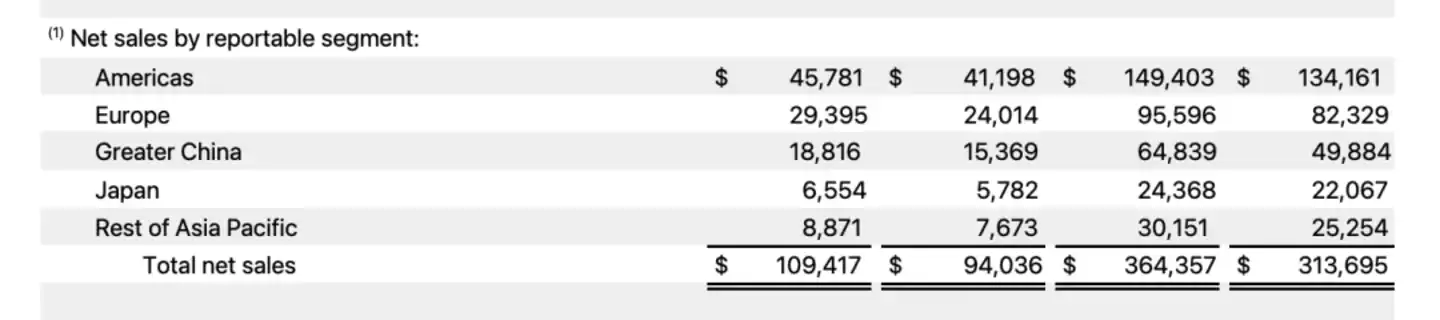
Apple achieved double-digit growth in nearly all global markets. Americas revenue grew 11.1%, Europe and Greater China both grew 22.4%, Japan grew 13.4%, and other Asia-Pacific markets grew 15.6%. However, this quarter's revenue growth rate in the Greater China region was slightly below market expectations and also lower than last quarter's 28% growth rate.
Apple Earnings Report

Apart from iPhone and Mac, Apple's other businesses performed relatively flat. iPad revenue fell 5.9% year-over-year to $6.191 billion, the only product line to decline year-over-year. Cook attributed this to a high base from last year's cheaper iPad. Wearables, Home, and Accessories revenue grew 6.5% year-over-year to $7.883 billion.

Against the favorable backdrop of product revenue growing 18.1% year-over-year, Apple's quarterly Services revenue was $30.739 billion, growing only 12.1% year-over-year, both lower than the company's overall growth rate and below market expectations. In comparison, Apple's Services revenue growth last quarter was 16.3%.

The slowdown in Services growth is partly due to the "Apple Tax" beginning to loosen. In recent years, more and more countries and regions have begun challenging the closed ecosystem of the App Store.

The EU has already required Apple to open up to third-party app stores, and the Epic Games lawsuit against Apple forced it to allow external payment links in the US. In March this year, under domestic regulatory pressure, Apple also lowered the commission rate for China's App Store.

The gross margin for the Services business reached 75.6%, far higher than the Products business's 40.1%. Its slowing growth has somewhat impacted Apple's profit performance. Apple's gross margin last quarter was 49.3%; this quarter, after deducting tariff refunds, the gross margin is approximately 48.1%, an actual sequential decline of about 1.2 percentage points.

However, Apple's Services revenue may see some growth with the landing of the new Siri. Apple's new AI-powered Siri and Apple Intelligence are set to launch next quarter. Cook hinted during the earnings call that due to rising computing costs, some AI features might require payment to use.

Avoided AI Spending Burn, But Not AI Price Hikes

Although Apple delivered a quarter of bright growth, the market generally held a pessimistic view. After the earnings release, Apple's after-hours stock price plunged over 8%.

The direct trigger was Apple's pessimistic guidance for the next quarter. Apple expects next quarter's revenue to grow only 9% to 11% year-over-year, below market expectations. Apple management stated during the earnings call that besides the impact of foreign exchange fluctuations, the negative effects of supply chain constraints will intensify quarter by quarter after Q3, adversely affecting the iPhone, Mac, and iPad business lines.

Cook stated that supply chain constraints are mainly concentrated in the Mac product line, with the root cause being extremely strong market demand that they don't have enough capacity to absorb. "In the coming quarter, we will face tremendous pressure on the supply chain side." Apple's M-series chips are mainly manufactured by TSMC, but TSMC's capacity is also increasingly being ceded to AI chips.

Prior to this, Apple has already had to significantly raise prices due to rising memory and chip costs, covering many product lines including Mac and iPad, with some product prices increasing by over 3,000 yuan at the highest. Cook described during the earnings call that the current rise in memory prices is equivalent to a once-in-a-century flood, showing exponential growth, forcing them to adjust prices.

But the last price increase did not include Apple's most important iPhone product line. The market expects Apple's new iPhone to be released this autumn to see significant price hikes, with the starting price of the foldable iPhone possibly as high as over $2,000. The hot sales of iPhone last quarter might partly be related to consumers' panic buying before the price adjustment—considering new models are about to be released, the past second quarter has typically been a slow sales season for iPhone.

Under the pressure of price hikes, market confidence in iPhone sales next quarter is insufficient. Apple management's guidance for iPhone revenue growth next quarter is only around 15%, below Wall Street's expectation of 17.6%.

Apple is already preparing for the increasingly severe supply chain constraints. This quarter, Apple's inventory rose from last quarter's $6.747 billion to $11.092 billion, a sequential increase of 64.4% and an 87.2% year-over-year increase from $5.925 billion in the same period last fiscal year, nearly doubling year-over-year.

According to Bloomberg, Apple is negotiating memory chip purchases with ChangXin Memory Technologies (CXMT) and Yangtze Memory Technologies Corp (YMTC). But this move faces opposition from the US government and Micron Technology. Cook said during the earnings call that the global DRAM market is currently controlled by three companies—Samsung, Micron, and SK Hynix—and adding suppliers would help improve supply and prices.

Not spending on AI doesn't allow Apple to stay out of this AI frenzy. The record-breaking AI data center construction by tech giants like Microsoft, Google, Amazon, and Meta will also directly impact Apple's memory and chip supply, subsequently hurting its revenue.

Currently, the full-year AI capital expenditures announced just by Microsoft, Google, Amazon, and Meta will exceed $720 billion, far surpassing last year's $455.8 billion. Massive AI investments directly caused Google and Amazon's free cash flow to turn negative this quarter, while Meta's free cash flow also plummeted 91%.

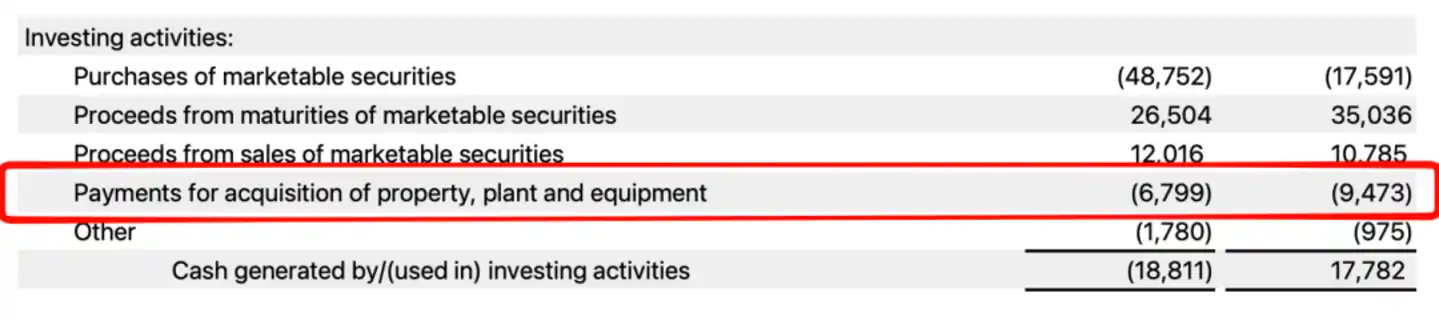
In comparison, Apple's capital expenditures this year have not only not grown but have even declined. In the first three quarters of fiscal 2026, Apple's expenditures on purchasing property, plant, and equipment were only $6.799 billion, down 28.2% year-over-year.
Apple Earnings Report

Restrained capital expenditures helped Apple's quarterly operating cash flow hit a historical high for the period. Operating cash flow for the first nine months of this fiscal year reached $117 billion, up 43.1% year-over-year. Cook is truly a master of capital management, helping the company save money even as he approaches retirement.

This is not to say Apple neglects AI investment. Compared to other manufacturers' greater enthusiasm for investing in AI computing power, Apple's investments seem to flow more into the R&D field.

This quarter, Apple's R&D expenses reached $11.729 billion, up 32.3% year-over-year, a growth rate approximately twice that of revenue. For the first three quarters of fiscal 2026, Apple's R&D expenses were $34.035 billion, up 32.5% year-over-year.

Just, such large-scale R&D investment has ultimately failed to yield many significant AI achievements, which is another level of "Only Apple can do."

This was Cook's last time participating in Apple's earnings call. This September, he will officially step down as Apple CEO. Cook specifically thanked the outside world during the earnings call, "Thank you to all our shareholders, especially the long-term shareholders who have trusted us over the years."

He said he has full confidence that Apple's future is bright.

Crypto di tendenza

Domande pertinenti

QAccording to the article, why did Apple's stock price surge despite its lack of significant achievements in AI?

AThe article states that while other tech giants like Meta and Google are facing skepticism due to their massive and escalating AI capital expenditures, Apple's relative lack of such spending became a highlight. Investors began to panic about whether the huge AI investments by others would yield returns. Therefore, Apple's slower pace in AI, which previously drew criticism, was later viewed as a virtue of restraint, leading to a stock price increase. The article sums it up as 'it's all thanks to the contrast with peers, where standing still can also be a form of leading.'

QWhat were the main drivers of Apple's revenue growth in the reported quarter?

AThe main drivers of Apple's revenue growth in the reported quarter were the iPhone and Mac product lines. Specifically, iPhone revenue increased by 21.7% year-over-year, contributing approximately 63% of the company's total revenue increment. Mac revenue also grew significantly by 28.7%. Together, these two product lines accounted for about 78% of Apple's total revenue growth for the quarter.

QWhat factor is cited as the primary reason for the negative market reaction following Apple's strong quarterly earnings report?

AThe primary reason for the negative market reaction (a sharp drop in after-hours trading) was Apple's pessimistic guidance for the next quarter. Apple projected revenue growth of only 9% to 11% for the upcoming quarter, which fell below market expectations. Management cited supply chain constraints, particularly affecting the Mac product line due to high demand and insufficient capacity, as a major factor that would negatively impact several business lines in the quarters ahead.

QHow does Apple's approach to AI capital expenditure differ from companies like Microsoft, Google, and Amazon?

AApple's approach to AI capital expenditure is significantly more restrained. While companies like Microsoft, Google, Amazon, and Meta have announced record-breaking AI capital expenditures (exceeding $720 billion in total for the year), Apple's capital spending on property, plant, and equipment has actually decreased. In the first three quarters of the 2026 fiscal year, Apple's spending in this area was $6.799 billion, a 28.2% year-over-year decline. This financial prudence has helped Apple achieve record operating cash flow. However, the article notes Apple's research and development (R&D) expenses have grown substantially, suggesting its AI investment is more focused on R&D rather than massive infrastructure build-out.

QWhat are the key supply chain challenges Apple is facing, and how is it attempting to address them?

AApple is facing severe supply chain constraints, primarily in memory (DRAM) and chip supply. The article attributes this to the booming demand for AI chips from other tech giants, which pressures the production capacity of suppliers like TSMC. Rising memory and chip costs have forced Apple to significantly increase prices for products like Mac and iPad. To address these challenges, Apple is reportedly negotiating with Chinese memory chip manufacturers ChangXin Memory Technologies and Yangtze Memory Technologies to diversify its supply chain, although this move faces opposition from the U.S. government and Micron Technology.

Letture associate

Weekly Editor's Picks (0725-0731)

Weekly Editor's Picks (0725-0731) provides a curated selection of deep analysis, filtering out market noise. Key themes from this week include: **Macro & Policy:** The Federal Reserve's upcoming meeting is marked by high uncertainty, balancing cooling inflation data against persistent price pressures. Meanwhile, the U.S. crypto regulatory Clarity Act faces critical political hurdles, with its 2026 passage probability seen as low. **Investing & Crypto:** Analysis suggests long-term crypto success depends on conviction through volatile cycles, focusing on assets like Bitcoin and core smart contract platforms. A trend noted is the increasing similarity between global equity markets (especially tech) and crypto, driven by narrative and leverage. Several major crypto protocols show strong revenue growth, but this isn't always translating to token price appreciation due to sell pressure and structural factors. **AI & Semiconductors:** Nvidia's rising credit default swap rates signal market concern over AI infrastructure financing risks. The storage sector experienced volatility as markets began pricing in potential 2027 oversupply. Despite a record profitable quarter, SK Hynix's results were deemed "below expectations," reflecting heightened investor demands for future growth visibility. **Markets & DeFi:** TradeXYZ demonstrated remarkable accuracy in pre-market pricing for a major A股 listing. The token ONDO saw gains, linked to its growing role in the on-chain tokenized stock ecosystem. **Ethereum:** Post-Pectra upgrade, a major structural shift is underway as Lido begins migrating millions of ETH to new validator architectures designed for capital efficiency. **Also Highlighted:** Butian's bullish stock market move; OpenAI's Altman promising major advances; Samsung and SK Hynix securing large AI chip deals; Apple reaching a $5T market cap; and ongoing discussions around exchange security following Poolin's bankruptcy case.

marsbit30 min fa

Weekly Editor's Picks (0725-0731)

marsbit30 min fa

PA Graphics Explanation | One Chart to Understand the Major Web3 Events in August 2026

**PANews Crypto Calendar: Key Web3 Events in August 2026** PANews introduces its revamped crypto calendar, featuring comprehensive coverage, flexible filtering, and easy export options. The market in August will be shaped by multiple key events across macroeconomics, regulation, tokenomics, and project developments: * **Macro & Policy:** Key US economic data releases (July Non-Farm Payrolls, CPI), the Federal Reserve meeting minutes, and the Jackson Hole Economic Symposium will be in focus. On the regulatory front, the US Senate plans to release a new draft of the *CLARITY Act*, while the EU's expanded crypto ban against Belarus comes into effect. * **Token Unlocks:** Significant token unlocks are scheduled for assets including ENA, AVAX, CONX, ZRO, and KAITO, which may influence market volatility. * **Project Updates & Shutdowns:** Several services, including Exchange Art, Ctrl Wallet, Zapper, NFTfi, and Summer.fi, are set to cease operations or undergo major adjustments. Users are advised to manage their assets accordingly. * **Corporate Activity:** Q2 earnings reports from companies like SpaceX, Circle, and Nvidia are due. Unitree Robotics will initiate its IPO subscription on the STAR Market, and Moonshot AI plans to begin a Pre-IPO financing round. * **Industry Events:** Major conferences such as Bitcoin Asia 2026 and the 2026 Digital Expo will take place. The overarching market narrative for August will revolve around macroeconomic expectations, regulatory developments, token unlock schedules, and ongoing industry consolidation.

marsbit1 h fa

PA Graphics Explanation | One Chart to Understand the Major Web3 Events in August 2026

marsbit1 h fa

Wall Street's Most Famous 'Cassandra' Now Has His Sights Set on Nvidia

Michael Burry, the famed "Big Short" investor, has once again captured Wall Street's attention with a series of short positions against major tech and semiconductor stocks, most notably Nvidia. In late June and July, through his "Cassandra Unchained" newsletter, Burry disclosed short bets against Nvidia, Tesla, Applied Materials, Caterpillar, the SOXX semiconductor ETF, and later, Micron Technology. His core thesis revolves around potential distortions in the AI infrastructure boom, specifically questioning whether extended depreciation schedules (e.g., 6 years vs. a realistic 2-3 years for AI chips) by cloud giants like Microsoft and Google artificially inflate profits. He also raises concerns about possible "off-balance-sheet circular financing," where chip demand might be propped up by vendor-backed funding to clients. Nvidia's stock experienced volatility following these disclosures, briefly dipping but largely holding near Burry's reported entry points, leaving his positions roughly flat or slightly underwater as of late July. This move is part of a pattern for Burry, whose track record since his legendary 2008 bet is mixed. He has faced notable losses, such as on Tesla in 2021, while scoring on broader market turns like the 2020 pandemic crash. His methodology focuses intensely on free cash flow and scrutinizing original financial documents to spot overvaluation and structural risks, but it often struggles with timing the market. The article contrasts Burry's stance with other prominent investors. Steve Eisman, another "Big Short" figure, is not shorting Nvidia, citing strong fundamentals but expressing nervousness about sustainability. Jim Chanos agrees with the broad "accounting mismatch" concern—comparing it to the dot-com bubble—but targets financial leverage in private equity firms rather than the chip stocks themselves. While Nvidia's short interest remains relatively low at 1.3-1.4% of float, the massive stock size means absolute short losses have been significant, exceeding $5 billion earlier this year. The piece concludes that for ordinary investors, the key takeaway is not replicating specific short bets but learning from the critical frameworks these investors use: questioning rosy accounting, identifying structural vulnerabilities, and maintaining skepticism during market euphoria, even if pinpointing the exact catalyst for a downturn remains elusive.

marsbit1 h fa

Wall Street's Most Famous 'Cassandra' Now Has His Sights Set on Nvidia

marsbit1 h fa

Weekly Selection丨Epic Stock Market Volatility, Changxin Tech's IPO Reshapes Storage Landscape, Saylor Aims to Re-Anchor STRC Around September 8th

PANews Weekly Digest: Market Turmoil, Tech Breakthroughs, and Crypto Developments. The week saw significant volatility across global markets. South Korea's KOSPI index experienced extreme turbulence, including multiple trading halts, largely driven by sharp declines in AI hardware stocks like SK Hynix. In contrast, China's Changxin Xinqiao (CXC) achieved a landmark IPO with a market cap surpassing 4 trillion yuan, marking a major success for the domestic DRAM industry after a decade of losses. In the crypto and Web3 space, several key narratives emerged. AI is driving demand for new infrastructure, with projects like AI agent wallets and programmable payments gaining traction, attracting interest from firms like Coinbase. The Bitcoin mining sector is pivoting, with companies like MARA focusing on energy management as electricity becomes a core AI-era asset. Meanwhile, the RWA (Real World Assets) sector faces a "utilization puzzle," with hundreds of billions in on-chain assets remaining dormant. Notable market movements included a historic single-day surge of over 17% for the KOSPI index and a significant migration of $16.5 billion in staked ETH within the Lido ecosystem. Michael Saylor announced a target to re-peg the STRC stablecoin around September 8th. Other highlights include discussions on Ethereum's ambitious 2030 roadmap for scaling and privacy, analysis showing high protocol revenues not always translating to token price gains, and warnings from Citi about potential extreme commodity price shocks by late 2026.

marsbit2 h fa

Weekly Selection丨Epic Stock Market Volatility, Changxin Tech's IPO Reshapes Storage Landscape, Saylor Aims to Re-Anchor STRC Around September 8th

marsbit2 h fa

Trading

Spot

Articoli Popolari

Cosa è $S$

Comprendere SPERO: Una Panoramica Completa Introduzione a SPERO Mentre il panorama dell'innovazione continua a evolversi, l'emergere delle tecnologie web3 e dei progetti di criptovaluta gioca un ruolo fondamentale nel plasmare il futuro digitale. Un progetto che ha attirato l'attenzione in questo campo dinamico è SPERO, denotato come SPERO,$$s$. Questo articolo mira a raccogliere e presentare informazioni dettagliate su SPERO, per aiutare gli appassionati e gli investitori a comprendere le sue basi, obiettivi e innovazioni nei domini web3 e crypto. Che cos'è SPERO,$$s$? SPERO,$$s$ è un progetto unico all'interno dello spazio crypto che cerca di sfruttare i principi della decentralizzazione e della tecnologia blockchain per creare un ecosistema che promuove l'impegno, l'utilità e l'inclusione finanziaria. Il progetto è progettato per facilitare interazioni peer-to-peer in modi nuovi, fornendo agli utenti soluzioni e servizi finanziari innovativi. Al suo interno, SPERO,$$s$ mira a responsabilizzare gli individui fornendo strumenti e piattaforme che migliorano l'esperienza dell'utente nello spazio delle criptovalute. Questo include la possibilità di metodi di transazione più flessibili, la promozione di iniziative guidate dalla comunità e la creazione di percorsi per opportunità finanziarie attraverso applicazioni decentralizzate (dApps). La visione sottostante di SPERO,$$s$ ruota attorno all'inclusività, cercando di colmare le lacune all'interno della finanza tradizionale mentre sfrutta i vantaggi della tecnologia blockchain. Chi è il Creatore di SPERO,$$s$? L'identità del creatore di SPERO,$$s$ rimane piuttosto oscura, poiché ci sono risorse pubblicamente disponibili limitate che forniscono informazioni dettagliate sul suo fondatore o fondatori. Questa mancanza di trasparenza può derivare dall'impegno del progetto per la decentralizzazione—un ethos che molti progetti web3 condividono, dando priorità ai contributi collettivi rispetto al riconoscimento individuale. Centrando le discussioni attorno alla comunità e ai suoi obiettivi collettivi, SPERO,$$s$ incarna l'essenza dell'empowerment senza mettere in evidenza individui specifici. Pertanto, comprendere l'etica e la missione di SPERO rimane più importante che identificare un creatore singolo. Chi sono gli Investitori di SPERO,$$s$? SPERO,$$s$ è supportato da una varietà di investitori che vanno dai capitalisti di rischio agli investitori angelici dedicati a promuovere l'innovazione nel settore crypto. Il focus di questi investitori generalmente si allinea con la missione di SPERO—dando priorità a progetti che promettono avanzamenti tecnologici sociali, inclusività finanziaria e governance decentralizzata. Queste fondazioni di investitori sono tipicamente interessate a progetti che non solo offrono prodotti innovativi, ma contribuiscono anche positivamente alla comunità blockchain e ai suoi ecosistemi. Il supporto di questi investitori rafforza SPERO,$$s$ come un concorrente degno di nota nel dominio in rapida evoluzione dei progetti crypto. Come Funziona SPERO,$$s$? SPERO,$$s$ impiega un framework multifunzionale che lo distingue dai progetti di criptovaluta convenzionali. Ecco alcune delle caratteristiche chiave che sottolineano la sua unicità e innovazione: Governance Decentralizzata: SPERO,$$s$ integra modelli di governance decentralizzati, responsabilizzando gli utenti a partecipare attivamente ai processi decisionali riguardanti il futuro del progetto. Questo approccio favorisce un senso di proprietà e responsabilità tra i membri della comunità. Utilità del Token: SPERO,$$s$ utilizza il proprio token di criptovaluta, progettato per servire varie funzioni all'interno dell'ecosistema. Questi token abilitano transazioni, premi e la facilitazione dei servizi offerti sulla piattaforma, migliorando l'impegno e l'utilità complessivi. Architettura Stratificata: L'architettura tecnica di SPERO,$$s$ supporta la modularità e la scalabilità, consentendo un'integrazione fluida di funzionalità e applicazioni aggiuntive man mano che il progetto evolve. Questa adattabilità è fondamentale per mantenere la rilevanza nel panorama crypto in continua evoluzione. Coinvolgimento della Comunità: Il progetto enfatizza iniziative guidate dalla comunità, impiegando meccanismi che incentivano la collaborazione e il feedback. Nutrendo una comunità forte, SPERO,$$s$ può affrontare meglio le esigenze degli utenti e adattarsi alle tendenze di mercato. Focus sull'Inclusione: Offrendo basse commissioni di transazione e interfacce user-friendly, SPERO,$$s$ mira ad attrarre una base utenti diversificata, inclusi individui che potrebbero non aver precedentemente interagito nello spazio crypto. Questo impegno per l'inclusione si allinea con la sua missione generale di empowerment attraverso l'accessibilità. Cronologia di SPERO,$$s$ Comprendere la storia di un progetto fornisce preziose intuizioni sulla sua traiettoria di sviluppo e sui traguardi. Di seguito è riportata una cronologia suggerita che mappa eventi significativi nell'evoluzione di SPERO,$$s$: Fase di Concettualizzazione e Ideazione: Le idee iniziali che formano la base di SPERO,$$s$ sono state concepite, allineandosi strettamente con i principi di decentralizzazione e focus sulla comunità all'interno dell'industria blockchain. Lancio del Whitepaper del Progetto: Dopo la fase concettuale, è stato rilasciato un whitepaper completo che dettaglia la visione, gli obiettivi e l'infrastruttura tecnologica di SPERO,$$s$ per suscitare interesse e feedback dalla comunità. Costruzione della Comunità e Prime Interazioni: Sono stati effettuati sforzi attivi di outreach per costruire una comunità di early adopters e potenziali investitori, facilitando discussioni attorno agli obiettivi del progetto e ottenendo supporto. Evento di Generazione del Token: SPERO,$$s$ ha condotto un evento di generazione del token (TGE) per distribuire i propri token nativi ai primi sostenitori e stabilire una liquidità iniziale all'interno dell'ecosistema. Lancio della Prima dApp: La prima applicazione decentralizzata (dApp) associata a SPERO,$$s$ è stata attivata, consentendo agli utenti di interagire con le funzionalità principali della piattaforma. Sviluppo Continuo e Partnership: Aggiornamenti e miglioramenti continui alle offerte del progetto, inclusi partnership strategiche con altri attori nello spazio blockchain, hanno plasmato SPERO,$$s$ in un concorrente competitivo e in evoluzione nel mercato crypto. Conclusione SPERO,$$s$ rappresenta una testimonianza del potenziale del web3 e delle criptovalute di rivoluzionare i sistemi finanziari e responsabilizzare gli individui. Con un impegno per la governance decentralizzata, il coinvolgimento della comunità e funzionalità progettate in modo innovativo, apre la strada verso un panorama finanziario più inclusivo. Come per qualsiasi investimento nello spazio crypto in rapida evoluzione, si incoraggiano potenziali investitori e utenti a ricercare approfonditamente e a impegnarsi in modo riflessivo con gli sviluppi in corso all'interno di SPERO,$$s$. Il progetto mostra lo spirito innovativo dell'industria crypto, invitando a ulteriori esplorazioni delle sue innumerevoli possibilità. Mentre il percorso di SPERO,$$s$ è ancora in fase di sviluppo, i suoi principi fondamentali potrebbero effettivamente influenzare il futuro di come interagiamo con la tecnologia, la finanza e tra di noi in ecosistemi digitali interconnessi.

174 Totale visualizzazioniPubblicato il 2024.12.17Aggiornato il 2024.12.17

Cosa è $S$

Cosa è AGENT S

Agent S: Il Futuro dell'Interazione Autonoma in Web3 Introduzione Nel panorama in continua evoluzione di Web3 e criptovalute, le innovazioni stanno costantemente ridefinendo il modo in cui gli individui interagiscono con le piattaforme digitali. Uno di questi progetti pionieristici, Agent S, promette di rivoluzionare l'interazione uomo-computer attraverso il suo framework agentico aperto. Aprendo la strada a interazioni autonome, Agent S mira a semplificare compiti complessi, offrendo applicazioni trasformative nell'intelligenza artificiale (AI). Questa esplorazione dettagliata approfondirà le complessità del progetto, le sue caratteristiche uniche e le implicazioni per il dominio delle criptovalute. Cos'è Agent S? Agent S si presenta come un innovativo framework agentico aperto, progettato specificamente per affrontare tre sfide fondamentali nell'automazione dei compiti informatici: Acquisizione di Conoscenze Specifiche del Dominio: Il framework apprende in modo intelligente da varie fonti di conoscenza esterne ed esperienze interne. Questo approccio duale gli consente di costruire un ricco repository di conoscenze specifiche del dominio, migliorando le sue prestazioni nell'esecuzione dei compiti. Pianificazione su Lungo Orizzonte di Compiti: Agent S impiega una pianificazione gerarchica potenziata dall'esperienza, un approccio strategico che facilita la suddivisione e l'esecuzione efficiente di compiti complessi. Questa caratteristica migliora significativamente la sua capacità di gestire più sottocompiti in modo efficiente ed efficace. Gestione di Interfacce Dinamiche e Non Uniformi: Il progetto introduce l'Interfaccia Agente-Computer (ACI), una soluzione innovativa che migliora l'interazione tra agenti e utenti. Utilizzando Modelli Linguistici Multimodali di Grandi Dimensioni (MLLM), Agent S può navigare e manipolare senza sforzo diverse interfacce grafiche utente. Attraverso queste caratteristiche pionieristiche, Agent S fornisce un framework robusto che affronta le complessità coinvolte nell'automazione dell'interazione umana con le macchine, preparando il terreno per innumerevoli applicazioni nell'AI e oltre. Chi è il Creatore di Agent S? Sebbene il concetto di Agent S sia fondamentalmente innovativo, informazioni specifiche sul suo creatore rimangono elusive. Il creatore è attualmente sconosciuto, il che evidenzia sia la fase embrionale del progetto sia la scelta strategica di mantenere i membri fondatori sotto anonimato. Indipendentemente dall'anonimato, l'attenzione rimane sulle capacità e sul potenziale del framework. Chi sono gli Investitori di Agent S? Poiché Agent S è relativamente nuovo nell'ecosistema crittografico, informazioni dettagliate riguardanti i suoi investitori e sostenitori finanziari non sono documentate esplicitamente. La mancanza di approfondimenti pubblicamente disponibili sulle fondazioni di investimento o sulle organizzazioni che supportano il progetto solleva interrogativi sulla sua struttura di finanziamento e sulla roadmap di sviluppo. Comprendere il supporto è cruciale per valutare la sostenibilità del progetto e il suo potenziale impatto sul mercato. Come Funziona Agent S? Al centro di Agent S si trova una tecnologia all'avanguardia che gli consente di funzionare efficacemente in contesti diversi. Il suo modello operativo è costruito attorno a diverse caratteristiche chiave: Interazione Uomo-Computer Simile a Quella Umana: Il framework offre una pianificazione AI avanzata, cercando di rendere le interazioni con i computer più intuitive. Mimando il comportamento umano nell'esecuzione dei compiti, promette di elevare le esperienze degli utenti. Memoria Narrativa: Utilizzata per sfruttare esperienze di alto livello, Agent S utilizza la memoria narrativa per tenere traccia delle storie dei compiti, migliorando così i suoi processi decisionali. Memoria Episodica: Questa caratteristica fornisce agli utenti una guida passo-passo, consentendo al framework di offrire supporto contestuale mentre i compiti si sviluppano. Supporto per OpenACI: Con la capacità di funzionare localmente, Agent S consente agli utenti di mantenere il controllo sulle proprie interazioni e flussi di lavoro, allineandosi con l'etica decentralizzata di Web3. Facile Integrazione con API Esterne: La sua versatilità e compatibilità con varie piattaforme AI garantiscono che Agent S possa adattarsi senza problemi agli ecosistemi tecnologici esistenti, rendendolo una scelta attraente per sviluppatori e organizzazioni. Queste funzionalità contribuiscono collettivamente alla posizione unica di Agent S all'interno dello spazio crittografico, poiché automatizza compiti complessi e multi-fase con un intervento umano minimo. Man mano che il progetto evolve, le sue potenziali applicazioni in Web3 potrebbero ridefinire il modo in cui si svolgono le interazioni digitali. Cronologia di Agent S Lo sviluppo e le tappe di Agent S possono essere riassunti in una cronologia che evidenzia i suoi eventi significativi: 27 Settembre 2024: Il concetto di Agent S è stato lanciato in un documento di ricerca completo intitolato “Un Framework Agentico Aperto che Usa i Computer Come un Umano”, mostrando le basi per il progetto. 10 Ottobre 2024: Il documento di ricerca è stato reso pubblicamente disponibile su arXiv, offrendo un'esplorazione approfondita del framework e della sua valutazione delle prestazioni basata sul benchmark OSWorld. 12 Ottobre 2024: È stata rilasciata una presentazione video, fornendo un'idea visiva delle capacità e delle caratteristiche di Agent S, coinvolgendo ulteriormente potenziali utenti e investitori. Questi indicatori nella cronologia non solo illustrano i progressi di Agent S, ma indicano anche il suo impegno per la trasparenza e il coinvolgimento della comunità. Punti Chiave su Agent S Man mano che il framework Agent S continua a evolversi, diversi attributi chiave si distinguono, sottolineando la sua natura innovativa e il potenziale: Framework Innovativo: Progettato per fornire un uso intuitivo dei computer simile all'interazione umana, Agent S porta un approccio nuovo all'automazione dei compiti. Interazione Autonoma: La capacità di interagire autonomamente con i computer attraverso GUI segna un passo avanti verso soluzioni informatiche più intelligenti ed efficienti. Automazione di Compiti Complessi: Con la sua metodologia robusta, può automatizzare compiti complessi e multi-fase, rendendo i processi più veloci e meno soggetti a errori. Miglioramento Continuo: I meccanismi di apprendimento consentono ad Agent S di migliorare dalle esperienze passate, migliorando continuamente le sue prestazioni e la sua efficacia. Versatilità: La sua adattabilità attraverso diversi ambienti operativi come OSWorld e WindowsAgentArena garantisce che possa servire un'ampia gamma di applicazioni. Man mano che Agent S si posiziona nel panorama di Web3 e delle criptovalute, il suo potenziale per migliorare le capacità di interazione e automatizzare i processi segna un significativo avanzamento nelle tecnologie AI. Attraverso il suo framework innovativo, Agent S esemplifica il futuro delle interazioni digitali, promettendo un'esperienza più fluida ed efficiente per gli utenti in vari settori. Conclusione Agent S rappresenta un audace passo avanti nell'unione tra AI e Web3, con la capacità di ridefinire il modo in cui interagiamo con la tecnologia. Sebbene sia ancora nelle sue fasi iniziali, le possibilità per la sua applicazione sono vaste e coinvolgenti. Attraverso il suo framework completo che affronta sfide critiche, Agent S mira a portare le interazioni autonome al centro dell'esperienza digitale. Man mano che ci addentriamo nei regni delle criptovalute e della decentralizzazione, progetti come Agent S giocheranno senza dubbio un ruolo cruciale nel plasmare il futuro della tecnologia e della collaborazione uomo-computer.

632 Totale visualizzazioniPubblicato il 2025.01.14Aggiornato il 2025.01.14

Cosa è AGENT S

Come comprare S

Benvenuto in HTX.com! Abbiamo reso l'acquisto di Sonic (S) semplice e conveniente. Segui la nostra guida passo passo per intraprendere il tuo viaggio nel mondo delle criptovalute.Step 1: Crea il tuo Account HTXUsa la tua email o numero di telefono per registrarti il tuo account gratuito su HTX. Vivi un'esperienza facile e sblocca tutte le funzionalità,Crea il mio accountStep 2: Vai in Acquista crypto e seleziona il tuo metodo di pagamentoCarta di credito/debito: utilizza la tua Visa o Mastercard per acquistare immediatamente SonicS.Bilancio: Usa i fondi dal bilancio del tuo account HTX per fare trading senza problemi.Terze parti: abbiamo aggiunto metodi di pagamento molto utilizzati come Google Pay e Apple Pay per maggiore comodità.P2P: Fai trading direttamente con altri utenti HTX.Over-the-Counter (OTC): Offriamo servizi su misura e tassi di cambio competitivi per i trader.Step 3: Conserva Sonic (S)Dopo aver acquistato Sonic (S), conserva nel tuo account HTX. In alternativa, puoi inviare tramite trasferimento blockchain o scambiare per altre criptovalute.Step 4: Scambia Sonic (S)Scambia facilmente Sonic (S) nel mercato spot di HTX. Accedi al tuo account, seleziona la tua coppia di trading, esegui le tue operazioni e monitora in tempo reale. Offriamo un'esperienza user-friendly sia per chi ha appena iniziato che per i trader più esperti.

1.3k Totale visualizzazioniPubblicato il 2025.01.15Aggiornato il 2026.06.02

Come comprare S

Discussioni

Benvenuto nella Community HTX. Qui puoi rimanere informato sugli ultimi sviluppi della piattaforma e accedere ad approfondimenti esperti sul mercato. Le opinioni degli utenti sul prezzo di S S sono presentate come di seguito.

活动图片