Cardano Founder Warns KelpDAO Hack Exposes Ethereum’s Weakest Link

bitcoinistPublished on 2026-04-22Last updated on 2026-04-22

Abstract

Cardano founder Charles Hoskinson argues that the $292 million KelpDAO exploit reveals a critical systemic flaw in Ethereum's DeFi ecosystem, rather than just a simple bridge failure. He emphasizes that the core issue was not a smart contract vulnerability, but a failure in cross-chain message verification. Specifically, a single-verifier setup allowed a forged message to be accepted, leading to the theft of 116,500 rsETH. Hoskinson warns that the attack’s true danger emerged when the stolen assets were used as collateral in lending markets, creating widespread bad debt contagion and triggering a liquidity crisis that caused up to $13 billion in withdrawals across multiple protocols. He calls for a broader industry discussion on bridge security and verifier design to prevent similar systemic risks.

Cardano founder Charles Hoskinson used his latest livestream to argue that the roughly $292 million KelpDAO exploit was not just another bridge failure, but a broader warning about how Ethereum’s restaking, cross-chain messaging, and lending stack can turn a single compromise into system-wide contagion.

In Hoskinson’s telling, the April 18 attack exposed what he sees as the most fragile part of modern DeFi: not necessarily application-level smart contracts, but the verification layers and interdependencies that sit between protocols. He said the exploit, which involved about 116,500 rsETH drained from KelpDAO’s Ethereum escrow, should force a wider industry conversation about bridge trust assumptions, verifier design, and the speed at which bad collateral can spread through lending markets.

Cardano Founder Warns Of Dangerous Flaw At The Heart Of Ethereum DeFi

Rather than deliver a standard postmortem, Hoskinson said he took internal incident-report material and used AI to turn it into a website that walked viewers through the mechanics of the exploit. That structure framed his larger point: the failure, as he described it, did not begin with broken contract math inside KelpDAO itself, nor with an obvious accounting flaw at LayerZero. Instead, he said it centered on a forged cross-chain message that was accepted as legitimate and allowed funds to be released on Ethereum.

“So, this was not a smart contract issue with Kelp and this was not a smart contract issue with LayerZero, but this was a cross-chain message forgery,” Hoskinson said. “So this was something new and different.”

The Cardano founder repeatedly returned to one design choice in particular: the reported use of a one-of-one verifier configuration. In his explanation, best practice would be a multi-verifier model such as three-of-five, but KelpDAO’s setup relied on a single active DVN. That, he argued, created an unacceptable single point of failure in a system already layered with staking wrappers, restaking protocols, bridges, and lending venues.

“The failure was in the verification logic, not the application logic,” he said. “Kelp did everything right from their contracts. They’re audited. They’re working well. The application’s working well. It’s the bridge configuration.”
Hoskinson also emphasized that the industry still lacks a settled account of exactly where responsibility lies.

According to his summary, three separate root-cause analyses emerged after the exploit: one from LayerZero, one from KelpDAO, and one tied to LlamaRisk and Aave governance discussions but none fully agree. That leaves open whether the break occurred in the messaging layer, verifier setup, KelpDAO’s acceptance logic, or in the seams between them.

What made the event especially significant, in his view, was not only the theft itself but what happened next. Instead of dumping the stolen rsETH on decentralized exchanges, the attacker allegedly used it as collateral in lending markets to borrow more liquid assets. That turned an exploit into a balance-sheet problem for other protocols, leaving what Hoskinson described as poisoned collateral behind.

He called that dynamic the real novelty of the incident. “It wasn’t just a bridge hack. It spread to lending which then created bad debt contagion inside these lending protocols. It created a bank run and we saw $13 billion of TVL pulled in a very short period of time for a $290 million hack.”

The Cardano founder said the broader DeFi liquidity shock reached far beyond KelpDAO itself. Citing public reporting referenced in his walkthrough, he pointed to at least nine directly affected protocols and said Aave alone saw between $6.6 billion and $8.45 billion in losses, while rsETH traded in a volatile range between about $1,600 and $2,500 during the 24 hours following the attack.

He also raised the possibility of Lazarus involvement, though he acknowledged attribution remains unconfirmed. “There’s a lot of evidence here that there’s Lazarus connections,” he said, before adding that no independent forensics firms had definitively proven it.

At press time, Cardano (ADA) traded at $0.2504.
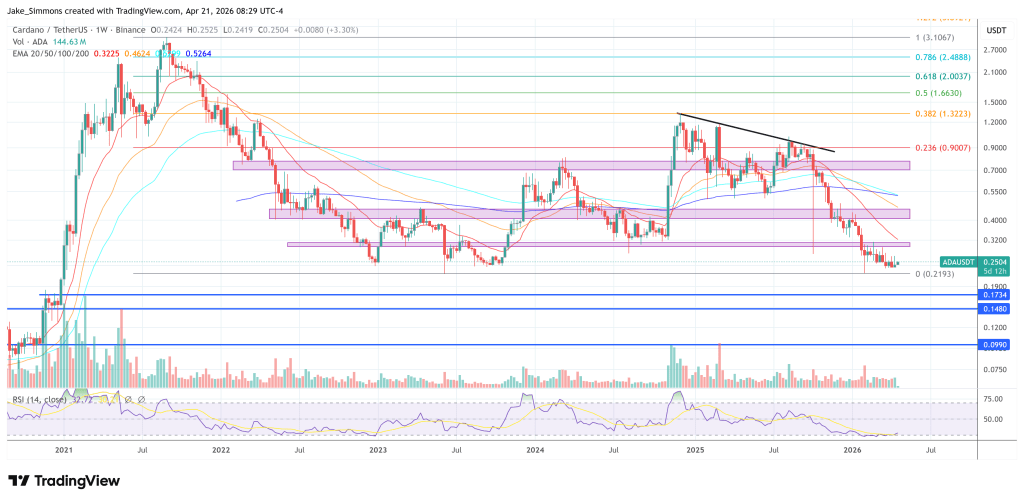
Cardano hovers below key resistance, 1-monthly chart | Source: ADAUSDT on TradingView.com

Related Questions

QWhat did Charles Hoskinson argue was the broader warning exposed by the KelpDAO exploit?

AHe argued that the exploit was a broader warning about how Ethereum's restaking, cross-chain messaging, and lending stack can turn a single compromise into system-wide contagion.

QAccording to Hoskinson, what was the specific technical failure that led to the KelpDAO exploit?

AThe failure was a cross-chain message forgery that was accepted as legitimate, not a smart contract issue with KelpDAO or LayerZero.

QWhat dangerous design choice did Hoskinson specifically criticize in the system's setup?

AHe criticized the use of a one-of-one verifier configuration, arguing that a multi-verifier model (like three-of-five) is a best practice to avoid a single point of failure.

QHow did the attacker allegedly use the stolen rsETH to create a wider contagion in the DeFi ecosystem?

AInstead of dumping it, the attacker used the stolen rsETH as collateral in lending markets to borrow more liquid assets, which turned the exploit into a balance-sheet problem and created bad debt contagion for other protocols.

QWhat was the estimated total value locked (TVL) that was pulled from protocols following the hack, according to Hoskinson's account?

AApproximately $13 billion of TVL was pulled in a very short period of time following the $290 million hack.

Related Reads

Uncovering the Truth About Agent Commerce, Payments, and Infrastructure

Decoding Agent Commerce, Payments, and Infrastructure: The Reality Over the past year, I've been building infrastructure for the Agent economy, engaging with major players like Stripe, Visa, Coinbase, Google, and dozens of startups. A clear conclusion emerges: true, large-scale demand does not yet exist. Startups face structural challenges. Data points illustrate this gap. Stripe's Agent commerce platform has over 1,000 merchants but only single-digit transacting agents. Visa's Agent payment token requires 9-month KYC and a $250M revenue threshold, accessible only to giants like Amazon. On-chain analysis reveals actual daily Agent transaction volume is around $17k, half of which are test transactions. The article analyzes four potential markets: **1. Agent-to-Merchant (A2M):** Current AI shopping UX is often inferior to traditional e-commerce for visual, comparison-heavy purchases (clothing, electronics). Chat interfaces are a step back. Real merchant interest is defensive "Agent Engine Optimization," fearing future obsolescence, not current demand. Potential exists in high-frequency, low-decision purchases (e.g., food delivery) or simplifying terrible UX (complex checkouts, non-native shoppers), but these require massive consumer distribution channels dominated by giants like DoorDash and Amazon. **2. Agent-to-API (A2A):** Developers already have subscriptions and billing for core APIs (compute, data). The argument for micro-payments via crypto for sub-dollar API calls is addressed by pre-paid balances today. The deeper issue is supplier resistance; major SaaS firms rely on enterprise contracts, not fractional cent pricing. Opportunity lies in the long tail of niche services, but this is a smaller market catering to developers, a historically low-paying group. **3. Agent-to-Agent (A2A):** This remains a theoretical long-term vision with near-zero current transaction volume. It involves unique challenges: discovery, trust, negotiation, dispute resolution. When it materializes, it will require a fundamentally new settlement infrastructure for high-speed, variable-value, multi-party transactions. It's a real long-term bet, but not the current market. **4. Agent-to-Finance (A2F):** This is the only category with existing, paying demand. Integrating AI into financial workflows (trading, portfolio management) is a natural evolution and enables new capabilities like autonomous rebalancing. However, competition favors incumbents with regulatory licenses, compliance infrastructure, and existing client relationships. **The Real Issue:** Why is infrastructure still being built? Incumbents can afford long-term bets, and payment companies see every problem as a nail for their payment hammer. However, payment is just one piece. The core challenge is *coordination*—orchestrating work between Agents and humans, verifying outcomes, and settling results. Payment is part of settlement, which is part of coordination. Companies that solve the coordination problem will subsume payments, not the other way around. Startups lack the infinite runway of giants and must find today's real market, which, after a year of exploration, lies outside these four categories—in an area with real, growing, and underserved activity.

marsbit2h ago

Uncovering the Truth About Agent Commerce, Payments, and Infrastructure

marsbit2h ago

Trading

Spot
Futures

Hot Articles

Discussions

Welcome to the HTX Community. Here, you can stay informed about the latest platform developments and gain access to professional market insights. Users' opinions on the price of S (S) are presented below.

活动图片