Période d'arbitrage de Harness, sauver le DeFi depuis la périphérie du SaaS

marsbitPublished on 2026-04-19Last updated on 2026-04-19

Abstract

L'article explore la convergence de l'IA et de la DeFi, soulignant comment les agents IA et les tokens redéfinissent l'organisation humaine et les modèles économiques. Il décrit la "tokenisation" des compétences humaines via des agents IA, où les Harness deviennent des espaces numériques pour l'interaction des agents plutôt que des lieux de collaboration humaine. La DeFi est considérée comme étant devenue une forme de SaaS, avec des données bon marché et une valeur dérivée de l'efficacité du capital plutôt que de l'information. L'article argue que l'IA, en apprenant des comportements humains, pourrait finalement restructurer la DeFi en améliorant la sécurité des contrats et l'efficacité organisationnelle, les tokens crypto évoluant potentiellement vers des représentations de taux de rendement du capital. Malgré la dévaluation des données et du contenu, le comportement humain conserve une valeur unique dans ce nouveau paradigme.

Rédaction :Maître Zuo

En regardant 500 ans en arrière, la contradiction entre le travail et le capital dans le système capitaliste a toujours été marquée par la victoire continue du capital.

Côté production, la participation de la main-d'œuvre s'est progressivement réduite au niveau de l'opération des machines ; côté consommation, la valeur de l'utilisateur réside dans la production de données d'utilisation pour les plateformes.

Ces deux forces se combinent pour soutenir la valorisation des entreprises sur le marché des capitaux.

Mais le mode d'organisation des personnes n'a pas pu être complètement quantifié à long terme, les KPI/OKR des cols blancs restent une forme de hiérarchie bureaucratique, et un salaire annuel d'un million et la rémunération à la pièce sont des variantes du taylorisme.

Sans formule claire, le capital ne peut pas l'évaluer, ce qui affecte l'efficacité du capital. Que la monnaie stable algorithmique soit ou non le Saint Graal du DeFi reste incertain, mais la capacité de calcul de l'organisation est bien la mesure du levier financier.

Les grands modèles ont décidé de recourir à la force brute de la quantité de Token. L'effondrement du SaaS de sécurité n'est qu'une apparence, la conception de produits est également en cours, remplacer les compétences professionnelles de niche et les mettre à l'échelle est la clé, l'innovation s'engage en territoire inconnu.

Cela nous apporte des启示 infinies, surtout à un moment où le mode DAO du DeFi s'effondre progressivement et que la tokenomics fait progressivement faillite.

En un mot, pourquoi le mode d'organisation de l'IA et le mode Token sont-ils plus efficaces que le DeFi ?

Comment tout cela a-t-il commencé ?

Token bon marché, Agent pratique.

Pour 300 % de profit, le capitaliste peut vendre sa propre corde de potence ;

Pour sauver son emploi actuel, le travailleur peut écrire des Compétences pour l'Agent.

Au niveau du capital, l'Agent doté de Compétences a un statut aussi sacré que le profit.

L'Agent représente la "capacité humaine" raffinée en Compétence, et plus encore, l'organisation humaine devient une chaîne de rituels d'interaction centrée sur l'Agent.

Le Prompt, le Context et désormais l'ingénierie Harness, transforment le mode d'organisation humaine en territoire inconnu, ou du moins réduisent le nombre de personnes.

Votre prochain collègue n'est pas un robot, il peut aussi être l'"instinct" de la capacité.

Ce n'est pas une illusion, la loi d'échelle au niveau des données échoue progressivement, mais la collecte et la production de données ne sont plus importantes. Avant la réussite de l'AGI, de nouveaux actifs d'évaluation sont nécessaires.
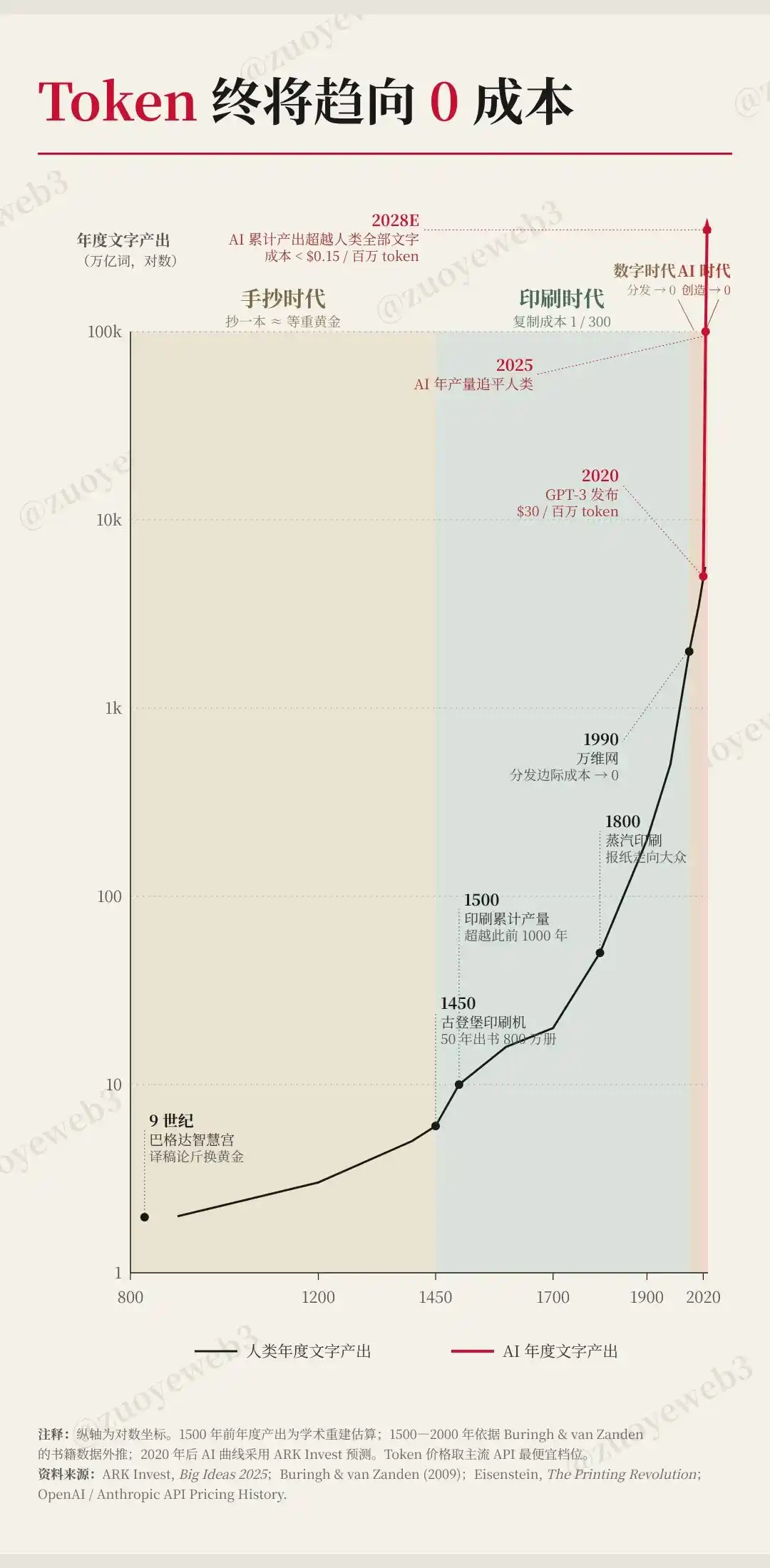
Légende de l'image : Le contenu n'a plus de valeur

Information complète :@ARKInvest

Depuis que Claude a choisi le domaine de la programmation pour réaliser la première étape de l'AGI, l'IA a dépassé le mode de divertissement de la fenêtre de chat et s'est introduite dans les marchés existants comme la programmation, la sécurité, et la conception venant d'être publiée.

Cette innovation disruptive créera-t-elle finalement une nouvelle croissance économique, ou entraînera-t-elle l'économie dans un mode de faible emploi permanent où le Token prend le poste et l'homme le perd ? Nous sommes en train d'assister à ce processus.

Mais la bon marché actuelle des Token, qui redistribue les capacités auparavant monopolisées par quelques grandes entreprises aux petites et micro-entreprises, créant ainsi des super-individus, n'est pas une illusion.

Prenons la Chine comme exemple, le volume d'appels de Token est passé de 100 milliards/jour en 2024 --> 100 billions/jour fin 2025 --> 140 billions/jour maintenant. La production de contenu et de données est sur le point d'entrer dans une ère de coût zéro.

Il est à noter que la pénurie de puissance de calcul est un état relatif. Les grandes entreprises ne monopolisent plus les "capacités", mais veulent toujours maintenir leurs avantages acquis en monopolisant la "puissance de calcul", mais elles ne peuvent pas arrêter la tendance inévitable de la bon marché générale des Token.

Les comparaisons des paradigmes des grands modèles de base sont variées, mais l'évolution de "comment l'IA aide l'homme" n'a pas reçu beaucoup d'attention à long terme.

À mon avis, Harness est une forme d'espace qui permet à l'Agent de se concentrer pour la première fois sur une tâche à l'intérieur d'une frontière, une stratégie de profondeur d'abord, contrairement à la priorité large des questions-réponses.
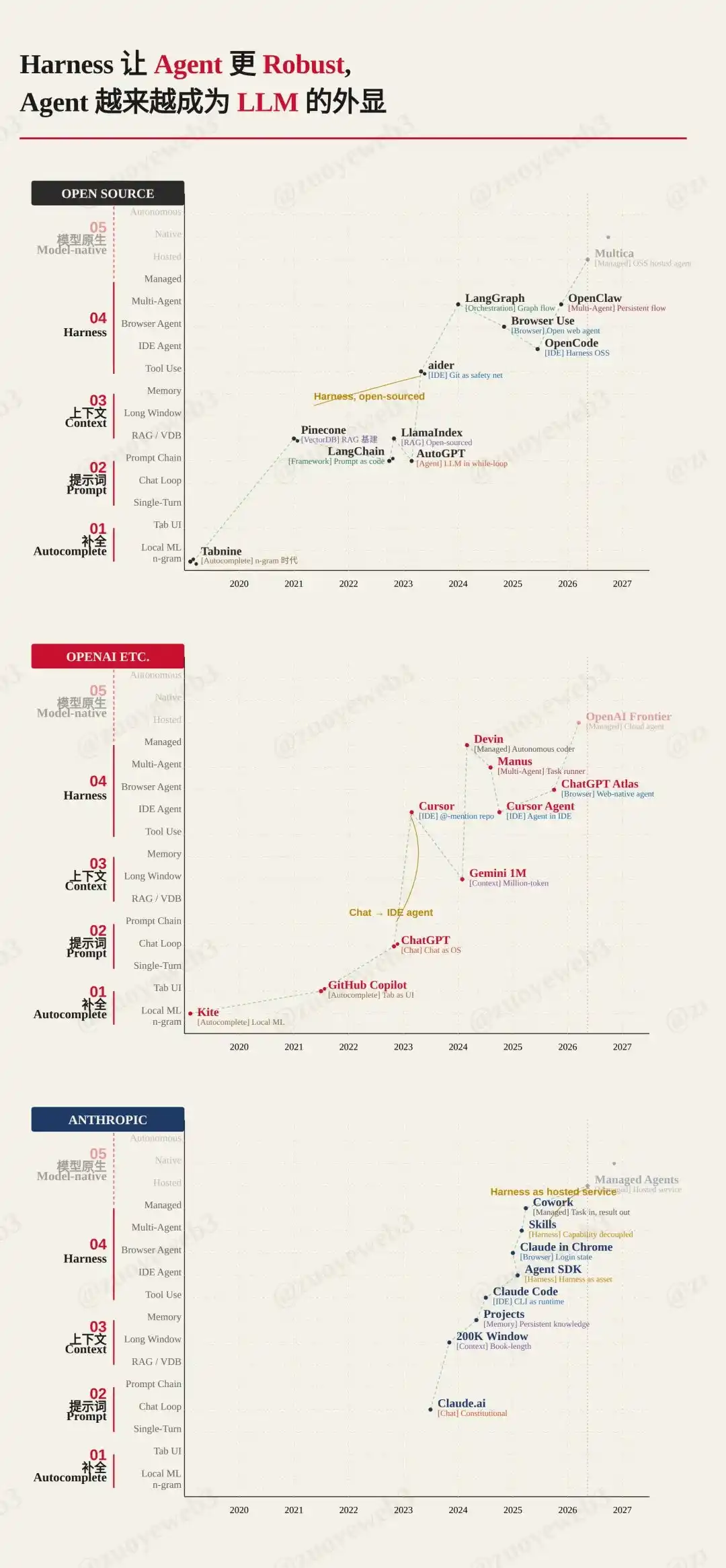
Légende de l'image : Histoire de l'évolution de l'Agent

Source de l'image :@zuoyeweb3

Dès que la touche Tab a été utilisée pour compléter du code, il n'était qu'une question de temps avant que l'homme ne devienne la couche d'entrée de l'IA.

Le coût d'essai diminue de façon exponentielle, permettant d'essayer davantage de modes de collaboration humaine intéressants :

  • Logiciel : SaaS, la source des capacités humaines ne vient plus de l'homme, mais de l'émergence de l'Agent
  • Matériel : Cartes de calcul + HBM, les centres de données servent directement les besoins de l'IA pour la première fois
  • Espace : Harness, pas un espace physique de collaboration humaine, mais un espace numérique d'interaction d'Agents
  • Interaction : L'armée de téléphones Douban est morte, Google supporte l'Agent GUI au niveau du système Android

La capacité de l'IA à "dire quoi" n'a pas une forte valeur commerciale, le coût de génération de texte est faible même pour l'homme, mais "faire quoi" fera que la consommation de Token dépassera celle de la génération d'images et de vidéos, similaire à AWS qui ne vend pas des serveurs mais du temps d'utilisation.

L'IA ne vend pas des Token, mais une "capacité de travail", c'est la racine de la peur de l'industrie SaaS. Malheureusement, le DeFi est devenu du SaaS, et non un grand modèle.

La SaaS-ification des protocoles DeFi

Le DeFi n'est pas dépassé, mais il est trop précoce.

L'IA est en train de réinventer l'ingénierie logicielle, ce n'est pas seulement le SaaS qui est remplacé, mais le SaaS est sans doute le plus typique.

Même le terminal Bloomberg, sa valeur commerciale la plus importante n'est pas son avancement technologique, mais l'autorité de son information, une autorité沉淀ée sur des décennies de liens sectoriels, de réseaux et d'autres données non standard.

L'Agent offre un choix, il peut spéculer sur l'avenir à partir des données, même la prochaine étape risquée peut surpasser les pairs et générer un petit profit.
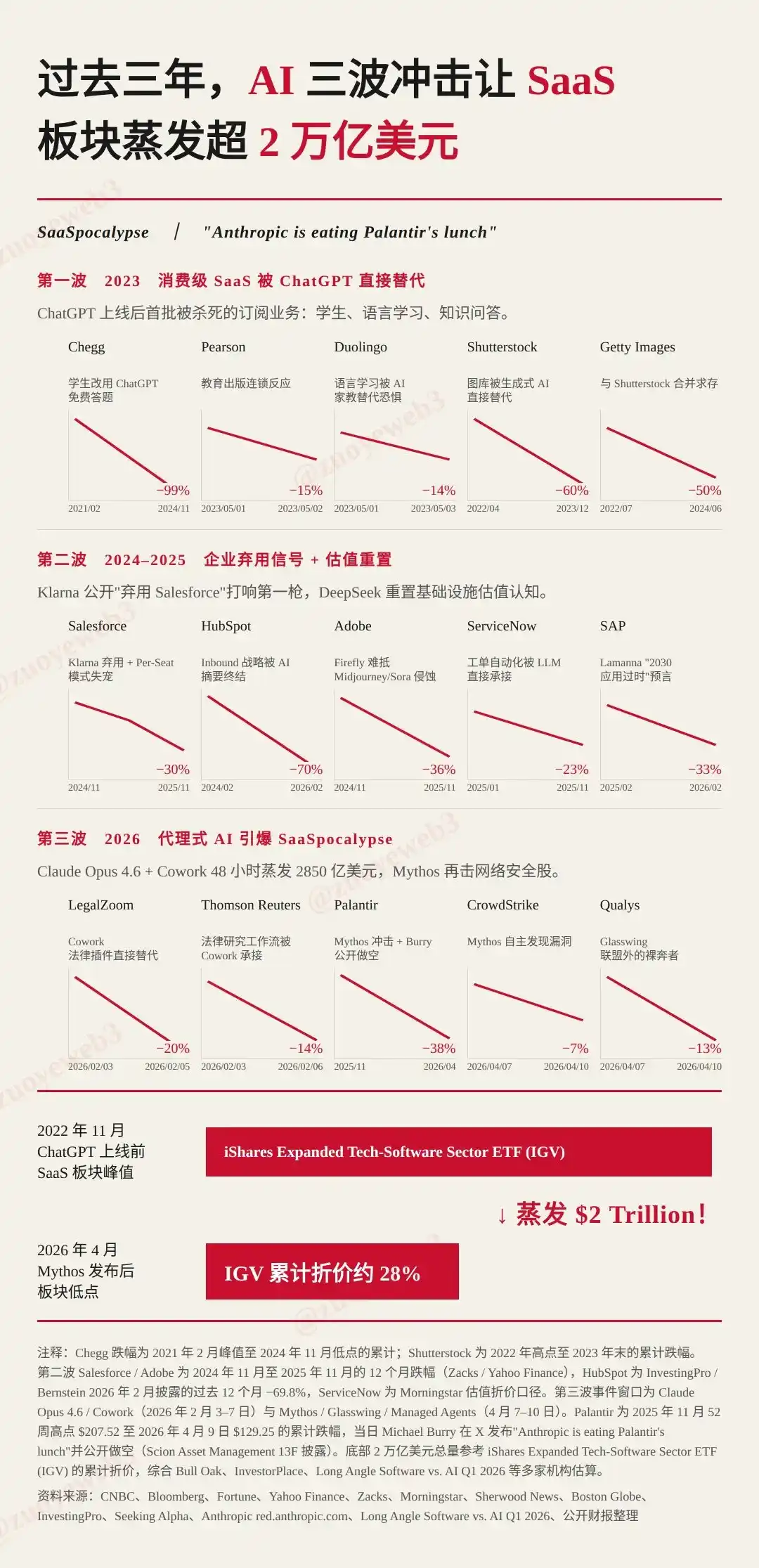
Légende de l'image : Effondrement du SaaS

Source de l'image :@zuoyeweb3

Vous pouvez comprendre que l'Agent utilise astucieusement la nature lucrative du capital. Bien sûr, on peut attendre les informations complètes du terminal Bloomberg, ou utiliser des données拼凑ées, inexactes, pour tenter de gagner un profit.

Ce n'est pas nouveau, Thomas Peterfi, fondateur d'IBKR, a "inventé", ou plutôt assemblé, le premier terminal de trading physique dans le domaine financier, et tout a commencé avec un P101 inutilisé.

Si une certaine manière d'utiliser les données peut générer plus de profit, alors vous pouvez obtenir plus de données, et la飞轮 se met en marche.

Le SaaS monopolise le passé, l'IA vend le futur.

Malheureusement, nous devons aborder le DeFi par là. Vous vous souvenez du mur payant de l'API de Dune/DeFiLlama ? S'asseoir sur des données en or et mendier de la nourriture, ou la fermeture finale d'Arkham Exchange.

Les données du secteur crypto n'ont jamais eu de valeur.

Mais le secteur crypto est aussi un système financier ouvert direct, les données qu'il génère peuvent être apprises et réapprises. Même avant l'IA, la vitesse de fork des projets était déjà réduite à quelques mois, et les Meme仿盘 de PumpFun peuvent être compressés à la seconde près.

Il existe une déduction contre-intuitive : le DeFi est le serveur de test préalable du système financier. L'IA+DeFi que nous essayons aujourd'hui deviendra le modèle de l'évolution financière future.

  • Par exemple, avant la crise financière de 2008, le LIBOR sans garantie a "déclenché" le tsunami financier, puis a été remplacé par l'indicateur SOFR généré par les transactions sur les bons du Trésor américain, mais le mécanisme de sur-garantie assure la finalité des liquidations du DeFi.

  • Par exemple, les producteurs de grands modèles ne veulent pas vendre des Token selon la consommation, ils doivent absolument les commercialiser par niveau, personnaliser les capacités, les adapter professionnellement. La tokenomics a déjà transformé la "valeur d'usage" en un vrai casse-tête.

Le Crypto Token s'attache à la valeur d'usage, l'AI Token s'attache à la valeur économique.

Sous cet angle, les attaques de pirates du DeFi ne sont qu'un test de stress常规 de l'entropie externe qu'un système ouvert ne peut pas réparer seul.

Semblable à l'humour noir du Catch-22, sans stimulus d'un système de signal externe, le chiffrement suppose par défaut que l'environnement actuel est sûr. Une fois qu'une crise de sécurité se produit, il s'effondre vers un système de traitement centralisé.

Par exemple, dans l'incident de Drift, les gens ont reproché à Circle son gel tardif.
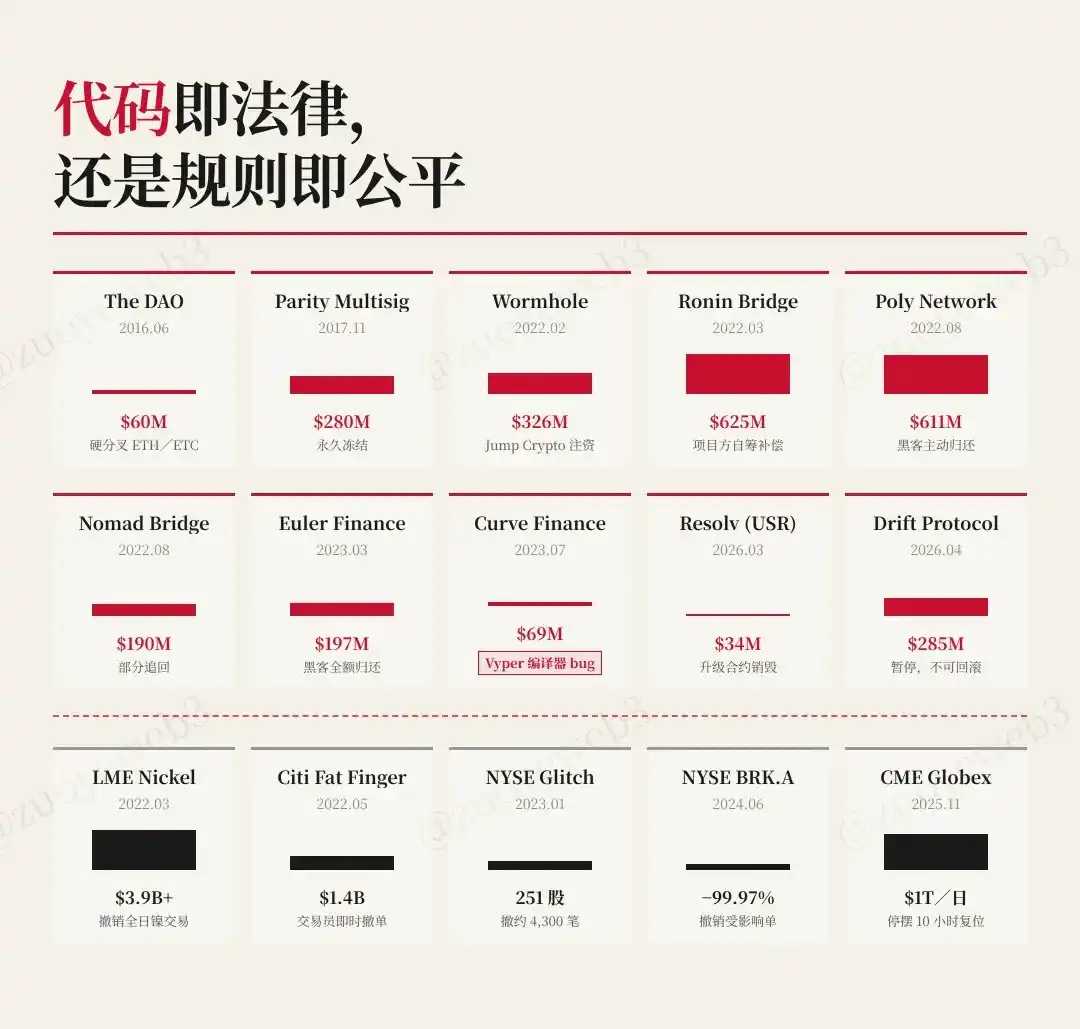
Légende de l'image : Le code ne peut pas résoudre les problèmes de sécurité

Source de l'image :@zuoyeweb3

On peut dire qu'avant le saut de capacité de l'IA, le DeFi avait déjà achevé sa SaaS-ification, ne pouvant facturer qu'en fonction du nombre de transactions, sans moyen de déplacer directement la "finance" sur la chaîne.

Le RWA sur la chaîne manque de liquidité, et le DeFi n'a pas de bonne solution pour cela.

Mais l'évolution des capacités de l'Agent semble apporter une lueur d'espoir, encore floue, pour réécrire les règles du DeFi.

  1. Tokenomics : Déployer le volume d'utilisation par canal, distribuer selon "l'efficacité du capital";

  2. Définition des règles : Mythos fournit la finalité de sécurité, l'IA protège contre les crises zero-day ;

  3. Organisation humaine : Très bien, le DeFi est déjà géré par quelques personnes pour des milliards.

La renaissance du récit d'ingénierie

D'où vient la sécurité ? De la déterminisme de la machine de Turing. D'où vient le danger ? De l'infini des possibilités.

Le "Fat Skill, Thin Harness" de YC Garry Tan me parle beaucoup, il s'agit essentiellement de bien définir les règles de base, une "liberté basée sur l'ordre".

La machine de Turing peut se combiner à l'infini, l'architecture von Neumann a toujours un décalage temporel entre le stockage et le calcul, et les grands modèles ne peuvent pas non plus produire de vrais nombres aléatoires.

Dans un avenir où les données n'ont pas de valeur, seul le comportement humain peut donner de la valeur au flux d'argent.

Mais le comportement humain a besoin de temps pour être complètement appris par l'IA, puis internalisé sous forme d'expression ingénierisée et codée.

Poursuivre l'infini avec le fini est finalement impossible. Le LLM ne peut pas éliminer complètement les hallucinations, il doit s'approcher du point où "ce n'est pas accessible à l'IA, ni à la puissance humaine" pour que le mécanisme de marché lui attribue un prix, et que nous puissions vraiment faire confiance aux smart contracts.

Les smart contracts actuels sont loin d'être un succès. Le fork de The DAO, le bug du langage de programmation Curve,甚至 le multi-signature de Drift, prouvent tous que "l'homme a le contrôle final sur le code".

L'interrogation morale n'a pas de valeur économique. Le mode de collaboration dans le domaine du DeFi s'est effondré du DAO à la fondation et à l'"équipe"归根到底 parce qu'il y a des besoins réels de mise à jour des contrats et de coopération commerciale.

Mais l'homme est incapable d'écrire un code éternellement sûr et dynamiquement mis à jour. Souvenez-vous, c'est impossible pour toujours.

Si on ne met jamais à jour, alors Curve nous apprend par sa propre expérience que la pile de dépendances technologiques peut aussi poser problème.

Le présent détermine le passé, le passé détermine le futur.

Du fonds Médaille d'Or de Simons à Numerai exécutant des stratégies d'IA, l'IA n'est pas rare dans le domaine financier. Un autre cas contre-intuitif, les signaux de交易 aident反而 l'IA à évoluer.
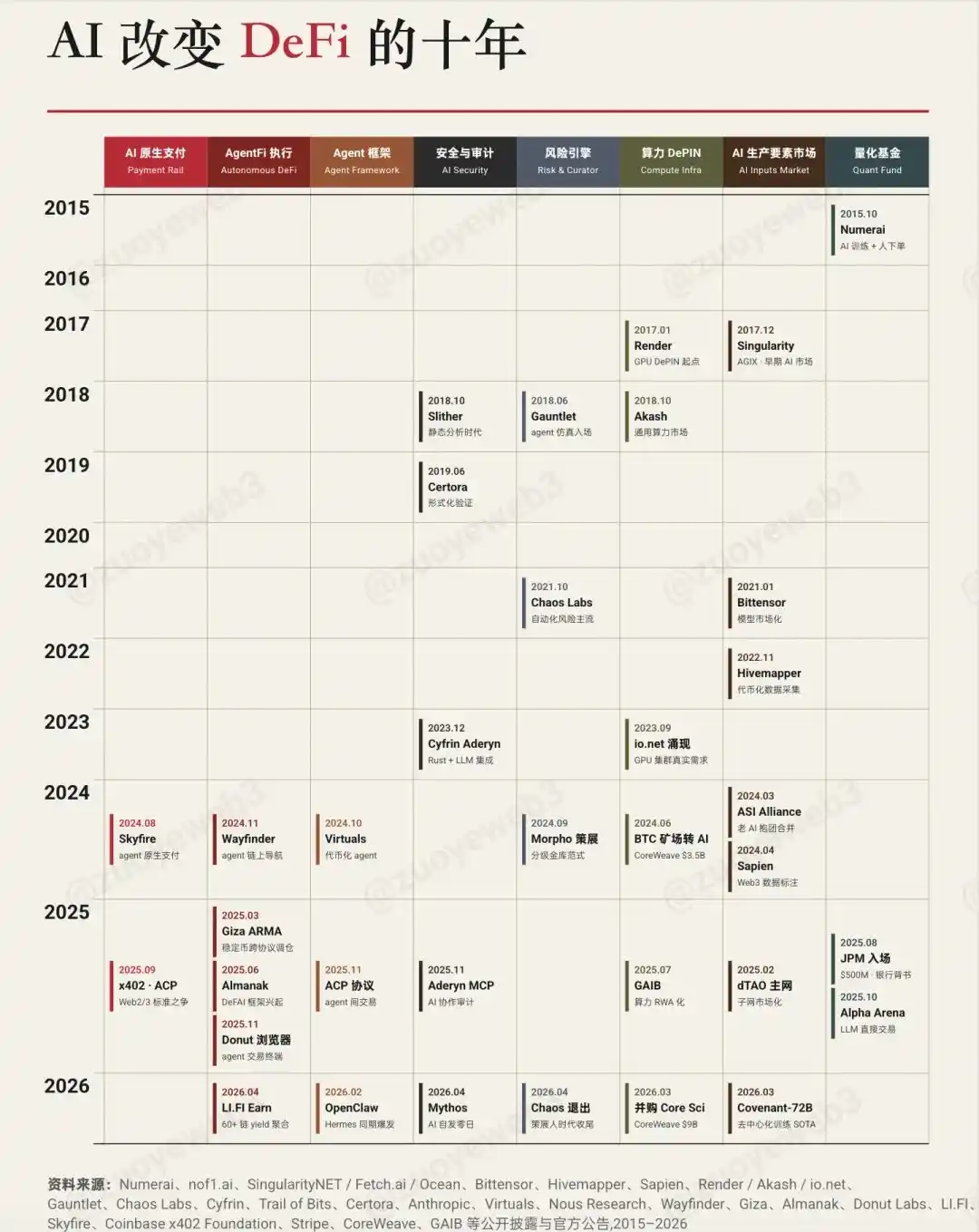
Légende de l'image : 10 ans d'IA et de DeFi

Source de l'image :@zuoyeweb3

Le modèle IA est toujours un paradigme informatique, une machine à états qui traite des signaux. Sans signal externe, il manque de la capacité de simuler le monde extérieur en interne. L'engagement de Yang LeKun et Li Fei-Fei envers le modèle mondial a du sens à cet égard.

Mais du point de vue du DeFi, pour que l'IA交易 de manière autonome, il faut que l'intention humaine soit apprise par l'Agent through behavior. C'est aussi l'importance de l'homme pour l'IA, même si l'Agent remplace la main-d'œuvre, il imite et résume le comportement humain.

甚至, l'homme ne peut pas有意 être aléatoire, une petite intention délibérée a une loi statistique,甚至 les caractéristiques physiologiques humaines才有 de l'aléatoire, par exemple, "J'aime physiologiquement la stratégie de market making d'Ethena, et je déteste la stratégie d'arbitrage de XX", ce qui implique une préférence floue.

Il est très certain que faire de la blockchain/DeFi l'infrastructure de l'IA a subi un échec lamentable au cours des dix dernières années, deAI/deAgent/deOpenclaw rencontreront des situations similaires.

Utiliser directement les derniers grands modèles pour改造 les diverses structures du DeFi, par exemple, après les tests de Mythos, les contrats sont par défaut sécurisés, toute modification est détectée en temps réel, augmentant ainsi le niveau de danger.

Et dans l'organisation humaine, le choix de l'IA est "pas de personnes", seulement les "capacités" des personnes. Le DeFi est l'industrie la plus adaptée à cela,甚至 sans égal. Après la conception des règles, le DeFi n'améliore l'efficacité du capital que sous prétexte de sécurité, en référence à la classification L1/2/3/4 de la conduite autonome, il passera必然 par un processus d'autorisation d'information --> droit d'utilisation limité des fonds --> droit d'utilisation complet des fonds.

Si l'Agent continue d'apprendre les capacités ingénierisées des traders, les capacités de gestion des Curateurs, alors il surpassera必然 l'homme dans le domaine des transactions et des收益. Mais malheureusement, les données DeFi accumulées n'ont pas encore été systématiquement apprises et entraînées par les systèmes d'IA, l'IA actuelle dans le milieu des crypto est encore au stade de l'arnaque.

Mais je suis très certain que l'utilisation réelle des fonds est la prochaine vague principale de la transformation du DeFi par l'IA, inévitable.

Alors, après que la sécurité (contrat) et l'organisation (humaine) aient été重新 mises à niveau, à quoi ressemblera la tokenomics ?

  • Le Token de l'ère PoW était un justificatif de consommation de puissance de calcul,基本identique à l'AI Token actuel ;

  • Le Token de l'ère PoS est un justificatif d'escompte de收益 attendus, l'AI Token évolue dans cette direction (fournir la capacité de remplacer l'homme est l'expression IA de cette valeur économique) ;

  • Le Crypto Token de l'ère IA a déjà dépassé notre champ d'ingénierie, nous ne pouvons que faire des prédictions irresponsables basées sur la théorie.

En référence à Sky qui utilise la distribution de tokens pour contrôler l'APY de chaque canal, et Claude qui utilise la consommation de Token pour定价 la capacité du modèle, le futur Crypto Token sera probablement un justificatif de "taux de rendement du capital".

Notez la distinction : le Token de l'ère PoS, commeETH 等, son收益 attendu est une hypothèse économique, un raisonnement经验iel a priori. Mais avec la conception ingénierisée de l'IA, les divers paramètres du DeFi se rapprocheront无限 de la réalité, leur taux de rendement et de risque sont hautement crédibles et vérifiés en temps réel.

甚至, les utilisateurs peuvent déterminer le prix actuel du Token en fonction du grand modèle et de l'Agent utilisés par le protocole DeFi, ainsi que du score des indicateurs d'optimisation Harness, acheter s'ils sont optimistes, vendre s'ils sont pessimistes.

Conclusion

Des milliers de peines indicibles et l'avenir imprévisible de l'humanité.

L'avenir du DeFi se divise en aspects économiques et techniques. La tokenomics n'a pas de bonne solution pour le moment, mais on entrevoit une lueur d'espoir en matière de sécurité. Claude Mythos peut menacer le monde, mais inversement, il peut aussi gérer l'argent.

AlphaGo a résolu le problème des échecs Go, Claude a résolu le problème de la programmation. De tels scénarios ne feront qu'augmenter à l'avenir. Les contrats du DeFi, l'organisation humaine,甚至 l'unité de计价 économique, ont tous un espace théorique pour être optimisés.

Au moins, l'homme n'a pas à craindre d'être complètement remplacé. À une époque où les données n'ont pas de valeur, le comportement a son propre sens. Au moins pour le moment, la prise de contrôle de l'homme par l'Agent reste des "micro-tâches", des "micro-paiements" et autres détails, des détails constamment répétés. Nous devons faire en sorte que ce comportement de répétition, de copie, génère de la valeur. L'IA fait baisser la valeur des données et du contenu de manière无限, se rapprochant du coût zéro, et la valeur économique unitaire (coût) de l'AI Token et du Crypto Token baisse constamment, c'est une tendance générale.

甚至 on peut dire que c'est la première fois que l'argent s'ouvre vraiment aux individus, qu'il soit utilisé pour le travail de l'IA ou que le Crypto soit utilisé pour la consommation.

Related Questions

QQuel est le principal argument de l'article concernant l'impact de l'IA sur les modèles organisationnels traditionnels ?

AL'article soutient que l'IA, en particulier grâce aux Agents et au Harness, transforme fondamentalement les modèles organisationnels en quantifiant et en automatisant les capacités humaines, réduisant ainsi la dépendance à la main-d'œuvre humaine traditionnelle et permettant une efficacité capitalistique sans précédent.

QComment l'article décrit-il l'évolution du coût des Tokens d'IA et son implication pour les entreprises ?

AL'article décrit une baisse massive du coût des Tokens d'IA, passant de 100 milliards/jour en 2024 à 140 billions/jour en 2025. Cette démocratisation des 'capacités' auparavant monopolistiques permet aux petites entreprises et aux individus de rivaliser, rendant la production de données et de contenu quasi gratuite et défiant les modèles économiques traditionnels des SaaS.

QQuel est le problème fondamental identifié avec les contrats intelligents (smart contracts) dans le DeFi selon l'auteur ?

AL'auteur affirme que les humains sont incapables d'écrire un code 'toujours sûr et dynamiquement évolutif'. Les smart contracts ne sont pas infaillibles, comme le montrent les incidents comme The DAO, les bugs de Curve ou la dépendance aux multisigs, prouvant que 'l'homme a le contrôle final du code' et que le système a besoin de signaux externes pour la sécurité.

QQuelle est la proposition centrale de l'article pour 'sauver' le DeFi grâce à l'IA ?

ALa proposition centrale est d'utiliser les derniers modèles d'IA (comme Claude Mythos) pour réécrire les règles du DeFi. Cela implique de créer des contrats par défaut sécurisés, de surveiller les modifications en temps réel pour détecter les menaces, et de permettre aux Agents d'apprendre et d'automatiser les compétences des traders et des gestionnaires pour une efficacité capitalistique supérieure, tout en minimisant le rôle humain direct.

QComment l'article envisage-t-il l'évolution future de la valeur des Tokens Crypto à l'ère de l'IA ?

AL'article prédit que les Tokens Crypto évolueront vers des 'certificats de taux de rendement du capital'. Contrairement à la valeur spéculative basée sur des hypothèses économiques (comme dans le PoS), leur valeur sera directement corrélée à des paramètres DeFi vérifiables et en temps réel, tels que les modèles d'IA utilisés, les scores d'Harness' et les performances des Agents, reflétant fidèlement le risque et la rentabilité.

Related Reads

When Crypto Meets the World Cup: CoinW and Modrić's Art of "Navigating Cycles"

When Encryption Meets the World Cup: CoinW and Modrić's "Transcending Cycles" Philosophy In the context of the 2026 FIFA World Cup and its massive global audience, the crypto exchange CoinW announced football legend Luka Modrić as its global brand ambassador. This move is framed not merely as a marketing tactic, but as a strategic experiment in user profile migration. It targets mature, financially stable football fans—particularly in Europe, Southeast Asia, and Latin America—who traditionally have low crypto awareness but value trusted, time-tested authority figures like Modrić. The article draws parallels between Modrić's enduring, disciplined career—marked by consistency and success at the highest level over two decades—and CoinW's own development path. Founded in 2017 during a volatile industry period, CoinW focused on building robust infrastructure and risk management. It weathered the 2022 industry crisis without major security incidents, subsequently earning recognition like "Europe's Most Trusted Exchange" and growing to over 20 million registered users. This "long-termism" is translated into user-centric products. CoinW Academy lowers the initial knowledge barrier. Its integrated ecosystem (CoinW, GemW, DeriW, PropW) and the recent launch of a TradFi section—offering perpetual contracts on traditional assets like stocks, gold, and oil—aim to create a unified platform for diverse assets. For the World Cup, CoinW launched the "We Are The Game" campaign, collaborating with Alchemy Pay to offer zero-fee deposits and local payment options, aiming to transform spectators into participants and lower entry barriers. Ultimately, CoinW's sports partnerships and product strategy are presented as a concerted effort to build trust and accessibility for the "silent majority" still outside crypto—shifting the industry narrative toward inclusivity and long-term value.

Foresight News3m ago

When Crypto Meets the World Cup: CoinW and Modrić's Art of "Navigating Cycles"

Foresight News3m ago

A Panoramic View of the Solana Privacy Ecosystem: The Complete Privacy Stack from Computation to AI

**Solana Privacy Ecosystem: A Comprehensive Overview from Computation to AI** Solana's privacy ecosystem, while nascent, is rapidly evolving to address key challenges across multiple layers. Key figures like Helius CEO Mert acknowledge that Solana has lagged in privacy but highlight its unique potential for scalable, composable privacy protocols, potentially leveraging technologies like ZK compression without persistent rollups. The foundational layer is **Private Compute**, addressed by providers like Arcium and Magic Block. Arcium utilizes Multi-Party Computation (MPC) networks to process encrypted data off-chain with final settlement on Solana, supporting use cases like confidential payments (via its C-SPL token standard) and encrypted data analysis. Magic Block employs Trusted Execution Environments (TEEs) to create private, ephemeral rollups, offering confidentiality, scalability, and composability. Both enable private order books, dark pools, and DeFi rails. Building on this infrastructure are applications for **Private Transfers and Balances**. Umbra, built on Arcium, offers encrypted token accounts with amount, balance, and sender-receiver linkage privacy, plus compliance features. Privacy Cash uses Tornado-style shielded pools for SOL, while Hush provides private staking and trading with integrated swaps via Jupiter. To eliminate **On-Chain Trails** from everyday activities like trading, protocols like encifherio and VanishTrade are emerging. encifherio privately routes swaps through Jupiter by encrypting transaction details within TEEs. VanishTrade routes trades through shielded liquidity pools. Darklake offers a ZK-native "blind slippage" AMM and private perpetuals to hide trading intent and prevent front-running. More advanced applications include **Private Prediction Markets**. Platforms like Melee Markets use Arcium's MPC to encrypt order books, allowing participants to place hidden bets without revealing their market position until settlement. Finally, the ecosystem is expanding into **Private AI**. Loyal leverages both Magic Block and Arcium to create a decentralized protocol where user-AI interactions, queries, and preferences are encrypted on-chain, giving users ownership and control over their data while enabling private transactions and yield generation. In summary, Solana's privacy stack is developing from core compute and transfer privacy towards sophisticated applications in DeFi, prediction markets, and AI, aiming for a future where Fully Homomorphic Encryption (FHE) and Zero-Knowledge (ZK) proofs combine for a complete privacy solution.

marsbit4m ago

A Panoramic View of the Solana Privacy Ecosystem: The Complete Privacy Stack from Computation to AI

marsbit4m ago

Spain's Stunning Upset: A Sharp Review of World Cup Betting Methods from 'Solid' to 'Meh'

"Spain Stunned: A Critical Review of World Cup Betting Methods from 'Awesome' to 'Trash'" The 2026 World Cup has already delivered its first major upset, as tournament favorite Spain was held to a goalless draw by Cape Verde. This shock result highlights the unpredictable nature of sports and the risks involved in betting on favorites. The article critically compares four major channels for World Cup predictions across five key dimensions: market clarity, transaction transparency, variety of bets, user access/compliance, and promotional incentives. Traditional online sportsbooks and China's official sports lottery offer familiar but opaque systems using complex odds. While they provide a vast array of betting options, their market mechanics and liquidity are not transparent to users. In contrast, new crypto prediction markets like Polymarket, Kalshi, Opinion, and Predict.fun present a clearer model. They translate probability directly into a tradable price (e.g., a 16¢ price equals a perceived 16% chance to win), making market sentiment easily visible. These platforms offer full transparency into order books and trading activity. User access varies significantly. China's sports lottery is fully compliant but primarily offline. Crypto markets require digital wallets and carry regulatory uncertainties. Kalshi is US-regulated but geographically restricted. Traditional offshore books pose the highest compliance and fund security risks. For engagement, Predict.fun leads with a $2 million incentive campaign and gamified features on BNB Chain. Traditional books also ramp up promotions during the World Cup, while other platforms focus more on core market functionality. In summary, the landscape is diversifying. Traditional platforms offer betting as entertainment, while emerging prediction markets frame the World Cup as a transparent, real-time information market. The core appeal remains the same: the human desire to price the future and validate one's predictions.

marsbit9m ago

Spain's Stunning Upset: A Sharp Review of World Cup Betting Methods from 'Solid' to 'Meh'

marsbit9m ago

Trading

Spot
Futures

Hot Articles

What is LINON

Linde plc Tokenized Stock (Ondo): Revolutionizing Traditional Equity Access Through Blockchain Innovation The emergence of Linde plc Tokenized Stock (Ondo), represented by the ticker $LINON, signifies a monumental shift in the fusion of traditional financial structures and decentralized finance (DeFi). This innovative financial instrument showcases the tremendous potential of blockchain technology to democratize access to traditional equity markets while ensuring the security and regulatory compliance necessary for institutional-grade financial products. Through Ondo Finance's pioneering tokenization platform, $LINON provides a seamless pathway for global investors to engage with one of the world's leading industrial gas companies, Linde plc, creating a blockchain-native representation of the underlying equity. Introduction to Linde plc Tokenized Stock The landscape of financial markets is witnessing a groundbreaking transformation through the tokenization of real-world assets. Linde plc Tokenized Stock (Ondo) epitomizes this revolutionary approach by bridging the gap between conventional stock ownership and blockchain-enabled financial infrastructure. The $LINON token allows investors to gain exposure to one of the prominent industrial companies worldwide through decentralized technology. Operating within Ondo Finance's comprehensive ecosystem, $LINON symbolizes a practical application of tokenization technology that enhances accessibility, efficiency, and global connectivity in traditional financial markets. By leveraging blockchain infrastructure, this tokenized stock enables international investors to participate in U.S. equity markets, overcoming traditional barriers associated with cross-border investing. The significance of $LINON goes beyond technological innovation; it represents a fundamental shift in asset structuring, distribution, and trading in the digital age. This tokenized stock maintains all the economic benefits associated with traditional Linde plc shares while offering improved liquidity, programmable compliance features, and seamless integration with decentralized finance protocols. The development of $LINON indicates a growing acceptance of blockchain technology as a viable means for traditional finance, exemplifying how even well-established assets like Linde plc can integrate into blockchain systems. This approach preserves the core attributes that appeal to investors while introducing advanced capabilities that enhance the overall investment proposition. Project Overview and Objectives Linde plc Tokenized Stock (Ondo) encapsulates a strategic effort to democratize access to traditional equity markets through advanced blockchain technologies. The primary objective of $LINON is to provide approved global investors seamless access to the economic exposure associated with Linde plc shares, furthering an effort to create a more inclusive financial ecosystem. Beyond the digital representation of traditional assets, $LINON endeavors to eliminate barriers of geography and time zones that limit investor participation. Its design ensures that blockchain technology can elevate traditional investment vehicles without undermining the security or compliance requirements expected by investors. Key goals of the project include enhanced liquidity provision, programmable compliance mechanisms, and interoperability with other blockchain networks. Each $LINON token is fortified by actual Linde plc securities housed at U.S.-registered broker-dealers, allowing holders to reap economic advantages akin to traditional stockholders, such as dividend reinvestment. Furthermore, $LINON aims to establish new industry standards for institutional-grade tokenized securities, paving the way for traditional assets to embrace blockchain technology while remaining compliant with regulatory frameworks. By associating itself with a company as reputable as Linde plc, the project opens avenues for exploring tokenized equities catering to both conservative institutional players and daring retail investors. Project Creator and Development Team The vision for Linde plc Tokenized Stock (Ondo) comes from Nathan Allman, founder and CEO of Ondo Finance. His background in traditional finance coupled with expertise in blockchain technology positions him uniquely to navigate the complexities of asset tokenization. Allman's academic journey began at Brown University, focusing on Economics and Biology, equipping him with valuable analytical skills. His time at Goldman Sachs in the Digital Assets division strengthened his understanding of the interplay between financial institutions and emerging technologies, laying the groundwork for his later endeavors in alternative investment strategies. Under Allman's guidance, Ondo Finance has emerged as a leader in asset tokenization, launching $LINON as a flagship example of the company's larger mission towards revolutionizing traditional financial systems using blockchain technology. His commitment to leveraging blockchain for creating institutional-grade financial products has shaped the landscape of real-world asset tokenization. Investment and Funding Structure The growth of Ondo Finance, the platform powering Linde plc Tokenized Stock (Ondo), is bolstered by robust financial backing from prestigious venture capital firms and strategic investors. This strong investment foundation underpins the development of the key infrastructure essential for compliant tokenized securities like $LINON. In August 2021, Ondo Finance secured $4 million in seed funding led by a major venture capital firm, which enabled the company to commence platform development and establish the necessary regulatory processes for tokenizing real-world assets. This early investment cemented Ondo Finance's credibility within the industry. The Series A funding round followed, garnering $20 million with participation from renowned firms committed to transformative technology companies. This backing demonstrated substantial institutional confidence in Ondo Finance's vision, allowing it to hone its approach to asset tokenization through mechanisms that ensure compliance and accessibility. Noteworthy contributors, including institutional investors and experienced partners, have added significant value to Ondo Finance’s development efforts. Their involvement underscores the confidence across sectors in Ondo Finance's approach to bridging traditional finance with blockchain innovations. Technical Infrastructure and Innovation The technical architecture that underpins Linde plc Tokenized Stock (Ondo) represents a sophisticated melding of traditional finance systems and cutting-edge blockchain technology. The architecture's foundation is built on the Ethereum network, renowned for its security and programmability—both critical for intricate financial instruments. The $LINON tokenization process comprises creating a blockchain-native representation of Linde plc shares that preserves economic benefits while augmenting investor capabilities. Each token corresponds to actual shares held at U.S.-registered broker-dealers, creating a compliant custody structure that legitimizes the asset's existence and value. Automated compliance systems are integrated into the tokenization process, managing critical components such as know-your-customer (KYC) verification and anti-money laundering (AML) protocols. This incorporation of programmable compliance empowers $LINON to uphold regulatory standards essential for institutional proliferation. Cross-chain interoperability characterizes the advanced technical features of $LINON. While initially deployed on Ethereum, the framework is designed for expansion to other networks such as Solana and BNB Chain. This adaptability enhances liquidity and accessibility, allowing investors to select their preferred blockchain ecosystems. Historical Timeline and Development Crafting the history of Linde plc Tokenized Stock (Ondo) unfolds in parallel with the evolution of Ondo Finance's tokenization platform. The timeline's inception dates back to March 2021 when Nathan Allman laid the foundations for creating institutional-grade financial products on blockchain infrastructure. The initial funding round in August 2021 provided crucial resources for developing the platform and establishing partnerships necessary for effective tokenization. By January 2023, Ondo Finance launched its tokenized treasury products, establishing mechanisms that would facilitate future tokenized equities such as $LINON. A pivotal milestone arose in February 2025 when Ondo Chain—a Layer 1 blockchain designed specifically for asset tokenization—was introduced. This infrastructure enhances capabilities vital for institutional markets, demonstrating Ondo Finance's long-term commitment to tokenization. Subsequently, the launch of Ondo Global Markets in September 2025 marked the official debut of $LINON. This milestone showcased the successful transition from development to active trading, enabling investors around the world to access American financial markets seamlessly. Ongoing development plans include a targeted expansion of available tokenized assets to over 1,000 by the end of 2025, pointing to a bright future for Ondo Finance's ecosystem and its mission to broaden tokenized equity accessibility. Regulatory Compliance and Legal Framework The legal architecture governing Linde plc Tokenized Stock (Ondo) emphasizes a sophisticated approach to regulatory compliance, allowing tokenized securities to be implemented within a blockchain-based framework. The legal structure governing $LINON spans multiple jurisdictions while maintaining a robust legal footing. Compliance systems ensure that only eligible investors can access the token, enforced through automated verification that aligns with international regulations. This innovative regulatory technology promises real-time enforcement of complex requirements, considerably enhancing efficiency in operating within the regulatory landscape. The custody framework undergirding $LINON ensures that the underlying shares are securely held at U.S.-registered broker-dealers, complying with necessary regulations while delivering blockchain-driven access to investors. The token maintains its economic equivalency and security through this carefully structured custody arrangement. KYC and AML compliance systems are embedded within the smart contract architecture, ensuring integrity and adherence to regulatory practices while fostering transparency for investors. The jurisdictional restrictions mark a commitment to navigating the evolving landscape of international securities laws. Market Impact and Industry Significance The advent of Linde plc Tokenized Stock (Ondo) holds profound implications for the broader financial landscape, symbolizing a clear shift towards blockchain-enabled markets. $LINON serves as a proof-of-concept for integrating traditional companies into blockchain ecosystems, showcasing the potential benefits such as broader accessibility and improved efficiency. The market's response to $LINON indicates a growing acceptance of tokenization among institutional investors, contributing to the emergence of an expanding sector wherein traditional assets can be interconnected with blockchain innovations. The success of $LINON further solidifies market confidence, indicating an overarching shift towards recognizing asset tokenization as a transformative force in finance. Future Development and Expansion Plans The future trajectory for Linde plc Tokenized Stock (Ondo) centers around the expansion of the tokenization ecosystem and enhanced infrastructure supporting blockchain-enabled financial services. Plans for cross-chain integration usher in new opportunities for liquidity and flexibility within the investment framework, with existing capabilities poised for continuous enhancement. With the introduction of Ondo Chain, Ondo Finance aims to transition $LINON to an optimized blockchain environment specifically designed for asset tokenization. This new infrastructure heralds exciting prospects for the development of institutional-grade financial products, ensuring ongoing compatibility with contemporary investment strategies. Further integration with decentralized finance protocols signifies a commitment to empowering $LINON holders through advanced financial strategies. The anticipated expansion of available tokenized assets promises to broaden investor access, enhancing the utility and appeal of the platform. In alignment with ambitions for regulatory expansion, ongoing efforts to secure approvals for new jurisdictions will enhance investor access, further positioning $LINON at the forefront of the burgeoning tokenization market. Conclusion Linde plc Tokenized Stock (Ondo), as represented by the $LINON token, stands at the intersection of traditional finance and blockchain innovation. It embodies a transformative milestone in how financial assets are structured, distributed, and engaged within modern investment ecosystems. The technical sophistication behind $LINON, combined with its regulatory compliance framework, illustrates that asset tokenization can improve financial infrastructure rather than simply digitizing existing products. This pioneering effort not only enhances investor access to U.S. equity markets but also signifies an evolution of how traditional financial services can integrate blockchain technology. As the asset tokenization market grows exponentially, with prospects suggesting significant valuation increases, $LINON paves the way for a future where tokenized securities become standard fixtures in the financial landscape. The trajectory of $LINON will undoubtedly influence how traditional finance adapts to a transformed, blockchain-powered world.

3.2k Total ViewsPublished 2025.12.05Updated 2025.12.05

What is LINON

What is CRMON

Salesforce Tokenized Stock (Ondo): Revolutionising Traditional Equity Access Through Blockchain Innovation The emergence of Salesforce Tokenized Stock (CRMON) marks a pivotal advancement in integrating traditional financial markets with blockchain technology. This innovative approach offers investors unprecedented access to equity exposure through tokenisation. Developed by Ondo Finance, CRMON provides tokenholders with economic exposure equivalent to holding Salesforce stock (CRM) while automatically reinvesting dividends. This effectively bridges the gap between conventional equity markets and decentralised finance (DeFi). Introduction and Comprehensive Overview of Salesforce Tokenized Stock In recent years, the financial landscape has dramatically transformed due to blockchain technology, fundamentally altering how investors access and interact with traditional assets. The development of Salesforce Tokenized Stock (CRMON) is a prime example of this evolution, representing a sophisticated fusion of conventional equity markets with cutting-edge distributed ledger technology. CRMON is a tokenised version of Salesforce stock, emerging from the innovative work of Ondo Finance, a leading platform in the real-world asset tokenisation sector that positions itself as a bridge between traditional finance and decentralised systems. Designed to provide tokenholders with economic exposure that mirrors the performance of the underlying Salesforce stock, CRMON incorporates automatic dividend reinvestment mechanisms. This eliminates many traditional barriers associated with international equity investment, such as complex brokerage relationships, currency conversion challenges, and restricted trading hours. The tokenisation process reimagines stock ownership as a blockchain-native asset while maintaining its economic equivalence with the underlying security, offering enhanced portability and integration capabilities within decentralised finance ecosystems. CRMON transcends its individual utility as an investment instrument to represent a fundamental shift in how financial markets can operate in an increasingly digital world. By maintaining full backing through U.S.-registered broker-dealers and implementing robust compliance frameworks, CRMON demonstrates that tokenised securities can achieve the regulatory standards necessary for institutional adoption while delivering the technological advantages of blockchain infrastructure. Understanding Tokenized Real-World Assets and CRMON's Strategic Position Tokenised real-world assets signify one of the most significant innovations in modern finance, fundamentally reimagining how traditional securities are represented, traded, and utilised within digital ecosystems. CRMON operates as a tokenised equity instrument correlating directly with Salesforce stock while optimising accessibility and efficiency. This aligns with Ondo Finance's broader mission to democratise access to institutional-grade financial products through innovative tokenisation strategies. The tokenisation process guarantees complete economic equivalence with the underlying Salesforce equity. Each CRMON token represents a proportional claim on Salesforce stock held by qualified custodians, with dividend payments automatically reinvested to maintain continuous exposure to total return performance. This structure simplifies dividend management and ensures that tokenholders receive the full economic benefit of their equity exposure, encompassing both capital appreciation and income generation. Ondo Finance's strategy in tokenising Salesforce stock demonstrates its expertise in creating compliant, institutional-grade products that meet traditional financial markets' stringent requirements. The platform’s focus on merging regulatory compliance with blockchain benefits positions it at the forefront of decentralised finance, captivating both institutional and retail investors seeking blockchain-native solutions. The Technology and Innovation Framework Behind CRMON The technological infrastructure supporting CRMON integrates blockchain technology with traditional financial mechanisms, delivering institutional-grade security and compliance while maintaining the operational advantages of decentralised systems. Built on the Ethereum blockchain, CRMON utilises robust smart contract capabilities to ensure transparent, secure operations. The smart contract architecture incorporates layered security and compliance mechanisms, enabling automated compliance checks and real-time asset backing verification. Integration with oracle services maintains accurate pricing and dividend information, ensuring CRMON reflects the underlying Salesforce stock's accurate performance. This architecture delivers automated dividend reinvestments and other corporate actions, eliminating manual processing requirements and directly enhancing tokenholder benefits. Ondo Finance ensures CRMON's security structure includes daily third-party verification of holdings, independent collateral agents, and a multiple-layer custody system through partnerships with established financial institutions. This framework safeguards tokenholder interests against operational risks while providing robust asset backing. The user interface enhances integration capabilities, allowing seamless interaction between CRMON and various decentralised finance protocols, as well as cryptocurrency exchanges. This interoperability enables users to leverage their tokenised equity across multiple platforms, creating sophisticated investment strategies that marry traditional equity characteristics with blockchain-native innovation. Leadership and Corporate Structure of Ondo Finance The leadership team behind CRMON and Ondo Finance blends expertise from traditional finance and blockchain technology, presenting a robust combination of skills essential for successfully bridging conventional markets with decentralised finance. Nathan Allman, the founder and CEO, emerged from a distinguished financial background before establishing Ondo Finance in 2021. Allman's experience includes notable roles at major financial institutions, including significant contributions to developing cryptocurrency market services. His insights into regulatory compliance were paramount in developing products like CRMON that successfully unify traditional securities with blockchain technology. With a team of professionals boasting substantial experience in both conventional finance and blockchain sectors, Ondo Finance's leadership comprises diverse expertise that covers every aspect of tokenised asset development. Justin Schmidt serves as President and COO, contributing unique operational expertise, while Chris Tyrell brings essential compliance knowledge. Investment Landscape and Funding History The investment landscape surrounding Ondo Finance reflects significant institutional confidence in its mission to tokenise real-world assets. The company has raised substantial funds through various investment rounds, attracting leading venture capital firms and strategic investors that recognise the transformative potential of tokenised securities like CRMON. Notably, Ondo Finance completed a successful Series A funding round in 2022, led by well-known venture capital firms. This funding success validates Ondo Finance's innovative approach to creating compliant, institutional-grade tokenised products. In total, Ondo Finance has successfully secured substantial funding, raising significant capital for product development and market expansion, including a noteworthy token sale that reinforced its governance structure through the establishment of the ONDO token. The diverse composition of investors reflects broad market confidence in Ondo Finance's business model, demonstrating support from both traditional and blockchain-native organisations. Operational Mechanics and Technical Implementation The operational framework supporting CRMON exemplifies sophisticated integration of traditional financial mechanisms with blockchain technology. The technical implementation introduces multiple layers of security, compliance, and operational efficiency to meet institutional standards while enhancing accessibility. The tokenisation process begins by acquiring actual Salesforce stock through U.S.-registered broker-dealers, ensuring each CRMON token maintains direct correlation with the underlying equity performance. Smart contracts automate operational processes, including dividend reinvestment and corporate action processing, facilitating a streamlined user experience. The Minting and redemption processes allow authorised participants to manage CRMON tokens effectively. During U.S. trading hours, institutions can mint new tokens by depositing stablecoins that are used to purchase corresponding Salesforce equity. This structure maintains a tight correlation with underlying assets, enhancing liquidity and price discovery. Additionally, the infrastructure supports twenty-four-hour token transfer capabilities, providing CRMON holders with operations outside traditional market hours. This represents a significant advantage over conventional securities ownership, thus promoting integration with decentralised finance applications. Plans for cross-chain compatibility through partnerships signal further ambitions for CRMON's market reach. By expanding to other blockchain networks, Ondo Finance aims to enhance accessibility and user engagement with tokenised equity products. Timeline and Historical Development of Tokenized Equity Innovation The timeline of CRMON's development and Ondo Finance's broader tokenised capabilities demonstrates a systematic innovation process beginning with the company's founding in 2021. 2021: Ondo Finance is founded by Nathan Allman and co-founders, launching initial products focused on structured vault offerings on the Ethereum blockchain. 2022: The company completes substantial funding rounds—both equity and token sales—totaling significant capital and launching initial tokenised U.S. Treasury products. 2023-2024: Ondo Finance experiences substantial growth, establishing partnerships with major financial institutions while expanding its product offerings beyond fixed-income securities. February 2025: Ondo Global Markets is announced, marking the transition into equity tokenisation with plans for accessing over one hundred U.S. stocks and ETFs. September 2025: The official launch of Ondo Global Markets includes CRMON alongside other tokenised equity offerings, marking a significant evolution in Ondo Finance's product ecosystem. This timeline highlights the organisation's rapid growth and its capability to adapt its technological and compliance frameworks to accommodate different asset classes effectively while maintaining security and regulatory integrity. Regulatory Framework and Compliance Approach Ondo Finance's regulatory framework showcases a sophisticated compliance strategy, essential for achieving institutional adoption in the tokenised securities market. The company's strong partnerships with U.S.-registered broker-dealers promote adherence to Securities and Exchange Commission regulations and apply robust investor protections. Acquisitions, such as Oasis Pro—a registered broker-dealer—significantly enhance Ondo Finance's compliance capabilities, ensuring thorough alignment with existing regulatory structures. The company employs independent verification procedures that foster transparency, aiming for a solid performance standards reputation. Furthermore, Ondo Finance's commitment extends to international regulatory compliance, ensuring token access remains restricted to eligible investors while adhering to pertinent cross-border securities regulations. Comprehensive attention to tax implications and reporting requirements fortifies the security and compliance landscape of CRMON, ensuring that investor obligations remain manageable. Future Prospects and Market Positioning The forward-looking landscape for CRMON and Ondo Finance illustrates substantial growth opportunities driven by institutional adoption of blockchain technology and escalating demand for efficient alternatives to conventional securities ownership. Market projections indicate the tokenised asset sector could value multiple trillion dollars by 2030. With plans to scale CRMON offerings significantly and integrate it with a dedicated blockchain infrastructure—Ondo Chain—Ondo Finance aims to elevate its institutional-grade tokenised asset operations. Additionally, the development of strategic partnerships enhances distribution capabilities while establishing the company's credibility in the financial market. Furthermore, the integration of tokenised equity with decentralised finance protocols offers new potential for innovative financial products and strategies previously impossible with traditional securities. These factors underscore CRMON's positioning to effectively capture increased market share and deliver innovative solutions for international investment exposure. Conclusion Salesforce Tokenized Stock (CRMON) symbolises a transformative development within financial markets, successfully bridging traditional equity ownership with blockchain technology to create unprecedented accessibility for global investors. Through Ondo Finance's sophisticated tokenisation framework, CRMON provides complete economic exposure to Salesforce equity performance while enhancing operational advantages that exceed traditional ownership. The launch of CRMON reflects the broader evolution of financial markets towards blockchain infrastructures that maintain regulatory compliance while delivering increased efficiency. Ondo Finance's extensive approach to regulatory adherence, institutional-grade security, and technological innovation solidifies CRMON as a model for future tokenised securities, delivering access previously unattainable in conventional brokerage structures. As the tokenised asset sector continues to develop, CRMON is well-positioned to address historical inefficiencies in capital markets while providing investors with innovative solutions for accessing traditional securities. The outlook for CRMON looks exceptionally promising, supported by ambitious expansion plans, technological innovations, and strategic partnerships, thereby representing a pioneering model of modern financial infrastructure evolving through blockchain integration.

3.3k Total ViewsPublished 2025.12.05Updated 2025.12.05

What is CRMON

What is SHOPON

Shopify Tokenized Stock (Ondo): A Comprehensive Analysis of Real-World Asset Tokenization in Web3 This article delves into the Shopify Tokenized Stock (Ondo), recognised by its ticker symbol $SHOPON, exploring its implications at the intersection of traditional finance and blockchain technology. As a part of Ondo Finance's tokenized securities platform, Shopify’s tokenized stock exemplifies advancements in democratizing access to global capital markets through innovative digital assets. Introduction and Overview of Shopify Tokenized Stock (Ondo) Shopify Tokenized Stock (Ondo), or $SHOPON, portrays a pivotal innovation in the realm of tokenized securities, allowing investors to gain economic exposure akin to directly owning shares of Shopify Inc. This token, developed under the umbrella of Ondo Finance, not only provides investors with the ability to hold digital representations of the company’s stock but also integrates features such as automatic reinvestment of dividends. This advancement represents a substantial shift in the landscape of decentralized finance (DeFi), linking conventional equity markets with blockchain solutions designed to enhance accessibility, transparency, and liquidity. By eliminating geographical barriers and enabling 24/7 trading capabilities, $SHOPON is positioned as a bridge connecting traditional financial instruments and the emerging Web3 ecosystem. What is Shopify Tokenized Stock (Ondo), $SHOPON? The $SHOPON token serves as a digital manifestation of Shopify Inc.'s shares, engineered to provide a direct correlation to the underlying asset's performance. Through the utilization of blockchain technology, the token gives holders a mechanism to participate in the economic benefits associated with equity ownership, including capital appreciation and dividend distribution. The unique aspect of $SHOPON lies in its automatic dividend reinvestment mechanism, which allows returns to compound without necessitating active management by the investor. This feature inherently enhances its attractiveness as an investment vehicle, particularly for individuals seeking passive income growth alongside exposure to high-performing equities. The tokenization process is facilitated by the custody of actual Shopify shares through regulated intermediaries, ensuring that every $SHOPON token is verifiably backed by real equity. This structure empowers investors with the dual advantages of both traditional financial characteristics and the innovative benefits tied to blockchain technology. Who is the Creator of Shopify Tokenized Stock (Ondo)? The creator of Shopify Tokenized Stock (Ondo), Nathan Allman, is an experienced figure in the finance sector, formerly associated with Goldman Sachs. His rich background includes significant expertise in digital asset development, bridging the gap between traditional finance and cryptocurrencies. Allman’s educational journey, marked by studies at Brown University, provided him with a deep understanding of economics and biology, equipping him with analytical skills that inform his strategic vision. In 2021, he founded Ondo Finance, committing to developing tokenized securities that meet institutional-grade standards while leveraging blockchain's transformative capabilities. Under Allman's leadership, Ondo Finance has focused on creating compliant and innovative financial products that empower a diverse investor base. Who are the Investors of Shopify Tokenized Stock (Ondo)? The investment landscape surrounding Shopify Tokenized Stock (Ondo) is notably robust, underpinned by significant institutional support. Primarily, Pantera Capital stands out as a strategic partner through the Ondo Catalyst initiative, a $250 million commitment aimed at accelerating the development of on-chain capital markets. This partnership not only signifies institutional confidence in the potential of tokenized assets but also reinforces Ondo Finance's operational capabilities and market positioning. The funding pathways have included earlier rounds that amassed millions in seed funding and further structural investments, solidifying relationships with both venture capital firms and private investors. Moreover, the financial framework is complemented by strategic partnerships with established financial institutions and technology companies, enhancing Ondo’s infrastructure and operational expertise. How Does Shopify Tokenized Stock (Ondo), $SHOPON Work? At the core of $SHOPON's operational framework is a sophisticated system integrating traditional finance mechanisms with blockchain technology. The custody of actual Shopify shares ensures that token holders retain authentic economic exposure, safeguarding their investments in line with recognized legal structures. The smart contracts employed in managing $SHOPON handle various functions, including automatic dividend reinvestment and ownership transfer, offering instant settlement and increased liquidity, marking a significant departure from conventional trading systems plagued by multi-day settlement delays. By providing interoperability with other decentralized finance applications, $SHOPON empowers holders with potentially lucrative opportunities for advanced investment strategies, including lending and automated market making. This complex integration presents a unique value proposition, catering to both traditional and crypto-native investors. The innovative structure of $SHOPON also allows for real-time settlements and transactions documented on the blockchain, delivering unparalleled transparency and security—a major advancement over standard equity trading practices. Timeline of Shopify Tokenized Stock (Ondo) March 2021: Nathan Allman establishes Ondo Finance, initially focusing on decentralized finance yield optimization. August 2021: Completion of a $4 million seed funding round led by Pantera Capital. January 2023: Launch of initial tokenized treasury security products, laying the groundwork for future equity tokenization. July 2025: Announcement of the Ondo Catalyst initiative, a strategic investment program valued at $250 million, aimed at propelling the development of tokenization in capital markets. September 3, 2025: Launch of Ondo Global Markets featuring over 100 tokenized U.S. stocks and ETFs, including $SHOPON. Technical Implementation and Blockchain Infrastructure Shopify Tokenized Stock (Ondo) operates on a technical architectural framework that marries blockchain protocols with traditional financial custody arrangements. The ecosystem leverages Ethereum's smart contract capabilities, providing seamless transaction management while ensuring compliance with regulatory standards through established financial custodians. Central to this architecture are security measures and transparent transaction records that affirm the legitimacy of each tokenholder's economic stake. With automated features managed by intricate smart contracts, $SHOPON not only streamlines ownership transfers but also allows for the tactical reinvestment of dividends—a hallmark of modern investment strategies. Moreover, the incorporation of LayerZero technology facilitates cross-chain interoperability, making $SHOPON accessible across multiple blockchain environments while preserving its functional robustness. This forward-thinking technical design positions $SHOPON as an adaptable asset within the larger DeFi milieu. Regulatory Framework and Compliance Architecture $SHOPON's regulatory framework is built upon the meticulous navigation of existing financial regulations that govern securities. The custody arrangements for the underlying Shopify shares are managed by U.S.-regulated broker-dealers, ensuring compliance and protection for investors. By maintaining a separation between the blockchain tokenization process and traditional custody, $SHOPON adheres to legal requirements while offering innovative functionalities that challenge conventional constraints. This dual-layered compliance approach enhances investor confidence and underscores Ondo Finance's commitment to regulatory integrity. Notably, the availability of $SHOPON is tailored to international investors from regions such as Asia-Pacific, Europe, and Africa, as regulatory parameters in the U.S. and U.K. present challenges in accessing tokenized securities. Market Access and Global Distribution Strategy The distribution strategy of $SHOPON is keenly designed to optimize global access while conforming to regulatory standards. The platform aims to establish comprehensive coverage for eligible investors across multiple regions, effectively dismantling traditional barriers through the implementation of blockchain technology. Integration with various cryptocurrency wallets and exchanges also promotes user-friendliness and accessibility, establishing a streamlined experience for investors to manage their holdings. Moreover, the 24/7 trading capabilities afforded by the tokenized model allow participants to react promptly to market shifts, fundamentally transforming how global equities are accessed and traded. Technology Integration and Cross-Chain Functionality The remarkable technological underpinnings of $SHOPON propagate its multi-chain functionality, set to expand its reach beyond Ethereum to networks such as Solana and BNB Chain. Such cross-chain capabilities allow users flexibility when navigating between blockchains, concurrently leveraging distinct network attributes to optimize their trading experience. LayerZero serves as the backbone for ensuring decentralized transfers between networks while providing the requisite security and speed, quintessential for maintaining investor trust. This comprehensive interoperability illustrates $SHOPON's commitment to being a versatile, user-centric asset in the evolving investment landscape. Ecosystem Integration and DeFi Compatibility Incorporating $SHOPON into broader DeFi protocols signifies its potential beyond traditional stock ownership. Token holders can leverage their holdings for various sophisticated strategies and applications, enhancing investment returns and liquidity management. By establishing a presence in lending protocols and automated trading systems, $SHOPON effectively democratizes access to advanced financial strategies previously limited to institutional investors. Such integration contributes to a more competitive and dynamic financial landscape, where individual investors can capitalize on tools typically reserved for larger entities. Risk Management and Security Framework Security remains paramount in the operational infrastructure of $SHOPON. The tokenization framework employs multiple layers of protection—beginning with regulated custody of the underlying Shopify shares. The operational protocols establish rigorous auditing, key management, and transaction monitoring standards, thus safeguarding against potential vulnerabilities. Moreover, meticulous adherence to evolving regulatory requirements provides an extra layer of security, fortifying investor protections and institutional compliance. Market Impact and Industry Implications The introduction of Shopify Tokenized Stock (Ondo) heralds a transformative shift in how financial markets operate, emphasizing the potential of tokenized securities to reshape traditional investment paradigms. The successful integration of $SHOPON encapsulates the efficiencies inherent in blockchain technology and opens avenues for new user demographics previously barred from extensive market participation. The impact extends beyond the immediate benefits to token holders, indicating broader trends that may challenge the status quo of investment services, particularly in addressing geographic restrictions and operational costs typically associated with traditional brokerage platforms. Undeniably, $SHOPON encapsulates the potential for traditional institutions to innovate further, leveraging the increasing demand for seamless blockchain access to complement existing financial infrastructure. Future Development Roadmap and Strategic Vision As Ondo Finance looks forward, the trajectory of $SHOPON rests on ambitious goals aimed at broadening the spectrum of available tokenized assets significantly. Over the next few years, plans are in place to expand to more than 1,000 tokenized securities, further enhancing market participation and investment options for individuals worldwide. Continued integration with traditional financial actors, development of specialized institutional products, and enhancements in automated trading capabilities will ensure that $SHOPON maintains its position at the forefront of financial innovation. Regulatory collaboration will also remain a focal point, establishing a framework that not only supports the compliance requirements but also promotes a healthy environment for tokenized asset proliferation. Conclusion and Market Significance In summary, Shopify Tokenized Stock (Ondo), represented by the ticker $SHOPON, is more than merely a tokenized equity offering; it embodies the innovation possible when traditional finance collides with modern blockchain applications. With a robust technical architecture, a commitment to compliance, and a clear strategic vision, $SHOPON exemplifies the potential for tokenized assets to enhance liquidity, accessibility, and functionality in capital markets. As the global investment landscape evolves, the transformative implications of $SHOPON extend beyond individual investors to revolutionize how financial instruments are perceived, traded, and utilized within both traditional and decentralized frameworks.

3.3k Total ViewsPublished 2025.12.05Updated 2025.12.05

What is SHOPON

Discussions

Welcome to the HTX Community. Here, you can stay informed about the latest platform developments and gain access to professional market insights. Users' opinions on the price of EDGE (EDGE) are presented below.

活动图片